
You hit “send” at 11:47 p.m.
Subject line: “Letter of Intent – You Are My Top Choice.”
You feel relieved. You told them. You were clear. You did the thing everyone on Reddit says you’re supposed to do.
What you do not see is the PD opening that email the next morning, searching your name in their spreadsheet, and seeing a note:
“Told our associate PD in the hallway they were also sending a ‘top choice’ letter to [program across town].”
That email is now memorable. Just not in the way you hoped.
Let me be blunt: bad “top choice” letters are the kind of thing program directors remember for years. People quote them. They get brought up when your med school sends another applicant. You do not want to be that story.
This is your warning label.
1. The Cardinal Sin: Double (or Triple) Dipping Your “Top Choice”
Everyone thinks they’re being clever. “Programs will never know.” That’s the kind of naive thinking that gets you quietly buried on a rank list.
Here’s what you’re messing up when you send “you are my #1” to more than one program:
- PDs talk. Constantly.
- APDs move institutions and remember names.
- Coordinators keep receipts. And emails. And screenshots.
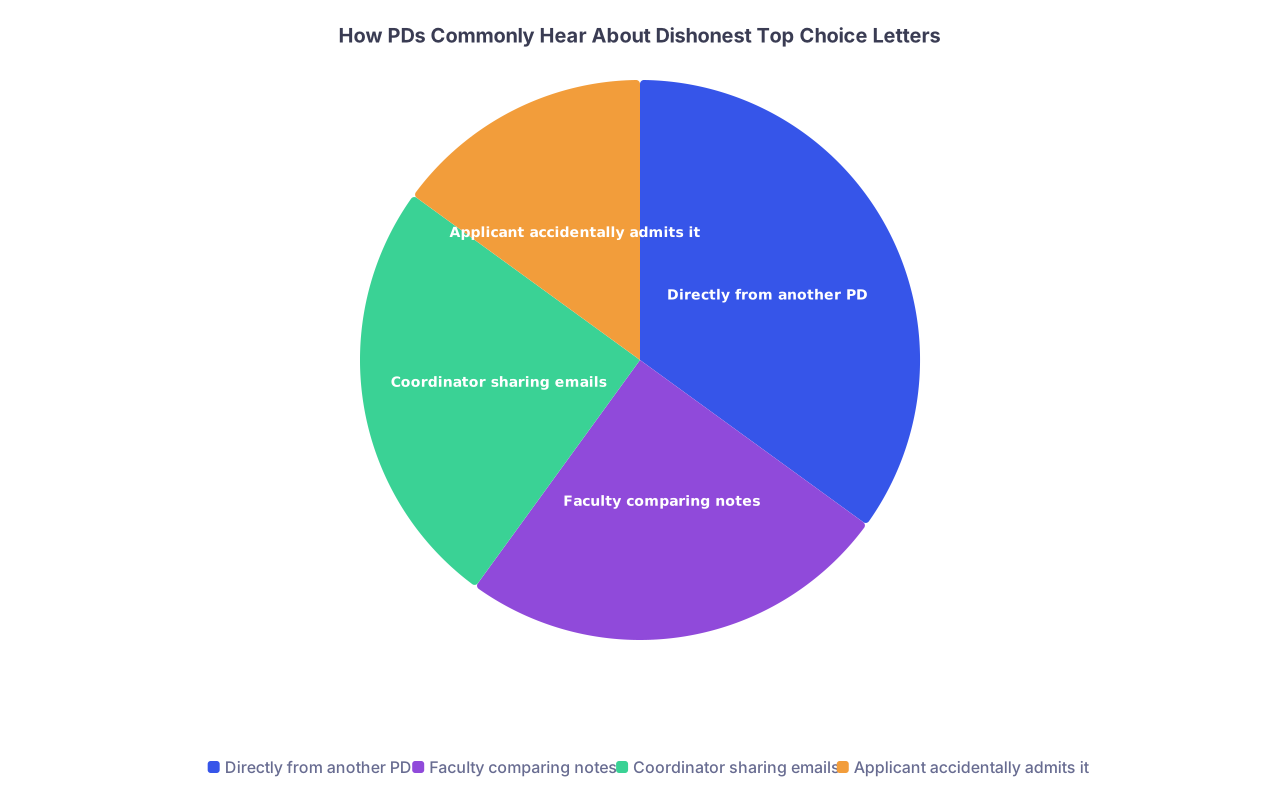
| Category | Value |
|---|---|
| Directly from another PD | 35 |
| Faculty comparing notes | 25 |
| Coordinator sharing emails | 25 |
| Applicant accidentally admits it | 15 |
How you get caught (and yes, people do)
I’ve seen all of these at least once:
- Applicant tells a faculty mentor at Program A, “You’re my top choice, but I also sent the same letter to Program B because it’s so competitive.” Mentor is friends with Program B. That conversation lasts about 90 seconds.
- Applicant sends a “top choice” letter to Program C and Program D. The emails get forwarded to the same subspecialist who works at both places. That person does not forget.
- Applicant posts on a public forum (with enough details to be identifiable locally) bragging about “gaming” top choice letters. A resident screenshots it and sends it to their PD.
Do not underestimate how small your specialty is. Or how bored people get in February.
What happens when you’re caught lying
This is not a victimless white lie. It hits three critical areas:
Professionalism
- PDs don’t say: “Oh, they’re just playing the game.”
- They say: “If they’re willing to lie about this, what are they going to lie about with patients? Or call schedules?”
Trust
- You go from “solid candidate” to “do not want on my team.”
- That trust drop is not recoverable in a few weeks before rank lists are certified.
Downstream reputation
- Your med school gets remembered as “the place where that applicant lied to us and [other program].”
- That can affect how your classmates’ applications are subconsciously viewed.
Here’s the rule that prevents you from torching your reputation:
Never use the phrase “top choice,” “number one,” or “I will rank you first” for more than one program.
If you can’t commit that honestly, don’t say it at all. There are other ways to express strong interest without crossing that ethical line.
2. Sloppy, Copy-Paste, or Obviously Generic Letters
The second category of memorable mistakes: you send a letter that screams, “I wrote this for 15 programs and changed two nouns.”
PDs are not stupid. They can spot a generic letter in under five seconds.
Red flags they clock immediately:
- Sent from a Gmail that looks like undergrad spam.
- No mention of a single specific interaction, faculty, or track.
- The same sentence structure they’ve read from three other applicants that week.

The copy-paste disasters PDs remember
Real examples I’ve seen or heard about:
- “I had a wonderful time interviewing at [PROGRAM NAME].” The placeholder is still there. That email gets shared around the office.
- Email addressed to the wrong program: “Dear Dr. Smith, after visiting [Other University] I know it is my top choice.” Sent to Dr. Lee, at a completely different institution.
- Letter praising features the program does not have: “Your strong cardiology fellowship pipeline” (they do not have cardiology fellowships), “your 4+2 schedule” (they run a traditional 6+2).
This is how you end up as the joke slide in the PD meeting.
The lazy structure that gives you away
If your letter looks like this:
“Dear Dr. X, I really enjoyed meeting your residents and learning about your program. I believe your program would be a great fit for my career goals in internal medicine. I especially value your commitment to education and research. I am confident I would thrive as part of your team.”
That is nothing. Those sentences could apply to any of 150 programs.
What PDs remember—in a bad way—is when it’s clear you didn’t care enough to spend ten minutes tailoring.
The rule set to avoid this:
- Do not send a “master template” with 90% identical fluff.
- Do not use features from one program’s website and blindly paste them into another’s email.
- Do not trust yourself to manually replace every program name at 1 a.m.
Better move: if you’re going to write a “top choice” letter at all, write it from scratch for that one program. Or don’t send one.
3. Overpromising, Underthinking: Making Commitments You Haven’t Processed
This is the quieter mistake, but arguably more serious: promising things you can’t realistically deliver.
Common forms:
- “I will rank your program #1.” But you’re still interviewing next week.
- “I am fully committed to a career in academic oncology research.” You have zero publications, and your actual rank list is full of community-heavy programs.
- “My partner and I are excited to move to [city].” Your partner has already told you they will not move there.
You think you’re just writing nice words. PDs read those as professional statements. They place weight on them.
The ethical trap
There’s a line between strategic communication and dishonesty. You cross it when you:
- State something as already-decided that is actually undecided.
- Implied certainty regarding life plans that are extremely conditional.
- Sell a career trajectory because you think it’s what the PD wants, not because it’s remotely true for you.
If your “I will rank you #1” changes later, you’re not going to get sued. But you’ve treated a program, and the people who advocated for you, like props in your process. That sort of behavior leaks. Over time. Through faculty, coordinators, alumni.
Saner phrasing that doesn’t trap you
Use language that is both honest and strong when appropriate:
- “Your program is the one I am most excited about right now, and I am strongly considering ranking it first.”
- “Your program is among my very top choices, and I would be genuinely thrilled to match there.”
- “If I train in [city], your program is clearly my first choice.”
If you are not 100% decided, do not write as if you are. PDs remember the ones who played games.
4. Timing Games, Desperation Vibes, and Weird Subject Lines
You can also mess this up without lying at all—just by being awkward, unprofessional, or tone-deaf in how and when you send your letter.
Bad timing that sends the wrong message
Some of you wait so long that the letter is pointless. Others send so early it feels forced.
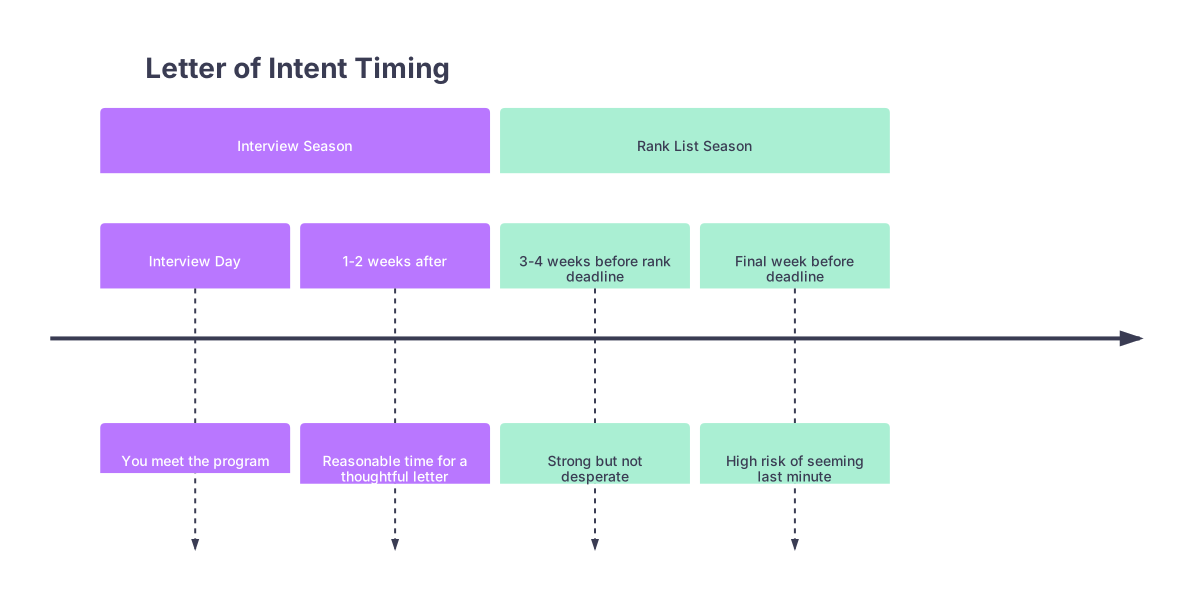
| Period | Event |
|---|---|
| Interview Season - Interview Day | You meet the program |
| Interview Season - 1-2 weeks after | Reasonable time for a thoughtful letter |
| Rank List Season - 3-4 weeks before rank deadline | Strong but not desperate |
| Rank List Season - Final week before deadline | High risk of seeming last minute |
Mistakes:
- Sending a “top choice” email the same day as your interview. Reads as scripted, not thoughtful.
- Emailing at 2 a.m. local time with a rambling 1000-word essay. Desperation vibes.
- Dropping your first contact with the PD 48 hours before rank list certification. They know exactly what you’re doing.
A clean window: 1–3 weeks after your interview, when you’ve had time to reflect, and they still actually remember you.
Subject lines that make you look amateur
Subject lines PDs remember for the wrong reasons:
- “pls consider me strongly for your program”
- “I will 100% rank you first!!”
- “I am your best applicant”
- “TOP CHOICE LETTER (Urgent)”
You’re not applying to a YouTube partnership. You’re trying to join a profession.
Clean subject line options:
- “Letter of Intent – [Your Name]”
- “Continued Interest – [Your Name]”
- “[Your Name] – Post-Interview Update”
You want boring, professional, and searchable. That’s it.
5. Content That Backfires: Red Flags Inside the Letter
Even if you avoid lying, copying, and terrible timing, the content itself can sink you. PDs remember letters that show poor judgment more than they remember letters that are merely generic.
Here’s the stuff that gets talked about:
1. Making it about your needs, not what you bring
If your letter reads like a wishlist instead of a professional communication, you’ve lost them.
Red flag lines:
- “Your location is perfect because my family all lives within 30 minutes, and I will have an easy support system.”
- “I love that call seems lighter at your program compared to others I visited.”
- “Your program seems less malignant than some others I interviewed at.”
You just told them your main filter is comfort. Not growth. Not fit. Comfort. That sticks.
Better framing: you can mention geographic or lifestyle fit once, but anchor the letter in what value you bring and why you’re aligned with their training style.
2. Oversharing and emotional dumping
This is not therapy. You do not need to empty your personal trauma file into a “top choice” letter.
I’ve seen letters that include:
- Detailed financial hardship breakdowns.
- Long stories about relationship breakups.
- Complaints about “toxic” experiences at other programs.
PDs are evaluating whether you’ll:
- Handle stress reasonably.
- Get along with residents and staff.
- Avoid turning minor conflicts into ongoing drama.
Dumping emotionally heavy content in an unsolicited email? Not a great look.
3. Throwing other programs under the bus
The fastest way to raise every PD’s skepticism? Criticize other programs in writing.
Examples PDs remember:
- “Your program was the only one where the residents did not seem burned out, unlike at [City] where the residents looked miserable.”
- “I did not feel respected by the faculty at [another institution], which made your program stand out.”
Here’s what happens: they wonder what you’ll say about their program to the next person. And they will not assume you’ll be kind.
Keep your praise positive and self-contained. You don’t need to insult anyone else to express enthusiasm.
6. Who You Send It To, Who CCs Themselves, and Other Political Landmines
You can write a decent letter and still create drama via who you involve. This part gets messy because academic medicine is political. You don’t need to like that. You do need to not ignore it.
| Action | Generally Safe | Risky / Avoid |
|---|---|---|
| Email to PD only | Yes | |
| CC program coordinator | Often yes | |
| CC 3–5 faculty you met | Risky | |
| Forward letter to home advisor | Yes | |
| Ask faculty to “pressure PD” | Avoid |
Mistake: CC’ing half the department
People do this thinking, “more eyes = more support.” No. More eyes = more opportunities for someone to roll theirs and say, “why is this student spamming everyone?”
Stick to:
- To: Program Director
- CC: Program Coordinator (optional, often helpful)
If a specific faculty advocate explicitly asked you to keep them posted, then CC them. Otherwise, leave them out.
Mistake: Back-channel lobbying that annoys the PD
Another story PDs tell each other:
Applicant asks three different faculty who barely know them to “put in a good word” with the PD. All three email the PD within 48 hours, saying almost nothing of substance.
The message PD hears: this applicant is high-maintenance and overly transactional.
When is faculty support actually helpful?
- When it’s from someone who knows you well.
- When it’s unsolicited or lightly prompted (“If you truly believe I’d be a good fit, I would really appreciate any support.” Not: “Can you email the PD for me?”)
- When it’s one or two voices, not a flood.
You can’t brute-force yourself up a rank list with volume.
7. Overvaluing the Letter Itself (and Underestimating Everything Else)
Big mistake: thinking the “top choice” letter is the lever that will rescue a mediocre application or an awkward interview performance.
Look at reality.
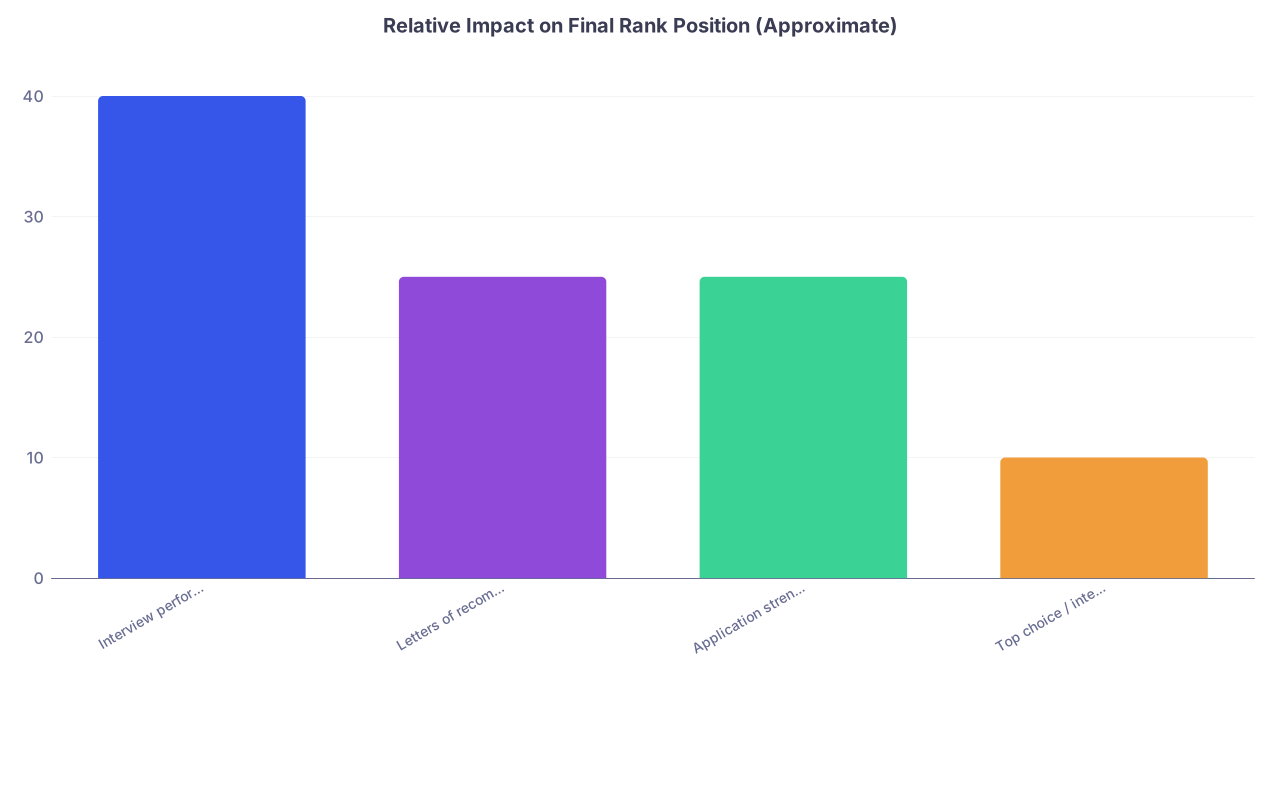
| Category | Value |
|---|---|
| Interview performance | 40 |
| Letters of recommendation | 25 |
| Application strength | 25 |
| Top choice / intent letter | 10 |
PDs do not overhaul their rank list because of your one email. What they might do:
- Use it as a tiebreaker between you and a very similar applicant.
- Shift you up or down a small number of spots if the letter clarifies true interest or reveals questionable judgment.
- Remember you slightly more clearly when discussing borderline decisions.
That’s it.
So the mistake is twofold:
- Thinking a great letter can erase a poor interview. It cannot.
- Thinking a bad letter “won’t matter.” It can—when it reveals dishonesty, immaturity, or sloppy thinking.
Treat the letter as a fine-tuning tool, not an engine.
8. What a Non-Disastrous Top Choice Letter Actually Looks Like
Let me give you a skeleton that doesn’t make PDs roll their eyes. You’ll notice what’s missing: theatrics, ABSOLUTE PROMISES™, desperation.
Structure:
- Subject line: “Letter of Intent – [Your Name]”
- Greeting: “Dear Dr. [PD Last Name],”
- Hook: One sentence reminding them who you are.
- Clear statement of interest: Honest, specific.
- 2–3 specific program details that truly matter to you.
- Brief alignment statement about what you bring.
- Polite closing.
Example (assuming you’re genuinely committed):
Dear Dr. Patel,
Thank you again for the opportunity to interview at the University Hospital Internal Medicine Residency on January 10. I enjoyed speaking with you about resident education and appreciated the chance to meet several of your residents.
After completing my interview season and reflecting carefully, I have decided that your program is my top choice, and I plan to rank University Hospital first on my rank list.
The combination of your X+Y schedule, the strong support for resident research through the Clinician Scholar Track, and the genuine camaraderie I saw among the residents convinced me that I would receive outstanding training while being part of a supportive community. I am particularly drawn to the breadth of subspecialty exposure and the opportunity to work closely with faculty in cardiology, given my interest in pursuing fellowship in the future.
I believe I would be a good fit for your program because of my commitment to resident-led teaching, my experience in quality improvement projects, and my interest in serving diverse patient populations similar to those at University Hospital. I would be truly excited and grateful for the chance to train with your team.
Thank you again for your time and consideration.
Sincerely,
[Your Name], MS4
[Medical School]
No drama. No theatrics. No weird flexes. Professional, clear, specific.
Final Takeaways: The Mistakes You Cannot Afford
Keep these in your head before you hit send on anything with the words “top choice” in it:
- Do not lie. Never call more than one program your #1. This is how you become a cautionary tale at PD meetings.
- Do not be sloppy. Wrong names, copy-paste templates, and lazy, generic content are remembered—and not in the “let’s move them up” way.
- Do not overplay the letter. It’s a fine-tuner, not a miracle cure. Use it to communicate honest, specific interest—not to game the system.
If you avoid those three categories of errors, your letter will at least fade into the background—quietly competent, professionally appropriate.
And in this context? Being forgettable is a lot safer than being unforgettable for the wrong reason.