
Most letters of intent are bland, manipulative, and useless. The ones that work feel uncomfortably specific.
Let me break that down line by line.
You are not writing a polite reminder. You are trying to change a rank list. That is a very different job. The PD has maybe 20–40 seconds for your email. They are skimming with one question in mind:
“Does this message give me any actionable reason to move this applicant up?”
If the answer is no, your letter goes in the mental trash. Nicely. Quietly. Permanently.
What follows is the anatomy of a high‑impact, residency‑style letter of intent (LOI), dissected line by line. You can adapt this to fellowships or even competitive jobs, but I will talk in the language of PDs, rank lists, and ERAS because that is where most people actually use these.
1. What a Letter of Intent Really Is (And Is Not)
Most applicants confuse three different documents:
- Thank‑you note
- Letter of interest
- Letter of intent
Only the last one is supposed to move your position on a rank list. If you do not treat it like that, you are wasting your shot.

The working definition
A letter of intent is:
A short, unambiguous statement to a single program that you will rank them number one, backed by 2–3 tightly linked, program‑specific reasons that match your track record.
It is not:
- A generic love letter sent to 20 programs.
- A second personal statement.
- A guilt trip.
- A negotiation.
Program directors are not naive. They have all seen:
“You are among my very top choices.”
That phrase is code for: “I am sending this to five places and hoping one of you bites.”
If you want impact, you do the uncomfortable thing: you commit. One program. One clear promise.
2. Structural Blueprint: The Skeleton Before the Line‑By‑Line
Before I tear apart the wording, you need the framework. A powerful LOI is brutally lean:
- Subject line (for email)
- Opening line: who you are + explicit intent
- Core: 2–3 tightly argued, program‑specific reasons
- Short reaffirmation of fit and gratitude
- Clean close with contact info
That is it. 250–400 words. If you are at 700, you are writing therapy, not strategy.
| Feature | High-Impact LOI | Weak LOI |
|---|---|---|
| Number of programs | 1 | 5–20 |
| Word count | 250–400 | 600–1,000 |
| Intent language | Explicit, unambiguous | Vague, hedged |
| Program specificity | Concrete, named details | Generic praise |
| Evidence of fit | Linked to track record | Aspirational, buzzword-heavy |
You are writing to a busy PD glancing at their inbox between reviewing cases and fielding complaints from residents. Respect that reality.
3. Line‑By‑Line Dissection: A Model Letter of Intent
Here is a realistic, residency‑style LOI. I will assume Internal Medicine, but the logic is specialty‑agnostic.
I will show you the full text first, then we will cut it apart line by line.
Sample Letter of Intent (for structure)
Subject: Letter of Intent – John Smith, Internal Medicine Applicant
Dear Dr. Patel and the University Hospital Internal Medicine Residency Selection Committee,
Thank you again for the opportunity to interview at University Hospital on January 12. I am writing to state clearly that I will be ranking the University Hospital Internal Medicine Residency Program as my number one choice.
My decision is based on three factors that align closely with my background and long‑term goals:
First, the clinician‑educator pathway you described during morning report reflects exactly the career I am pursuing. At State Medical School I created our first near‑peer EKG workshop series, and I hope to continue developing small‑group teaching skills. The opportunity to have protected time on the clinician‑educator track, along with direct mentorship from faculty like Dr. Nguyen, would give me the structure I have been looking for.
Second, the program’s commitment to longitudinal care at the Eastside Community Clinic matches my prior work with underserved populations. During medical school I spent two years in the student‑run clinic serving primarily immigrant patients with limited English proficiency. The way your residents follow patients over multiple years at Eastside, combined with the embedded behavioral health team, is exactly the model of primary care I hope to practice.
Third, I felt a strong sense of community during my interview day, especially seeing how the senior residents supported the interns on the cardiology service. Several residents described a culture that “pushes you but never leaves you alone,” which is the environment in which I know I learn best.
Because of this alignment between my experience, my values, and what your program offers, I am confident that University Hospital is the best place for my residency training. I would be honored to train with you and your team.
Thank you again for your consideration. Please let me know if I can provide any additional information.
Sincerely,
John Smith
AAMC ID: 12345678
State Medical School, Class of 2025
Now we dissect.
4. From Subject Line to Salutation: The Opening Moves
Subject line
Subject: Letter of Intent – John Smith, Internal Medicine Applicant
Why this works:
- “Letter of Intent” up front. No ambiguity. PDs search their inbox using these exact words.
- Your name and specialty in one line. Easy to mentally place you on their list.
- No fluff: not “Continuing my strong interest in your excellent program…”
Do not get cute. You are not writing marketing copy.
Salutation
Dear Dr. Patel and the University Hospital Internal Medicine Residency Selection Committee,
Three things done correctly:
Program director first, by name.
Find the correct spelling. It is on the website or the invite. If you write “Dear Program Director,” you look lazy.Program name spelled out.
Not “Dear IM Residency at UH.” You want zero chance of a wrong‑program copy‑paste disaster.Committee included.
Rank discussions are group sport. Acknowledge that.
If you did not meet the PD (for example, group interview where the APD led), you still address the PD. They sign the rank list.
5. The First Paragraph: The Only Two Jobs That Matter
Thank you again for the opportunity to interview at University Hospital on January 12. I am writing to state clearly that I will be ranking the University Hospital Internal Medicine Residency Program as my number one choice.
This paragraph has two and only two jobs: timestamp and commitment.
Line 1: timestamp and politeness
“Thank you again for the opportunity to interview at University Hospital on January 12.”
- Short gratitude, anchored to the specific date. That lets the reader quickly recall your interview day.
- No long gush about how “it was truly a pleasure and an honor”; one clean line is fine.
Line 2: the core intent sentence
“I am writing to state clearly that I will be ranking the University Hospital Internal Medicine Residency Program as my number one choice.”
This is the money line. Most people weaken it. They write:
- “You will be ranked very highly on my list.”
- “You are among my top choices.”
- “I intend to rank you at or near the top of my list.”
Translation: “I am hedging. Do not trust me.”
You need an unambiguous, binary sentence:
- “I will be ranking [Program] as my number one choice.”
- Or: “I will rank [Program] first on my list.”
If you are not willing to write that, you are not writing a letter of intent. You are writing a letter of interest. Different beast. Much weaker.
Also: you send this to one program. You do not lie to five PDs. They compare notes. More often than you think.
6. The Reason Block: Credible, Program‑Specific Alignment
My decision is based on three factors that align closely with my background and long‑term goals:
This “topic sentence” does two crucial things:
- Signals structure: they know 3 reasons are coming, not 9.
- Frames those reasons as aligned with your existing background, not just vague desires.
PDs are allergic to aspirational buzzwords with no receipts. You fight that here.
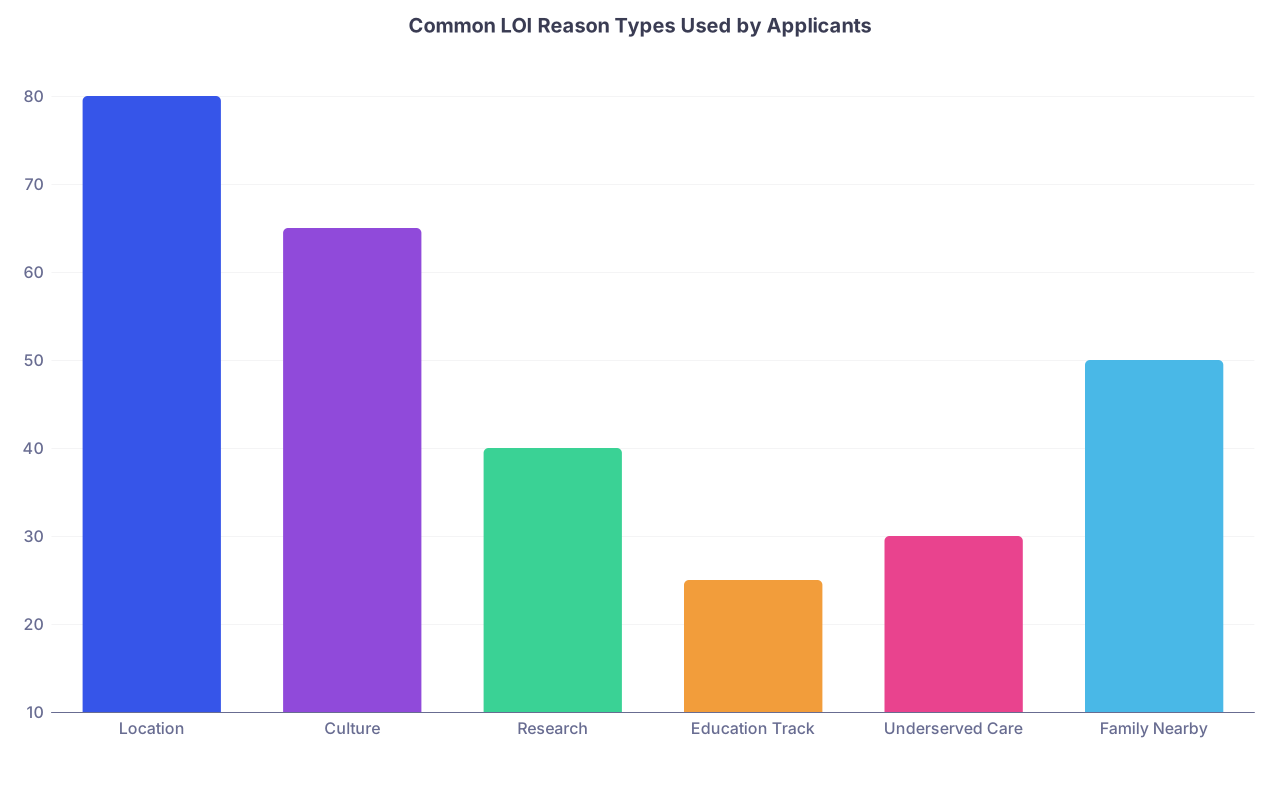
| Category | Value |
|---|---|
| Location | 80 |
| Culture | 65 |
| Research | 40 |
| Education Track | 25 |
| Underserved Care | 30 |
| Family Nearby | 50 |
Most applicants default to “location” and “culture.” Both are weak on their own. You need reasons that:
- Are visible from the program’s side (they can see you would actually use what they offer).
- Connect to things you have already done.
Let us go line by line through each reason.
Reason 1: Career trajectory + concrete program feature + track record
First, the clinician‑educator pathway you described during morning report reflects exactly the career I am pursuing. At State Medical School I created our first near‑peer EKG workshop series, and I hope to continue developing small‑group teaching skills. The opportunity to have protected time on the clinician‑educator track, along with direct mentorship from faculty like Dr. Nguyen, would give me the structure I have been looking for.
Breakdown:
“First, the clinician‑educator pathway you described during morning report…”
- Starts with “First,” which is fine—you are signaling structure.
- Mentions a specific element from interview day: “described during morning report.” This proves you were awake and present.
- Names the actual pathway. No generic “strong teaching environment” fluff.
“…reflects exactly the career I am pursuing.”
Now you state the career aim, but you will immediately back it up. Alone, this would be empty.
“At State Medical School I created our first near‑peer EKG workshop series, and I hope to continue developing small‑group teaching skills.”
This is the key move: linking your claim (“I want to be a clinician‑educator”) to one specific thing you already did that fits that arc.
Better than “I enjoy teaching,” which every applicant writes.
“The opportunity to have protected time on the clinician‑educator track, along with direct mentorship from faculty like Dr. Nguyen, would give me the structure I have been looking for.”
- “Protected time” and “faculty like Dr. Nguyen” are concrete, program‑specific hooks.
- You are not just repeating what is on the website, you are referencing a real person you met or heard about.
This is what strong alignment looks like: your past, your stated future, and their specific offerings line up in a straight line.
Reason 2: Values + longitudinal structure + demonstration of prior commitment
Second, the program’s commitment to longitudinal care at the Eastside Community Clinic matches my prior work with underserved populations. During medical school I spent two years in the student‑run clinic serving primarily immigrant patients with limited English proficiency. The way your residents follow patients over multiple years at Eastside, combined with the embedded behavioral health team, is exactly the model of primary care I hope to practice.
Again, three moves in sequence:
Name the feature and value:
“the program’s commitment to longitudinal care at the Eastside Community Clinic”
That is not “your commitment to service.” It is “longitudinal care at [named clinic].” Different level of specificity.
Show you have lived this value already:
“two years in the student‑run clinic serving primarily immigrant patients with limited English proficiency.”
That line tells the PD: this is not a CV ornament. Two years, clear population, defined barrier (language). Lived experience.
Connect to their model of care:
“follow patients over multiple years” + “embedded behavioral health team”
Again, concrete details that match what they are proud of. You are telling them, “I will actually use the parts of your program you care about.”
This is how you elevate “I like underserved care” from generic to persuasive.
Reason 3: Culture + observed behavior + self‑awareness
Third, I felt a strong sense of community during my interview day, especially seeing how the senior residents supported the interns on the cardiology service. Several residents described a culture that “pushes you but never leaves you alone,” which is the environment in which I know I learn best.
“Culture” on its own is usually fluff. Here it is not, because:
You base it on an observed behavior.
“seeing how the senior residents supported the interns on the cardiology service.”
That sounds like something that actually happened, not brochure language.
You quote residents’ words.
“pushes you but never leaves you alone”
That kind of phrase is exactly how real residents talk on interview day. Using their words back to them is powerful. It shows you listened and internalized.
You connect it to self‑knowledge.
“which is the environment in which I know I learn best.”
This is not “I like friendly programs.” It is “this specific balance of autonomy and support is matched to how I function.”
The third reason does not introduce a new domain (research, say). It deepens the human and cultural fit. That is smart.
7. The Closing Paragraphs: Seal the Commitment Without Groveling
Because of this alignment between my experience, my values, and what your program offers, I am confident that University Hospital is the best place for my residency training. I would be honored to train with you and your team.
This paragraph does three things cleanly:
- Summarizes without rehashing details: “alignment between my experience, my values, and what your program offers.”
- Restates the superlative claim: “best place.” That matches “number one” from the opening. Consistency matters.
- Ends on respect, not desperation: “I would be honored,” not “I would be devastated if I were not ranked.”
Then the final sign‑off:
Thank you again for your consideration. Please let me know if I can provide any additional information.
Sincerely,
John Smith
AAMC ID: 12345678
State Medical School, Class of 2025
The “additional information” line is boilerplate but fine; it opens the door for follow‑up without asking for anything specific.
Include your:
- Full name
- AAMC ID (for residency / ERAS context)
- School and class year
- Phone number is fine to add; not mandatory, but it removes friction if they want to call.
8. Timing, Logistics, and Common Strategic Mistakes
A brilliant letter sent at the wrong time or to the wrong place is wasted effort.
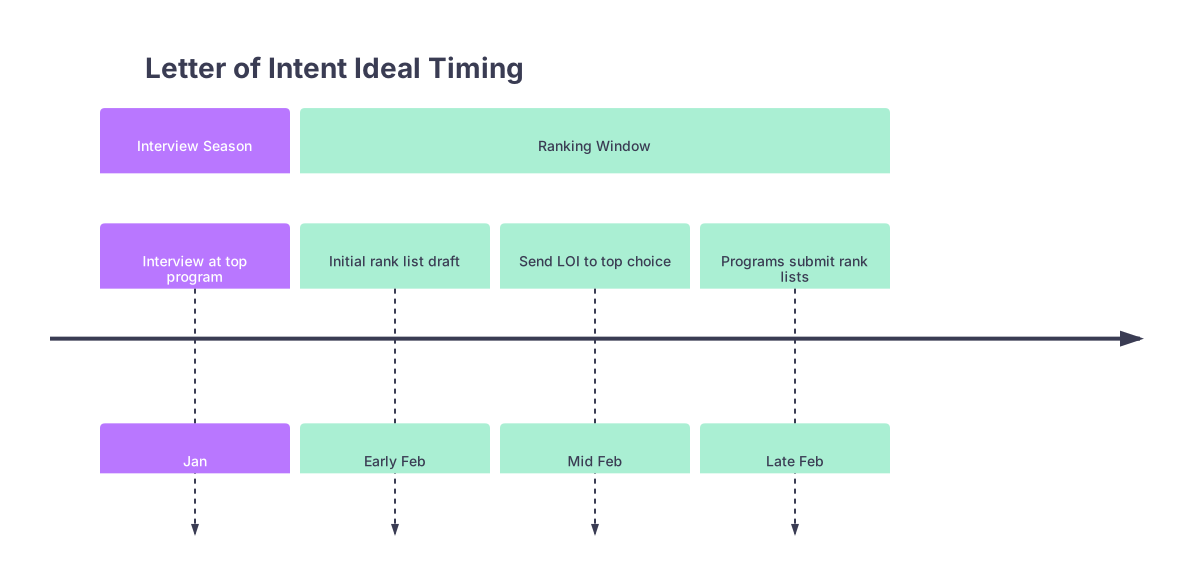
| Period | Event |
|---|---|
| Interview Season - Interview at top program | Jan |
| Ranking Window - Initial rank list draft | Early Feb |
| Ranking Window - Send LOI to top choice | Mid Feb |
| Ranking Window - Programs submit rank lists | Late Feb |
When to send
For typical NRMP timelines:
- Interview at your #1: anywhere from Nov–Jan
- PDs start serious rank discussions: late Jan–mid Feb
- Rank lists submitted: late Feb
Your LOI should land after you are genuinely sure they are #1, but before most programs freeze their list. In practice:
- Usually 1–3 weeks before the program’s internal “rank meeting.”
- If you do not know when that is, aim for mid‑February.
Sending in December is usually too early; everyone forgets by ranking time. Sending 48 hours before the NRMP deadline is often too late; lists are already set.
Who to send it to and how
Basics that people still screw up:
- Send via email, not ERAS message center or random portal, unless the program explicitly instructs otherwise.
- Address to the program director, CC the program coordinator.
- Subject line exactly as we discussed. PDF attachment is fine but not necessary; body text is usually enough.
If the program’s website explicitly says “We do not consider letters of intent or post‑interview communication,” respect that. Sending one anyway does not make you look passionate. It makes you look unable to follow directions.
Fatal mistakes I see over and over
Here is the short list of things that reliably damage applicants:
Sending “number one” letters to multiple programs.
They talk. People move between institutions. There is nothing like being caught in a lie to evaporate goodwill.Using generic praise.
If your reasons for “loving” Program A could be copied and pasted to Programs B, C, and D, you have written an expensive thank‑you note. Not an LOI.Leaning heavily on geography with no substance.
“I want to be near my family in Boston” is a reason. It is not a program‑specific reason. On its own, it will not move your position significantly.Negotiating or hinting at leverage.
“I also interviewed at several other top programs…” No. They do not care who else interviewed you. This is not a bidding war.Overly emotional pleas.
“Matching at your program would mean the world to me” or “I will be heartbroken if…” PDs are selecting residents, not managing your feelings.Blurring LOI and update letter.
Adding one relevant update is fine (“Since we met, our QI abstract at your institution was accepted as an oral presentation at SGIM”).
Dumping a full CV refresh into your LOI turns it into a mess.
9. Customizing the Template to Your Situation
You cannot just copy the sample letter and change names. PDs see the same structure repeated and can smell templates. But you can borrow the logic:
- Clear “you are number one” sentence in paragraph 1.
- 2–3 reasons, each following this internal structure:
- Specific program feature →
- Your prior related experience →
- How this will concretely shape your future there.
- Short close reinforcing that they are the single best fit.

Example variations for different priorities
Research‑heavy applicant to an academic powerhouse:
Emphasize named labs, ongoing projects you could plug into, and actual research skills you bring (stat methods, prior publications), not just “interest.”Community‑oriented applicant to a community‑based program:
Highlight continuity clinics, community partners, patient populations, and clinic structures over flashy research.Applicant with a strong geographic tie:
You can use location as one of the three reasons, but make it more than “family is nearby.” Tie it to your planned long‑term practice in that region and existing professional networks there.
10. What PDs Actually Remember From Your Letter
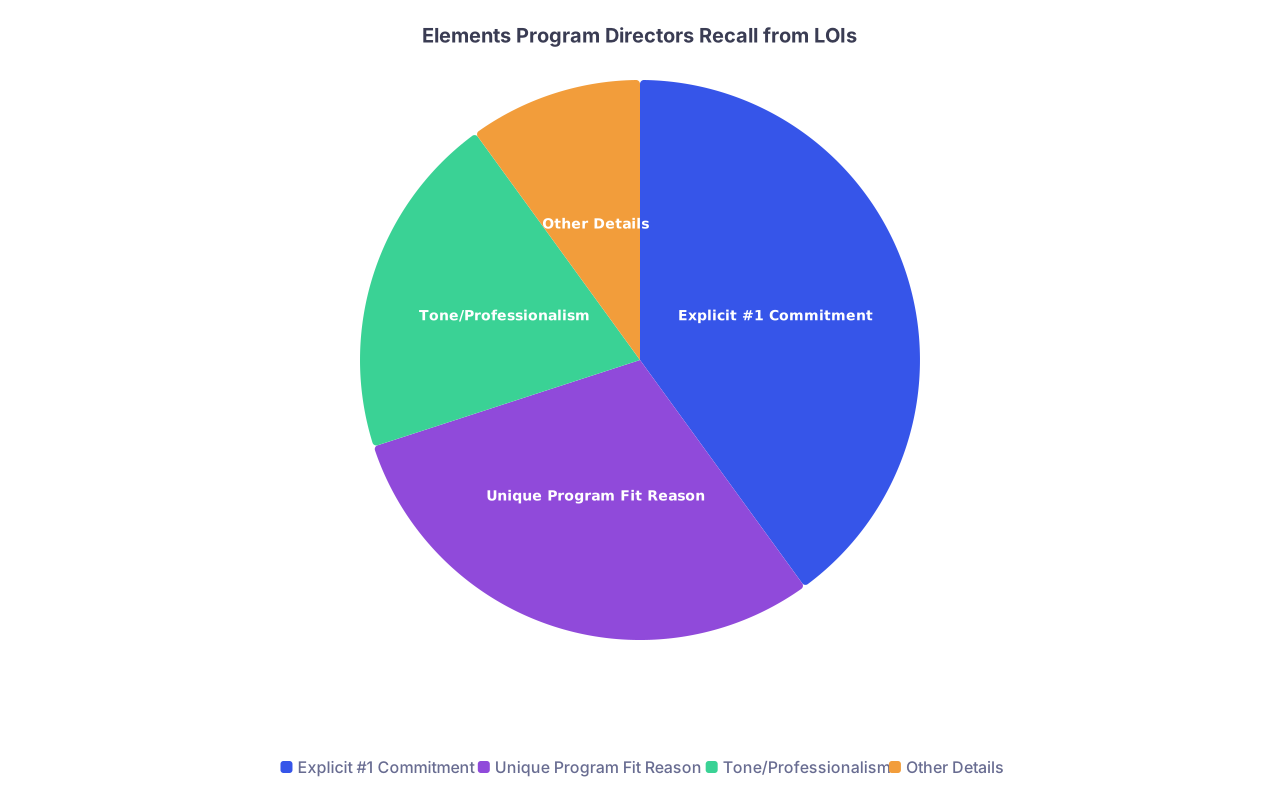
Let me be blunt. After reading, a PD might remember exactly three things about your LOI:
- Did you explicitly say “we are number one”?
- Was there at least one reason that made them think “Yes, they would genuinely thrive here”?
- Did you seem honest and consistent with what they saw on interview day?
Everything else is seasoning.
| Category | Value |
|---|---|
| Explicit #1 Commitment | 40 |
| Unique Program Fit Reason | 30 |
| Tone/Professionalism | 20 |
| Other Details | 10 |
So you design your letter to maximize those three impressions:
- Put the explicit commitment in a place they cannot miss (first paragraph).
- Make at least one of your reasons so specific and aligned that it feels memorable.
- Keep your tone professional, confident, and not melodramatic.
11. The Future of LOIs: Will They Still Matter?
You are in the “MISCELLANEOUS AND FUTURE OF MEDICINE” category, so let us look forward a bit.
Programs are increasingly frustrated by:
- Volume of post‑interview emails
- Perceived gamesmanship
- Lack of correlation between LOIs and actual rank behavior
Some specialties and programs have moved toward:
- “No post‑interview communication” policies
- Standardized signaling tokens or preference signals (for example, EM preference signals, IM tokens in some pilots)
- Automated or portal‑based preference forms rather than free‑form emails

But until the system fully standardizes, two things remain true:
- Programs still care which applicant is genuinely committed to them.
- A concise, honest, well‑targeted LOI is still the cleanest way to send that signal in most specialties.
Will this look different in 10 years? Probably. You may end up clicking “This program is my first choice” on an NRMP‑like portal with 200 characters of explanation. But the underlying logic will be identical:
- Choose one place.
- Give them a credible reason to believe you.
- Back it with evidence from what you have already done.
FAQ (Exactly 5 Questions)
1. Should I send more than one “number one” letter to improve my odds?
No. It is unethical, and it backfires. PDs talk, faculty move between institutions, and some programs explicitly compare notes. Getting caught in that lie will damage your reputation in ways you cannot control. Pick one program, commit, and live with the decision.
2. Can a strong LOI make up for a weaker application or interview?
It can move you within a band, not across continents. A thoughtful LOI might bump you a few spots if you were already in the “probably rankable” pile. It will not rescue a disastrous interview or a file that the committee already decided not to rank.
3. Is it better to focus on personal reasons (family, partner’s job) or professional reasons in my LOI?
Lead with professional, program‑specific reasons. You can include one brief personal/geographic factor if it is significant, but it should not be the main argument. PDs want to know how you will engage with their training environment, not just their zip code.
4. How different should my LOI be from my personal statement?
Very different. Your personal statement is about who you are and why the specialty fits. Your LOI is about why this exact program should rank you highly and why you will rank them first. Avoid reusing paragraphs or stories; the LOI should feel like a direct continuation of the interview conversation.
5. What if my top program says they do not consider post‑interview communication?
Then believe them. Do not send a letter of intent. It will, at best, be ignored and, at worst, signal that you cannot follow instructions. Focus instead on making sure your ERAS file is clean, your letters are in, and your references are strong. Your “signal” to that program was your interview performance.
Key points, stripped down:
- A real letter of intent is singular, explicit, and short: one program, one clear “you are my number one,” 2–3 specific, evidence‑backed reasons.
- The reasons that move rank positions are program‑specific, grounded in your actual track record, and expressed in concrete terms—not generic flattery.
- Timing and honesty matter as much as wording: send it once, to one program, at a moment when they can still use the information without feeling manipulated.