It is 11:47 p.m. You just finished a beautiful letter of intent to your top residency program. You explained exactly why Internal Medicine at “X University” is the right fit, referenced specific faculty, and tied your goals to their patient population. You feel good.
Then you scroll back up and see your sign-off:
“Thanks!! Hope to hear back soon :)
Best,
Alex
Sent from my iPhone”
This is how very strong applicants quietly kill their own credibility.
They do the hard part well—the content. Then they lose professionalism in the last 10%. Sign-off, formatting, weird fonts, random emojis, sloppy file names. Things programs will never list on their website as “selection criteria” but that still flick on a tiny mental red flag when a PD reads them at midnight between two committee meetings.
Let me walk you through the mistakes that do the most damage and how to avoid them.
1. Casual, Clingy, or Awkward Sign-Off Language
This is where otherwise polished letters fall apart. I see this constantly.
Here is what not to do.
The “Too Casual” Sign-Offs
These read like texts, not professional correspondence:
- “Thanks!!”
- “Thanks a bunch!”
- “Cheers”
- “Talk soon!”
- “Hope to hear from you ASAP :)”
- “Looking forward to hearing back!” (as the last line, especially when it sounds like an expectation)
Why this is a problem:
- You are not emailing a friend. You are writing to a program director, APD, or coordinator in a high-stakes selection process.
- It signals poor professional judgment about boundaries and tone.
- It can come across as presumptuous or pushy, especially versions that hint you expect a reply.
Use “Thank you for your time and consideration.” or “Sincerely,” and move on. Boring wins here.
The “Clingy / Desperate” Ending
These almost never sound the way you think they do:
- “I would be forever grateful for the opportunity to train at your institution.”
- “This program is my dream and I would do anything to match there.”
- “I am begging for the chance to join your team.”
- “I hope you will take pity on me and consider my application.”
Program directors do not want desperation. They want colleagues.
This kind of language:
- Shifts the tone from professional to emotional pleading.
- Can make you seem less stable or less confident.
- Undercuts the strong, thoughtful reasoning you hopefully showed earlier.
You can express strong interest without begging:
- Wrong: “This is my dream program and I will be devastated if I do not match here.”
- Better: “If given the opportunity, I would be honored to train at [Program], and I would make it my top choice on my rank list.”
Straightforward. Clear. Professional.
The “Over-Familiar” Sign-Off
I have seen this:
- “Take care,
Mike”
Or:
- “Looking forward to working together next year!
Sam”
Or the worst combination: “Warmly,” plus a nickname you never used before.
The problem:
- You have not matched yet. You are not colleagues. You may never meet.
- “Working together next year” presumes an outcome that has not happened. It can feel presumptuous or naïve.
Keep the boundary clear:
- “Sincerely,”
- “Best regards,”
- “Respectfully,”
Anything that sounds like you are already matched? No.
2. Sloppy Name, Title, and Program References
This is where PDs roll their eyes and quietly move on.
Getting Names or Titles Wrong
Common errors:
- Spelling the PD’s name incorrectly.
- Using the wrong title (“Dr. John Smith, MD, PhD, FACP, Program Director of Pediatrics” when they are Internal Medicine).
- Mixing up institutions (“Dear Dr. Lee, Program Director, XYZ Medical Center” when they are at ABC Hospital).
I have literally seen:
- “Dear Dr. Johnson,”
in a letter sent to Dr. Johnston.
That screams mass email, not genuine interest.
You undercut your LOI by:
- Signaling that you did not double-check basic facts.
- Looking like you repurposed another program’s letter and rushed the edits.
Double-check every proper noun:
- Program name
- Hospital name
- City
- PD name and title
- Any faculty you mention
If you copy-paste, assume you made a mistake somewhere and proofread specifically for all names.
Mislabeling the Relationship
Example mistakes:
- Addressing the letter “To Whom It May Concern” when the PD’s name is on the website in 3 seconds.
- Writing “Dear Program Coordinator” instead of “Dear Dr. [Last Name]” when you are sending an LOI about rank intentions.
Coordinators matter, but your LOI about ranking should be addressed to leadership (usually Program Director or the rank list committee chair if known). Otherwise it looks like you do not understand how the decision structure works.
3. Formatting That Screams “Unprofessional”
You can write an excellent letter and still look unserious because of how you package it.
Fonts, Colors, and “Pretty” Formatting
Never do the following in an LOI:
- Colored text (blue, purple, grey “aesthetic” fonts).
- Script or novelty fonts.
- Multiple font types in the same letter.
- Excessive bold/italic/underlining.
This is not a wedding invitation or a social media post. It is effectively a legal-ish document in a professional context.
Stick to:
- Fonts: Times New Roman, Calibri, Arial, Georgia.
- Size: 11 or 12 point.
- Color: Black. Just black.
Centered Paragraphs and Odd Alignment
I have seen LOIs where every paragraph is centered like a poem. Or justified with strange spacing. Or with random indentation patterns.
Result: It looks like the applicant does not know how to write a professional letter. It also makes skim-reading harder. That matters when a PD has 60 letters to review.
Basic formatting rules:
- Left align everything.
- Single space within paragraphs; extra line between paragraphs.
- One-page max. If you go past one, they will stop reading.

Weird Margins and Tiny Text to Cram More In
Tactic: 0.3 inch margins and 10-point font so you can squeeze in one and a half pages of content.
Message it sends:
- “I do not understand or respect brevity.”
- “I think my story is special enough to bend basic rules.”
- “You, busy program director, should work harder to read my stuff.”
Do not fight the one-page norm. If you need formatting tricks to make it fit, you are saying too much.
4. Subject Lines, File Names, and Email Details That Look Amateurish
Programs will not tell you this in an info session, but yes—subject lines and file names influence how your LOI lands.
Subject Lines That Look Like Spam or Demands
Avoid:
- “IMPORTANT: My Rank List”
- “PLEASE READ – Letter of Intent!!!”
- “URGENT: I will rank you #1!”
- “Follow up #3”
These come across as pushy, immature, or spam-like.
More subtle mistake: no subject line at all. Or “Hi” / “Question”.
Use a calm, informative subject line:
- “Letter of Intent – [Your Name], [Specialty] Applicant”
- “Update of Interest – [Your Name], [AAMC ID]”
- “[Your Name] – Letter of Intent for [Program Name]”
You want the coordinator or PD to understand why you are emailing at a glance.
File Names That Look Sloppy
You attach your LOI as:
- “letter_of_intent_NEW_final_V4_revised_reallyfinal.docx”
- “LOI_generic_template.doc”
- “IMG_202402File.pdf”
This does not kill you. But it does not help you either. It signals disorganization and lack of awareness that other people have to handle your file.
Name it:
- “Lastname_Firstname_LOI_[ProgramName].pdf”
Professional. Searchable. Easy to file.
| Type | Example File Name |
|---|---|
| Best | Nguyen_Linh_LOI_Mayo_IM.pdf |
| Acceptable | Patel_Aarav_LetterOfIntent_UCLA_Peds.pdf |
| Risky | LOI_new_final_version4.docx |
| Risky | myletterforresidency.pdf |
| Very Bad | PLEASE_READ_THIS_LETTER_OF_INTENT!!!.doc |
“Sent from my iPhone” and Other Signatures
Do you have to remove “Sent from my iPhone”? No.
But when the rest of your sign-off is already borderline casual, it piles on the informality. And it hints you might have dashed it off quickly between cases.
Better move: set up a professional email signature and use it consistently:
- Full name
- Medical school
- AAMC ID (for residency)
- Email, phone
Everything else—quotes, jokes, disclaimers, political slogans—does not belong in a residency LOI email.
5. Tone Mismatch Between Body and Ending
One of the most subtle but damaging mistakes: the body of the letter is thoughtful, specific, professional. Then the conclusion shifts tone completely.
Example of a Disjointed Ending
Body: Detailed discussion of your sub-I at the program, the QI project you want to pursue with Dr. X, and your long-term goal in academic medicine.
Ending:
“Anyways, that is about it from me.
Thanks for checking this out!
Best,
Jason :)”
The PD feels an abrupt drop in maturity across three lines. You essentially just undermined everything above.
Keep the tone consistent:
- If the letter is formal, the ending should be formal.
- If you adopt a slightly conversational but professional tone, still end with a standard closing and neutral language.
Safe ending structure:
- One short closing sentence that reinforces interest.
- A polite thank you.
- A standard sign-off.
For example:
“I remain very interested in the opportunity to train at [Program].
Thank you for your time and consideration.
Sincerely,
[Your Name]”
Not creative. That is the point.
6. Content Creep in the Final Paragraph
Many applicants try to do too much in their last paragraph. They think of it as “the last shot,” so they cram in extra arguments, emotion, or awkward promises.
Watch for these mistakes:
Making Promises You Should Not Make
- “If you rank me highly, I will guarantee to rank you number one.”
- “I promise to work harder than any other resident in your program.”
- “You will not regret choosing me.”
You cannot guarantee any of that, and it sounds naive. Also, never condition your ranking on theirs in any way that sounds like a deal or trade. NRMP does not like that game, and PDs know the rules very well.
You can say:
- “I will be ranking [Program] as my top choice.” (If true. And you should only say this to one program.)
You should not say:
- “If you rank me to match, I will rank you #1.”
Different universe.
Sneaking in New Content You Did Not Explain
Ending paragraphs are not the place to introduce:
- New major experiences
- New publications
- Big personal stories
If there is a genuine update (publication accepted, significant award), mention it briefly once earlier in the letter, then close. The final paragraph is for reinforcing fit and signaling your level of interest, not for surprise information dumps.
7. Grammar, Punctuation, and Tiny Errors That Signal Carelessness
You do not need to write like a novelist. But you cannot afford obvious sloppiness.
The Usual Offenders
- “Residency” capitalized randomly (“I hope to join your Residency Program”).
- Program name inconsistencies (“Internal Medicine Residency Program at X” vs “X internal medicine residency program” vs “X IMR” in one letter).
- Sentence fragments that are accidental, not rhetorical.
- Missing words: “I very interested in your program”
- Comma splices: long sentences stitched together with commas.
One or two minor typos will not sink you. But patterns of error say:
- You rushed this.
- You do not double-check important communications.
- You maybe do not care as much as you claim.
You are applying to professions where a mis-placed decimal can kill someone. Attention to detail is not optional.
Have:
- One person who writes well review the letter.
- Someone else who knows you clinically check it for tone.
Not your entire friend group. Just 1–2 high-quality readers.
8. Over-Formatting to “Stand Out”
Last category: the “I need to stand out visually” trap.
Things I have actually seen in LOIs:
- Bullet points describing personal qualities (“• Hard working • Compassionate • Team player”).
- Underlined, bold, all caps phrases (“I WANT TO MATCH AT YOUR PROGRAM”).
- Highlighted text in yellow to emphasize interest.
- Personal logo or branded header.
This is not marketing. It is not an MBA application portfolio. It is medicine.
These flourishes:
- Pull attention away from your reasoning and your fit.
- Make you look like you do not understand norms in professional communication.
- Can feel performative or self-promotional in a way that turns off academic physicians.
You “stand out” by:
- Being specific about why that program.
- Sounding like a future colleague, not a salesperson.
- Being clear, concise, and respectful of their time.
Not by visually decorating your letter.
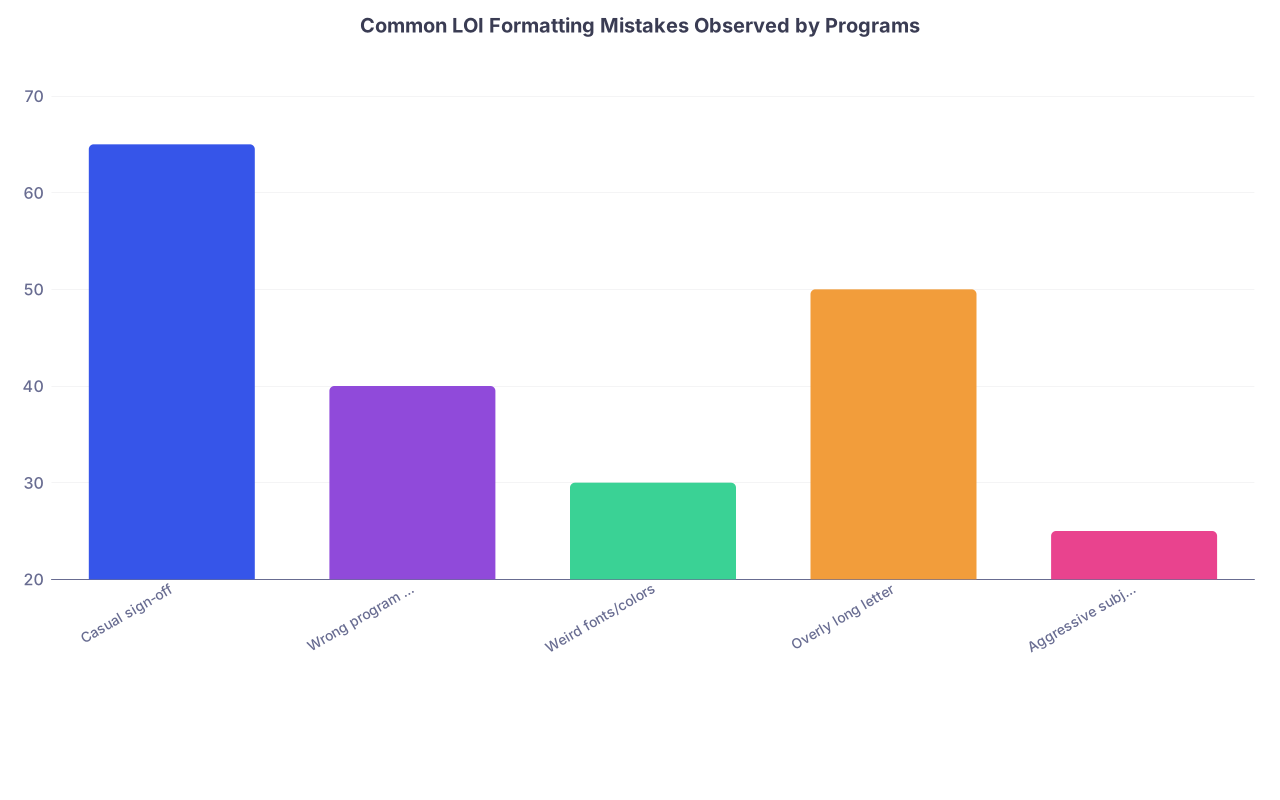
| Category | Value |
|---|---|
| Casual sign-off | 65 |
| Wrong program name | 40 |
| Weird fonts/colors | 30 |
| Overly long letter | 50 |
| Aggressive subject line | 25 |
9. A Clean, Professional Template You Will Not Mess Up
You do not need a fancy template. You need something so simple it is hard to ruin.
Basic structure:
- Date and program details (optional in an email body, required if as a PDF letter).
- Proper salutation.
- One short paragraph stating:
- Who you are
- That you are writing an LOI
- Your level of interest (including “will rank #1” if true).
- 1–2 short paragraphs showing specific fit.
- Final short paragraph reiterating interest and thanking them.
- Professional sign-off.
Example ending you can safely copy:
“Thank you very much for your time and consideration.
Sincerely,
[First Last, degree]
[Medical School]
[AAMC ID: XXXXXXXX]
[Email] | [Phone]”
Boring, clean, professional. No one on a rank committee will ever complain about this.

| Step | Description |
|---|---|
| Step 1 | Draft LOI |
| Step 2 | Check tone and content |
| Step 3 | Verify names and program details |
| Step 4 | Clean formatting and font |
| Step 5 | Professional subject line and file name |
| Step 6 | Final proofread by one trusted reader |
| Step 7 | Send to program |
Key Points to Remember
- Strong content can be quietly sabotaged by casual, clingy, or over-familiar sign-offs. Your final lines must match the professionalism of the rest of the letter.
- Boring is good: standard fonts, black text, simple file names, neutral subject lines, and classic closings (“Sincerely,” “Best regards,”) make you look like a future colleague, not a student playing email.
- Every detail—names, titles, formatting, tone—signals something about how you will show up as a resident. Do not let avoidable sloppiness undercut an otherwise excellent letter of intent.