
The blanket claim that “letters of intent don’t matter at all” is lazy—and wrong in the ways that actually cost applicants spots.
People say it because it feels empowering: “Focus on your application, not some email begging for love.” Cute phrase. Terrible strategy if you take it literally.
I’m going to walk through what data we do have, what PDs actually say when the recording “stops,” and where LOIs are useless, harmful, or quietly impactful. Not fairy tales. Not Reddit lore. Actual behavior patterns and numbers where they exist.
The problem with “LOIs don’t matter”
The absolutist mantra “they don’t matter at all” comes from three truths that get stretched past the point of accuracy:
- Programs are legally and ethically not supposed to ask for or rely on “you will rank us #1” statements.
- Rank lists are mostly set by the time mass LOIs start flying.
- Many LOIs are garbage: generic, dishonest, and obviously mass‑mailed.
All true. But here’s the bait-and-switch: people jump from “LOIs are not a primary selection tool” to “they have zero influence on anything.” That jump is not supported by the actual data—or by real PD behavior.
You want to know what actually happens with LOIs? It’s not romantic. It’s not magic. But it’s not “0% effect,” either.
Let me break it out.
What the data and surveys actually show
We don’t have randomized controlled trials of “no LOI vs LOI” (and never will). But we do have several relevant data points:
1. NRMP Program Director Survey: what’s on paper
Every few years, the NRMP asks program directors what they use and how much they care. LOIs are not a named category, but related items are:
| Factor | % of PDs Using | Mean Importance (1–5) |
|---|---|---|
| USMLE/COMLEX Step 2 CK | 94%+ | ~4.1 |
| MSPE/Dean’s Letter | ~86% | ~3.8 |
| Personal Statement | ~78% | ~3.4 |
| Letters of Recommendation in Spec. | ~84% | ~4.2 |
| “Perceived Interest in Program”* | ~70–75% | ~3.0 |
*Different specialties phrase this slightly differently, but some variant of “interest in the program” appears—and a majority say they look at it.
Where does “perceived interest” come from?
- Whether you showed up for second looks
- How you behaved on interview day
- Whether you actually seemed to know the program
- Emails and post‑interview communication (this is where LOIs live)
So no, they’re not logging “LOI from John Doe: +2 points,” but you’re kidding yourself if you think post‑interview contact isn’t feeding into that “perceived interest” variable.
2. PD and APD off-the-record behavior
I’ve sat in rank meetings. I’ve heard the exact phrases:
- “She sent a really thoughtful note; she’s very serious about us.”
- “He told three places we were #1. Pass.”
- “We’re low on our list for people with strong geographic ties. If they made it clear we’re their first choice, I’ll bump them a bit.”
Nobody is saying “we rebuilt the whole list because of that LOI.” What happens is more boring—and more realistic:
- Marginal adjustments within small tiers
- Tiebreaks between similar candidates
- Deciding how “safe” it is to keep someone high if you suspect they’ll rank elsewhere higher
This is very different from “LOIs are everything” and very different from “LOIs don’t matter at all.”
3. Applicant‑side data: weak but still signal
Every class, I see the same pattern:
- Applicants with solid-but-not-elite stats who:
- Sent 1 honest, targeted LOI to a realistic top choice
- Got ranked highly there
- Matched there
- Near‑identical applicants who:
- Sent nothing
- Matched fine, sometimes even at that place… but more often not, and slid down to mid‑list options
Is that a perfect causal chain? No. Self‑selection bias, blah blah. I know the stats arguments.
But when you consistently see borderline candidates pulled “up a notch” at programs where they sent clear, believable interest—and not at similar programs where they didn’t—that’s signal. Maybe small. Not zero.
Where the “LOIs don’t matter” crowd is actually right
Let me concede the parts of the myth that are essentially true, because if you misunderstand this you’ll waste time or worse, lie yourself into trouble.
LOIs don’t fix a fundamentally weak app
If your:
- Step 2 CK is 208 for ortho
- You failed Step 1 and barely passed on retake
- You had unexcused professionalism dings
No constellation of words will rescue you at a stretch program. You’re not “one letter away” from Mayo Ortho.
Programs care about:
- Board scores
- Clinical performance
- Specialty‑specific letters
- Interview performance
LOIs might nudge at the edges. They are not a parachute for a free‑falling file.
LOIs don’t usually trigger new interviews
If you’re cold‑emailing programs pre‑interview with “letter of intent” language, that’s not strategy. It’s spam with a stethoscope.
Pre‑interview, at best, a few PDs might take a second glance at your file if there’s a strong, specific connection (former research mentor, prior away rotation, spouse in the city). But the default is: no one’s moving heaven and earth for a generic “I really love your program” from a stranger.
LOIs are primarily a post‑interview phenomenon.
LOIs don’t magically vault you from rank #40 to #3
There’s fantasy, and then there’s how rank lists are actually built. Programs typically:
- Tier applicants (e.g., A, B, C tiers)
- Roughly sort within tiers, then refine
A realistic LOI effect, in many places, looks like:
- “We have her around 15; she’s clearly very serious about us and local—let’s bump her to 10.”
- “He’s tied with these others. He sent a thoughtful note and really clicked with our residents—put him at the top of this micro‑cluster.”
Not:
- “We had her at 37. Now she’s 2 because she said we’re #1.”
If someone told you LOIs do that, they’re selling hope, not strategy.
Where LOIs actually move the needle
Now the part almost nobody articulates cleanly: the narrow but real situations where LOIs have measurable impact.
1. Tiebreaks within tiers
This is where most of the “real world effect” lives.
Two vetted, interview‑approved candidates:
- Similar scores
- Similar evals
- No red flags
One wrote a specific, grounded LOI explaining why they’re ranking the program #1 and how that aligns with their life and career. The other didn’t.
Who’s safer to keep at the top of the list when you’ve only got, say, 8 positions and 30 very strong applicants above the “we’re comfortable they’ll match somewhere” line?
It is delusional to pretend that explicit, credible interest does not influence that call. PDs do not want to burn rank slots on people who are clearly using them as “safety #6.”
2. Mid‑tier programs protecting against “flight risk”
Programs in desirable cities but not top‑name brands live here. Think strong-but-not-famous IM or EM programs in competitive metros.
Pattern I’ve heard verbatim:
“If we think they’re a Harvard‑or‑bust person, we’ll rank them, but not burn a top 5 spot. If they tell us we’re #1, I’m more willing to gamble higher.”
Here’s what that means in practice:
- A believable LOI can move you from “we like them but they’ll probably go somewhere ‘better’” territory into “we’ll rank them high enough that we actually might match them.”
Is that every program? No. But enough that you’d be foolish to ignore it.
3. Low‑to‑mid competitiveness specialties, borderline candidates
Think FM, psych in non‑coastal regions, peds, path, etc.
In these specialties, PDs often have more flexibility and less paralysis around “we must obey strict numerical tiers.” They care a lot about:
- Fit
- Likely retention in the region
- People who won’t leave after PGY‑1
Your LOI that says:
- “My partner is already working in this city.”
- “I grew up two hours away and plan to practice here long term.”
- “Your focus on X matches the niche I’ve already committed to.”
Now you’re signalling: not a tourist. Not a flight risk. That matters in these spaces, sometimes more than your extra 3 CK points.
4. SOAP and prelim/backup scenarios
During SOAP, PDs are triaging a firehose. You’re not writing poetic LOIs—but short, clear interest emails and calls from mentors absolutely tilt decisions.
Same thing applies for prelim and transitional year programs, especially in crowded markets. If you want to stay in a specific town with your spouse, a crisp note and a faculty advocate often mean more than yet another generic ERAS app.
Where LOIs hurt you
The “LOIs don’t matter” crowd is reacting, in part, to all the ways people use them stupidly. Let me be blunt about those.
1. Lying about being “#1” to multiple programs
Programs talk. Residents talk. Coordinators really talk.
If your LOI template includes “You are my number one choice,” and you tweak 2 words and send it to five places, you are one forwarded screenshot away from being the cautionary tale at 3 PD meetings.
Best case: they ignore you.
Worst case: you get bumped down because you look dishonest.
If you’re going to say “#1,” mean it. And send it to one program.
2. Overly long, desperate, or clingy notes
Here’s what PDs and coordinators actually say about these:
- “Wall of text. I don’t have time for this.”
- “Feels needy.”
- “If this is how they are by email, I don’t want them paging me at 3 AM.”
Your LOI is not your memoir. It is not your last shot to re‑explain your childhood trauma. It’s a targeted, professional, 3–8 paragraph note max.
If you cannot keep it concise, you’re advertising poor judgment and poor communication skills.
3. Generic fluff that proves you don’t know the program
“I love your strong clinical training, diverse patient population, and supportive residents.”
That sentence could describe half of ACGME. If your LOI could be sent, unchanged, to 25 programs, it is worthless. At best. At worst, it tells the reader you didn’t bother to learn anything.
If you can’t name specific features of this program you care about—curriculum structure, clinic sites, niche tracks, faculty focus—you should not be sending an LOI there.
4. Violating program policies
Some programs explicitly say, “No post‑interview communication, it will not be considered.”
Do they all perfectly ignore it? Probably not. But if they went out of their way to write that, and you blow through it anyway, you’ve just signaled: rules are optional for me.
Not smart.
What a data‑aligned LOI strategy actually looks like
Let’s cut through the nonsense and sketch something that respects both the data and your time.
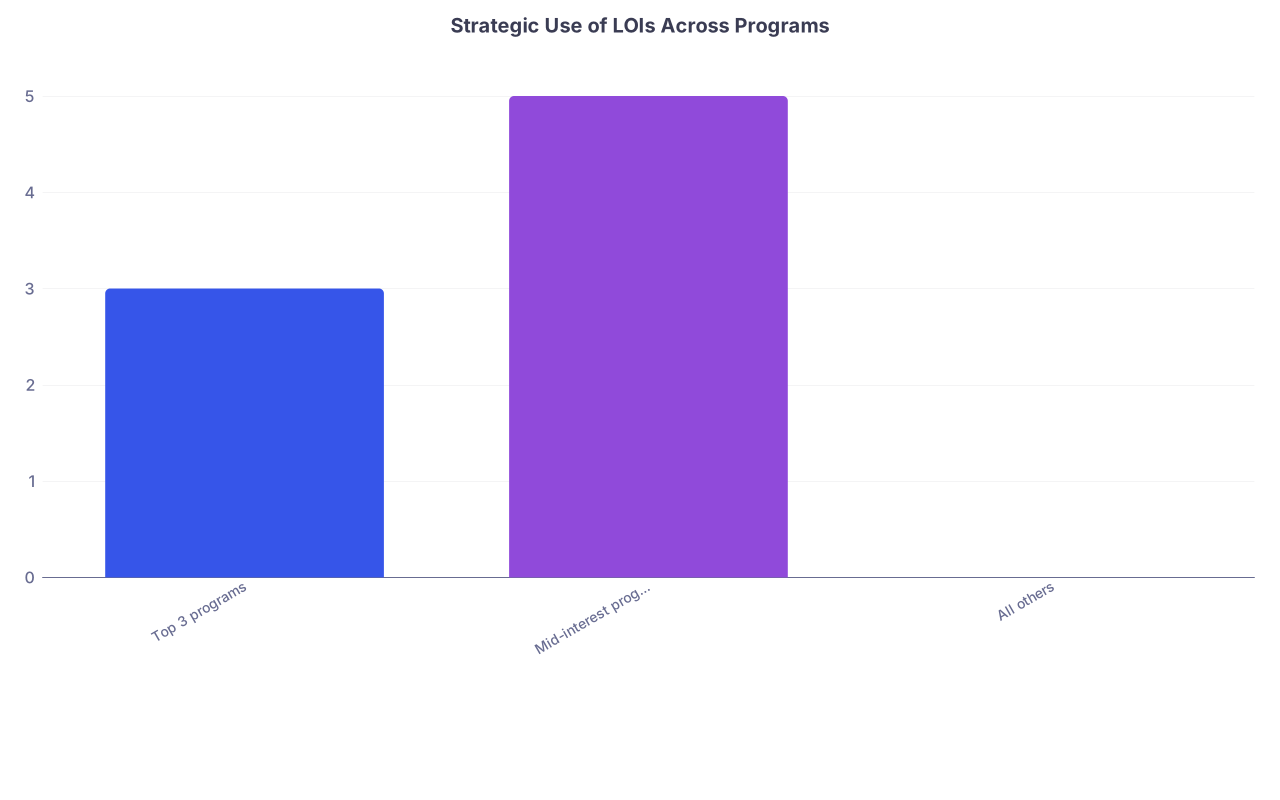
| Category | Value |
|---|---|
| Top 3 programs | 3 |
| Mid-interest programs | 5 |
| All others | 0 |
Smart approach, grounded in PD behavior and NRMP realities:
Identify your true #1.
The place you would actually choose over all others on your list. Not your “aspirational dream” if it’s delusional. A realistic #1.Send exactly one true LOI naming them as #1.
- Specific reasons tied to their program
- Evidence you’ve done your homework
- Clear, unambiguous “I will rank you first” language
Optionally send 2–4 shorter, high‑interest letters.
Not “intent” but “strong interest”:- “You’re one of my top choices.”
- “I can clearly see myself training here.”
- Again, specific ties and details.
Skip mass‑mailing everyone else.
You gain nothing by blasting 12 essentially identical emails. Diminishing returns hits fast. Your time is better spent refining your rank list and preparing for SOAP/backup options if needed.
And then stop. You’re done. Obsessing beyond that is anxiety management, not strategy.
How this intersects with the “future of medicine” and over‑application
Here’s the more meta point that almost nobody brings up:
LOIs emerged as an informal patch on a badly functioning market.
- Too many applications per applicant
- Programs over‑interviewing “reach” candidates
- Geography and partner/job constraints that ERAS doesn’t model well
So applicants started using LOIs as a crude signal of preference. Programs, even while officially pretending they don’t care, quietly respond, because any signal is better than none in a flooded pool.
In an ideal, data‑driven future:
- We’d have standardized preference signaling (like oto, derm, ophtho already use).
- Applicants could send X “tokens” to programs before interviews.
- Post‑interview communication would be regulated and transparent.
Until that’s universal, LOIs are the messy, analog workaround.
They aren’t going away this cycle. Or next.

| Step | Description |
|---|---|
| Step 1 | Application Submitted |
| Step 2 | Interview Offer |
| Step 3 | Interview Day |
| Step 4 | Post Interview Period |
| Step 5 | Rank List Based on Application and Interview |
| Step 6 | Interest Considered as Minor Factor |
| Step 7 | Program Rank List Finalized |
| Step 8 | Match Algorithm |
| Step 9 | LOI Sent? |
The people chanting “LOIs don’t matter at all” are pretending the current system is already rational and optimized. It isn’t.
The bottom line
Three takeaways you should not forget:
LOIs are not magic, but they’re not zero.
They don’t fix a weak app or conjure new interviews, but they do act as a tiebreaker and risk‑reduction signal—especially for borderline candidates and mid‑tier programs worried about “flight risk.”One honest, specific LOI beats five generic lies.
Tell one program they’re #1 and mean it. Use a handful of well‑crafted “strong interest” notes if you must. Skip the shotgun approach and the copy‑pasted fluff.Use LOIs like a scalpel, not a security blanket.
They’re a small, targeted tool within a system that still runs on scores, clinical performance, letters, and interviews. If you treat them as either worthless or magical, you’re playing the game wrong.