
What actually happens to your rank position when you send that “You’re my number one” letter of intent—do they move you up, or does it go straight into a folder nobody opens?
Let me be blunt: the mythology around letters of intent (LOIs) is wildly out of proportion to what they actually do. Every January, I watch otherwise rational applicants agonize over commas in their “I will rank you #1” emails, as if a program director in anesthesia or IM is waiting with a red pen and the rank list open, ready to bump them 10 spots for a nicely worded paragraph.
That’s not how this works. That’s not how any of this works.
Let’s separate what feels true from what’s supported by data, NRMP policy, and real program behavior.
What Programs Say vs What Programs Do
Med students love anecdotes. “My friend wrote a letter and matched at her top choice—see, it works!” No one talks to the 200 people who wrote similar letters and matched somewhere else because the letter changed exactly nothing.
We actually have some real data about what programs claim to do with post-interview communications.
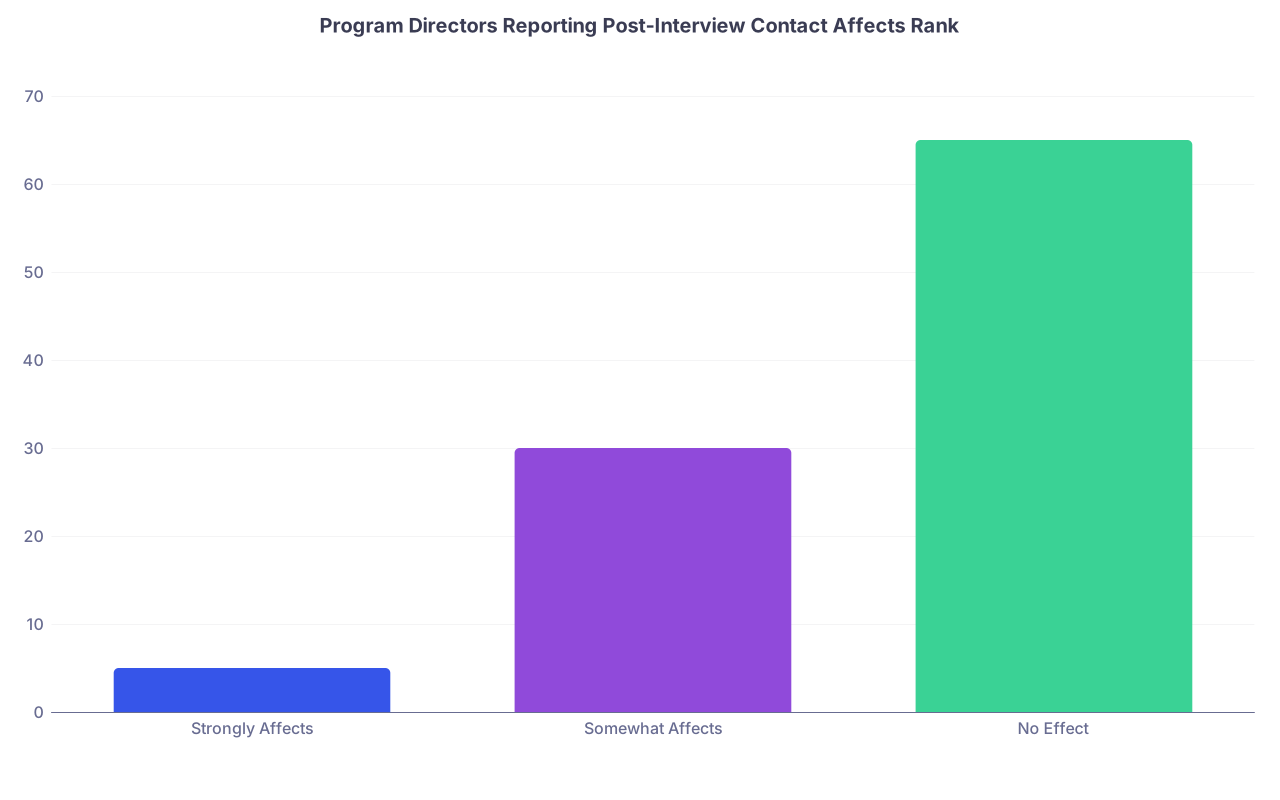
From multiple NRMP Program Director Surveys (2018–2024), when programs are asked whether applicant post‑interview contact affects their rank list, the pattern is pretty consistent:
| Category | Value |
|---|---|
| Strongly Affects | 5 |
| Somewhat Affects | 30 |
| No Effect | 65 |
Most PDs say either “no effect” or “mild effect.” The loudest myth is that PDs secretly shift people way up if they name the program as #1.
Reality: some do a tiny tweak. Many do nothing. A minority care a lot—but they’re not the majority.
And the stronger the program, the less they need to care. When you’re a mid-tier community IM program worried about filling, “interest” can matter. When you’re MGH, UCSF, or Mayo, you’re not desperately scanning inboxes at midnight hoping someone promises fidelity.
In other words: letters of intent might nudge you at some places, but they are not a rank-list elevator.
How Rank Lists Are Actually Built
If you do not understand this part, you will keep overvaluing letters.
Here is the rough order in which most programs actually build rank lists:
- Screen out obvious “no” candidates.
- Tier applicants by perceived strength: scores, MSPE, clinical grades, letters, research, interview performance.
- Within each tier, discuss perceived “fit” and specific preferences.
- Make an initial rank list.
- Adjust slightly around the margins for:
- Red flags
- Internal candidates
- Couples match issues
- Known strong interest (from the interview day, home connections, people they know)
- Lock the list and stop touching it unless something huge happens.
Notice what’s missing? “Wait until January to see who emails us.”
When a PD or coordinator says, “We don’t change the list based on post-interview communication,” often they are not lying. Especially at academic places with large classes, the rank meeting is painful and time-consuming, and nobody is excited to reopen that file because someone wrote a nice paragraph.
Are there exceptions? Absolutely. I’ve seen:
- A PD move an applicant 2–3 spots up within a small tier because they sent a very clear, credible “I will rank you #1” that matched what they said on interview day.
- A program bump someone down because their communication was pushy or dishonest (e.g., they got forwarded evidence the person told three programs they were #1).
But let’s be clear: we’re talking fine-tuning, not jumps from rank 45 to rank 5.
Does a Strong Letter of Intent Move You Up? The Real Answer
Here’s the part nobody likes because it’s not black‑and‑white.
A strong, honest letter of intent:
- Sometimes moves you slightly within your existing tier.
- Rarely moves you between major tiers.
- Almost never rescues a weak application.
- Can hurt you if it’s desperate, obviously copy-pasted, or dishonest.
So the myth that needs killing is this:
“If I send the perfect LOI, I can transform my outcome.”
No. The heavy lifting was done by your Step/COMLEX scores, your MSPE, your letters, and your interview performance. The LOI is, at best, a tie-breaker among people they already like.
Let’s put this in a simple comparison.
| Factor | Relative Impact on Rank |
|---|---|
| Interview performance | Very High |
| Clinical evaluations/MSPE | High |
| Letters of recommendation | High |
| USMLE/COMLEX scores | Moderate–High |
| Research/academic output | Moderate |
| Fit / subjective impression | Moderate |
| Letter of intent (solid) | Low |
| Letter of intent (amazing) | Low–Moderate (edge) |
| Post-interview silence | Neutral |
Your LOI, at best, is in the “low to low‑moderate” lane. If your expectations are higher than that, you’re setting yourself up for magical thinking.
Where Letters of Intent Actually Matter More
The context matters. LOIs mean very different things in three scenarios:
You’re a clearly top‑tier candidate for that program.
They already want you. You’re in their top group. Here, a letter can:- Confirm you’re serious and not just “interviewing up.”
- Make them slightly more comfortable keeping you very high even if they suspect you’re competitive elsewhere.
Effect size: modest but real.
You’re in the middle of their rank pool.
You interviewed fine, looked like many of their candidates. No huge red flags, no massive “wow.”
Here, a good LOI can:- Nudge you above another “middle of the pack” applicant with similar metrics who didn’t communicate.
- Make someone in the room vouch for you when they tweak the tail end of the “likely to match” segment.
Effect size: small, but if you’re on the bubble between rank 30 and 40 at a program that fills around 25–30? It might matter.
You were a weak or borderline interview.
No letter of intent is saving this. The PD and faculty already decided you’re low on the list, if ranked at all. Your LOI becomes background noise.
So yes, there are cases where an LOI meaningfully helps—just not in the dramatic way people fantasize about.
The Ethics and Gamesmanship Problem
Let’s talk about the part most people like to dance around: honesty.
The NRMP rules are crystal clear:
Programs and applicants may express interest and intentions.
No one is allowed to require or demand a promise.
No one is allowed to make a guarantee of matching.
So what happens every cycle?
- Applicants tell multiple programs “You are my #1.”
- Programs tell multiple applicants “We will rank you very highly.”
- Everyone lies or exaggerates, and then we all pretend we did not.
This arms race makes LOIs less meaningful. Program directors are not stupid. They know:
- A certain fraction of “You’re my top choice” emails are false.
- Applicants in highly competitive specialties often hedge their risk.
- Some medical schools essentially script these letters for students.
So what do smart programs do? They discount the signal. Heavily.
The more programs are burned by “You’re my #1” applicants who match elsewhere, the less they trust those letters in the future. Exactly like hearing “we should get coffee sometime” from a colleague who never follows through.
That doesn’t mean you should never send an LOI. It means if you want yours to matter, it has to look and feel different from the generic spam programs get flooded with in January.
What a “Strong” Letter of Intent Actually Looks Like
Here’s the ironic part: most applicants obsess over flowery language and forget signal.
A “strong” LOI, from a program’s perspective, has three features:
Credibility
Your behavior matches your words.
You interviewed there early and still say they’re your #1 in February? That’s more credible than someone who interviewed at their “big dream” program later and suddenly discovered this lower‑tier place is their soulmate.Specificity
Vague: “I loved the supportive culture and diverse patient population.”
Stronger: “On my interview day, Dr. X’s description of how PGY-2s run the MICU with early attending backup matched exactly the level of autonomy I want, and your X+Y schedule with protected ambulatory time fits my goal of staying academically active in outpatient cardiology.”
Translation: You understood the program. You’re not mass‑mailing that sentence to 12 places.Consistency
What you tell your home advisors or faculty who know PDs travels.
I’ve watched PDs get texts from faculty elsewhere: “FYI, this applicant is telling us we’re their #1.”
If you claim three “#1”s, don’t be surprised when your words start to carry zero weight.
Now, does having a “strong” LOI guarantee movement? No. But if a program is going to move you at all, it will be on the basis of those things, not your thesaurus use.
When Sending a Letter of Intent is Rational vs Pointless
Let’s separate signal from superstition.
Good reasons to send a single, honest LOI:
- You have a clear, authentic #1 where you’d absolutely be thrilled to match, even over objectively more “prestigious” options.
- Your metrics are solid but not absurdly above the program’s usual range—so they might plausibly worry you’ll go elsewhere.
- You had strong conversations on interview day, clicked with residents, and can reference concrete parts of the experience.
Dubious or pointless contexts:
- You’re blanket‑sending “top choice” language to three or more programs. That’s not a strategy; that’s lying.
- You’re far below the program’s usual competitiveness and hoping the letter compensates for weak scores, failed attempts, or lukewarm interview. It won’t.
- You’re applying to a hyper‑elite program where almost every interviewed applicant would happily train. Your “you’re my #1” is indistinguishable from dozens of others.
And here’s a more uncomfortable truth: I’ve seen more applicants meaningfully helped by normal, thoughtful post‑interview thank‑you notes that reinforced genuine connection, than by one melodramatic LOI dropped three weeks before rank list certification.
Programs remember the person who wrote clearly, followed up on a shared clinical interest, and sounded like a future colleague—not the person who wrote like a political speechwriter begging for votes.
The Future: LOIs Are Probably Getting Weaker, Not Stronger
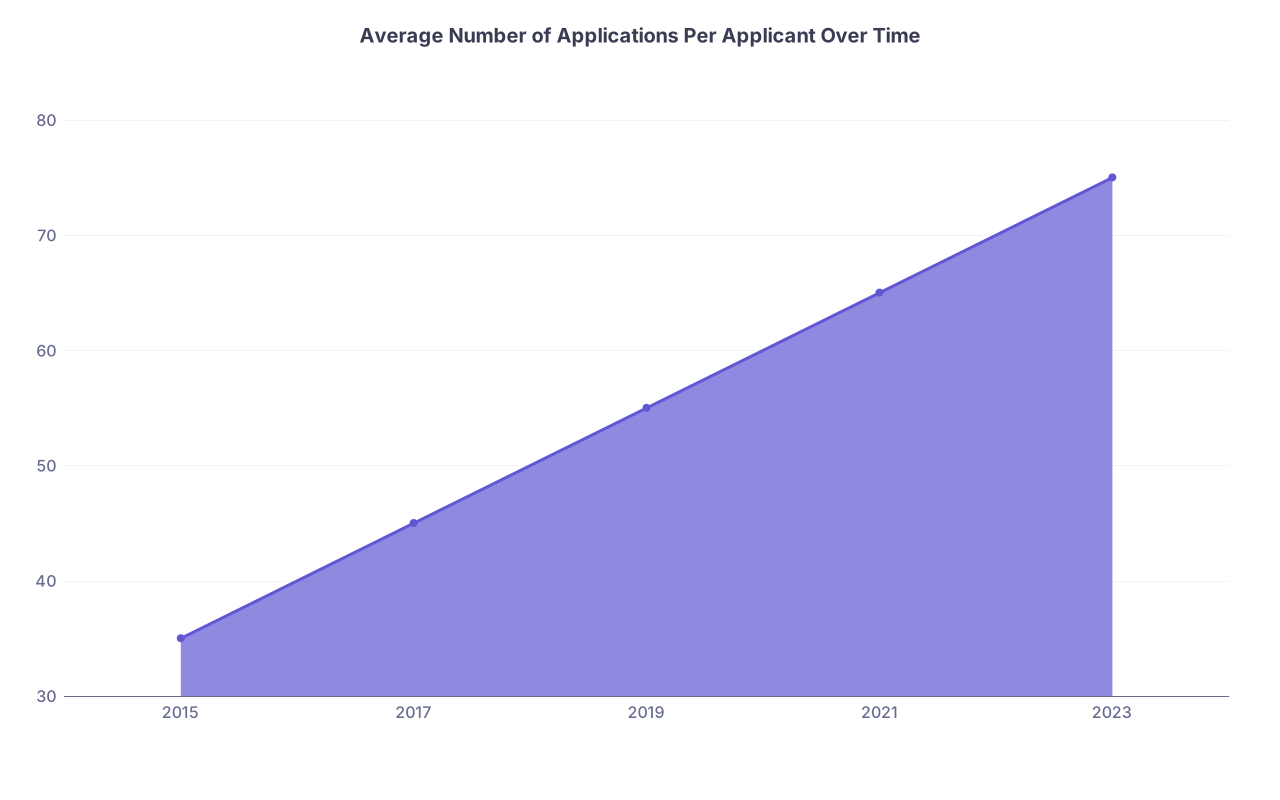
Look at the broader trend lines: more applicants per spot, more interviews per applicant, more noise overall.
| Category | Value |
|---|---|
| 2015 | 35 |
| 2017 | 45 |
| 2019 | 55 |
| 2021 | 65 |
| 2023 | 75 |
As volume explodes, programs are doing exactly what you’d expect rational humans to do: they’re leaning more heavily on structured data (scores, MSPEs, SVI-type tools in some fields, standardized letters) and less on unstructured noise like random emails and calls.
Some specialties already have programs that:
- Officially state they ignore all post‑interview communication.
- Explicitly forbid signaling preference or rank intentions.
- Use standardized ranking rubrics where “post‑interview contact” is literally not a column.
Will every program move that way? No. But the direction of travel is obvious. Signals that are easy to fake and impose cognitive load on PDs tend to be devalued over time.
If you’re hoping LOIs become the decisive secret weapon of the future, you’re betting against the way systems evolve under information overload.
A More Rational Way to Think About LOIs
Let me strip this down to something you can actually use.
Think of a letter of intent as:
- A low‑power tiebreaker, not a primary tool.
- A one‑time signal, not a mass‑produced campaign.
- A reflection of your integrity, not a playground for strategic lying.
If you send one, do it because:
- You’ve thought hard about where you belong.
- You’re prepared to live with that decision even if you end up not matching at flashier places.
- You’re willing to trade the tiny potential boost at that one program for the lost flexibility of being “all things to all programs.”
Spend 95% of your energy on things that actually move the needle: how you interview, how you present your experiences, how you communicate with residents and faculty on the day, what your letters say about you.
Spend 5%—if that—on polishing one honest, specific LOI to your real #1.

Key Takeaways
- Programs rarely move you far up their list for a strong letter of intent. At best, it’s a minor tiebreaker within a tier, not a magic elevator.
- A single, honest, specific LOI to a true #1 can sometimes help at the margins—but lying to multiple programs or expecting a weak application to be rescued by a letter is fantasy.
- The future is moving toward structured, reliable signals and away from noisy, easily gamed ones. Treat LOIs as optional, low-impact tools—not the centerpiece of your match strategy.