
Program directors do not believe most letters of intent.
Let me say that again so it lands: by the time your letter hits their inbox in January or February, they assume at least half of what you wrote is strategic fiction. The only question is whether your letter lands in the “maybe actually serious” bucket or the “generic noise from another applicant trying to game the Match” bucket.
What decides that? Not the length. Not your Step score. Not the flattery.
The phrases. The tiny tells that make a PD lean back in their chair and say, “Yeah, this kid is ranking us somewhere…but not first.”
You’re not hearing this from the dean’s office. You’re hearing it from what I’ve watched PDs, APDs, and selection committee members actually say during ranking meetings and in the hallway gripes between interviews.
Let me walk you through the phrases that quietly kill your credibility—and what to write instead if you actually want them to believe you.
How PDs Really Read Letters of Intent
First reality check: your letter of intent is not read like a personal statement. It’s read like a lie detector test.
They’re not reading for prose. They’re scanning for:
- Is this person truly committing to us, or hedging?
- Does their story match what we saw on interview day?
- Does this sound like a mass email with the name swapped out?
- Are they trying to manipulate us, or do they understand how this game is actually played?
Most mid‑to‑large programs will partition letters mentally into three piles:
| Letter Type | How PDs Treat It | Real Impact on Rank |
|---|---|---|
| Clear, credible #1 | Taken seriously | Can move you up |
| Vague / hedging | Discounted | Minimal to none |
| Obviously generic | Ignored | Zero impact |
The mistake applicants make? They think they can keep everyone happy. Tell three programs they’re “number one.” Use flexible language. Protect themselves.
Problem: PDs have read thousands of these. The soft, lawyered phrases you think are clever? They’re red flags.
Let’s go through the worst offenders.
The Hedging Phrases That Scream “You’re Top 3, Not #1”
These are the phrases PDs mock out loud. I’ve watched this happen more than once. APD opens an email on screen share, reads a line, and the room groans.
1. “I will be ranking your program very highly”
This is the classic coward’s phrase. Almost every PD I know dismisses it on sight.
Translation to them: “You’re somewhere between 1 and 8 and I don’t want to commit.”
Subtext: “I’m sending this to several programs.”
They’ve all seen the same language in emails sent to different institutions. Residents forward screenshots to each other. PDs compare lines at conferences. You think they don’t? They absolutely do.
How it lands in ranking discussions:
“They sent us a ‘very highly’ email. Fine. They like us. But that doesn’t change anything.”
If you truly want impact, soft qualifiers kill you. Either commit or don’t. “Very highly” is the linguistic equivalent of shrugging.
What to write instead if you mean it:
“I will be ranking [Program Name] as my number one choice.”
One sentence. No dressing. No “barring unforeseen circumstances.” If you’re not ready to say that, then do not pretend you are sending a letter of intent. You’re sending a “just letting you know I liked you” email—which is fine, but has much less weight.
2. “One of my top choices” / “Among my top programs”
Same problem, different costume.
To a PD, “one of my top choices” translates to: “I want you to think you matter without actually telling you anything.”
They will not re-rank you based on that. At best, it confirms that you liked them. They already assumed that—you interviewed, didn’t you?
I’ve literally heard a PD say:
“If they can’t say number one, I assume we’re not number one. Next.”
Brutal, but that’s how they protect themselves from getting burned in March.
If you truly can’t commit but still want to communicate interest, then be honest:
“I remain very interested in your program and expect to rank [Program Name] near the top of my list.”
Notice: that’s interest, not a letter of intent. Don’t label it as one. Don’t pretend it’s equivalent.
The Over-Flattery That Makes You Sound Fake
Some of you write like you’re applying to Hogwarts, not a residency program. It backfires.
3. “Your world-class program”
You know who calls it a “world-class program”? The program’s own marketing material and applicants trying too hard.
PDs know where their program sits in the ecosystem. A middle‑tier community program being called “world-class” feels like a template. A strong academic program hears it 200 times a year.
It doesn’t help you. It makes you look like you pasted in generic praise that could apply anywhere.
Much better to be specific and concrete:
- “The strength of your inpatient cardiology service…”
- “The autonomy residents described on night float…”
- “Your structured second-year research block…”
That’s what makes them believe you’ve actually thought about them, not their brochure.
4. “I was beyond impressed / incredibly impressed / extremely impressed”
You can almost feel the thesaurus sweat on the page.
Too much emotional language reads as compensation. PDs have a good nose for when someone is trying to butter them up instead of saying something real.
An attending on a selection committee once muttered while reading:
“Everyone is ‘incredibly impressed.’ Show me you understood what you saw, not how many adverbs you know.”
Better:
“On interview day, residents consistently described strong mentorship from faculty and a high level of operative autonomy by the third year. That combination is what I’m looking for.”
Specific beats syrup. Every time.
The Vagueness That Makes Them Question Your Maturity
The next class of phrases doesn’t scream “liar,” but it does whisper “not quite ready.”
5. “I believe I would be a good fit for your program”
Weak. Passive. Empty.
Of course you “believe” that. You applied. You interviewed. The PD isn’t wondering whether you believe you’re a good fit. They want to know whether you understand why you’d fit there.
This is where a lot of letters fall apart. Vague “fit” language without traits that match the program culture.
You want to sound like you’ve actually reflected. For example:
At a county-heavy safety-net program:
“I’m drawn to the high-volume, underserved patient population and the expectation that residents take primary ownership of their patients.”At a research-heavy academic program:
“I’m looking for a program that expects residents to ask questions and contribute to scholarship; your dedicated research curriculum and track record of resident publications match my goals.”
Compare that to: “I believe I would be a good fit.” One of those feels like an adult. One feels like a pre-med platitude.
6. “I am confident I will thrive in your program”
Another empty calorie phrase. It’s about you, not them, and again doesn’t say anything measurable.
What PDs prefer hearing: awareness of reality and humility about the grind.
Something like:
“I know your program has a demanding call schedule and high clinical volume. That’s the environment in which I learn best, and my experiences on [specific rotation] convinced me that I handle long, high-intensity days well.”
That shows you aren’t delusional, and you’re not just romanticizing their reputation.
The Red-Flag Phrases That Trigger Distrust
These are the ones that can actually hurt you. Not because PDs are offended, but because they start to doubt your honesty or professionalism.
7. “Assuming I match at your program…”
This one makes PDs flinch.
It sounds like you’ve misunderstood how the algorithm works or you’re subtly trying to pressure them. It creates this weird, transactional tone—like you’re pre‑negotiating.
Worse, there’s a hint of entitlement. They don’t like that.
Better:
“If I have the opportunity to train at [Program Name], I would be excited to [X].”
Conditional, but respectful. No weird algorithm language.
8. “I will withdraw from all other programs if I match at yours”
I’ve seen variations of this. PDs hate it.
Of course you’ll withdraw from other programs if you match there. That’s literally how the Match works. You can’t be in two places.
When people write this, it signals they don’t understand the process, or they’re so desperate they’re throwing random promises in the air.
Keep your promises grounded in reality:
“I will be ranking [Program Name] as my number one choice.”
That’s verifiable and meaningful. Anything beyond that veers into cringe.
9. “If I am fortunate enough to match at your prestigious institution…”
This kind of faux‑humble groveling has fallen out of favor. Older faculty sometimes tolerate it. Most younger PDs roll their eyes.
The problem isn’t respect. The problem is tone. It sounds like you’re trying to cosplay “grateful supplicant” instead of speaking as a colleague-in-training.
You do not need to act like they’re doing you a personal favor. You’re entering a mutually beneficial contract: your labor and growth for their service coverage and academic mission.
You can signal gratitude without theatrics:
“I would be grateful for the opportunity to train at [Program Name] and contribute to your [specific mission].”
The Template Tells: How PDs Spot Copy-Paste Letters
Here’s a dirty little secret: PDs and APDs absolutely trade stories—and occasionally phrases—they’ve seen in letters. Some of you reuse the exact same letter, with “I was especially drawn to…” plugged in and the program name swapped.
They notice.
Common template tells:
- The same exact three-sentence structure: why I like your location, why I like your training, generic closing.
- Vague praise about “strong clinical training and research opportunities” that applies to every mid‑sized academic program in the country.
- The “I could see myself growing both personally and professionally in your program” line. This is everywhere.
One PD I know in the Midwest keeps a “Bingo card” of applicant clichés on their whiteboard. When a letter hits five phrases, they stop reading carefully.
Here’s how to write in a way that screams “this letter could only have been sent to you”:
Reference a specific resident by name and conversation topic.
“Speaking with Dr. Patel about her experiences on your MICU months convinced me that…”PDs remember who was on interview day. That grounds your letter.
Mention a concrete structural feature that actually differentiates them.
“The 4+2 schedule and consistently protected didactics are rare, and they align with how I learn best.”Tie your background to a distinctive patient population they actually serve.
“Having grown up in a border community, I’m drawn to your heavy Spanish‑speaking patient population and the integrated medical-legal partnerships your residents described.”
If a PD can swap their program’s name out and drop in a rival’s name without changing anything else, your letter is useless.
The One Thing That Matters More Than Any Phrase
Here’s the uncomfortable truth: the content matters less than the coherence of your story.
PDs are cross-checking your letter of intent against:
- Your interview comments
- Your application (research, electives, geographic ties)
- Any signals you sent earlier (PSLF forms, supplemental signals, pre‑interview emails)
If you told them on interview day that your partner is locked into the Northeast and your letter suddenly declares a Midwestern program as your “clear number one,” they raise an eyebrow. They’re not dumb. They know you’re telling someone else the same thing.
On the other hand, if your signals line up:
- You rotated there or did a home rotation
- You mentioned them early as a top choice to residents or faculty
- You have geographic or family ties that point to that city
- Your letter says, simply and clearly, “You’re my #1”
Then yes, that can move you from “probably mid‑list” to “we should push them up; they’re likely to come.”
This is why over-engineered phrasing hurts you. PDs care far more about whether your story is believable than whether you used fancy language.
Future Direction: How Letters of Intent Are Quietly Changing
Letters of intent are drifting into a weird gray zone.
A lot of PDs will tell you, on the record, “We don’t factor letters of intent heavily.” Off the record, they admit exactly what I’ve described: a believable, clear #1 letter can absolutely bump you in borderline cases.
But a few trends are changing the game:
- Signaling systems (like ERAS signals, preference signaling in some specialties) are formalizing what used to be email‑based intent.
- The NRMP and AAMC are cracking down harder on coercive language, promises, and weird “if you rank us first we’ll rank you highly” games.
- Younger PDs are more “data and structure” oriented and less swayed by emotional letters—unless it solves a specific problem (“We need someone with ties to this region who is actually likely to come.”).
What does that mean for you?
Letters of intent are becoming less about emotional persuasion and more about clarifying signal. Think of them as a final alignment check, not a drama performance.
That’s why the subtle phrases matter so much: because your letter’s job now is to say one thing cleanly—
“Here’s where you sit on my list, and here’s why that makes sense given who I am.”
Everything else is noise.
What a Clean, Credible Letter of Intent Actually Sounds Like
To make this concrete, here’s the skeleton that most PDs respond well to. Not a template to copy word‑for‑word, but a structure.
One sentence: explicit ranking statement
“I will be ranking [Program Name] as my number one choice.”Two to three short paragraphs: specific, grounded reasons
- One about training structure / clinical experience
- One about culture / residents / mentorship
- Optional: one about geography or personal fit, if relevant and real
One sentence: coherent tie‑in to your future plans
“Your emphasis on X aligns with my goal to Y.”One closing line: gratitude without groveling
“Thank you again for the opportunity to interview and for your continued consideration.”
Notice what’s not in there:
- No “very highly” hedging
- No “world-class” fluff
- No five-sentence paragraph about how “humbled” and “beyond impressed” you were
- No bizarre promises about withdrawing from the Match
Just a clear signal and a believable story.
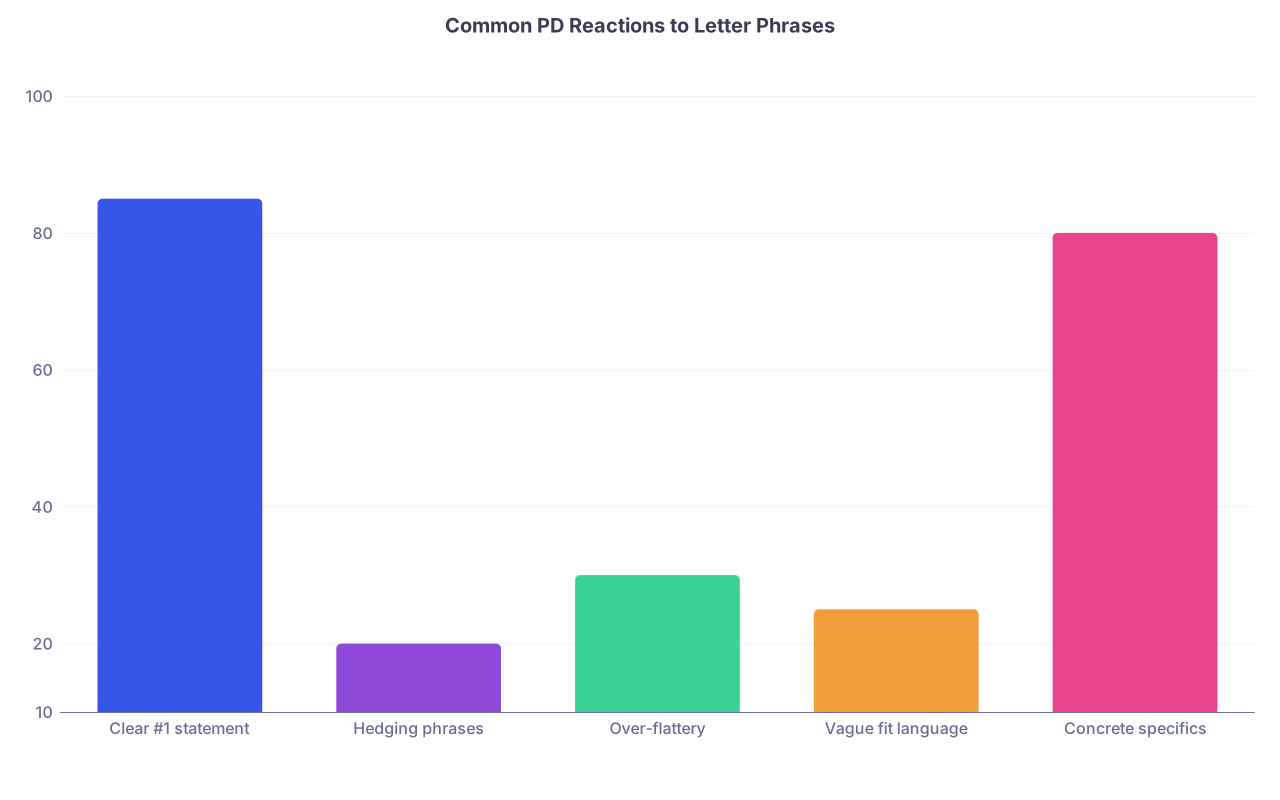
| Category | Value |
|---|---|
| Clear #1 statement | 85 |
| Hedging phrases | 20 |
| Over-flattery | 30 |
| Vague fit language | 25 |
| Concrete specifics | 80 |

| Step | Description |
|---|---|
| Step 1 | Open Letter |
| Step 2 | Treat as generic interest |
| Step 3 | May move up a few spots |
| Step 4 | Question honesty |
| Step 5 | Minimal impact |
| Step 6 | Clear #1 statement |
| Step 7 | Story matches application |
FAQ: Letters of Intent That PDs Actually Believe
Should I ever tell more than one program they’re my “number one”?
No. That’s how you burn your reputation. PDs talk. Residents talk. When you get caught—and people do—you become a cautionary tale. Tell one program they’re #1. Tell others you’re “very interested” if you want, but don’t lie.If a PD emails me saying, “You’ll be ranked highly,” should my letter of intent change?
No. Those messages are almost always vague by design and mean less than you think. If that program is truly your first choice, send a clear #1 letter. If it’s not, don’t contort your whole list around some noncommittal email. Rank in your real order of preference.Does sending no letter of intent hurt me?
Usually, no. For many programs, letters only matter at the margins—tie‑breaker situations, uncertainty about whether you’d actually come. If you’re already clearly high on their list from the interview, you may be fine without one. But if you have a genuine #1, a good letter is low‑risk and occasionally high‑reward.Can a bad letter of intent actually drop me on the list?
Mildly bad? Usually no. They’ll just ignore it. But if your letter contradicts things you told them, looks dishonest, or suggests you don’t understand the Match rules, yes—it can make them uncomfortable and bump you down, especially if there are plenty of similar applicants.How long should a letter of intent be?
Half a page to one page, max. Many PDs skim on their phone between meetings. Three tight paragraphs beat a full page of rambling. If they have to scroll more than once on a laptop screen, you’ve probably said too much and diluted your signal.
If you remember nothing else, remember this:
Cut the hedging. Kill the fluff. Make one honest, specific, and coherent commitment. That’s what PDs actually listen to, beneath all the noise.