The fastest way to get your letter of intent ignored is to sprinkle in random program details and hope nobody notices you do not actually care.
Most applicants sound fake because they write to impress the program, not to connect with it. They Google three facts, jam them into a paragraph, and call it “personalized.” Faculty read that garbage all day. They can smell it in one sentence.
You can do much better. And it is not about more adjectives or “genuine passion.” It is about process and discipline.
Here is how to reference program-specific details so they actually believe you.
Step 1: Stop Using “Program Fit” Filler Language
First fix: strip the phrases that scream “I copied this from Reddit.”
Common offenders:
- “I am particularly drawn to your program because of its strong clinical training.”
- “Your program’s commitment to resident wellness really stands out.”
- “I would be honored to train at such a prestigious institution.”
Alone, these are useless. They tell the reader:
- You did not do the work.
- You probably sent this to eight other programs.
- You do not understand what makes them different.
You can keep the ideas, but not the empty shells. Instead of:
“I am impressed by your program’s diverse patient population.”
You write:
“On my interview day, Dr. Patel described the consult volume on the county service. The chance to manage that level of pathology as a primary resident, rather than just writing ‘suggested plans’ that someone else implements, is exactly what I want in training.”
Notice the difference:
- Specific person.
- Concrete scenario.
- Clear implication for your training.
Rule: If a sentence could appear in a letter to five other programs with zero edits, delete or rewrite it.
Step 2: Gather Real Program Details The Right Way
You cannot sound genuine if your details come only from the homepage and the first line of the mission statement.
You need three categories of intel:
- Public but underused
- Hidden in plain sight
- Directly experienced
1. Public but underused
Skip the giant “About Us” paragraph. Look where fewer people look:
- Rotation schedule PDFs
- Resident clinic models
- Call schedules
- Conference calendars
- Specific tracks (global health, clinician educator, research)
- Quality improvement or curriculum pages
You are looking for structures that shape resident life, not marketing slogans.
Example: Internal Medicine program
- Everyone writes: “impressed by your strong research.”
- Serious applicant notes: “Your X+Y schedule and the protected ambulatory week every sixth week solve a problem I have seen repeatedly during residency: outpatient continuity getting destroyed by ward demands.”
2. Hidden in plain sight: residents and faculty
This is where applicants get lazy or creepy. You need to hit the middle.
Do:
- Read resident bios for consistent themes (many are former teachers? lots of global health? strong local ties?).
- Skim recent faculty publications to see what work is actually being done.
- Check recent grand rounds or conference topics if posted.
Do not:
- Cram a random paper title into your letter just to prove you can use PubMed.
- Name-drop a faculty member you never met and have no real overlap with.
Good use:
“The resident bios repeatedly mention longitudinal community engagement. That resonates with my experience running a weekly diabetes group visit in medical school and my interest in continuing group-based care models.”
Bad use:
“I am excited about the opportunity to work with Dr. X, who published ‘Novel Biomarkers in XYZ’ in 2017.”
Nobody believes that second line unless your CV screams basic science in that niche.
3. Directly experienced: interviews, rotations, conversations
This is where your best material comes from. You just have to capture it correctly.
After:
- Interview days
- Away rotations
- Virtual socials
- Phone calls with residents
You should immediately write down:
- 3 specific moments (quotes, reactions, stories)
- 2 concrete structures (how a rotation works, teaching format, schedule nuance)
- 1 gut-level reaction (“I actually wanted to be there” / “These attendings were brutal” / etc.)
Then, when you write the letter of intent, you are not relying on vague feelings. You have receipts.
Step 3: Convert Details Into Credible Sentences
Referencing details well is a writing problem, not an information problem.
You need three ingredients in a sentence:
- Specific program fact
- Your prior experience or goal
- Explicit connection between the two
Let me show you how to do this cleanly.
The 3-Part Structure
Use this mental template:
“Because I did/valued X, I was struck by Y detail at your program, which would allow me to Z.”
Now in practice:
Example 1 – Schedule
Lazy:
“Your X+Y schedule is attractive and offers strong outpatient training.”
Real:
“In medical school, I watched residents constantly reschedule clinic patients when they were pulled back to the wards. Your X+Y system, with fully protected ambulatory weeks, looks like the rare structure that actually protects continuity. That matters to me because I want to graduate comfortable managing my own panel, not just cross-covering others’ patients.”
Example 2 – Research
Lazy:
“I am excited by your strong research program.”
Real:
“I spent two years in a outcomes lab building risk prediction models but struggled to bring those tools into day-to-day patient care. Hearing Dr. Lee describe how residents at your program lead EHR-based projects that directly change order sets convinced me this is an environment where data work can translate into practice, not just publications.”
Example 3 – Culture
Lazy:
“The collegial atmosphere really stood out.”
Real:
“On the interview social, when a PGY-3 openly described how the chiefs helped him restructure his schedule during his father’s illness, it did not sound rehearsed. It sounded like a place where residents can admit they are struggling without being labeled weak. That is the kind of culture I want to join, and contribute to.”
You see the pattern. Detail. Your story. Connection.
Step 4: Use Program Details Without Sounding Like a Stalker
Referencing specific people and projects can help, but it can also make you sound fake or inappropriate. There is a line.
When it works to name people
You can safely mention:
- Faculty you directly interacted with (interview, rotation, project)
- Residents you spent real time with
- Leaders whose teaching or behavior you personally observed
Good:
“Working with Dr. Chen on the cardiology consult service, I appreciated how consistently she pushed me to commit to a plan before offering guidance. That expectation of ownership, while still feeling supported, is exactly how I want to grow.”
Good:
“Talking with Dr. Morales during interview day, I was struck by how intentionally she described building the new addiction medicine rotation and how residents were included in design decisions.”
These are grounded. They are about your interaction and what it showed you.
When it backfires
Red flags:
- Citing a faculty paper you read but have no link to.
- Mentioning a resident you stalked on social media.
- Referencing personal info that was never shared with you directly.
Bad:
“I saw on Dr. Green’s Instagram that she balances being a mother with being a surgeon. This was very inspiring and shows the program supports wellness.”
Creepy. Do not.
Better to generalize:
“Several residents openly discussed having children during training and described concrete schedule flexibility (e.g., call swaps, backup coverage) that made it sustainable. That degree of structural support, not just slogans about wellness, matters to me.”
Name-dropping rule
If you would be uncomfortable having that person read the sentence out loud in morning report, do not include it.
Step 5: Avoid the “Copy-Paste with Find and Replace” Trap
Program directors read dozens of letters that are obvious template hacks. You know the kind:
“I am writing to express my strong interest in the [PROGRAM NAME] residency program at [INSTITUTION]. I am impressed by the diverse patient population and commitment to education…”
Here is how you avoid looking like that.
Build a reusable skeleton, not a reusable letter
You can absolutely reuse structure. You should not reuse generic content.
Think of your letter in blocks:
Opening:
- Declare intent.
- One line that is specific to this program.
Middle:
- 2–3 program-specific paragraphs tied to your goals.
- 1 paragraph about what you bring.
Closing:
- Clear statement of ranking intent.
- Thank you that is not sugary.
Then, for each program, you swap in:
- Different specific details
- Different stories
- Different connections
| Letter Block | Reusable Structure | Must Change Per Program |
|---|---|---|
| Opening sentence | “I am writing to…” | Program name, 1 specific anchor detail |
| Program paragraph 1 | Your structure | Rotation/curriculum detail and your link |
| Program paragraph 2 | Your structure | Culture/people/system detail and your link |
| What you bring | Mostly reusable | Small tweak to align with program strengths |
| Closing | Structure | Rank intent language and program name |
If only the program name changes, your letter is trash. Fix it.
Use a sanity check
After you write a letter, run this test:
- Replace the program name with a competitor’s.
- Replace any faculty/resident names with generics.
- Ask: “Would this letter still mostly make sense for that other program?”
If yes, you are not specific enough. At least two paragraphs should break under this test.
Step 6: Reference “Future of Medicine” Details Without Sounding Like Hype
Your category is “Miscellaneous and Future of Medicine.” Which is exactly where many applicants start sounding like overexcited TED Talk speakers. That is a problem.
Program directors do not want your abstract thoughts on AI or precision medicine. They want to know:
- Have you thought concretely about where the field is going?
- Do you understand what their program is actually doing about it?
- Can you plug into that in a realistic way?
Pick 1–2 future-facing themes per program
Examples:
- AI/clinical decision support
- Telemedicine and virtual care
- Population health and value-based care
- Genomics and precision therapeutics
- Health equity and structural determinants of health
Then connect specific program activity to your specific interest.
Bad:
“With the rise of AI and machine learning in medicine, I am excited about your program’s embrace of innovation.”
Better:
“During interview day, Dr. Alvarez described how your residents participate in reviewing alerts from your sepsis prediction model and adjust thresholds based on real-world usability, not just model performance. My prior work building risk tools that never left the research server taught me how crucial that human-in-the-loop step is. I want to train where residents are part of that loop.”
See the difference? You are not worshipping buzzwords; you are grounded in how medicine is actually changing in that environment.
Avoid generic “future” clichés
Cut or rewrite sentences like:
- “As medicine becomes more interdisciplinary…”
- “As healthcare increasingly relies on technology…”
- “In the ever-changing landscape of healthcare…”
Instead, name the thing and the local effort:
“Your longitudinal telehealth clinic, where interns carry a panel of rural patients they may never meet in person, reflects where primary care is genuinely headed. That model aligns with my experience running virtual group visits and my interest in expanding access beyond city centers.”
Specific. Observable. Local.
Step 7: Use Details Sparingly but Precisely
You do not need twelve program-specific details. In fact, that starts to feel forced.
Ideal:
- 2–3 deep, well-connected specifics beat 8 shallow name-drops.
Think in terms of “anchor details”:
- Structure anchor – schedule, clinic model, rotation design.
- Culture anchor – how people behaved or described their environment.
- Future anchor – how the program is engaging with where the field is going.
If you can hit those three categories with credible examples, your letter will already stand out.
Example: Putting it all together (abbreviated)
Just to show you rhythm, here is how a paragraph might look when done correctly:
“On my interview day, the chiefs described how your night float system keeps the same cross-covering resident on for several nights in a row, allowing them to follow patients’ trajectories rather than hand off after a single shift. That design echoes what I valued most in my sub-internship – the chance to watch patients over time and adjust management based on longitudinal observation rather than one-off impressions. Training in a system structured for continuity, not just throughput, fits how I want to grow as a clinician.”
No buzzwords about “strong training.” No generic “diverse population.” Just structure → your experience → fit.
Step 8: Quick Diagnostic – Does Your Letter Sound Fake?
Here is a simple triage checklist. Be honest.
Red flag phrases (usually fake)
If your letter has more than 3 of these, you are in trouble:
- “I was particularly impressed by…”
- “Your program’s commitment to…”
- “I am confident that your program will provide…”
- “I would be honored to train at…”
- “Second to none”
- “Unique opportunity to…”
You can keep one or two. But for each one, ask: is there a specific, grounded sentence right next to it that proves it?
Green flag features (usually real)
You are probably on the right track if:
- You mention a specific story from your interview or rotation.
- You reference a structural detail that 90% of applicants will ignore.
- At least one paragraph would not make sense if pasted into a different program letter.
- You can hear the resident or faculty member’s voice in your head when you re-read the line.
Step 9: A Simple Workflow You Can Actually Follow
Let me give you a concrete process so this does not balloon into a 20-hour perfectionism project.
Right after each interview / rotation
- Open a doc titled: “Program Notes – [Name].”
- Create three headings:
- Structure
- Culture
- Future / Innovation
- Under each, write 2–3 bullet points with specific details or quotes. Do not aim for prose. Just dump.
- Add one line: “Why this program feels different from others.”
This should take 10 minutes, max. Do it the same day.
Before writing the letter
- Re-read your notes.
- Circle or highlight:
- One structure detail.
- One culture moment.
- One future/innovation element.
- Decide what part of your background best connects to each.
Writing the letter
Use this rough outline (adapt it as needed):
Opening (2–3 sentences)
- Clear statement: you will rank them #1 / very highly (depending on your goal).
- Immediate anchor to one specific detail (not their city, not their prestige).
Paragraph 1 – Structure
- Detail about schedule/clinic/rotation.
- Your prior experience that makes this valuable.
Paragraph 2 – Culture
- Story or observation from interview/rotation.
- What it tells you about how you will be treated / how you can contribute.
Paragraph 3 – Future
- Specific initiative / project / track related to future of medicine.
- Your concrete experience or goal that matches.
Paragraph 4 – What you bring
- Short, tight summary of your strengths, framed in program language.
Closing (2–3 sentences)
- Very clear restatement of intent.
- Brief thanks without extra sugar.
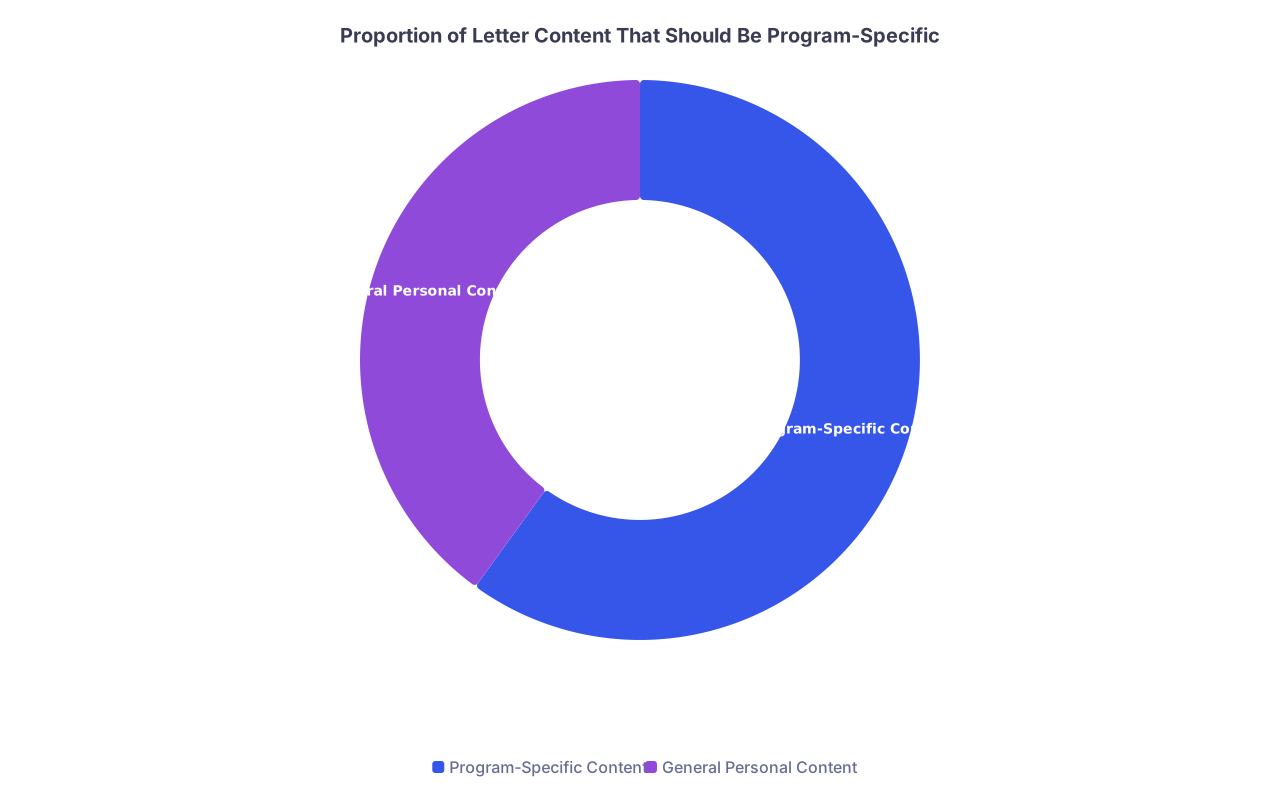
Visual: How Much of Your Letter Should Be Program-Specific?
| Category | Value |
|---|---|
| Program-Specific Content | 60 |
| General Personal Content | 40 |
Aim for ~60% of your letter being meaningfully program-specific. Not just names. Actual structures, people, and initiatives tied to your story.
Example of a Revision: Fake → Credible
Let me take a very typical, bad paragraph and fix it.
Original (fake-sounding):
“I am particularly drawn to the XYZ Internal Medicine Residency because of its strong clinical training and commitment to research and innovation. The diverse patient population and supportive faculty will provide the ideal environment for me to grow into a well-rounded physician. I am also excited by your program’s emphasis on resident wellness and work-life balance.”
This could go to literally any IM program in the country.
Revised (program-specific and real):
“XYZ’s decision to keep interns on the county inpatient service for a full two months at the start of the year, paired with daily bedside teaching rounds, mirrors what I valued most in my sub-internships: immersion with close supervision. On interview day, when Dr. Singh described pushing interns to present full assessment and plans from day one, it sounded demanding but honest. That is the kind of pressure that made me grow during my ICU rotation, and it is how I want to start residency.”
See the difference:
- Specific structure.
- Named person.
- Self-awareness about how you respond to pressure.
- Zero generic buzzwords.
One More Tool: Process Map for Building a Strong Letter

| Step | Description |
|---|---|
| Step 1 | Interview or Rotation |
| Step 2 | Capture notes same day |
| Step 3 | Sort notes into Structure, Culture, Future |
| Step 4 | Select 2-3 anchor details |
| Step 5 | Match each anchor to your experience |
| Step 6 | Draft letter using block outline |
| Step 7 | Check for fake-sounding phrases |
| Step 8 | Run copy-paste sanity test |
| Step 9 | Finalize and send |
Follow this once and you will already be ahead of most of your cohort.
The Bottom Line
Three takeaways you should not forget:
- Specific beats flattering. Program details only work when they are concrete, underused, and tightly linked to your actual experiences and goals.
- Depth beats quantity. Two or three well-developed program-specific points will beat eight shallow, name-dropped facts every single time.
- Process beats inspiration. If you consistently capture notes after interviews, sort them, and run a sanity check for fakery, your letters of intent will stop sounding generic and start sounding like you actually belong there.