
The interview day is overrated—what you do after a mediocre interview often matters more.
You walked out knowing you were flat. Answers too generic. Missed key talking points. Or you just did not click with the program director. Fine. Sulking does nothing. A targeted, strategic letter of intent can still move you from “forgettable” to “viable” if you do it correctly.
Most applicants either do not send anything, or they send a lazy “thank you so much, I loved your program” email that reads identical for 20 places. That is useless. The programs can smell template language from a mile away.
You are going to do something different: a surgical letter of intent that (1) addresses what you think fell flat, (2) gives them new, concrete evidence to trust you, and (3) makes it easy for them to justify bumping you up their rank list.
Let me walk you through exactly how.
1. First: Decide If You Should Send a Letter of Intent
Not every mediocre interview deserves a letter of intent. Some are just dead ends. You need triage.
Ask yourself three blunt questions:
- Did anything at that program genuinely fit you better than most others?
- Can you clearly state why you would choose this program over similar ones?
- Did you underperform enough that your application on paper might not rescue you?
If the answers are:
- Yes / Yes / Yes → Strong candidate for a letter of intent.
- No / Vague / Not really → Probably not worth a “this is my top choice” letter. Use a targeted interest letter instead (less committal).
Here is the distinction most people screw up:
- Letter of Intent (LOI):
“If I match here, this is my absolute top choice. I will rank you first.”
You send this to one program. Period. Sending to multiple is dishonest and risky.
- Letter of Interest / Update Letter:
“I am very interested in your program and want to update you on X, Y, Z.”
You can send this to multiple places.
You are here for the first one: you did not impress, but you want this place badly. Fine. We can work with that.
2. Understand What Programs Actually Use LOIs For
Programs are not romantic about this. They use your letter of intent to answer three questions:
Are you likely to rank us highly or first?
They hate using early rank spots on people who do not match there.Can we justify pushing you up based on something specific?
They need reasons they can say out loud in a ranking meeting:- “She has deep community ties.”
- “His research aligns with our main PI.”
- “She wants to stay in this city for family reasons.”
- “He has a clear career plan that fits what we offer.”
Are you mature enough to communicate clearly and concisely?
Your letter is a writing sample. Sloppy = risk.
If your letter does not make these three things easier for them, it is noise.
3. Diagnose What Went Wrong on Interview Day
You cannot fix what you did not analyze. Take 15 minutes and write down, brutally:
- What questions you stumbled on
- What you wish you had said but did not
- Any weird/awkward moments (over-talking, blanking, giving canned answers)
- Any signals that interest seemed lukewarm on your end
Then group your “mistakes” into categories:
Content gap – you never explained:
- Why this program in particular
- Your long-term goals
- Why this location
- How you handle conflict, failure, or feedback
Vibe problem – you came off as:
- Too stiff
- Too casual
- Disengaged or “checked out”
- Overly rehearsed / robotic
Context problem – they may have misunderstood:
- A red flag in your application (leave, failure, gap year)
- A switch in specialty interest
- An odd research or work history
Your letter of intent is not an apology essay. It is a second shot at giving them the information and signal of commitment that did not land the first time.
4. Timing: When to Send a Letter of Intent
Send it too early and it feels impulsive. Too late and the rank list is already basically set.
General rule:
Residency (NRMP-style match):
- Best window: 1–3 weeks before rank list deadline
- Acceptable: 1–4 weeks after your interview, as long as it is before final ranking meetings
Fellowships / non-match programs:
- 1–2 weeks after the interview, or when they signal they are moving toward decisions
If you had a truly terrible day and want to rescue the situation, do not wait months. But do not email them the same night either. You want thoughtful, not desperate.
5. Who You Send It To (And How)
Do not play games. Send to the person who actually has weight:
- Residency: Program Director, cc Coordinator
- Fellowship: Program Director, possibly also Section Chief if heavily involved
- Academic position: Division chief or hiring leader
Subject line needs to be clean and obvious, not cute. Examples:
- “Letter of Intent – [Your Name], [Specialty] Applicant”
- “Update and Letter of Intent – [Your Name]”
And yes, email is fine. PDF attachment is optional. Most PDs will read inline email text before they ever open a file.
6. Structure of a Targeted Letter of Intent (Template That Works)
Here is the basic spine. You will notice what is missing: fluff.
- Direct statement of intent
- Specific reasons this program is your top choice
- New or clarified information that strengthens your file
- Concise acknowledgment of anything that did not come across well on interview day (if relevant)
- Clear, respectful closing
Let us walk each piece with real language.
1. Opening: Say The Thing Clearly
Bad:
“It was such an honor to interview with your esteemed program…”
Good:
“Thank you for the opportunity to interview at [Program Name] on [date]. After learning more about your program, I am writing to state clearly that [Program Name] is my first choice, and I will rank your program #1.”
That one sentence does three things:
- Signals commitment
- Uses explicit “first choice” language
- Removes ambiguity
If you are not ranking them #1, do not say this. You can still send a strong interest letter, but then it is not a true LOI.
2. Middle: Give Them 3–4 Specific, Defensible Reasons
This is where most letters fall apart. “I loved the collegial environment” is meaningless. Everyone says that.
You want tight, factual reasons that the PD can repeat to the committee without rolling their eyes.
Think in 3 buckets:
- Program features that match your goals
- People you connected with by name
- Location / personal circumstances that tie you there
Keep it short. Example:
“I am especially drawn to your program for three reasons:
Training environment – The combination of high-acuity patients at [Hospital Name] and strong outpatient training at [Clinic Name] matches my goal of becoming a well-rounded general [specialist] who is comfortable managing complex pathology in a community setting.
Scholarly focus – Speaking with Dr [X] about the [specific QI or research project] confirmed that your program would support my interest in [example – medical education, health disparities, outcomes research]. This aligns with the work I began in medical school on [1-sentence reminder of your prior project].
Long-term commitment to the region – My partner and I plan to remain in [City/Region] long term, and my family lives within driving distance. Training at [Program] would allow me to build clinical and professional roots in the community where I hope to practice after residency.”
Nothing vague. Nothing that could be pasted into a letter for five other programs unchanged.
3. Add New, Concrete Information They Did Not Have
This is where you fix the “I did not impress” problem. Give them new ammo:
- Updated grades or exams
- New publications, presentations, or projects
- Additional responsibilities or leadership roles
- Clarifying context for any part of your story that seemed fuzzy
Examples:
“Since my application was submitted, I have:
- Completed my Sub-Internship in [specialty] with Honors, with strong feedback on clinical judgment and team communication.
- Submitted a manuscript as second author on [topic] to [journal].
- Continued my work with [clinic/project], focusing on [specific outcome or activity].”
If your interview flopped around a particular story or red flag, you can briefly and professionally tighten it:
“On interview day, I felt that I did not fully articulate the context of my leave of absence during second year. In short, this was related to [1-line professional description, not drama]. Since returning, I have [honors/Step 2 improvement/consistent performance], and my recent evaluations reflect the reliability and resilience I now bring to my training.”
One paragraph. No diary writing. You are not on trial; you are clarifying.
4. Repairing a Weak Interview Without Groveling
If you clearly underperformed, you can indirectly acknowledge it without saying, “I know I did terribly.”
Two safe approaches:
Clarification approach
“Reflecting on our conversation, there are two aspects of my goals that I would like to clarify…”Addition approach
“There are a few additional points that I did not have the chance to fully explain during our interview…”
Then drop in:
- A more mature explanation of your career goals
- A brief example of a clinical scenario that shows how you work
- A short clarification of why this specialty and not another
Example:
“During my interview, I mentioned an interest in both hospital-based and outpatient care but did not clearly describe how I see my future practice. My primary goal is to work as a general [specialist] in a community hospital with significant underserved patient populations. I want the breadth of training your program offers, particularly through your rotations at [site], to prepare me for that role.”
Clean. Direct. No self-deprecation.
5. Closing: Respectful, Confident, Short
End with something like:
“Thank you again for considering my application. I would be honored to train at [Program Name] and, as mentioned, will be ranking your program first. Please let me know if I can provide any additional information.”
Sign with:
- Full name
- AAMC ID / ERAS ID (if applicable)
- Email and phone
That is it. No begging, no over-selling.
7. What A Program Director Actually Does With Your LOI
Let us be realistic.
A targeted, honest LOI will not turn a bottom-20% candidate into a top-5 pick. But it can:
- Break a tie between you and a similar candidate
- Nudge you a band higher if they were on the fence
- Prevent you from being ranked at the very bottom
- Rescue you from a lukewarm impression if your file is otherwise solid
Here is what I have seen:
- PD reads your email at night on their phone.
- If it is thoughtful and specific, they forward it to: “Assistant PD / chief residents / coordinator” with a 1-liner:
- “FYI, this applicant is ranking us #1.”
- “Good fit for our QI track.”
- During the ranking meeting, when your name comes up, someone says:
- “This is the applicant who wrote they are ranking us first and want to do [X] with Dr [Y].”
That comment alone can move you up 3–10 slots, depending on program size and how crowded your tier is.
So no, a letter of intent does not give you magic powers. But it absolutely influences marginal decisions. And a lot of applicants live and die in the margins.
8. Pitfalls That Will Kill Your Letter’s Effect
If you are going to send a letter of intent and you did not shine in person, you cannot afford these mistakes:
1. Sending identical-sounding letters to multiple programs
Yes, PDs talk. Yes, coordinators gossip. I have heard programs compare LOIs from the same applicant.
Overly emotional or dramatic tone
“It has always been my dream to train at your world-renowned program…” No. You are a future physician, not a fan.Novel-length letters
Anything over ~500–600 words and they skim or bail. Aim for 300–500 words. Tight.Backhanded explanations
“I was very nervous and do not feel I showed my true self…” You are asking them to re-interpret their experience. They will not.Implied pressure
“I hope you will see how committed I am and reflect that in your ranking.” Never tell them what to do with their rank list.
9. How A Targeted LOI Fits Into Your Overall Strategy
Your letter of intent is one tool, not your entire rescue plan. Combine it with:
Thoughtful thank-you follow-ups
Short, specific emails to individual interviewers within 24–48 hours of interview day. Not scripts—real callbacks to your conversations.Updated ERAS / application documents
If the system allows, upload updated CVs, publications, or exam scores.Reasonable communication volume
One LOI. Maybe one later minor update if something big happens (award, publication). Do not become the applicant who emails weekly.
Tie all of this into a simple system for yourself:

| Step | Description |
|---|---|
| Step 1 | Interview Day Ends |
| Step 2 | 24-48 hr - Send thank you emails |
| Step 3 | 1-2 weeks - Reflect and diagnose issues |
| Step 4 | Draft targeted LOI |
| Step 5 | Optional interest/update email |
| Step 6 | Send LOI to PD |
| Step 7 | Monitor for further updates or changes |
| Step 8 | Program top choice? |
Do this across your programs, but reserve true “I will rank you #1” language for the single place that honestly earns it.
10. Sample Targeted LOI (You Can Adapt, Not Copy)
Do not copy-paste this. Use it as a scaffold.
Subject: Letter of Intent – Jane Doe, Internal Medicine Applicant
Dr Smith,
Thank you for the opportunity to interview at the [University Hospital] Internal Medicine Residency on January 9. After learning more about your program, I am writing to state clearly that [University Hospital] is my first choice, and I will rank your program #1.
I am especially drawn to your program for three reasons. First, the combination of tertiary care at [Main Hospital] and continuity clinic at [Community Clinic] aligns with my goal of practicing as a general internist in a diverse urban setting. Second, my conversation with Dr Patel about the resident-led transitions of care project confirmed that your program would strongly support my interest in quality improvement. This builds on my prior work reducing 30-day readmissions through a discharge counseling initiative at my medical school. Third, my partner and I plan to remain in [City] long term, and training at [University Hospital] would allow me to build clinical and professional ties in the community where I hope to practice.
Since submitting my ERAS application, I have completed my Internal Medicine Sub-Internship with Honors, with particular strengths in communication and end-of-life care noted in my evaluations. I also presented a poster on our readmissions project at the [Regional ACP Meeting] in December and am preparing a manuscript for submission.
Reflecting on our interview, I realized that I did not fully articulate my long-term career goals. My primary objective is to work as a hospitalist with a focus on improving care transitions for patients with limited health literacy and social support. The patient population and QI opportunities at [University Hospital] make your program uniquely suited to help me develop the skills needed for this work.
Thank you again for considering my application. I would be honored to train at [University Hospital] and, as mentioned, will be ranking your program first. Please let me know if I can provide any additional information.
Sincerely,
Jane Doe
AAMC ID: 12345678
[email protected] | (555) 123-4567
11. Quick Comparison: LOI vs Generic Thank-You
| Feature | Targeted LOI | Generic Thank-You Email |
|---|---|---|
| States rank position | Yes, explicitly | No |
| Program-specific details | High | Low / vague |
| New information included | Yes | Rarely |
| Affects rank discussions | Often | Seldom |
| Appropriate frequency | 1 program only | All interviewers/programs |
To be blunt: thank-you notes are courtesy. LOIs are strategy.
12. When Not To Bother With A Letter of Intent
Some situations where a letter of intent is a waste of oxygen:
- You know you are not ranking them #1.
- Your interview tanked because of severe professionalism concerns (arguing, disrespect, clear red flag). No letter fixes that.
- You have zero specific reason to choose that program beyond “it’s strong” and “nice people.”
- The program explicitly states they do not consider post-interview communications for ranking (a few do). You can still send a short thank-you, but do not expect impact.
Invest your effort where there is realistic upside.
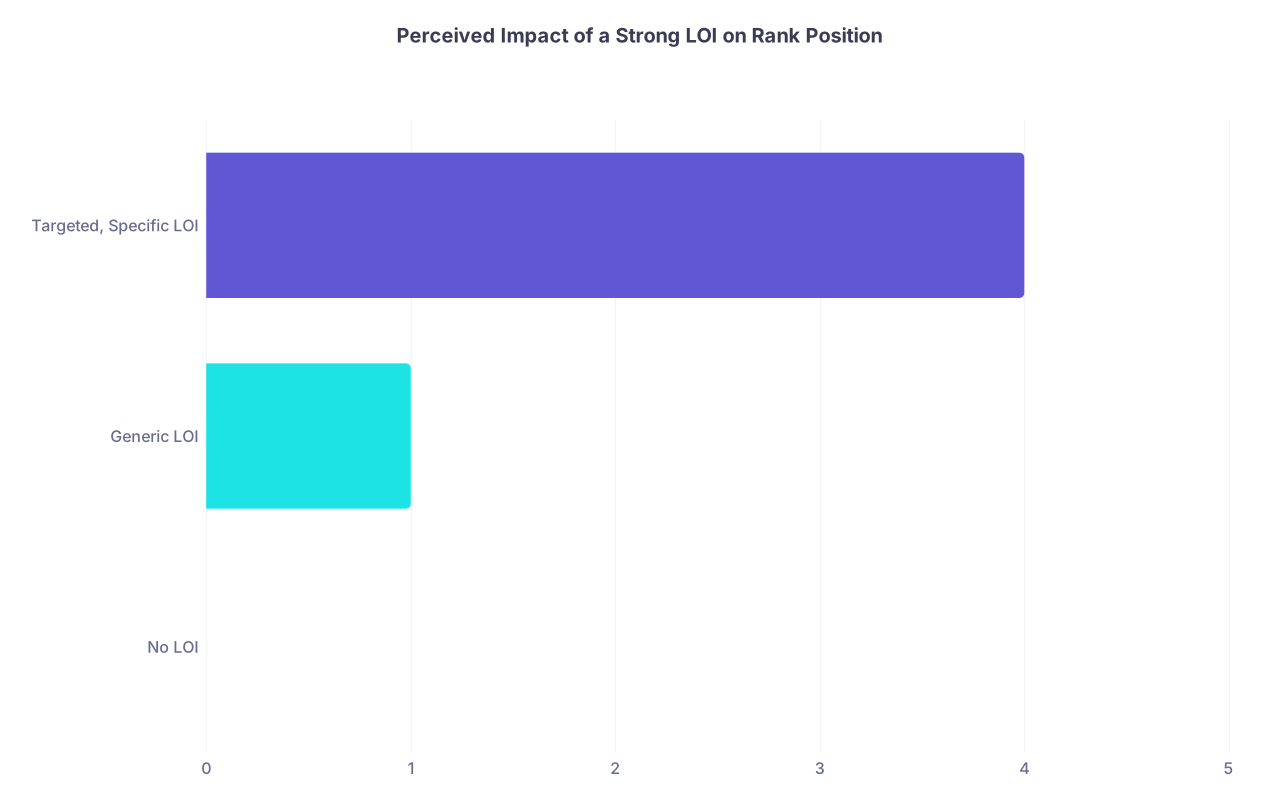
Visual: How Much Impact Can A Good LOI Have?
| Category | Value |
|---|---|
| No LOI | 0 |
| Generic LOI | 1 |
| Targeted, Specific LOI | 4 |
Think of those numbers as “average slots moved” in a realistic program. Not magic. But definitely not zero.
13. Common Edge Cases (And How To Handle Them)
You Already Said “You’re My Top Choice” Verbally
If during the interview you said something like, “You’re my top choice,” you still send a written LOI. It:
- Confirms you thought about it after seeing other programs
- Gives the PD something to forward or reference later
Just reference it subtly:
“During my interview, I mentioned how strongly I felt about training at [Program]. After completing the rest of my interviews, I can confirm that [Program] remains my first choice, and I will rank your program #1.”
You Did Better Than You Thought Later In The Season
Maybe you wrote an early LOI before you saw a clearly better-fit program. Do not send a second LOI to a different program claiming they are #1. That is how reputations get wrecked.
If you misjudged and the LOI went to a program that is now #2 or #3, accept that and adjust your rank list honestly. You are not bound by your letter. But do not keep lying.
14. The Big Picture: You Are Proving Judgment, Not Just Interest
Anyone can say, “You’re my top choice.” That is cheap.
By writing a clean, specific, restrained letter of intent after a so-so interview, you are signaling:
- You can reflect on your performance.
- You can communicate complex information concisely.
- You know how to manage a professional relationship without being needy.
- You understand that medicine rewards people who fix things, not just complain about them.
That is what a program wants in their residents or fellows.
You did not impress on interview day. Fine. Most careers can survive one underwhelming afternoon. Use the letter of intent as your controlled do-over.
| Category | Value |
|---|---|
| No follow-up | 20 |
| Thank-you only | 55 |
| Generic LOI | 15 |
| Targeted LOI | 10 |
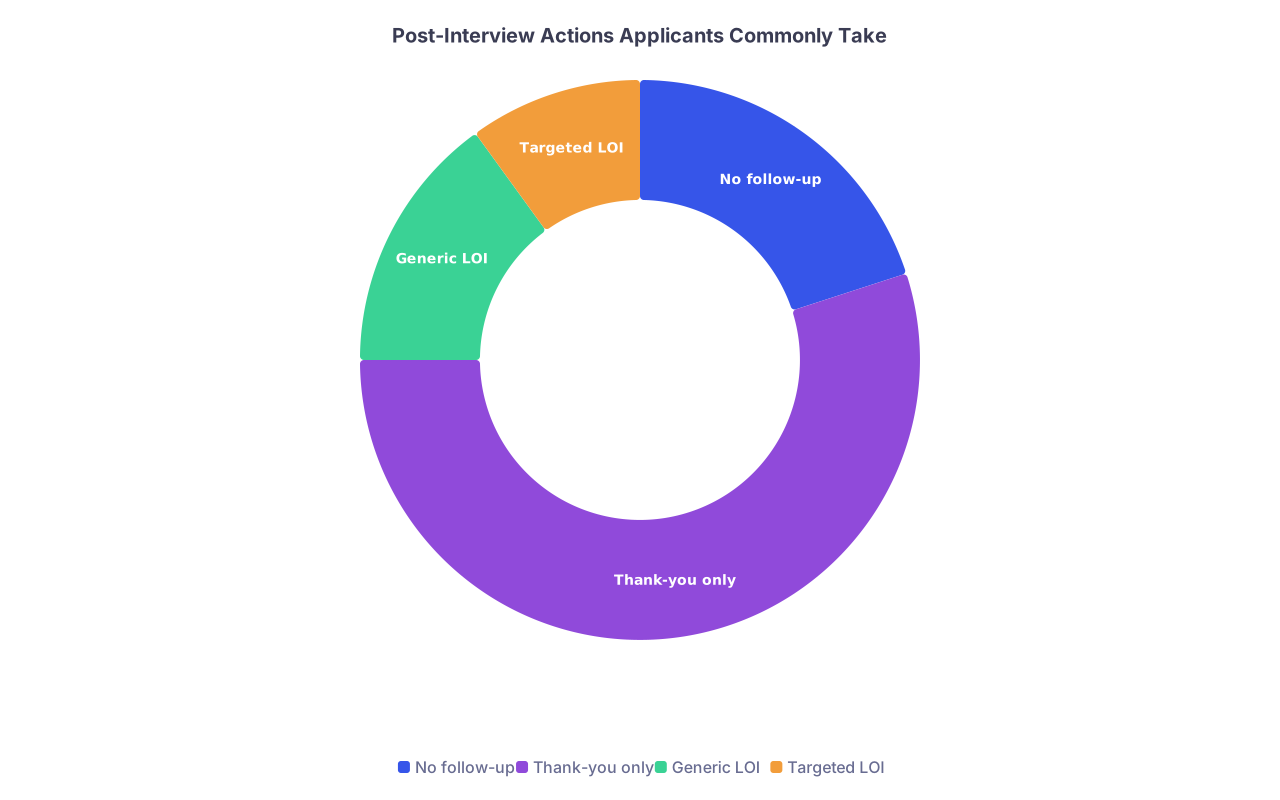
Be in the small group that actually uses this tool correctly.