
The worst use of a letter of intent is sending it to the wrong program.
Most applicants do not fail the Match because they were weak on paper. They fail strategically. They fall in love with brands, chase prestige, and throw their single strongest signal—a letter of intent—at a program that was never going to rank them high enough to matter.
You get very few real shots with letters of intent. Treat them like a limited resource, because they are.
Here is how to systematically decide which programs actually deserve that letter.
Step 1: Admit What a Letter of Intent Can And Cannot Do
Before you prioritize anything, fix the expectations. Most people wildly overestimate or misplace the power of a letter of intent.
What a letter of intent can do:
- Act as a tiebreaker between you and one or two similar applicants
- Push you up a few spots on a rank list at a program that already likes you
- Clarify geographic / personal commitment (especially for couples, visa issues, or major moves)
- Reassure a program director you are not just prestige-shopping
What a letter of intent cannot do:
- Rescue a weak application at a program that barely interviewed you out of courtesy
- Turn a lukewarm interview into a top-5 ranking
- Override a bad faculty evaluation or red flags in your file
- Compensate for clear mismatch in scores, visa restrictions, or institutional priorities
Let me be blunt: you send a letter of intent to a place that already sees you as a realistic match, not to a long-shot fantasy.
So the real problem is not “Should I send a letter of intent?” but:
Which program is both realistic and worth committing to as my true #1?
Step 2: Build a Shortlist Before You Start Ranking
You cannot prioritize if everything is still fuzzy in your head. You need a controlled shortlist of contenders.
Here is the protocol.
Dump all programs into three buckets immediately after interview season:
- Green: “I could be genuinely happy here”
- Yellow: “Acceptable if needed; something feels off”
- Red: “No, unless I have no other option”
Ignore the reds completely for letter of intent purposes. You are not sending a letter to a backup you would dread going to.
Among your green programs, mark:
- Programs that explicitly told you, “We rank people who show strong interest higher.”
- Programs that said some version of, “We really like you,” especially if said directly by PD/Chair or multiple faculty.
- Programs aligned tightly with your career goals (e.g., academic cardiology, community primary care, global health).
Call these your letter-of-intent-eligible programs.
If you end up with more than 5–7 on this list, you are not being honest with yourself. Tighten it.
Step 3: Score Programs With a Brutal, Weighted System
Feelings are noisy. You need numbers. Not because numbers are perfect, but because they expose your biases.
Create a simple scoring sheet. Something like this:
| Factor | Weight (1–5) | Score (1–5) | Weighted Score |
|---|---|---|---|
| Career fit (fellowships, niche) | 5 | ||
| Geographic / personal fit | 4 | ||
| Program interest in you | 5 | ||
| Training quality | 4 | ||
| Culture / wellness | 3 |
You compute: Weighted Score = Weight × Score and then sum them per program.
Now, how do you actually rate each category without lying to yourself?
1. Career Fit (weight high: 4–5)
Score 1–5 based on:
- Fellowships they regularly place into your field
- Track record: conferences, research, niche experiences
- Faculty strength in your area (e.g., strong epilepsy group for neurology, transplant for surgery)
If you want heme/onc and they have not matched anyone into heme/onc in 5 years, that is a 1 or 2. Prestige does not fix that.
2. Geographic / Personal Fit (weight 3–5, depends on your real life)
This is not fluff. Geography is why residents quit or transfer.
Factor in:
- Proximity to spouse/family/partner
- Cost of living vs your loans
- City size comfort (you hate huge cities but are ranking NYC #1? Be honest.)
- Schools for kids if you have them, or are planning them
Give a 5 to places where living there will support your life, not crush it.
3. Program Interest in You (weight 4–5)
This is where most people get lazy and vague: “I think they liked me.” Useless.
Concrete signals:
- Post-interview emails or calls from PD/APD explicitly expressing strong interest
- Personal notes referencing details from your interview day
- Statements like:
- “You would be a great fit here.”
- “We hope to see you high on your list.”
- “We would love to have you.”
- Faculty you connected with emailing you separately
Weak signals (count, but lower points):
- Standard mass emails (“We enjoyed meeting you.”)
- Generic news updates
Score:
- 5 = multiple strong signals from leadership
- 4 = at least one clear, specific expression of enthusiasm
- 3 = neutral but warm, no red flags
- 1–2 = obviously generic or mildly cold interaction
This factor matters enormously for letter of intent targeting. If they are cold, your letter will not melt the ice.
4. Training Quality (weight 3–4)
No, this is not “top 10 list” nonsense. It is about what you become after three to seven years.
Look at:
- Case volume and complexity
- Autonomy: Do seniors actually run the show?
- Board pass rates
- Where graduates go (jobs, fellowships, locations)
Do not outsource this to people flexing on Reddit. Ask:
- “Where did the last 5 years of residents go?”
- “How much time do seniors have at the end of PGY-3/4?”
Score higher where you will actually learn enough to be safe and competitive.
5. Culture / Wellness (weight 2–4)
You have seen this: residents who look hollow on interview day. That program is done. Do not send a letter there.
Use:
- How honest residents were when faculty left the Zoom room
- How many seemed burned out vs genuinely okay
- Schedule transparency (do they dodge questions about hours and call?)
- Attrition: “Have any residents left the program in the last 5 years?”
If you are guessing, you did not ask enough.
Step 4: Combine Score With Match Likelihood
Here is where people screw up:
They either
- chase their “favorite” program that is unlikely to rank them high, or
- chase their “safest” program they would regret choosing as #1.
You must balance desirability with plausibility.
Use a simple mental model: desire × probability of success.
Estimate Your Match Probability Tier Per Program
Not exact, but you can tier each program into three rough likelihood buckets based on:
- How competitive you are versus their typical residents (scores, research, school background)
- How the interviews felt (multiple friendly faculty vs one rushed 10-minute Zoom)
- Any explicit comments about “You fit our program well” or future plans
Create something like this:
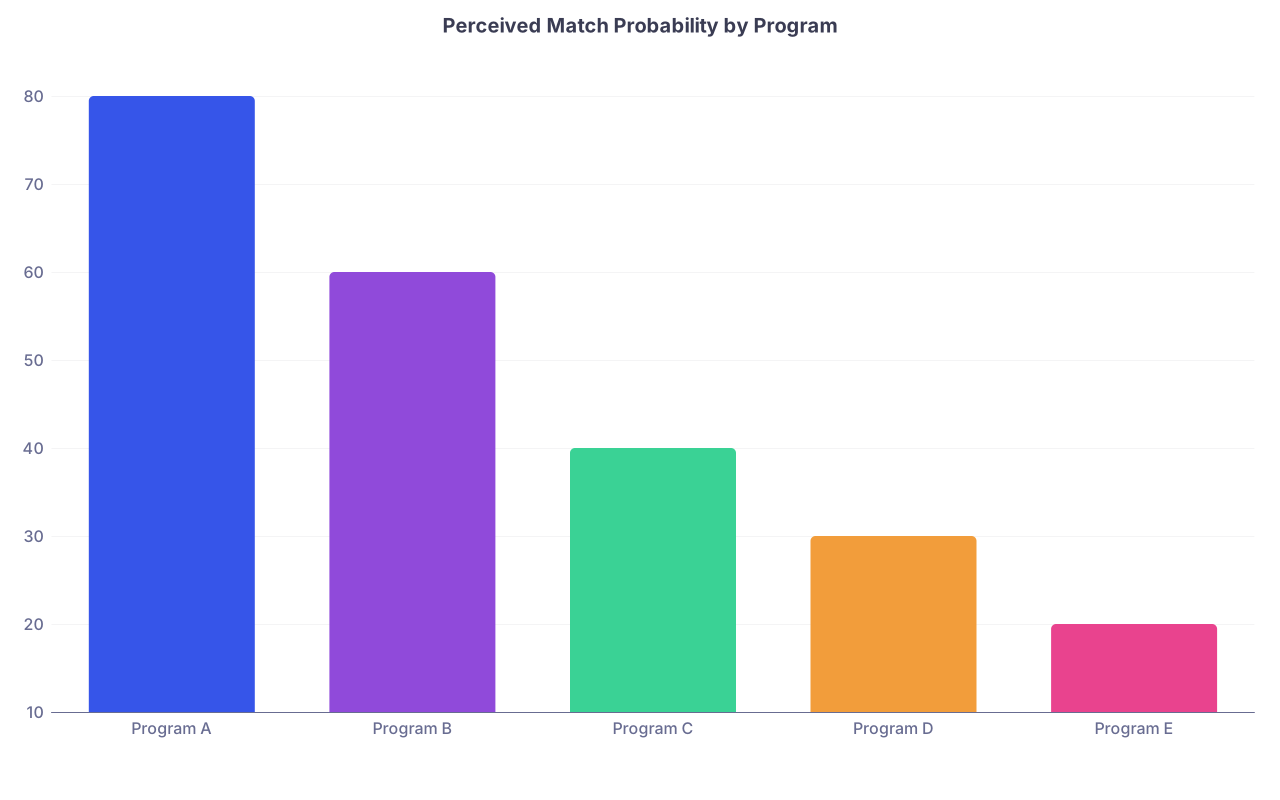
| Category | Value |
|---|---|
| Program A | 80 |
| Program B | 60 |
| Program C | 40 |
| Program D | 30 |
| Program E | 20 |
Of course these numbers are guesses, but the ranking is what matters.
Rough guide:
- High likelihood: strong interest signals, your profile matches their usual residents
- Medium likelihood: solid interview, no explicit strong signals
- Low likelihood: you were a stretch to get the interview, or conversations felt stiff and distant
Now overlay this with your weighted priority scores.
The sweet spot for a letter of intent:
High-priority programs with moderate-to-high perceived match probability.
Not:
- Absolute long-shots purely for prestige
- Programs you would only tolerate, even if they love you
Step 5: Run a Simple Decision Flow Before You Commit
Time to make an actual choice. One program. That is what a true letter of intent means.
Use a strict decision flow like this:

| Step | Description |
|---|---|
| Step 1 | Start |
| Step 2 | Calculate scores for all green programs |
| Step 3 | Estimate match likelihood tiers |
| Step 4 | Filter to high priority and medium or high likelihood |
| Step 5 | Choose highest priority remaining |
| Step 6 | Compare life impact if matched |
| Step 7 | Send LOI to that program |
| Step 8 | Choose program with best combo of fit and likelihood |
| Step 9 | At least 2 programs left |
| Step 10 | If only 1 program would clearly change your life for better |
If you are still stuck between two or three after this, ask very specific tiebreaker questions:
- If both offered me a guaranteed spot today, which email would make me more relieved?
- Which program would I regret not choosing if I end up there anyway?
- Which city would my partner or family actually prefer to live in for 3–7 years?
If one clearly wins these, that is your letter-of-intent program.
If it stays murky, your priorities are not clear yet. You need to stop thinking “residency” in abstract and picture actual Tuesday nights in each place.
Step 6: Beware the Three Common Traps
Trap 1: The Prestige Mirage
You had a great day at a well-regarded mid-tier academic program in a city you actually like. The PD called you afterward. Residents were normal humans.
But. There is also a big-name brand program where the day was lukewarm, the faculty seemed distracted, and residents low-key warned you off. You are tempted anyway.
I have seen this play out: people send letters to the big name, land there, and spend three years regretting it.
Your letter of intent should not be a brand worship letter. It should be a this is where my actual life and career will work best letter.
Trap 2: The Flattery Illusion
Programs send nice words to almost everyone. Some send “You would be an excellent fit” to 200 applicants. It means nothing.
Weight only:
- Direct PD/APD outreach
- Very specific references to your goals/fit
- Multiple faculty independently saying they hope you come
If your whole case for a letter is “They sent a nice generic email,” that is not a case.
Trap 3: The Panic-Backup Misfire
Some applicants send letters of intent to their perceived “safest” program. They think it raises match odds.
What it actually does:
- Wastes your strongest signal on a place that was already likely to rank you highly
- Potentially pulls you away from a much better-fit program that already liked you
Use your letter of intent to differentiate among strong fits, not to cling to the lowest rung.
Step 7: Consider Special Situations (Where the Letter Matters More)
There are scenarios where a letter of intent is more than just a “nice to have.” If you fall into these, push the weight of geographic/personal fit higher in your scoring.
Couples Match
Programs need to understand that your rank behavior is constrained by your partner’s list.
A letter of intent can:
- Clarify that you are willing to rank them #1 if your partner matches within a defined radius
- Show coordinated interest from both of you in the same city / institution
Target:
- A program where both of you have plausible matches within commuting distance
- At least one institution that explicitly said they are open to working with couples
Visa-Dependent Applicants (IMGs, non-US citizens)
For visa-dependent applicants, program choice is narrower and riskier.
Use your letter strategically at a program that:
- Has a strong history of sponsoring your specific visa type
- Explicitly reassured you about sponsorship
- Indicated they value you beyond “filling a spot”
Here, the letter goal is to say, “If you sponsor me, I will absolutely come.” That can matter.
Major Life Constraints
Examples:
- You are a caregiver for a sick family member in a specific city
- You have kids in stable schools and cannot uproot often
- You have a serious medical condition requiring specific local care
Letter of intent here is partly advocacy. You are flagging that ranking you highly is not a wasted slot; you are committed.
Step 8: When To Finalize And Send Your Letter
Timing matters more than wordsmithing.
General rules:
- Send after you have completed all interviews and your rank list thinking has settled.
- Aim for 2–3 weeks before rank list certification (earlier is fine, late last-minute emails can seem desperate).
- Do not send “I am still deciding” teasers. Wait until you are ready to actually say:
- “If matched to your program, I will attend and not rank any program above you.”
Got that last part? That is what a real letter of intent is. Not “I really like you,” but “You are #1. Period.”
If you cannot say that confidently, you are not ready to send it.
Step 9: One True Letter of Intent, Not Duplicates
Some applicants ask: “Can I send letters of intent to multiple programs and just be vague?”
Yes. You can lie. People do. But let me be practical:
- Programs talk sometimes. Not a lot, but enough.
- Faculty move between institutions.
- Old emails get forwarded.
If you send “You are my clear #1” to three programs, assume someday that will surface. This field is not that big.
Strategically, it also dilutes your mental clarity. Letters of update or interest? Fine to send to multiple places. But:
- One explicit “You are my number one” letter of intent.
- Several “I remain very interested and will rank your program highly” letters of interest, if you want.
That is how you keep integrity and still play the game intelligently.
Step 10: Sanity Check Your Choice With Real People
Once you have:
- Scored your programs
- Tiered your match likelihood
- Chosen a target
Do a quick reality check with:
- A trusted mentor who actually knows your file
- A chief resident familiar with multiple programs
- Or a PD/advisor at your school (if they are not politically entangled)
Ask one direct question:
“Given my application and interviews, does it make sense that I would send a letter of intent to Program X as my #1?”
If they look confused or hesitant, dig in. You might be overestimating your chances at that program or underestimating another.
Do not crowdsource this on social media. You will get noise, not expertise.
A Quick Example: Putting It All Together
Let me walk a realistic scenario.
You are an internal medicine applicant with strong mid-range stats, some research, and solid letters.
You have 5 green programs:
- Program A: Solid university program, mid-sized city, PD emailed you personally after interview.
- Program B: Big-name academic center, very competitive, your interview felt rushed.
- Program C: University-affiliated community program, same city as your partner’s job, residents seemed happy.
- Program D: Smaller community program, extremely friendly, but limited fellowships and research.
- Program E: Prestige coastal program, your dream city, but no post-interview contact.
You score them using the framework. You end up with:
- Total priority score (out of 100):
- A: 85
- B: 78
- C: 90
- D: 70
- E: 82
Your estimated match likelihood:
- A: High
- B: Medium–low
- C: High
- D: Very high
- E: Low
Overlay both:
- C looks best: highest priority + high likelihood + partner in same city.
- A is also strong, but slightly worse on personal fit.
- B and E are prestige traps with lower probability and no extra life upside.
- D is safe but objectively worse for long-term career.
In this case, Program C is the clear letter-of-intent target. Even if A and B have bigger names.
If you send the letter to B or E, you are gambling your strongest signal on lower odds for ego reasons. That is how people quietly ruin their match.
A Visual Planning Snapshot
If you are the visual type, sketch something like this early on:
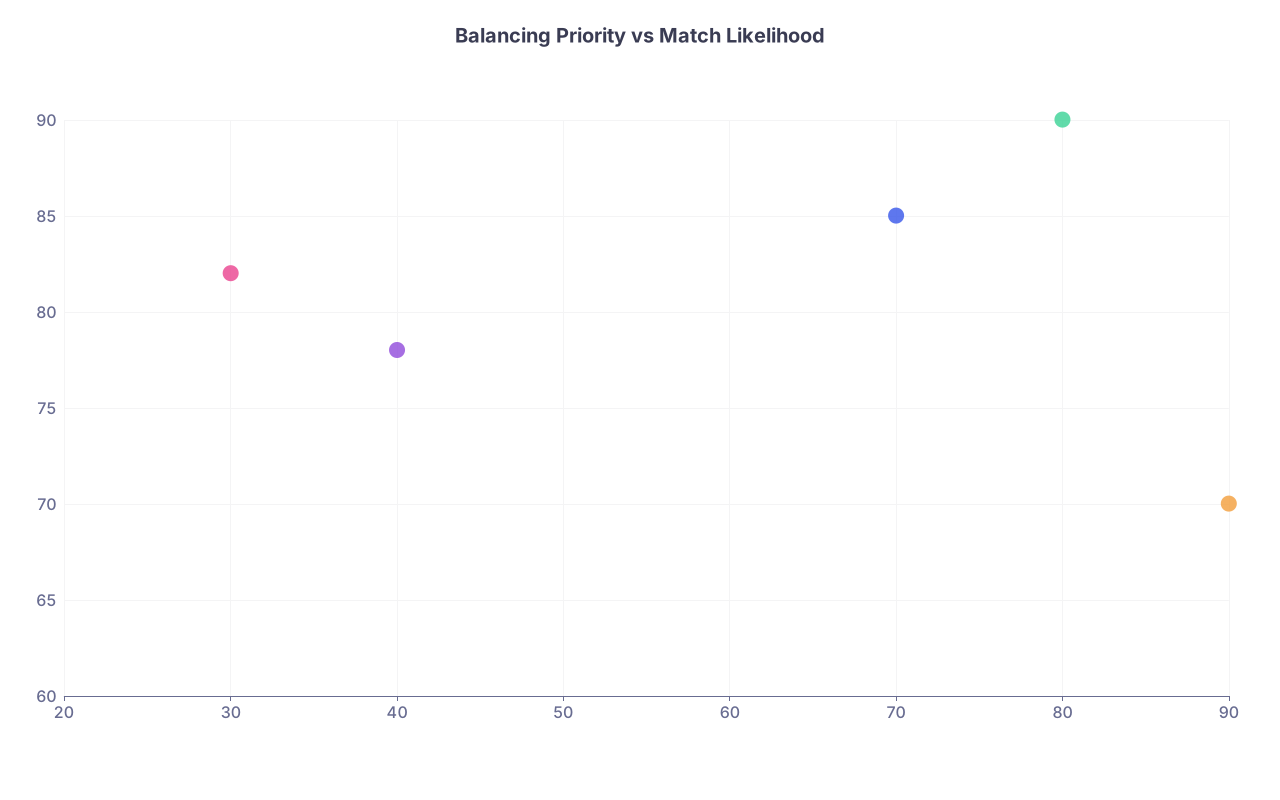
| Category | Value |
|---|---|
| Program A | 70,85 |
| Program B | 40,78 |
| Program C | 80,90 |
| Program D | 90,70 |
| Program E | 30,82 |
Where:
- X-axis = estimated match likelihood (0–100)
- Y-axis = your total priority score (0–100)
Your letter of intent goes to a point in the upper-right quadrant, not just the highest Y or fanciest label.
How To Use This Without Overcomplicating Your Life
You do not need a 20-tab spreadsheet. You need:
- A shortlist of green programs you actually like.
- A simple weighted score per program (career, geography, interest in you, training, culture).
- A rough probability tier for each program.
- One program that clearly lands in the sweet spot:
- High personal priority
- Reasonable to strong likelihood
- Major positive impact if you match there
That program deserves your letter of intent.
The Bottom Line
- A letter of intent is a precision tool, not a mass email. Use it on one program that is both right for you and realistically within reach.
- If you cannot clearly explain why a program beats your other options on life + career + plausibility, it does not deserve your letter.
- Prestige without fit is a trap. Your future self cares more about daily life and training quality than the name on your white coat.