
The vague, fluffy post-interview LOI is useless. Program directors skim it, shrug, and move on. You are writing to influence a rank list, not to make yourself feel better.
Here is how to fix it—paragraph by paragraph—so your letter of intent actually says something, signals commitment, and stays out of the trash folder.
Ground Rules Before You Write a Single Paragraph
If your foundation is wrong, even a perfectly structured LOI will not help you.
Send a true LOI to only one program.
If you are telling three places “You are my clear #1,” you are lying to at least two of them. They can tell; many talk to each other. Do not gamble your reputation.Be specific or do not bother.
Generic: “I loved the program and the people.”
Useful: “Dr. Lee’s description of the QI track and the weekly M&M structure convinced me this is where I will grow most.”Keep it short.
Aim for 3–6 paragraphs, about 300–450 words. This is not a personal statement sequel. This is a targeted, tactical update and commitment.Timing matters.
Best window: 1–3 weeks before rank lists lock. Late enough that your rank is probably sketched but still modifiable. Early enough that it can be discussed in ranking meetings.Respect program rules.
If they explicitly say “Do not send post-interview communications,” then do not. You can send a more neutral “update” letter if allowed, but a formal LOI may violate policy.
Paragraph 1: The Opening and the Commitment
Purpose:
Grab attention and state your intention clearly within two sentences.
Your goals:
- Remind them who you are.
- Thank them briefly.
- Declare your rank intention in plain English.
What belongs in this paragraph:
Identification + context
- Your name
- Your interview date
- Program name spelled correctly, full formal name
A brief thank you (one sentence)
- Do not recap the whole day. Show respect and move on.
A clear, unambiguous commitment
- One sentence. No hedging, no “strongly considering,” no “among my top choices.”
Concrete examples:
Residency LOI opening (strong, direct):
“My name is Sarah Patel, and I interviewed with the Internal Medicine Residency at University Hospital on January 12. Thank you again for a thoughtful and well-organized interview day. I am writing to let you know that your program is my unequivocal first choice, and I will be ranking University Hospital Internal Medicine Residency as my number one program.”Medical school LOI opening (similar structure):
“My name is Jason Kim, and I interviewed at Lakeside School of Medicine on November 3. I remain extremely grateful for the opportunity to learn more about Lakeside. I am writing to state clearly that Lakeside is my top choice, and I will attend if offered admission.”
What to avoid:
- “You are one of my top choices.” (That is not an LOI. That is fence-sitting.)
- “I am very interested and will strongly consider attending.” (Means nothing.)
- Long emotional opening paragraphs that say zero about ranking.
Paragraph 2: Why This Program Specifically (Not Your Life Story)
Purpose:
Show that your #1 ranking is based on concrete fit, not desperation or prestige chasing.
Your goals:
- Name 2–3 specific features of the program.
- Tie each feature directly to your goals, values, or learning style.
- Make it impossible to copy-paste this paragraph to another program without it looking ridiculous.
You are answering: “Why us, not just why this specialty?”
What belongs in this paragraph:
Specific program elements
- Tracks (e.g., clinician–educator, QI, global health)
- Call structure, night float system, schedule quirks you genuinely like
- Community served, patient population demographics
- Explicit educational structures: protected didactics, bootcamps, simulation
Your personal link
- Your career goals: hospitalist vs. subspecialty, academic vs. community, rural vs. urban.
- Learning needs: heavy autonomy vs. tight supervision, strong board support, procedural exposure.
-
- Refer to faculty or residents you met.
- Reference conversations and details to prove you paid attention.
Example structure:
Sentence 1–2: Core feature + your goal
“Your structured three-year clinician–educator pathway aligns directly with my goal of becoming a teaching hospitalist. The emphasis your residents described on early, progressive responsibility in leading teaching rounds is exactly the sort of challenge I am seeking.”Sentence 3–4: Another feature + concrete moment
“Speaking with Dr. Nguyen about the weekly resident-led evidence-based medicine conference made clear that residents are trusted to drive curriculum, not just attend. I was also impressed by how your interns described managing a high-acuity, underserved population while still feeling well supported.”
Full example paragraph:
“Your structured three-year clinician–educator pathway aligns directly with my goal of becoming a teaching hospitalist. The emphasis your residents described on early, progressive responsibility in leading teaching rounds is exactly the sort of challenge I am seeking. My discussion with Dr. Nguyen about the weekly resident-led evidence-based medicine series demonstrated how seriously the program takes scholarly teaching. In addition, the opportunity to care for a diverse, largely underserved patient population at County General, while still benefiting from the subspecialty depth of the University Hospital rotations, is precisely the training environment I am seeking.”
This paragraph answers: we are not a placeholder; we are your plan.
Paragraph 3: Why You Fit Them (Not Just Why They Fit You)
Purpose:
Show that you are not simply asking for a favor. You are offering something useful back.
Your goals:
- Match your strengths to their stated priorities.
- Use 2–3 concrete examples from your past.
- Make it obvious that the program would be smart to rank you highly.
What belongs in this paragraph:
Identify 1–2 program priorities or culture traits
- Team-based care
- Resident wellness and sustainability
- Diversity, equity, and inclusion
- QI and systems improvement
- Teaching and mentorship
Link your track record to those priorities
- A project you led
- Longitudinal work you did (not one 2-hour volunteer shift)
- Leadership roles that mirror their environment
Focus on impact, not buzzwords
- “I led X that resulted in Y,” not “I am passionate about leadership.”
Example paragraph:
“I believe I would contribute strongly to the collaborative and quality-focused culture your residents described. In medical school, I co-led a multidisciplinary sepsis QI project that reduced door-to-antibiotic time by 18 minutes across two inpatient units. The structure of your QI curriculum and the opportunity to present work at the annual resident research day would allow me to build on this experience and mentor more junior residents interested in improvement work. I was especially drawn to how your chief residents described residents having a real voice in program changes, a process I would be eager to participate in.”
For medical school LOIs, same idea:
“At Lakeside, students described a culture where collaboration is valued over competition. During undergrad, I helped design a peer-tutoring program for first-generation students in STEM, and we increased course pass rates by 12 percent over two semesters. I would bring that same approach to supporting my classmates through your small-group, case-based curriculum and would be excited to engage with the Learning Communities program as both a learner and, eventually, a mentor.”
Common mistakes:
- Listing adjectives: “I am hardworking, empathetic, and dedicated.” Everyone says that.
- Rewriting your personal statement. This is not the place.
- Being vague: “I care about underserved populations.” How? When? Show one real thing.
Paragraph 4: Updates Since Interview (Only If You Have Real Ones)
Purpose:
Convince them you are still moving forward fast and are an even stronger candidate now.
If you have no real updates, skip this paragraph or keep it to a single, honest sentence linking back to ongoing work. Do not manufacture filler.
Good updates include:
- New publication accepted or in press
- Significant poster or oral presentation at a named conference
- Major leadership role assumed
- Substantial project milestone reached (implementation, not just “we’re planning”)
- Step 2/CK or new exam scores if they are strong and matter for your situation
Weak / fake updates:
- “I continue to enjoy volunteering at the free clinic.” (Unless something concrete changed.)
- “I am still working hard in my rotations.” (I hope so.)
- “I read more about your city and really like it.” (No.)
How to structure this paragraph:
Transition phrase (short)
- “Since we met, I have…”
- “Since interview day, there have been a few important updates to my application…”
1–3 bullet-like sentences (but keep them as normal prose)
- Each update gets its own sentence with a concrete result or status.
Optional tie back to program
- Show how the update reinforces your fit or goals relevant to them.
Example with strong updates:
“Since we met, there have been several meaningful updates to my application. Our manuscript on implementing a resident-driven sepsis alert system has been accepted for publication in Academic Medicine, and I will be presenting this work as an oral abstract at the upcoming SGIM national meeting. I also received my Step 2 CK score of 259, which I believe reflects the strong clinical foundation and study habits I will bring to residency. These developments further solidify my desire to train at a program like yours that values scholarship in clinical systems improvement.”
Example with modest updates:
“Since interview day, I have continued to deepen my involvement in our student-run free clinic, where I now help coordinate the expansion of our hypertension outreach visits. While these updates are modest, they have reinforced my interest in training at a program such as yours that serves a large population of patients facing similar barriers to care.”
If you truly have nothing:
You can omit this paragraph entirely and move straight to a closing paragraph. That is better than padding.
Paragraph 5: The Close and the Subtle Nudge
Purpose:
Reinforce your commitment, keep the tone professional, and make it easy for them to remember you positively.
Your goals:
- Restate your ranking plan in a calm, confident way.
- Express that you will be genuinely happy to join them.
- Keep the door open for any follow-up questions (without being needy).
What belongs in this paragraph:
One sentence that restates your commitment
- Do not invent a new phrase that hedges what you said earlier.
- Use simple, direct language again.
One sentence expressing appreciation and fit
- Emphasize alignment, not flattery.
Optional: contact line
- “Please let me know if I can provide any additional information.”
Example strong closing:
“Thank you again for the opportunity to interview and to learn more about your program. I remain fully committed to ranking University Hospital Internal Medicine Residency as my number one choice and would be honored to train with you and your residents. Please let me know if I can provide any additional information as you finalize your rank list.”
For medical school:
“I remain certain that Lakeside School of Medicine is where I hope to begin my medical training, and I will gladly accept an offer of admission if extended. Thank you again for your time and consideration, and please let me know if there is any further information I can provide.”
What not to do:
- Beg: “I am begging you to please consider ranking me.”
- Add conditions: “If my circumstances do not change, I will rank you #1.” (Sounds like a hedge.)
- Add guilt: “My whole family is counting on this.” (Uncomfortable at best, manipulative at worst.)
Formatting, Tone, and Delivery: Details That Quietly Matter
Now that the paragraphs are clear, do not ruin it with sloppiness.
Subject line and greeting
Use a simple, searchable subject line:
- “Letter of Intent – [Full Name] – [Specialty] Applicant”
- “Letter of Intent – [Full Name], MD – Internal Medicine”
Greeting:
- Address the program director directly if possible.
“Dear Dr. Martinez,” - If you truly cannot identify a clear PD or dean:
“Dear Program Director,” or “Dear Admissions Committee,”
Avoid:
- “To whom it may concern,” (cold and generic)
- Using first names (“Dear Sarah,”) unless you have a pre-existing, clearly informal relationship.
Length and style
- 300–450 words total. If your reader has to scroll three times on a phone, it is too long.
- Use normal paragraph breaks. No wall of text.
- Use professional language, but do not write like a legal contract.
Quick checklist:
- No slang.
- No emojis.
- No multiple exclamation points.
- Spellcheck, then read it once out loud. Any sentence you trip over: fix it.
Where and how to send
- Residency: Email directly to the program coordinator and CC the program director, unless the program has a portal and explicitly requests you use that instead.
- Medical school: Follow instructions. Some want updates in a portal, others via email to admissions.
Name your file (if attaching):
- “LastName_FirstName_LOI_ProgramName.pdf”
Paste the text into the email body as well; attachments get lost or ignored.
Ethical Lines You Do Not Cross
Let me be blunt. There are ways to hurt yourself with an LOI.
Do not send a true LOI to multiple programs.
If you want to send “letters of continued interest” to several, fine—but remove any “#1” language and make them clearly non-committal.Do not lie about updates.
If a paper is “submitted,” say “submitted,” not “accepted.” People verify. CV dishonesty is the kind of thing that does not go away.Do not pressure programs.
No ultimatums. No “If you rank me highly, I will definitely match here.” That is not how this works, and it makes you look naive.Do not violate explicit communication policies.
Some specialties (peds, EM historically) or individual programs discourage post-interview communication. Respect that. There are ways to express interest within the allowed channels (e.g., neutral update letters) if needed.
Putting It All Together: An LOI Template You Can Actually Use
Here is a full, coherent example you can adapt—do not copy it verbatim, but follow the structure.
“Dear Dr. Martinez,
My name is Daniel Rivera, and I interviewed with the Internal Medicine Residency at Cityview Medical Center on January 8. Thank you again for a warm and well-organized interview day. I am writing to let you know that your program is my clear first choice, and I will be ranking Cityview Internal Medicine as my number one program.
Your program’s commitment to training residents who excel in both inpatient medicine and ambulatory care aligns directly with my goal of becoming a primary care physician for underserved urban communities. The longitudinal clinic experience at the Riverside Community Health Center, combined with the robust inpatient exposure at Cityview, offers exactly the balance I am seeking. My conversations with Dr. Shah about the community health track and with residents about the protected half-day clinic each week convinced me that I would receive outstanding preparation for the career I envision.
I believe I would contribute meaningfully to the collaborative, patient-centered culture your residents described. During medical school, I served as clinic coordinator for our student-run free clinic, where I helped implement a new follow-up protocol that increased completion of post-discharge appointments by 22 percent over six months. I would be eager to bring this experience to your resident QI projects and to support my co-residents in caring for patients facing similar barriers to care.
Since we met, there has been one important update to my application. Our manuscript on improving transitional care for patients with heart failure has been accepted as a poster presentation at the upcoming ACP national meeting. Preparing this work has further solidified my interest in programs like yours that emphasize outcomes-focused, community-engaged care.
I remain fully committed to ranking Cityview Internal Medicine as my number one choice and would be honored to train at your institution. Thank you again for your time and consideration, and please let me know if I can provide any additional information as you finalize your rank list.
Sincerely,
Daniel Rivera”
That is what a focused, honest, program-specific LOI looks like.
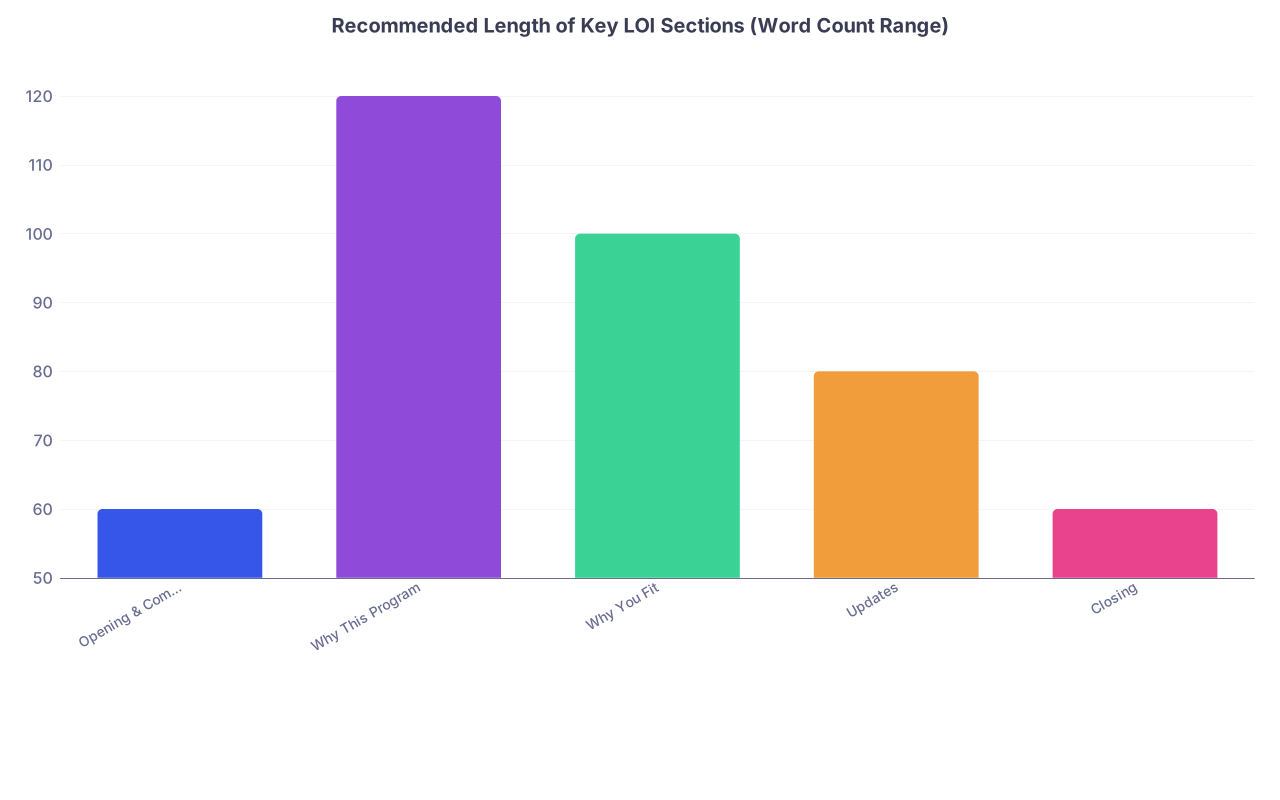
| Category | Value |
|---|---|
| Opening & Commitment | 60 |
| Why This Program | 120 |
| Why You Fit | 100 |
| Updates | 80 |
| Closing | 60 |

| Step | Description |
|---|---|
| Step 1 | Want to send LOI |
| Step 2 | Do not send LOI |
| Step 3 | Send neutral interest or update letter |
| Step 4 | Draft LOI with 5 paragraph structure |
| Step 5 | Proofread and verify facts |
| Step 6 | Email to coordinator and PD or upload to portal |
| Step 7 | Program allows post interview contact |
| Step 8 | Is this your true 1 program |

Your Next Concrete Step
Open a blank document and, in five short headings, write:
- Opening & Commitment
- Why This Program (3 specific things)
- Why You Fit (2 concrete examples)
- Updates (if any)
- Closing Sentence
Under each heading, draft only 2–3 sentences. Once those are in place, weave them into a single, clean page. Then stop. Send it.