
The way most applicants write “top choice” letters of intent is broken.
They send vague love letters to programs that sound identical, hedge their language so they do not “burn bridges,” and then wonder why nothing moves on the rank list. Or worse, they quietly violate the single-true-top-choice rule and send multiple LOIs, assuming “everyone does it.” Programs can smell that dishonesty a mile away.
You want a framework that works. That you can repeat year after year. That is ethical, sharp, and actually changes outcomes.
Here is that framework.
What a “True” Top Choice LOI Actually Is (And Is Not)
Let me be blunt: a real top choice LOI is a commitment, not a vibe.
If you are not willing to:
- Rank that program #1 no matter what, and
- Stand by that statement if someone asks you directly in March
…then it is not your true top choice. It is just “one of your favorites.” Do not send a “true #1” LOI to that program.
A genuine top choice LOI must meet all three of these conditions:
Singular
- You send one such letter.
- Not “one per tier”, not “one per coast”. One.
Unambiguous
- Uses clear language:
- “You are my unequivocal first choice.”
- “I will rank [Program] #1.”
- No hedging with “strongly considering ranking you very highly.” That means nothing.
- Uses clear language:
Actionable
- Contains specific, program-based reasons.
- Shows that if they move you up, you fit their culture and priorities.
- Makes it easy for them to say in the ranking meeting: “This person is ours.”
Everything below assumes you accept that definition. If you want a letter that keeps all your options open and offends nobody, this is not the strategy for you. That kind of letter is wallpaper.
Step 1: Decide If You Actually Need a Top Choice LOI
Not everyone should send one. That is the first mistake.
You should send a true top-choice LOI if:
- You have a clear, strong #1 that feels meaningfully better than your #2.
- You would not second-guess ranking them #1 even if another program “wave” comes later.
- You have already interviewed and have enough information to stand behind that choice.
You should not send one if:
- You are genuinely torn between 2–3 programs and keep flipping your rank order weekly.
- You are still waiting on multiple late-cycle interviews from programs you might rank higher.
- You are just anxious and want to “do something” to control the match.
If you do not meet the criteria yet, your job is not to write. It is to decide.
Fast decision protocol (48 hours max)
Give yourself a hard 48-hour deadline:
- List your top 3 programs.
- For each, write three concrete pros and three concrete cons. Not vague sentiments—specifics about:
- Training volume
- Case diversity / patient population
- Teaching culture
- Fellowships / career outcomes
- Location + support system
- Ask yourself one question:
“If I match here, can I honestly say I did not settle?”
Whichever program passes that test more strongly than the others is your #1. If two feel tied, you are not ready; no LOI yet.
Step 2: Understand What Programs Actually Use LOIs For
Programs do not treat LOIs as contracts. They know the NRMP rules. What they use them for is tie-breaking and story-building.
In ranking meetings, I have watched this play out almost verbatim:
- “This person was solid, good interview, mid-range scores.”
- “Yeah, and they said we were their top choice in a follow-up letter.”
- “OK, we can probably move them up a bit; they are likely to come.”
Or the opposite:
- “They sent us a letter saying we are their #1.”
- Another PD: “They told my friend’s program the same thing last year.”
- That applicant instantly loses credibility.
So the program’s questions when they see your LOI:
- Do we believe this person is honest?
- Does this letter show that they understand who we are?
- Will they add to our culture and not be miserable here in February?
- Is this enough to move them up one tier on our list?
If your LOI is generic, they cannot answer yes to #2 or #3. If you lie and send multiple “you are my #1” letters, they might answer no to #1. Either way, you lose the main value.
Step 3: The Structural Blueprint – 5-Paragraph LOI That Works
You do not need to reinvent the wheel each cycle. Use a standard, disciplined structure.
Five paragraphs. One page. That is it.
- Opening + Commitment (2–3 sentences)
- Evidence of Fit – Training & Curriculum (1 short paragraph)
- Evidence of Fit – People & Culture (1 short paragraph)
- Your Value Proposition – What They Get (1 short paragraph)
- Restated Commitment + Professional Closing (2–3 sentences)
Let us break that down with detail you can actually use.
Step 4: Build Each Paragraph Step-by-Step
Paragraph 1 – Open With the Commitment, Not the Fluff
Do not start with “Thank you for the opportunity to interview at your excellent program.” Everyone writes that. Open with the point: they are your #1.
Structure:
- Single direct sentence stating top-choice status.
- One sentence of context (interview date or rotation connection).
- Optional: one brief phrase summing up why.
Example:
Dear Dr. Smith and the [Program] Residency Leadership,
I am writing to state clearly that [Program] is my unequivocal first choice for residency, and I will be ranking your program #1 on my rank list. After interviewing on December 5 and speaking with several of your residents, I left convinced that your emphasis on [X] and [Y] aligns uniquely with my training goals.
Notice what is missing: no hedging, no “very interested,” no “strongly considering.”
Paragraph 2 – Training & Curriculum: Prove You Paid Attention
Programs are sick of letters that could be sent to 100 different places. This is where you differentiate.
Pick 2–3 very specific program features that matter to your career trajectory:
- “4+1 ambulatory structure with continuity clinic in a FQHC”
- “Dedicated PGY-2 ultrasound rotation with protected scanning time”
- “Night float system that prevents 28-hour calls”
- “Scholarly tracks: medical education, QI, global health”
Do not list everything. Choose what really matters to you and tie it to your prior experience or goals.
Example:
The structure of your training fits the intern and attending I hope to become. Your 4+1 schedule with continuity clinic at [Clinic Name] would let me continue the longitudinal care I valued at [Medical School Clinic]. The dedicated PGY-2 ultrasound rotation and your strong culture of bedside teaching are exactly what I am seeking as I work toward a career in academic hospital medicine.
If an attending at that program reads your letter and thinks, “Yes, that is us,” you did this right.
Paragraph 3 – People & Culture: Show You Understand Their Personality
This is where most LOIs turn into word salad:
- “Supportive residents”
- “Collegial environment”
- “Diverse patient population”
Those phrases are filler. Every program claims that on their website. You need to reference specific individuals, conversations, or moments.
Examples:
- “Pre-interview dinner conversation with Dr. Patel and Dr. Nguyen about…”
- “A resident saying, ‘Our chiefs will go to bat for us.’”
- “The way your PD described handling a struggling intern.”
Example paragraph:
What stood out most during my interview day was the culture your residents described. When Dr. Lee shared how faculty routinely stay late to walk through complex cases, it echoed the mentorship I received from Dr. [Name] during my sub-internship. I remember one resident saying, “Our chiefs make sure no one falls through the cracks,” and that kind of invested leadership is exactly the environment in which I know I will thrive and contribute.
Now yourself ask: could this paragraph be copy-pasted to another program without changing names? If yes, it is too generic. Fix it.
Paragraph 4 – Your Value Proposition: Why Ranking You Higher Makes Sense
This is the most underused part of LOIs. Applicants spend all their time saying why they like the program and almost none explaining what the program gets in return.
Your job here: write 3–4 sentences that make the PD think:
“If we move this person up, we are gaining something concrete that aligns with our priorities.”
Focus on 2–3 elements:
- Your work ethic and reliability (with evidence, not adjectives).
- Distinctive experiences that match their strengths (global health track, QI, underserved care).
- A pattern of behavior that predicts how you will be as a resident.
Example:
If I am fortunate enough to train at [Program], I will bring the same persistence and collaborative mindset that have defined my path so far. At [Medical School], I helped build a QI project in our inpatient service that reduced [X metric] by [Y%], and I am eager to engage with your residency’s existing QI infrastructure. I enjoy teaching and have served as a near-peer tutor since M2, and I am particularly excited about the opportunity to work with your residents-as-teachers curriculum.
Specific. Measurable. Program-aligned.
Paragraph 5 – Restate Commitment and Close Professionally
End clearly. Do not fade out with generic gratitude.
Include:
- One restatement: they are your unequivocal #1.
- One line connecting that to your future career.
- Simple thank-you + sign-off.
Example:
I want to reiterate that I will be ranking [Program] as my first choice because I believe your training environment is the best place for me to become the kind of [specialty] physician I hope to be. Thank you again for the opportunity to interview and for the time and energy you dedicate to your residents.
Sincerely,
[Your Full Name]
AAMC ID: [#######]
Yes, include your AAMC or ERAS ID. Make their lives easier.
Step 5: Timing, Medium, and Logistics – Do Not Overcomplicate This
You can write a perfect letter and still blunt its impact if you mistime it or send it into the void.
When to send your LOI
General rule: 2–4 weeks before rank lists are certified.
- Early January: premature for many programs (still interviewing, not thinking ranks yet).
- Late February: may be too late; rank meetings often already occurred.
The sweet spot:
- For most NRMP specialties: first half of February.
- If you interviewed very late (e.g., Jan 30), wait at least a week so you do not look impulsive.
If your program posted or said specific guidance (“we finalize ranks by Feb 10”), aim 5–7 days before that.
How to send it
Use email. Direct and traceable.
- To: Program Director
- CC: Program Coordinator (always)
- Optional CC: Associate PD who interviewed you, or a faculty mentor you connected with
Subject line options:
- “Letter of Intent – [Your Name], [Specialty] Applicant”
- “[Your Name] – [Specialty] LOI for [Program Name]”
Attach a PDF version if you want, but always paste the full text into the email body. Nobody wants to open 50 attachments in rank week.
Step 6: Ethical Guardrails – How Not to Burn Your Reputation
This part matters. Program directors talk. Coordinators talk even more. Break trust once and it follows you.
Here is the non-negotiable rule:
You send exactly one letter that says, “You are my #1 and I will rank you first.”
Not one per region. Not slightly rephrased clones. One.
What you can send to other programs:
- “You remain one of my very top choices.”
- “I plan to rank your program highly.”
- “I would be thrilled to train at [Program].”
These are honest, non-binding, and do not conflict with your #1 LOI. They are expressions of interest, not commitments.
A quick comparison:
| Type | Example Phrase |
|---|---|
| True top-choice (use once) | "I will be ranking your program #1 on my list." |
| Strong interest (ok to reuse) | "I plan to rank your program highly." |
| Too vague (weak) | "I remain very interested in your program." |
| Ethically risky (avoid) | "You are one of my top two choices." |
If you are tempted to send two true #1 letters because “everyone does it,” do not. Some do. And every cycle, a few get caught.
Step 7: Common Failure Patterns And How To Fix Them
Let me walk through the most common LOI errors I have actually seen and how to correct them.
Error 1: The one-paragraph gush
Content: 10 lines of “I loved your program, the faculty were amazing, the residents were so kind…” No structure, no commitment, no specifics.
Fix:
- Use the 5-paragraph structure above.
- Put the #1 statement in the first sentence.
- Force yourself to name specific rotations, tracks, or quotes.
Error 2: The copy-paste letter
I have watched PDs read a letter out loud and say, “I bet this exact paragraph is in their email to [Neighboring Program] too.” The applicant loses authenticity points on the spot.
Fix:
- For each of paragraphs 2–4, underline every word that is program-specific: names, tracks, structures, quotes.
- If fewer than half the words are specific, rewrite.
Error 3: The hedged “rank you highly” LOI sent as if it were a commitment
Applicants fool themselves: “Well, I sort of implied they are my #1 without saying it, so I keep my options open.” Programs see right through that.
Fix:
- Decide: is this your #1 or not?
- If yes, use direct, explicit language.
- If not, remove any language that could be misread as a promise.
Error 4: Waiting too long
You draft the LOI, sit on it for three weeks, send it three days before rank deadline. Some programs already met and finalized.
Fix:
- Put a self-imposed deadline:
- Decide #1 program: by late January.
- Draft LOI: within 3 days.
- Send LOI: between Feb 1–15 (for typical NRMP timelines).
Step 8: Quick Self-Check Before You Hit Send
Use this as a final filter. Read your letter and answer these honestly.
Commitment Check
- Does your letter contain a sentence that could only truthfully be sent to one program?
- Would you be comfortable repeating that sentence out loud to an NRMP investigator?
Specificity Check
- Does your letter mention:
- Named tracks/rotations unique to the program?
- Something said by a specific resident/faculty?
- A structural element (schedule, patient population) that genuinely matters to you?
- Does your letter mention:
Brevity Check
- Is it one page or less?
- Is every paragraph 3–6 sentences max?
- Any sentence you cannot defend as necessary—cut it.
Tone Check
- Does it sound like a professional colleague, not a desperate applicant?
- Any flattery that would make you roll your eyes if you were PD? Remove it.
If you pass all four, send the letter. Then stop tinkering.
Sample Outline You Can Adapt
Here is a skeletal version you can fill in, word by word:
Opening
- “I am writing to state clearly that [Program] is my unequivocal first choice, and I will be ranking your program #1 on my list. After interviewing on [Date] and speaking with [X/Y], I am confident that your [specific attributes] align best with my goals in [career interest].”
Training Fit
- “Your [schedule/rotation/track] would allow me to [do X]. I was especially drawn to [specific feature], which reflects the type of [research/clinical/education] environment I sought during medical school at [School/Experience].”
Culture Fit
- “During my interview day, I was struck by [quote/interaction]. [Resident/Faculty] described [specific aspect of culture], which reminded me of [prior team/experience] where I thrived in [specific way]. I see myself contributing to this same environment at [Program].”
What You Bring
- “In residency, I will bring [key strengths] supported by [specific examples: leadership, projects, QI, teaching]. I am particularly eager to engage with your [track/committee/project] and to grow within your [education/mentorship] structure.”
Closing
- “For these reasons, I will rank [Program] as my first choice for residency training. I would be honored to join your team and contribute to the care of your patients and the growth of your program. Thank you again for your time and consideration.
Sincerely,
[Name, Credentials, ID]”
- “For these reasons, I will rank [Program] as my first choice for residency training. I would be honored to join your team and contribute to the care of your patients and the growth of your program. Thank you again for your time and consideration.
Use that skeleton. Customize ruthlessly.
Visual: Timeline For Deciding and Sending Your LOI
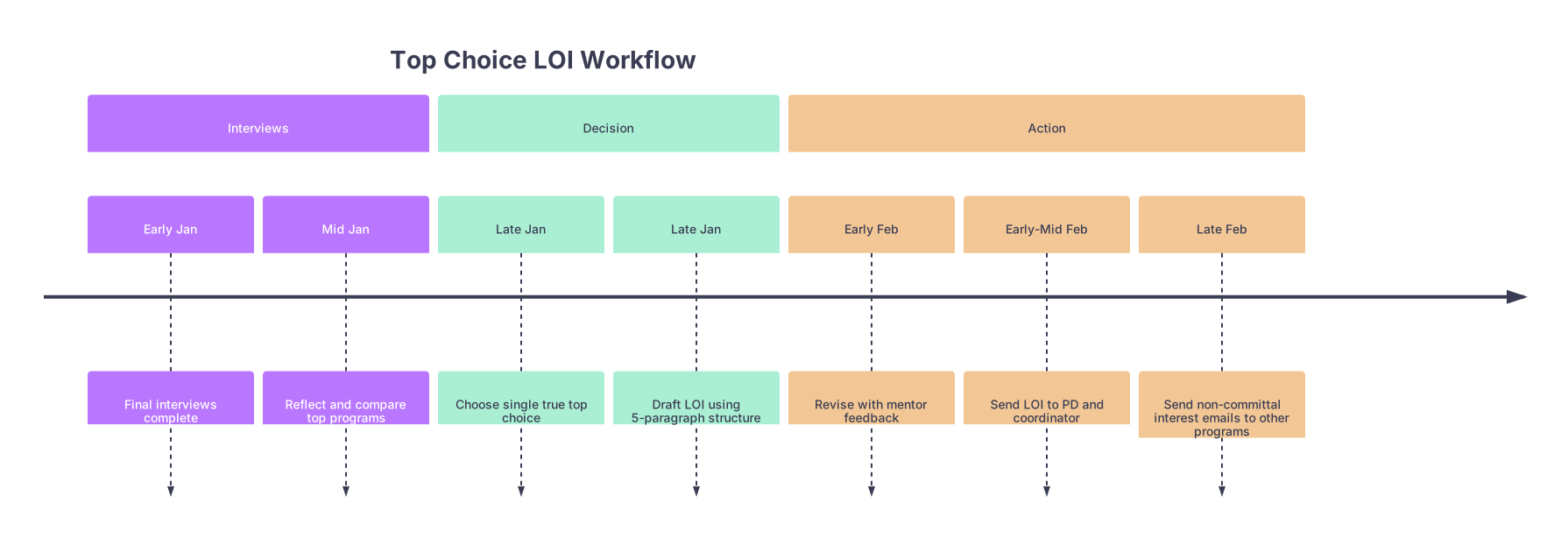
| Period | Event |
|---|---|
| Interviews - Early Jan | Final interviews complete |
| Interviews - Mid Jan | Reflect and compare top programs |
| Decision - Late Jan | Choose single true top choice |
| Decision - Late Jan | Draft LOI using 5-paragraph structure |
| Action - Early Feb | Revise with mentor feedback |
| Action - Early-Mid Feb | Send LOI to PD and coordinator |
| Action - Late Feb | Send non-committal interest emails to other programs |
How This Fits Into the Bigger Picture (Future of Medicine Angle)
The match is becoming more numbers-heavy and impersonal every year. AI screens applications. Step scores shifted to pass/fail in some cases. Signals, preference signaling tokens, supplemental applications—everything pushes toward mass processing.
A sharp, honest, single top-choice LOI cuts through that machinery.
It signals three things programs still care about more than any metric:
- You understand who they are, not just what they offer.
- You have enough professional maturity to make and own a decision.
- You treat your word as binding, even when no one is policing it.
In a future where algorithms will filter the first 90% of the process, that last 10%—the part that feels human, specific, and principled—will matter more, not less.
Use your LOI to show you are that kind of physician.
FAQs
1. What if I send a true top-choice LOI and then get blown away by a late interview somewhere else?
Then you have a real ethical problem, not a wording problem. The right move: either keep your original LOI promise and rank them #1, or if you genuinely must change, do not send a new #1 letter elsewhere and accept that you broke your word once. Do not compound the issue by sending multiple conflicting LOIs. Long term, your reputation matters more than one match outcome.
2. Do programs ever move someone significantly up their rank list just because of an LOI?
Yes. I have seen applicants move from “solid, mid-list” to “we should get this person” because their LOI made clear they were an excellent fit and truly committed. It will not rescue a fatally weak file, but in the crowded middle—where many applicants look similar on paper—a sharp, honest, specific LOI can easily be the difference of several slots. And a few slots can be the difference between matching there and not.