
You Are Here
It is mid-January. You just got off a solid interview day at a program you actually liked. The PD was normal. Residents seemed happy. The city is livable.
Now everyone is telling you:
“Send a letter of intent.”
“Let them know they’re your number one.”
“Use this template I used last year, it worked for me.”
You open the template. It starts with:
“Dear Program Director, I am writing this letter to express my sincere interest in your esteemed residency program…”
It could be for medicine, surgery, derm, or an Amazon warehouse shift supervisor job. It says nothing about you, nothing about them, and definitely nothing that will move you on their rank list.
Here is the problem: most LOIs are generic, interchangeable, and completely forgettable. But programs are actually reading them. On Zoom. In rank meetings. With your name on a big screen.
So your job is simple:
Turn that generic, recycled template into a letter that:
- Sounds like an actual person
- Proves you understood that specific program
- Gives them a clear, defensible reason to rank you higher
Let’s fix your template piece by piece.
Step 1: Understand What a LOI Actually Does (and Does Not Do)
Before touching a single sentence, you need to know the game you are playing.
What a strong LOI can do
- Break a tie between you and a similar applicant
- Remind them who you are in a positive, specific way
- Signal genuine interest and likelihood to rank them highly
- Hand a PD a simple narrative to defend you in the rank meeting
I have sat in rooms where the PD literally said:
“Applicant 47 sent a clear LOI, said we’re their number one, and referenced the Va rotation and QI track. They fit what we want.”
Then they moved the name up. No drama.
What a LOI will not do
- Rescue a disastrous interview
- Overrule a program’s internal red flags
- Turn a clear “no” into a “yes”
- Replace weak evaluations, mediocre letters, or professionalism issues
If your template is based on a fantasy (“This letter will magically overcome three failed Steps and a terrible interview”), you will write the wrong letter.
Your goal:
Make it easy and low-risk for a program to say, “Yes, this one belongs in our top group.”
Step 2: Diagnose Why Your Template Is Generic
Open your current LOI template and be brutally honest. Most templates fail in the same predictable ways.
Run it through this checklist:
1. Would this letter still “work” if I changed only the program name?
If yes, it is generic. That is the core problem.
Phrases that give this away:
- “Your esteemed program”
- “I was very impressed by the collegial environment”
- “I am confident I will be an excellent resident at your institution”
These can be sent to anyone, anywhere. Which means they mean nothing.
2. Is every compliment something I could write just by reading the website?
If you’re just copying:
- “Strong clinical training”
- “Diverse patient population”
- “Commitment to research and teaching”
…you sound like 90% of applicants. Programs know what is on their own website. They want to know what actually landed with you.
3. Is my “why this program” paragraph longer than my “why I fit here” paragraph?
If the letter talks more about how amazing they are vs. why you specifically match what they value, it reads like flattery, not alignment.
4. Does my tone sound like corporate HR?
Common culprits:
- “It would be an honor and a privilege”
- “I am writing to reiterate my strong interest”
- “I believe I would be a valuable asset”
If you cannot imagine saying the sentence out loud without laughing, rewriting is mandatory.
Now you know what is broken. Next: rebuild.
Step 3: The Simple, Effective LOI Structure
You do not need a poetic masterpiece. You need a clean, repeatable structure that is impossible to mess up.
Use this 5-part skeleton:
- Clear opening + intent statement
- Specific evidence you understood their program
- Tight narrative of why you fit them
- Explicit ranking signal (and honesty about it)
- Clean, respectful close
Let’s walk through each.
Step 4: Rewriting Each Section of the Template
1. Opening: Ditch “esteemed program,” get to the point
Generic version:
Dear Dr. Smith,
I am writing this letter to express my sincere interest in your esteemed Internal Medicine residency program…
Better version:
Dear Dr. Smith,
Thank you again for the opportunity to interview at the University Hospital Internal Medicine Residency on December 12. I left the day very clear that this is the type of program where I want to train.
Fixes:
- Use the actual program name
- Reference the interview date (anchors you in their memory)
- Make a simple, direct claim: “This is the type of program where I want to train.”
No adjectives necessary.
2. Prove you understood their program
This is where most LOIs die. Vague compliments, copied from the website or repeated from every other letter. You need concrete.
Replace generic praise with specific observations
Bad:
I was very impressed by your program’s strong clinical training and commitment to education.
Better:
The half-day continuity clinic structure with a stable panel from intern year on is exactly how I want to learn outpatient medicine. Hearing Dr. Patel describe how residents follow their patients from clinic to the inpatient wards was a clear sign that you prioritize longitudinal relationships, not just volume.
Notice:
- You reference an actual person (Dr. Patel).
- You reference an actual structure (half-day continuity clinic, longitudinal panel).
- You explain what this means to you (longitudinal relationships).
Another example:
Bad:
I appreciate your focus on research and innovation.
Better:
When Dr. Nguyen described the resident QI pathway and mentioned that several projects led to changes in the sepsis order set, it resonated with my experience leading a project to reduce unnecessary telemetry. I want a program where QI work is not theoretical but actually changes local practice.
You want 2–3 specific program details. Not a list of 10 bullet points. Quality beats volume.
Where to find real specifics if you forgot details
- Your interview notes (if you did not take any, start now for other programs)
- Program slides emailed to you
- Resident Q&A comments
- Faculty names / tracks mentioned during talks
- Unique call structure, clinic model, or rotation sites
If you cannot recall anything specific about a program, that is data. It might not belong high on your list anyway.
3. Show why you fit them (this is the part most templates ignore)
Most applicants only tell programs “I like you.” That is half the job. The other half: “Here is why I belong here.”
Tie 2–3 elements:
- One clinical / training aspect
- One culture / values aspect
- Optional: one academic / career development aspect
Example for IM:
My best clinical experiences in medical school have been on busy, team-based inpatient rotations where learners are given real responsibility with close supervision. At County Hospital, our team admitted 10–12 patients overnight, and I enjoyed being the point person for follow-up labs and calling consults while still being able to ask for help quickly. The way your residents described the “resident-run” admitting structure on the general medicine service sounds like a similar balance that I know I thrive in.
Example for EM:
I am drawn to programs where residents are expected to lead from early on. On my sub-internship, I was pushed to run short huddles at the start of shifts and present plans succinctly to attendings. Hearing your residents describe leading trauma activations as PGY-2s, with the trauma fellow available but not hovering, matched the kind of independence-with-backup I am looking for.
The pattern:
- Name what you are like in action (how you work, how you learn)
- Link that directly to a specific structure or experience at their program
- Make it obvious they are not just “great” but specifically great for you
Doing this well makes it much easier for a PD to say in a meeting: “They fit how we train.”
4. Ranking signal: be clear, be honest, be careful with absolutist language
This is where people either:
- Lie (“I will rank you number one” to 5 programs)
- Refuse to commit (“You are among my top choices”) and say nothing
You have options. Choose deliberately.
| Situation | Recommended Signal |
|---|---|
| True #1 | "I will be ranking your program first." |
| True top 2–3 | "I will be ranking your program at the very top of my list." |
| Strong interest, not sure rank | "I will be ranking your program highly." |
| Only expressing interest, not rank | "I remain very interested in your program." |
My view:
- You should only say “I will rank you first” to one program. Period.
- If you cannot commit, use “very top of my list” or “highly” and do not play games.
Example language:
After interviewing widely and reflecting carefully, I have decided that I will be ranking your program first on my list.
Or, if you are not ready to lock:
As I finalize my rank list, your program remains at the very top of my choices because of the combination of [X] and [Y].
Do not write a paragraph of emotional pleading. One sentence is enough; the rest of the letter should already make the ranking choice feel logical.
5. Close like a professional, not a supplicant
Bad:
I would be forever grateful for the opportunity to train in your esteemed program and will not disappoint you.
Better:
Thank you again for the time and effort you and your team invest in the application process. Please let me know if I can provide any additional information as you finalize your rank list.
Sincerely,
[Name], [School]
You are a future colleague, not a desperate client. Write like it.
Step 5: Concrete Before/After Template Makeover
Let’s put it together. Here is a classic generic LOI, then a stronger version using the same base structure.
Generic template (what many of you are using)
Dear Program Director,
I am writing this letter to express my sincere interest in your esteemed Internal Medicine residency program. I was very impressed by the collegial environment, strong clinical training, and diverse patient population. I know that your program would help me become an excellent physician.
I am passionate about Internal Medicine and committed to lifelong learning. During medical school, I worked hard on my rotations and always put patients first. I am confident that I would be a valuable asset to your program.
I especially appreciate your program’s commitment to research and education. I hope to pursue academic medicine and feel that your program’s many opportunities will allow me to grow as a clinician, researcher, and teacher.
Your program is one of my top choices, and I would be honored to match there. Thank you very much for considering my application.
Sincerely,
[Name]
It could be for any program. At any hospital. In any state.
Rewritten version: specific, aligned, and usable
Dear Dr. Smith,
Thank you again for the opportunity to interview at the University Hospital Internal Medicine Residency on December 12. I left the day very clear that this is the type of program where I want to train.
Several parts of the visit stayed with me. The half-day continuity clinic model with a stable patient panel from intern year on matches how I want to learn outpatient medicine. Hearing Dr. Patel describe following his clinic patients onto the inpatient service reinforced that your program values longitudinal relationships, not just throughput. I was also struck by how the residents talked about the night float system – specifically that interns are the first to see admissions, with seniors immediately available, which echoed the autonomy-with-support I have valued most in my own training.
My clinical strengths fit this environment. On our County Hospital medicine service, I enjoyed being the point person for new admissions overnight – organizing data, forming a plan, and then running it by my senior and attending. My evaluations consistently highlight that I take ownership of patients while being comfortable asking for help early. I want a residency where that type of initiative is expected and supported, and your residents’ stories about the “resident-run” medicine service sounded like a natural extension of what I already enjoy.
I also hope to continue my interest in quality improvement. The discussion of your resident QI projects, particularly the work that led to changes in your sepsis order set, resonated with my experience leading a telemetry overuse project at my home institution. I am looking for a program where resident QI is not just a graduation box but a path to meaningful changes, and your structured QI curriculum and mentorship seem like an excellent fit.
After reflecting on my interviews, I have decided that I will be ranking the University Hospital Internal Medicine Residency first on my list. The combination of strong, hands-on clinical training, true longitudinal care, and robust QI mentorship makes it the place where I believe I will grow the most over the next three years.
Thank you again for the time and energy you and your team invest in this process. Please let me know if I can provide any additional information as you finalize your rank list.
Sincerely,
[Name], [Medical School]
Does it have fancy prose? No.
Does it give a PD usable talking points? Yes: longitudinal care, resident-run service, QI, ownership with backup, clear #1 signal. That is the point.
Step 6: A Fast Editing Protocol to Upgrade Any LOI in 30 Minutes
Here is the “Problem Solver” part. You have a mediocre template. Thirty minutes. Let’s fix it methodically.
0–5 minutes: Strip filler
Delete:
- “esteemed”
- “I am writing this letter to…”
- “lifelong learning”
- Any sentence that could be in an HR brochure
Keep:
- Program name
- Interview date
- Any sentence that mentions a specific detail
5–15 minutes: Insert 2–3 program-specific details
Ask yourself:
- What did I actually like about this place, beyond buzzwords?
- Who or what did I remember two days later?
- What structure or experience there matched something I already know I like?
Write 2–3 short paragraphs like:
- “When X described Y…”
- “I was struck by how residents talked about Z…”
- “The [specific rotation / clinic / track] aligns with my interest in [concrete thing].”
Do not stack more than 3 big points. Past that, you sound like you’re listing the website.
15–25 minutes: Write the fit paragraph
Use this template:
- One sentence about how you work or what you are like clinically.
- One concrete past example from your training.
- One sentence linking that to their structure or culture.
Example skeleton:
I do best in [type of environment]. On [rotation / setting], I [specific behavior / responsibility]. I am drawn to your program because [training element] feels like the next step in that same direction.
Fill it once, then refine.
25–30 minutes: Decide your signal and clean the close
- Decide: #1, “very top”, “highly,” or just “interested.”
- Write one sentence. No more.
- Clean your closing paragraph: thank them, offer additional info, sign off.
Now read the whole thing out loud. If any sentence makes you cringe, fix it or cut it.
Step 7: Formatting, Length, and Logistics (So You Do Not Look Amateur)
Programs do not need a novel. They need clarity and professionalism.
Length
Target ¾ to 1 page, single spaced, standard margins. Roughly:
- 400–650 words
- 4–7 short paragraphs
Longer than that and people skim. When people skim, nuance dies.
Formatting basics
- Use the program’s official name as listed on ERAS or their website
- Address to the PD by name (Dr. Lastname). If unclear, “Dear Program Director” is acceptable but second-tier.
- Use a standard font (Times New Roman, Arial, Calibri) 11 or 12 pt
- Export as PDF if you are emailing directly
- If there is a portal text box, paste, then fix spacing before submitting
When to send
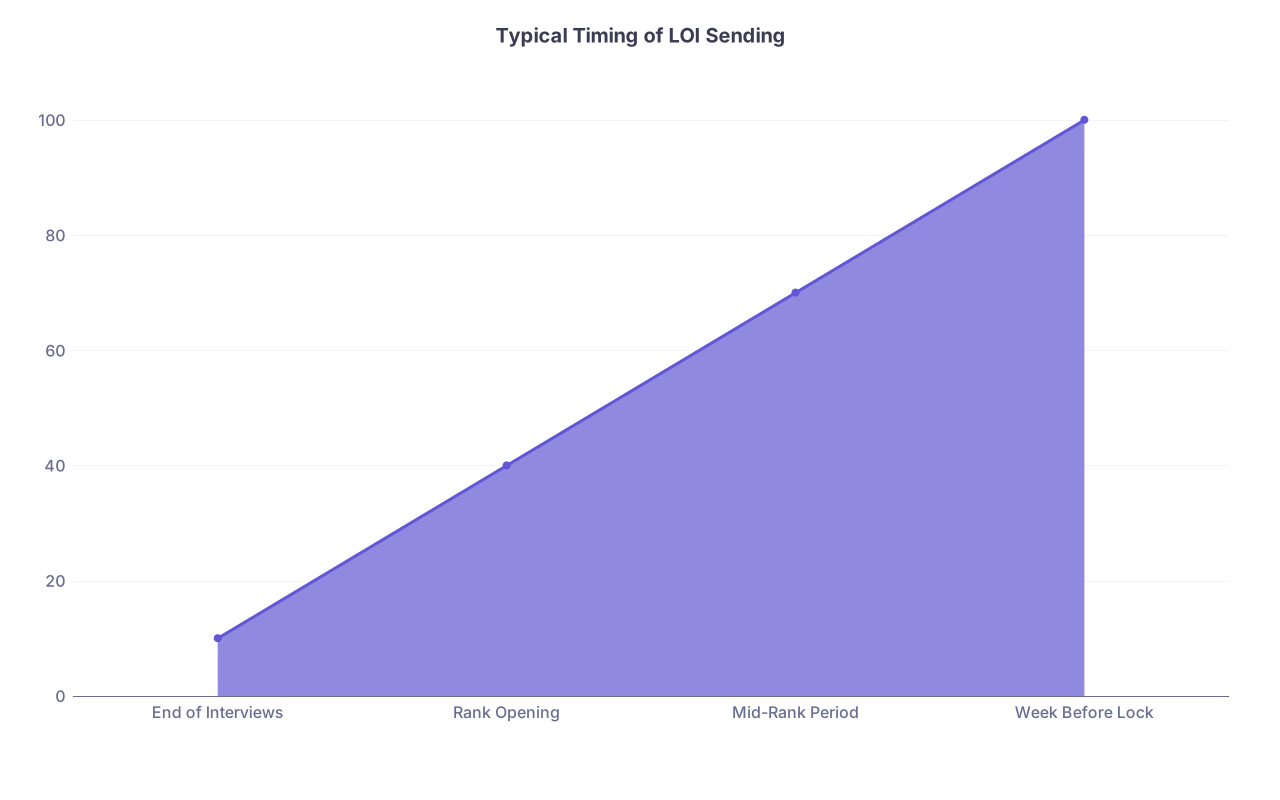
| Category | Value |
|---|---|
| End of Interviews | 10 |
| Rank Opening | 40 |
| Mid-Rank Period | 70 |
| Week Before Lock | 100 |
Ideal window:
- 1–3 weeks after your interview
- Before rank lists are finalized (for many specialties, that means by early–mid February)
Sending it 24 hours before rank list certification does not scream “thoughtful interest.”
How to send
- Follow program-specific instructions if they exist (some explicitly say “we do not use LOIs” – respect that)
- If not specified:
- Email to the program coordinator, cc’ing the PD, or
- Use ERAS communication tools if available / preferred
Subject line idea:
- “Letter of Intent – [Your Name], [Specialty] Applicant”
Short, clear, easy to search.
Step 8: Specialty and Context Nuances (Because Not All LOIs Are Equal)
Not every specialty treats LOIs the same. Quick reality check.
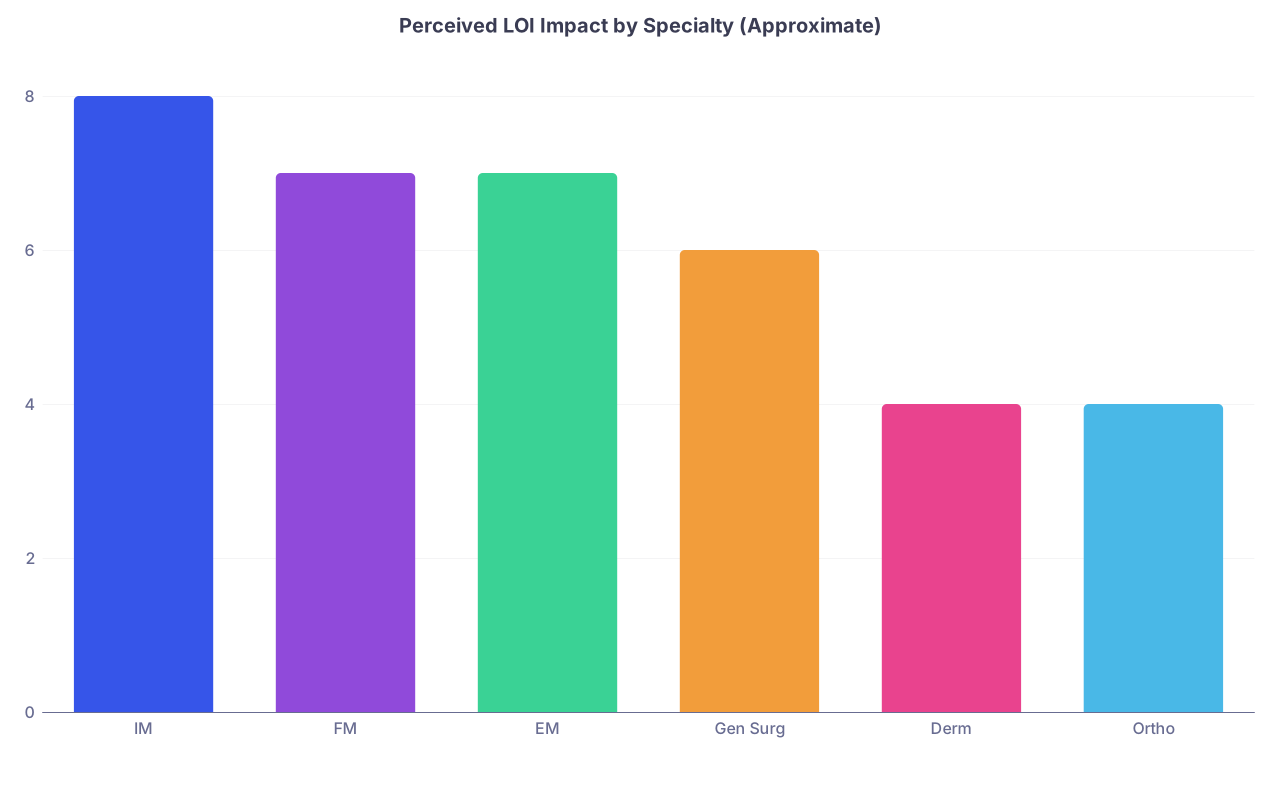
| Category | Value |
|---|---|
| IM | 8 |
| FM | 7 |
| EM | 7 |
| Gen Surg | 6 |
| Derm | 4 |
| Ortho | 4 |
Scale: 1 = basically ignored, 10 = often discussed in meetings.
These are rough, based on what I have seen and heard from PDs.
- Medicine / FM / EM: LOIs are often read and discussed, especially for borderline or tied candidates. Worth doing well.
- General Surgery: Mixed. Some PDs care, some barely read them. Still, a tight, specific LOI does not hurt.
- Derm / Ortho / super-competitive specialties: Often lower impact relative to research, letters, pedigree. Still can matter at the margins or for programs where you have a connection.
If a program or specialty organization explicitly discourages “gamesmanship” in communication, respect it. You can still send a “thank you + specific fit” email without promising rank position.
Step 9: Future-Proofing Your LOI Strategy
This process is not just for this cycle. You can reuse the skeleton anytime you need to signal intent:
- Away rotation follow-up
- Fellowship letters of intent
- Job offer interest letters
The core pattern is the same:
- Specific “you”
- Honest “me”
- Clear “why us together”
If you build one good, specific LOI now, you can strip the content and reuse the structure for years. That matters.

| Step | Description |
|---|---|
| Step 1 | Open Generic Template |
| Step 2 | Strip Filler Phrases |
| Step 3 | Add 2-3 Program Specific Details |
| Step 4 | Write Fit Paragraph Linking You to Them |
| Step 5 | Decide and Insert Ranking Signal |
| Step 6 | Format, Proofread, Send |