You just got the email.
“Hi [Applicant], we really enjoyed meeting you on interview day…”
You loved this program. You can see yourself there. Someone casually mentions, “If this is your top choice, you should send a letter of intent.”
You open a blank document. Cursor blinking. Clock ticking.
You have 45 minutes before sign-out, call, or your only free block of the day.
Here is how you get from blank screen to a clean, persuasive, program-ready letter of intent in 45 minutes. Not the “perfect” letter. The effective one that actually does its job.
What a Letter of Intent Actually Needs To Do
Forget the fluff. A strong letter of intent does three things:
- States clearly: “You are my top choice and I will rank you first.”
- Shows you understand the program specifically (not copy-paste).
- Connects your track record to what they value and need.
If your draft does not do those three, it does not matter how pretty the sentences are.
You have 45 minutes. So you need a tight process, not vibes and inspiration.
The 45-Minute Workflow (Exact Timeline)
Let us start with the high‑level structure, then I will break down each segment:
| Time Block | Task Focus |
|---|---|
| 0–5 min | Gather intel and open template |
| 5–15 min | Bullet the content (no prose) |
| 15–30 min | Draft paragraphs fast |
| 30–40 min | Edit for clarity and tone |
| 40–45 min | Final checks and send plan |
Now I will walk you through exactly what to do in each block.
Minutes 0–5: Set Up and Grab the Right Details
You are not writing yet. You are collecting ammo.
Step 1: Pull up the right tabs
Open:
- Program website “About / Education / Curriculum / Values” pages
- Your interview day notes (or emails, text you sent a friend about the interview)
- ERAS / application PDF (for quick recall of your own experiences)
You are hunting for 3–5 specific program details you can reference. Not generic stuff like “strong clinical training” or “supportive faculty.” Everyone says that.
Look for:
- Named tracks: “Primary Care Track,” “Clinician Educator Pathway,” “Global Health Distinction”
- Structural features: 3+1 schedule, X+Y, specific night float system, integrated clinic
- Culture statements: “We prioritize leadership development,” “We are committed to caring for the underserved,” “Residents drive QI projects”
- Unique opportunities: a free-standing children’s hospital, level 1 trauma center, simulation curriculum, specific fellowship pipelines
Jot them in a quick list in your doc. You will plug these later.
Step 2: Decide your angle
You need one primary “fit story”. Example angles:
- “I want to be an academic hospitalist and your clinician-educator track matches that.”
- “I am committed to underserved urban care and your county rotation structure fits me.”
- “I want to match into cardiology and your fellowship outcomes and research align perfectly.”
Pick one. Do not try to be everything to everyone in one page.
Minutes 5–15: Bullet the Content (Skeleton Only)
Do not start with full sentences. That is where you waste time.
You will create a bullet outline with five parts:
- Opening + explicit commitment
- Why this program (specific details)
- Why you fit them (your evidence)
- Reassurance about your intent and professionalism
- Clean, respectful close
Here is the structure, exactly.
1. Opening + explicit commitment
Bullets only, something like:
- Thank them for interview
- State: “I will rank your program first on my rank list”
- One short phrase about why (main angle)
Example bullets:
- “Thank you for the opportunity to interview with [Program].”
- “Writing to express that [Program] is my top choice, and I will rank it first.”
- “Drawn to your strong clinician-educator training and supportive resident culture.”
2. Why this program (program-centric section)
Aim for 3–4 bullets, each tied to something real from your earlier notes.
Examples:
- “3+1 schedule – continuity with clinic / protects time for QI and teaching”
- “Urban underserved population at [Hospital X], aligns with [my FQHC work]”
- “Conversations with Dr. [Name] and residents about autonomy and early responsibility”
- “Global health elective and support for resident projects in [region]”
Each bullet should be concrete enough that they recognize their own program in it.
3. Why you fit them (you-centric section)
Again, 3–4 bullets. Each bullet: Program need / value → your evidence.
Examples:
- “Interest in clinician-educator path → teaching award, developed M3 teaching materials”
- “Commitment to underserved care → 3 years at free clinic, QI project on [topic]”
- “Research culture → 2 abstracts at [conference], ongoing project in [field]”
- “Leadership emphasis → chief of student-run clinic, led peer mentoring group”
Tie at least one bullet directly to your main angle from earlier.
4. Reassurance about intent and professionalism
One or two bullets:
- Reaffirm ranking them first
- Emphasize honesty (you are not sending this to multiple programs)
- Signal that you respect the Match rules
Example bullets:
- “Not sending letters of intent to any other program.”
- “I understand and respect the NRMP Match process.”
5. Closing
Simple bullets:
- “Thank them again”
- “Offer to provide additional information”
- “Short, polite sign-off”
Minutes 15–30: Draft the Letter Fast
Now you turn bullets into prose. You are not trying to be poetic. Aim for clear, direct, professional.
Use this basic template and plug in your own specifics.
Paragraph 1: Opening and commitment
Target: 3–4 sentences.
Example:
Dear Dr. [PD Last Name],
Thank you again for the opportunity to interview with the [Program Name] [Specialty] Residency Program on [interview date]. I am writing to express my strong interest in your program and to state clearly that I will rank [Program Name] first on my rank list. After my interview day and continued reflection, I am convinced that your program is the best environment for me to grow into the kind of [hospitalist / subspecialist / clinician-educator / leader] I hope to become.
If their program director invites first names and you feel that is appropriate, fine, but default to “Dr. [Last Name].”
Paragraph 2: Why this program
Target: 4–6 sentences.
You are answering: “Why us, specifically, and not just any solid program?”
Example structure:
Several aspects of [Program Name] stood out to me during the interview day. The [specific schedule or track] would allow me to [short impact statement]. I was especially impressed by [specific rotation, clinic, or patient population], which aligns closely with my prior work at [institution / experience]. Speaking with Dr. [Name] and the residents about [culture theme: autonomy, mentorship, wellness, research] reinforced my sense that your program combines rigorous clinical training with a genuinely supportive environment.
Concrete example:
Several aspects of the University Hospital Internal Medicine Residency stood out to me during the interview day. The 3+1 schedule, with protected ambulatory weeks, would allow me to build strong continuity with my future primary care panel while preserving time for quality improvement and teaching activities. I was especially impressed by your dedicated rotations at County Medical Center, which align closely with my work at the Eastside Free Clinic serving largely uninsured patients. Speaking with Dr. Patel and several of the residents about the program’s emphasis on early autonomy and approachability of faculty reinforced my sense that your program combines rigorous clinical training with a genuinely supportive environment.
You see the pattern: name, detail, impact.
Paragraph 3: Why you fit them
Target: 5–7 sentences.
You are now tying your record to what you just praised.
Example:
My long-term goal is to become a clinician-educator in academic internal medicine, and my experiences to date have prepared me well to contribute to and benefit from your program. At [Med School], I helped design and lead a small-group curriculum for third-year students on clinical reasoning and received the [teaching award] for this work. In parallel, I have pursued scholarship in [field], presenting our project on [topic] at [conference]. I am particularly excited about the opportunity to work with your [specific division, track, or mentor], whose work in [area] closely aligns with my interests. I believe that my commitment to teaching, my background in caring for underserved populations, and my enthusiasm for resident-led quality improvement projects would fit well with the mission and culture of your residency.
Keep it restrained. Confident but not arrogant.
Paragraph 4: Reassurance and close
Target: 3–4 sentences max.
Example:
I want to reiterate that I will rank the [Program Name] [Specialty] Residency Program first on my rank list and that I am not sending letters of intent to any other program. I am committed to honoring the NRMP Match process and to being fully transparent about my intentions. Thank you again for your time and for the effort you and your team invest in resident education. Please let me know if I can provide any additional information.
Sincerely,
[Your Name]
AAMC ID: [ID]
[Email] | [Phone]
That is it. Direct. Clear. Ethical.
Minutes 30–40: Edit for Clarity, Ethics, and Impact
Now you switch from writer to surgeon. Cut what does not help.
1. Check for these 5 red flags
Go line by line and catch:
Vague praise
If you wrote “excellent training,” “great research,” “supportive culture” with no example—either attach a real detail or delete.Dishonest commitments
If you are not truly ranking them first, do not say you are. That is not “strategy,” that is lying. PDs talk.Over-the-top flattery
If it sounds like a fan letter to a celebrity, scale it back.Passive voice bloat
“It has been my intention…” → “I plan to…”
“I was able to work on…” → “I worked on…”Repetitive language
If “I am excited” appears three times, fix at least two.
2. Tighten every paragraph
You want clean, punchy, readable. Not LSAT reading comp.
Quick rules:
- Any sentence over 3 lines? See if you can split it.
- Any paragraph longer than 8–9 lines? See if you can cut 1–2 sentences.
- Delete filler phrases:
- “I believe that” → usually cuttable or implied
- “I feel that” → weak, remove
- “In my opinion” → no need, it is obviously your opinion
3. Check your specificity balance
You need a mix of:
- Program specifics: names, structures, tracks
- Your specifics: 2–3 key experiences with clear outcomes
If one side is lopsided (all about them, nothing about you; or vice versa), fix that. Add one sentence improving the weaker side.
Minutes 40–45: Final Checks and Send Plan
Last stretch. Do not get sloppy here. This is where many otherwise good letters die.
Step 1: Confirm logistics
Make sure you have:
- Correct program name
- Correct specialty (do not mix up IM vs Med-Peds, etc.)
- Program Director’s correct name and title
- Your AAMC ID in the signature
If you are sending to multiple programs on the same day, triple-check you have not left the wrong name anywhere. This is the cardinal sin.
Step 2: Decide email vs upload
Common options:
- Direct email to PD (cc: program coordinator), body of email or attached PDF
- ERAS / Thalamus / portal upload (if specifically allowed)
If emailing:
Subject line options:
- “Letter of Intent – [Your Name], [Specialty] Applicant”
- “Rank List Intent – [Your Name]”
Copy your letter into the body of the email. You can attach a PDF if you like, but do not send only an attachment with a blank body.
Short email wrapper:
Dear Dr. [Last Name],
I hope you are well. Please find below my letter of intent for the [Program Name] [Specialty] Residency Program. I remain very grateful for the opportunity to have interviewed with your program.
[Paste full letter here, starting with “Dear Dr. …” again, or adjust so you do not duplicate greeting]
Sincerely,
[Your Name]
Or you can treat the email body as the letter itself and skip the nested greeting. Just be consistent.
Step 3: Basic professionalism check
Last 60 seconds:
- Run spellcheck. Seriously.
- Scan for wrong program name, wrong PD name.
- Make sure your rank statement is unambiguous: “I will rank your program first.”
Then send it. Do not keep tinkering for three days.
The Core Template You Can Reuse
Here is a compact template you can adapt in under 10 minutes once you understand the structure:
Dear Dr. [Last Name],
Thank you again for the opportunity to interview with the [Program Name] [Specialty] Residency Program on [date]. I am writing to express my strong interest in your program and to state clearly that I will rank [Program Name] first on my rank list. After my interview day and further reflection, I am confident that your program is the best fit for my goals in [brief goal].
Several aspects of [Program Name] stood out to me. The [specific schedule/track/rotation] would allow me to [impact]. I was particularly drawn to [specific patient population, clinical site, or curriculum], which closely matches my prior work at [place/experience]. My conversations with [faculty/residents] about [culture theme] reinforced my impression that your program combines [training strength] with a genuinely supportive environment.
My long-term goal is to become a [career goal], and I believe that my background aligns well with your program’s strengths. At [Med School], I [key teaching/leadership experience]. I have also been involved in [research/quality improvement] in [field], presenting our work on [topic] at [conference/publication]. These experiences have prepared me to contribute to your emphasis on [education/research/underserved care/leadership], and I am particularly excited about the possibility of working with [specific division, track, or mentor].
I want to reiterate that I will rank the [Program Name] [Specialty] Residency Program first on my rank list and that I am not sending letters of intent to any other program. I am committed to honoring the NRMP Match process and being transparent about my intentions. Thank you again for your time and for the dedication you and your team show to resident education. Please let me know if I can provide any additional information.
Sincerely,
[Your Name]
AAMC ID: [ID]
[Email] | [Phone]
Save that. Next time, your “45 minutes” becomes 20.
Common Mistakes That Kill Otherwise Good Letters
You want to avoid doing what I see every cycle.
1. The “copy-paste with find/replace” letter
Programs can smell this from three miles away.
- If you can swap in a different program name and nothing breaks, your letter is generic.
- If you mentioned something they do not offer (“I love your global health track” when they do not have one), you are done.
Fix: At least two program-specific sentences that would be wrong anywhere else.
2. Over-sharing or emotional dumping
This is not a personal statement. It is not therapy.
Reining in examples:
- Do not re-tell your whole life story. One or two well-chosen experiences is enough.
- Do not bring up other programs (“I liked your program more than X and Y because…”). Completely unnecessary and looks unprofessional.
- Do not rant about the match, your school, or your previous training.
3. Playing games with honesty
Letters of intent only work if PDs believe them.
Common shady moves (do not do these):
- Sending “you are my #1” to multiple programs.
- Using vague hedges like “I will rank your program very highly” and pretending that is a letter of intent. That is just a thank-you note with ego.
Either commit or do not send a “letter of intent.” You can send a “letter of interest” if you truly are undecided, but that is a different animal and carries less weight.
Quick Visual: What Actually Matters Most in 45 Minutes
Here is how to mentally allocate your effort:
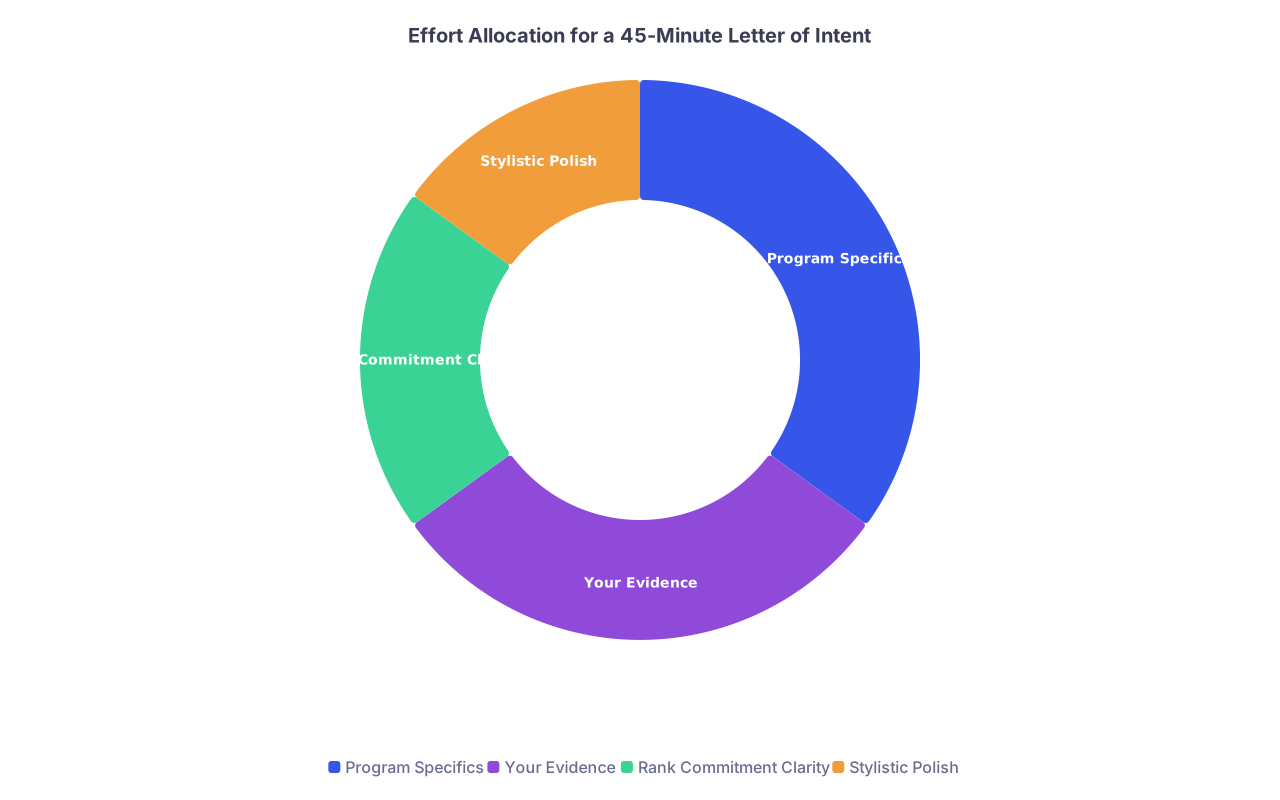
| Category | Value |
|---|---|
| Program Specifics | 35 |
| Your Evidence | 30 |
| Rank Commitment Clarity | 20 |
| Stylistic Polish | 15 |
If you obsess over synonyms and ignore program specifics, you have your priorities backward.
When You Should Not Send a Letter of Intent
Straight answer:
- If you are not 100% sure you will rank them first → do not send a letter of intent.
- If your school explicitly advises against it and you trust their PD-level intel → consider just a strong thank-you update instead.
- If the program explicitly says “We do not consider letters of intent” on their site → you can still send a short, respectful signal, but temper your expectations.
Match rules aside, your reputation matters. PDs remember the applicants who tried to game the system.
Putting It All Together: A 45-Minute Reality Run
Here is how a real 45-minute sprint might look:

| Step | Description |
|---|---|
| Step 1 | Start - 45 min left |
| Step 2 | Open program site and notes |
| Step 3 | Bullet outline of 5 parts |
| Step 4 | Draft 4 short paragraphs |
| Step 5 | Edit for clarity and honesty |
| Step 6 | Proofread names and program |
| Step 7 | Decide email vs upload |
| Step 8 | Send or schedule send |
You are not trying to outwrite everybody. You are trying to be the applicant who is:
- Clear
- Honest
- Specific
- Low-drama
Programs like that.
FAQ (Exactly 2 Questions)
1. If my top program already knows I am very interested, is a letter of intent still worth it?
Yes. Verbal enthusiasm in an interview and a concrete written statement are not the same thing. Programs are juggling hundreds of applicants. A short, clear letter that says, “You are my first choice and I will rank you first,” is easy to forward to the rank committee and hard to misinterpret. It costs you 45 minutes. The potential upside (one more nudge in a borderline discussion) is absolutely worth that time.
2. Can I send a “soft” letter that hints they are near the top without saying they are first?
You can, but do not call that a “letter of intent.” That is a letter of interest. It signals you like them but you are noncommittal. If you are not ready to commit them to #1, then write a brief update/interest letter: reinforce your enthusiasm, add any meaningful updates, and stop there. Reserve explicit “I will rank you first” language for exactly one program, once you are sure.
Key takeaways:
- A persuasive letter of intent is about clarity and specificity, not fancy prose.
- Use a simple 4-paragraph structure and spend most of your time on real program details plus your matching evidence.
- Do not play games with honesty; one program gets a true “I will rank you first” letter, and you keep your integrity intact.