
The worst mistake applicants make is jumping straight to a “You’re my #1” letter when the program is not ready to hear it. A smart applicant uses a letter of interest first—like a probe—then deploys the full letter of intent only when it actually moves the needle.
You are not writing love letters. You are managing a timed communication strategy in a crowded market. Let me show you how to use a letter of interest properly before you ever send a true letter of intent.
1. Letter of Interest vs Letter of Intent: Stop Blurring Them
Most applicants blend these into a mushy “I really like you” email. Programs read those all day and ignore them.
Here is the clean distinction you need to work with:
| Feature | Letter of Interest | Letter of Intent |
|---|---|---|
| Commitment level | Strong interest, non-binding | Explicit, ranked #1 commitment |
| Typical timing | Before/early interview season | Late season, before rank list lock |
| Goal | Get or secure interview | Influence rank list placement |
| Tone | Curious, enthusiastic | Confident, decisive |
| Risk if overused | Sounds generic / spammy | Loss of credibility if untrue |
Here is my position:
A letter of interest is a tool to open or maintain a door.
A letter of intent is a tool to move up a rank list.
Use the wrong tool at the wrong time, you waste both.
When you should be using a letter of interest
You use a letter of interest when:
- You have not interviewed yet and want:
- An interview at a dream program
- A signal that they are actually considering you
- You have interviewed, but:
- It is still relatively early in interview season
- You want to stay on their radar without burning your one “you’re my #1” bullet
- You have meaningful updates and want them seen
You do not use a letter of intent at those stages. That is premature commitment. Programs know it, and it cheapens your later, truly strategic communication.
2. The Phased Strategy: Interest First, Intent Later
If you treat letters as isolated events, you will send weak notes that disappear in crowded inboxes. You want a sequence.
Think of it as three phases:
- Pre-interview / early cycle – Letters of interest only
- Post-interview, mid-cycle – Strong letters of interest, with updates
- Late cycle, rank list time – One true letter of intent (maybe two, but I will explain the risk)
Here’s what that looks like structurally:
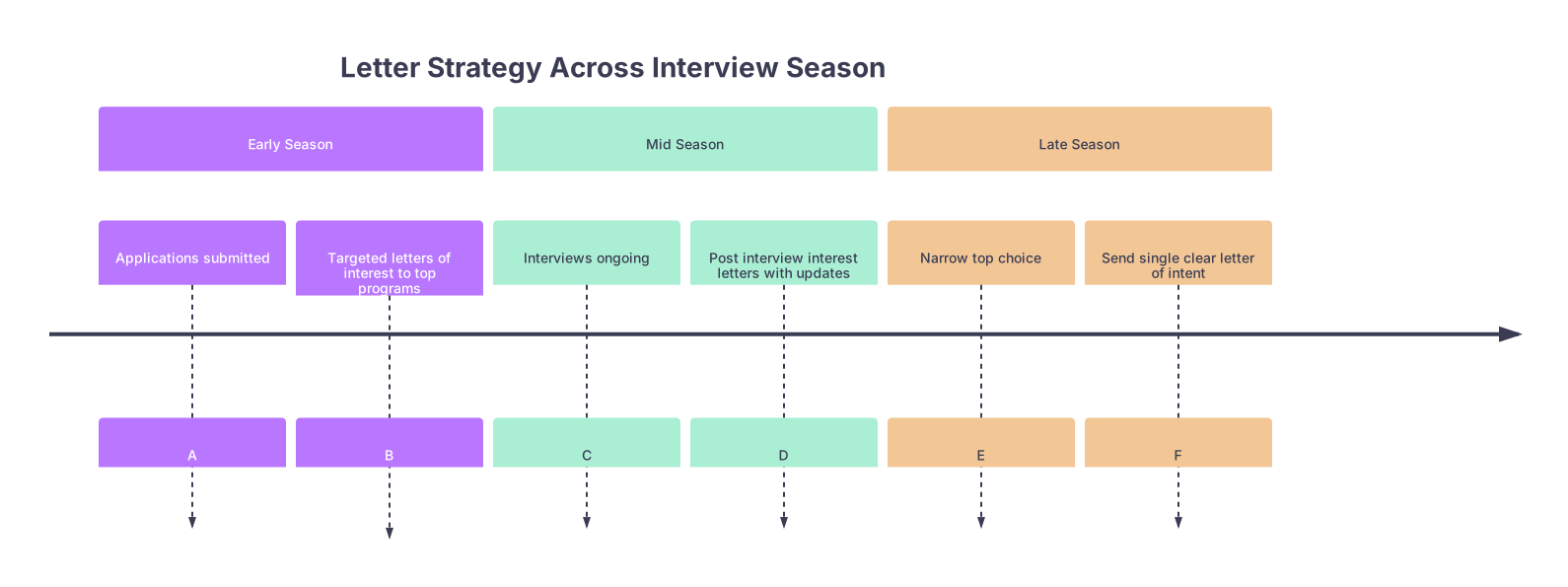
| Period | Event |
|---|---|
| Early Season - Applications submitted | A |
| Early Season - Targeted letters of interest to top programs | B |
| Mid Season - Interviews ongoing | C |
| Mid Season - Post interview interest letters with updates | D |
| Late Season - Narrow top choice | E |
| Late Season - Send single clear letter of intent | F |
Now let us break down what to actually do in each phase.
3. Phase 1: Using a Letter of Interest to Get the Interview
This is where a letter of interest earns its keep.
When to send pre‑interview
I recommend:
- Wait 3–4 weeks after your ERAS application is released
- Only send to:
- Programs in your realistic reach/target zone
- Places you can actually back up with specifics (geography, research fit, family, etc.)
Do not send 60 copy-paste letters. It looks desperate and some coordinators literally roll their eyes reading the same bland “your program is my top choice” line from 40 people.
What this letter is trying to accomplish
The pre-interview letter of interest should:
- Put your name in front of the PD or APD at least once
- Highlight one to three specific alignment points with the program
- Surface any strong contextual advantage:
- Ties to region
- Spouse/partner job in the area
- Prior rotation or research with their faculty
- Clear alignment with stated program strengths (rural, community, academic, global health, etc.)
Structure: Pre-interview Letter of Interest
Keep it under 300–350 words. Tight, specific, and easy to skim. Here is a basic skeleton:
Subject line:
- “Letter of Interest – [Your Name], [Specialty] Applicant”
- Or “Continued Interest in [Program Name] – [Your Name]”
Opening (1–2 sentences)
- Who you are (name, med school, specialty)
- A direct statement of interest
Why them (2–4 sentences)
- 2–3 specific things about the program
- Concrete, not fluff: “your 1:1 mentorship model” beats “your excellent training”
Why you fit (2–4 sentences)
- One or two key strengths that align with their mission
- Any geographic / personal connection
Close (1–2 sentences)
- Polite expression of hope for an interview
- No begging, no “I will attend if invited”
Here is a lean example:
Dr. Smith,
My name is Alex Rivera, a fourth-year student at University of Colorado applying to internal medicine. I am writing to express my strong interest in the [Program Name] Internal Medicine Residency.
Your program’s explicit commitment to longitudinal clinic continuity and robust clinician-educator pathways aligns directly with my career goal of becoming an academic general internist. During my subinternship on a similar firm system at University Hospital, I saw firsthand how longitudinal teams improve both patient care and resident education.
I have deep ties to the region, having grown up in [City] and with my immediate family still living here. My research with Dr. Patel on high-utilizer patients and my leadership in our internal medicine interest group reflect the same focus on vulnerable populations that your program highlights on the website and recent ACGME citation-free review.
I would be honored to interview at [Program Name] and would welcome the opportunity to contribute to your residents’ culture of teaching and service.
Sincerely,
Alex Rivera
Note the key things:
- No “top choice” language
- No overpromising
- Specific alignment points
- Clear, but contained enthusiasm
4. Phase 2: Post‑Interview Letter of Interest – Staying on the Radar
Here is where many applicants panic and jump straight to “You’re my #1” emails to three different places. That is sloppy.
Use a post-interview letter of interest first. This keeps the conversation warm, gives you an excuse to share updates, and sets the stage for a future letter of intent if this program ends up at or near the top of your list.
When to send post‑interview
- 1–2 weeks after your interview, assuming they have not explicitly told you “No post-interview communication”
- If there are meaningful updates later in the season, you can send a second, short interest/update note
What this letter should accomplish
Post-interview interest letters should:
- Reinforce your positive impression from the interview
- Highlight specific things you learned that made the program more attractive
- Briefly update them on significant new achievements (if any)
- Signal that they remain high on your list, without locking yourself in
Language to use (and avoid)
Use phrases like:
- “Your program remains one of my top choices.”
- “My interest in training at [Program] has only increased after the interview.”
- “I can clearly see myself thriving in your program’s culture.”
Avoid:
- “You are my number one choice”
- “I will rank you first”
- “I will definitely come if accepted”
(That is letter-of-intent territory and should be used sparingly, late.)
5. Phase 3: When You Escalate to a Full Letter of Intent
Only now do we talk about the real thing. The letter that actually says: “You are my top choice and I will rank you #1.”
The letter of intent is a strategic weapon, not a participation trophy. When you spray this to multiple programs, you are either lying or reckless. Programs talk. Coordinators talk. Fellows talk. Do not assume they live in separate universes.
When a letter of intent makes sense
You should consider a letter of intent only when:
- You have finished most of your interviews and can realistically see your rank list
- This program is either:
- Your clear #1, or
- A small group of programs among which you will pick a definite #1
- You are willing to follow through: if they match you, you will be fine training there
Most applicants should send exactly one true letter of intent. Rarely, two very carefully worded “near-intent” letters if the specialty/program culture supports that nuance. But if you are asking “Can I send 4 letters of intent?” the answer in practice is: no, you are just diluting your honesty.
Timing relative to rank lists
Ideal window:
- 2–3 weeks before rank lists are due (for you and for programs)
- Not so early that you might change your mind
- Not so late that your email is buried in the end-season chaos
6. Why a Letter of Interest First Actually Makes Your Letter of Intent Stronger
Here is the subtle but crucial point: using a letter of interest before a letter of intent sets the narrative.
Without interest-first:
- Your late “You’re my #1” letter shows up cold.
- PD reads it and wonders if you are just sending fifteen of these.
- There is no story arc. No sense that your interest developed across time.
With interest-first:
- They saw your sincere interest early.
- They saw you follow up post-interview with specifics.
- You send a letter of intent that now looks like the natural endpoint of an existing relationship, not a hail mary.
You are not just declaring a rank. You are closing a loop that started weeks or months ago.
Practically, PDs and APDs are human. They remember names they saw more than once. I have watched them at ranking meetings say: “This student kept in thoughtful contact, really wants to be here, and is a strong fit.” That matters at the margin between you and someone statistically identical.
7. Concrete Templates: Interest Now, Intent Later
You are busy. So let us put this into usable templates you can adapt.
A. Pre‑interview Letter of Interest (Short Template)
Subject: Letter of Interest – [Your Name], [Specialty] Applicant
Dear Dr. [PD Last Name],
My name is [Name], a [MS4 / IMG / current position] at [School/Institution], applying to [Specialty]. I am writing to express my strong interest in the [Program Name] [Specialty] Residency.
I am particularly drawn to your program’s [specific feature 1] and [specific feature 2]. During [relevant rotation, project, or experience], I developed a strong interest in [aligned area], and I believe [Program Name]’s focus on [X] would be an excellent fit for my training goals.
[If applicable: I have close ties to [city/region] through [family, prior training, partner job], and I am eager to practice in this community long term.] My experiences in [briefly mention one or two concrete strengths—research, leadership, teaching, community work] would allow me to contribute meaningfully to your residency.
I would be honored to interview at [Program Name] and appreciate your consideration of my application.
Sincerely,
[Name]
AAMC ID: [ID]
B. Post‑interview Letter of Interest (Targeted, Not Intent)
Subject: Continued Interest in [Program Name] – [Your Name]
Dear Dr. [PD Last Name],
Thank you again for the opportunity to interview at the [Program Name] [Specialty] Residency on [date]. Speaking with Dr. [Faculty], the residents at [event], and learning more about your [specific track/clinic/education structure] strengthened my enthusiasm for your program.
I was especially impressed by [one or two concrete things you observed—resident camaraderie on rounds, case conference structure, support for research, etc.]. These align closely with my goals of [short restatement of your career aim].
Since my interview, I have [brief update: submitted a manuscript, presented at a conference, taken on a leadership role, etc.]. These experiences have further reinforced my commitment to a career in [specialty focus or niche].
[Program Name] remains one of my top choices, and I can clearly see myself thriving in your resident community. Thank you for your time and consideration.
Sincerely,
[Name]
AAMC ID: [ID]
C. True Letter of Intent (After Interest Has Been Established)
Subject: Letter of Intent – [Your Name], [Specialty] Applicant
Dear Dr. [PD Last Name],
I am writing to express my clear intent to rank the [Program Name] [Specialty] Residency Program as my first choice. After completing my interviews and carefully considering my options, I am confident that your program is the best fit for my personal and professional goals.
My interview day on [date] confirmed what I had hoped from reviewing your curriculum and speaking with your residents: the combination of [specific program strengths—e.g., high-volume clinical training, strong mentorship, particular track] is exactly what I am seeking. The culture of [specific values: collegiality, resident autonomy, focus on underserved, etc.] I observed on my interview day is the environment in which I know I will thrive.
I believe I would contribute meaningfully to your program through [two or three concise strengths—teaching, scholarship, procedural interest, QI, leadership]. My long-term goal is to [career plan], and I see [Program Name] as the ideal setting to develop into that kind of physician.
Thank you for considering my application. I would be honored to train at [Program Name] and hope to join your residency class.
Sincerely,
[Name]
AAMC ID: [ID]
8. How Many Programs Should Get Letters of Interest?
Here is where people go off the rails and turn into spambots.
You need a targeted approach. Something like this:
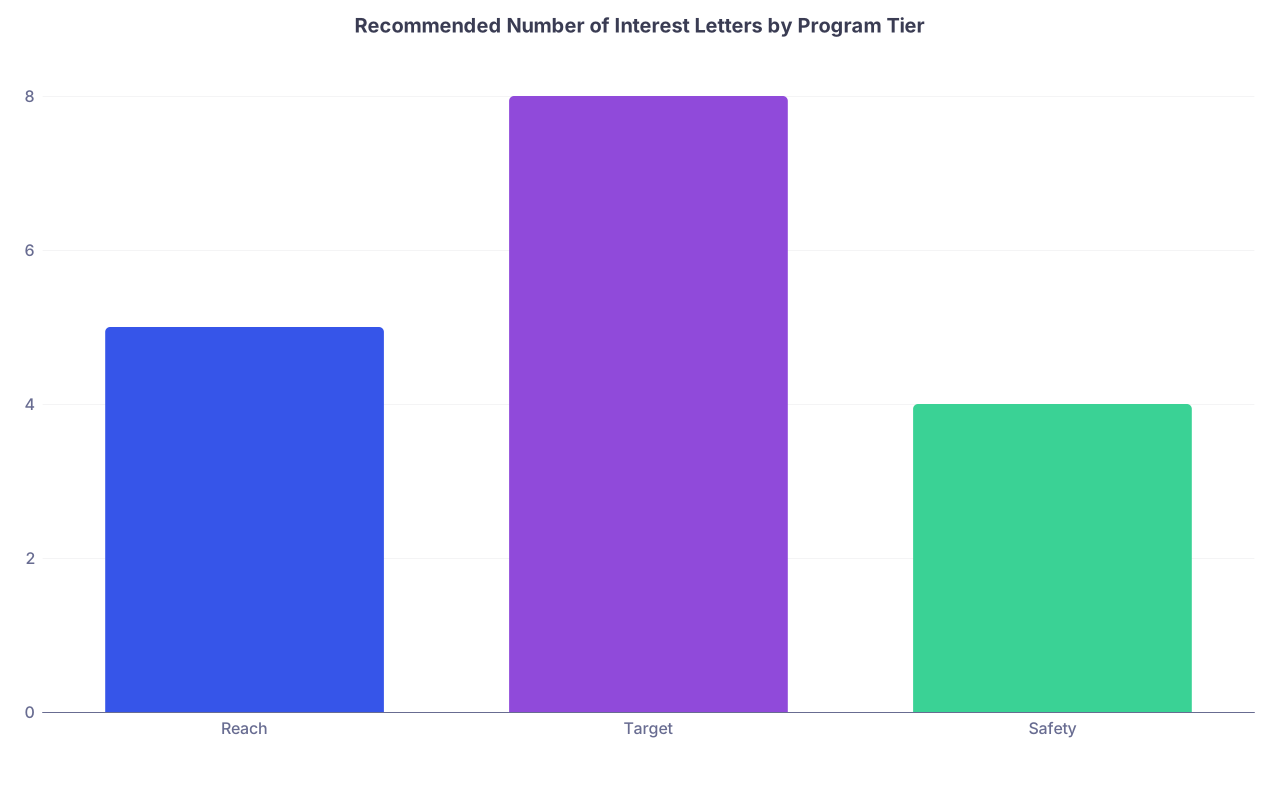
| Category | Value |
|---|---|
| Reach | 5 |
| Target | 8 |
| Safety | 4 |
Interpretation (for a typical applicant with ~40–60 applications):
- 5 reach programs – Where you are a bit under the typical metrics but have genuine interest or ties
- ~8 target programs – Where you are competitive and particularly interested
- ~4 safety programs – Where you would genuinely be willing to train and want to show respect/interest
That is ~17 thoughtfully written letters of interest, not 40 watered-down clones. If you cannot give each letter program-specific content, you are sending too many.
9. Common Screwups And How To Fix Them
Let me walk through errors I see every year and exactly what to do if you already made them.
Error 1: You Already Sent “You Are My Top Choice” to Multiple Programs Early
This is bad but not unrecoverable.
Fix:
- Stop sending more. Do not compound it.
- For the one program that is truly your #1, send a final letter of intent late in the season that is clear and specific.
- For others, you do not need to retract, but do not repeat the language. Use “very high on my list” instead.
- Going forward, reserve explicit #1 language for one place.
Error 2: Your Interest Letters Were Generic, Obvious Copy-Paste
Programs can tell when you simply swapped the program name.
Fix:
- For any program that truly matters to you, send a second, more specific letter midway through the season:
- Reference particular faculty, tracks, conferences, or comments from your interview day
- Show that you have done deeper research since your first message
- Keep it short, but detailed enough that it does not read like a template
Error 3: You Sent Nothing At All And Now It Is Late
You ignored letters and now you are two weeks from rank list deadline. Not ideal, but still fixable.
Fix:
- Pick 1 true #1 program – send a letter of intent this week.
- Identify 2–4 high-interest programs – send brief, specific late-season interest/update notes.
- Accept that you will not build a “narrative arc” at this point; you are going for last-minute signal boosting. Keep it respectful and not needy.
10. How To Keep Yourself Honest (And Sane)
The pressure to oversell and overpromise is intense. People around you will say things like “Everyone lies, just send 3–4 letters of intent.” That is lazy and short-sighted.
Here is a simple internal rule set I recommend:
Rule 1: One True #1.
Only one program gets the actual phrase “I will rank you first” or “You are my first choice.”Rule 2: Interest Before Intent.
No letter of intent goes to a program that has not already received at least one thoughtful letter of interest (pre- or post-interview).Rule 3: Specific or Silent.
If you cannot name at least two specific things about the program and how you fit them, do not send a letter. You are not interested; you are anxious.Rule 4: No Emotional Dumping.
Your stress, fear, or frustration does not belong in these messages. Keep them professional, confident, and concise.
11. A Quick Workflow You Can Actually Use This Week
To make this practical, here is a 7-day mini-plan to get your letter strategy under control.

| Step | Description |
|---|---|
| Step 1 | Day 1 - List Programs |
| Step 2 | Day 2 - Tier Them |
| Step 3 | Day 3 - Draft Base Templates |
| Step 4 | Day 4-5 - Personalize 5-7 Letters |
| Step 5 | Day 6 - Proofread and Send First Batch |
| Step 6 | Day 7 - Track Responses and Plan Next Wave |
Day 1:
Export your programs into a simple spreadsheet. Add columns:
- Tier (Reach / Target / Safety)
- Interview status
- Interest level (1–5)
- Notes (ties, research overlap, etc.)
Day 2:
Assign each program a tier and interest level. Highlight your top 10–15.
Day 3:
Write your 3 base templates:
- Pre-interview interest
- Post-interview interest
- Letter of intent
Day 4–5:
Personalize for 5–7 top programs. Add specific details. Do not send yet.
Day 6:
Proofread everything. Have one trusted person (not five) review for professionalism and clarity. Send your first wave of 5–7 letters.
Day 7:
Track who you sent to, what type, and when. Update weekly. This keeps you from doubling messages or forgetting who got what.
Key Takeaways
- A letter of interest is your first move—to open doors and build a believable arc of interest; a letter of intent is your final move—to clearly declare a single #1 program.
- Use phased communication: pre-interview interest → post-interview interest with updates → one true late-season letter of intent.
- Be selective, specific, and honest; if you cannot back up your interest with concrete reasons, you are not interested—you are just anxious.