
The worst way to handle a failed exam in your LOI is to pretend it never happened.
If you’re writing a letter of intent and you’ve failed an exam once—Step, shelf, COMLEX, OSCE, in‑training, whatever—you’re sitting on a landmine. Ignore it, and programs will fill in the blanks themselves. Over-explain it, and you sound defensive or unstable. The play you need is in the middle: clean, brief, accountable, and strategically placed.
This is the situation: you have one failed exam and you’re trying to convince a program, “Rank me highly. I’m reliable. I won’t implode during residency.” I’ll walk you through exactly how to do that in a letter of intent, line by line, including what not to say and where to put it so it helps you instead of hurting you.
1. First reality check: do you even need to mention it in a LOI?
Not every failure needs fresh oxygen in a LOI. Sometimes it’s already processed and dead; sometimes you must confront it head on.
Here’s the quick decision tree:

| Step | Description |
|---|---|
| Step 1 | One exam failure |
| Step 2 | Probably omit from LOI |
| Step 3 | Address briefly in LOI |
| Step 4 | Address directly in LOI |
| Step 5 | One sentence max if at all |
| Step 6 | Was it on a major licensing exam? |
| Step 7 | Already explained in personal statement or interview? |
| Step 8 | Program asked again or seemed concerned? |
You almost certainly should mention it in the LOI if:
- It was a major licensing exam (USMLE/COMLEX Step/Level 1 or 2, Step 3).
- You failed a core clerkship shelf that appears on your transcript.
- The program already asked about it in your interview or in emails.
- The failure is recent and close to when you’ll be starting residency or fellowship.
You can probably skip it (or give it one sentence at most) if:
- It was a minor in‑course exam, pre‑clinical block, or early remediation that does not appear as a failure on your official record.
- You already explained it well in your personal statement, and you did not get questions about it during the interview.
- Your more recent performance (higher Steps, strong clinical grades) clearly contradicts the idea that you are an ongoing risk.
Here’s the rule: if the failure is obvious on what they already have (transcript, score report, MSPE, ERAS), you do not get to “hope they miss it.” Assume they saw it. Decide whether your LOI is your last chance to reframe it.
2. What programs actually worry about when they see a failed exam
You’re not fighting the failure itself. You’re fighting their story about the failure.
Experienced PDs and faculty instantly start spinning up internal questions:
- Is this a pattern or a one‑off?
- Is this someone who collapses under pressure?
- Is this a professionalism problem in disguise? (No‑showing, not prepping, ignoring feedback.)
- Will this person pass boards on the first try when we are responsible for them?
You need your LOI to quietly answer those concerns without turning your letter into a confessional.
Read that again: LOI, not confession. You’re not dumping feelings; you’re building trust.
Here's what reassures programs:
- Clear ownership: no blaming the exam, the NBME, or the “unfair” curve.
- A believable explanation that matches your timeline.
- Concrete evidence of changed behavior and better results.
- Calm tone. Not panicked, not melodramatic.
If your paragraph about the failure sounds emotionally raw, you’re not ready to send it. They’re not your therapist; they just need to know you learned and adjusted.
3. Where to put the failure in your LOI (and where not to)
The structure of your LOI matters more than people admit. Clumsy placement makes your failure look bigger than it is.
Default LOI structure for someone with a single failed exam:
- Opening: Clear statement of intent and enthusiasm.
- Fit: Why this program, what you value in training, what you bring.
- Short, controlled failure paragraph (exam).
- Close: Reaffirm commitment, signal reliability.
Do not open with the failure. That screams: “My entire identity is this mistake.” Programs want to see that you see yourself as more than one bad day.
Also avoid sticking it at the very end as the last impression. You want it in the middle, bracketed by competence and commitment.
You’re aiming for something like this pacing:
- 60–70% of the letter = why you and this program are a strong match.
- 10–20% = the failure + what changed.
- 10–20% = forward-looking reassurance and closing.
4. How to actually write the “I failed once” paragraph
Let’s get to the script. Here’s a minimal structure that works across most scenarios:
- One sentence: state the fact.
- One to two sentences: brief, non-dramatic context.
- Two to three sentences: specific changes you made + subsequent stronger performance.
- One line: how the experience shapes how you’ll function as a resident/fellow.
That’s it. Not five paragraphs. Not your full emotional journey. Tight and factual.
Example: Failed Step 1, passed Step 2 solidly
You do not write:
I have always been a strong student, so failing Step 1 was extremely shocking and difficult for me, especially since my school…
No. That reads like you’re still stunned and wanting sympathy.
You write something cleaner, like:
During my second year, I failed Step 1 on my first attempt. I underestimated the time I needed to transition from class-based learning to comprehensive board-style preparation while balancing several extracurricular commitments.
After this result, I restructured my study approach completely: I met regularly with our academic support office, created a dedicated question-bank schedule, reduced nonessential activities, and took practice exams under test-day conditions. I passed Step 1 on my second attempt and later scored a [###] on Step 2 CK, reflecting a more disciplined and effective strategy.
This experience has made me far more deliberate in how I prepare for high-stakes situations, and I carry that same structured, proactive approach into my clinical work.
Notice a few things:
- One clear, unembellished sentence acknowledging the failure.
- Light context without a sob story.
- Very concrete changes (academic support, Qbank schedule, reduced commitments, practice tests).
- Forward-looking: ties the learning to how you now operate.
Example: Failed a core shelf or clerkship
I did not pass my initial Internal Medicine shelf exam and received a temporary grade of Incomplete for that clerkship. My mistake was treating the rotation and the exam as separate tasks rather than integrating daily learning with consistent exam preparation.
After that experience, I began using weekly question goals aligned with the content I was seeing on the wards, reviewed missed cases with residents, and met with my clerkship director for feedback. I passed the repeat exam and subsequently honored my Surgery and Pediatrics clerkships.
That setback made me much more systematic in how I turn clinical exposure into tested knowledge, which will be critical as a resident balancing patient care with future in-training and board exams.
Same pattern: brief fact, short explanation, concrete adjustment, evidence of improvement, future relevance.
5. What not to say about your failure
Let me be blunt: I’ve read some truly awful explanations from otherwise smart people. They sink apps more than the failure itself.
Avoid these traps:
Blaming the exam or the system.
Anything like “the exam did not reflect my abilities” or “the curve was unusually harsh” makes you sound naïve and defensive.Over-sharing personal drama.
If you bring in every detail—breakup, roommate issues, family fight—you look unstable. If there was a serious illness, bereavement, or crisis, it can be relevant, but even then keep it concise and factual:- “During that period, a close family member was critically ill, and I did not adjust my schedule appropriately. I’ve since…”
Positioning yourself as a victim of your school.
Complaining about lack of support, disorganized faculty, or “no one told us what would be on the exam” is a bad look. At most:- “I did not seek available resources early enough” (ownership on you).
Apologizing excessively.
One implied “I take responsibility” is enough. You do not need three variations of “I’m deeply sorry.”Sounding like you still don’t understand what went wrong.
If your explanation is just “test anxiety” or “I had a bad day” with nothing specific you changed, PDs will assume you’re at risk for another bad day.
The standard you’re held to: mature, self-aware, and operational. You identify what went wrong in operational terms and how you changed the system around you.
6. Tailoring your LOI strategy by exam type
Different failures raise different levels of concern. Tactfully addressing them means adjusting your emphasis.
| Exam / Issue | LOI Emphasis Level | Key Goal in Paragraph |
|---|---|---|
| Step/COMLEX 1 fail | Moderate | Show it was a one-off + strong Step 2 |
| Step/COMLEX 2 fail | High | Prove readiness for residency/boards |
| Step 3 fail (for fellowship) | High | Show you fixed prep and passed solidly |
| Single core shelf/clerkship fail | Moderate-Low | Show clinical growth + later honors |
| Preclinical block/course fail | Low | One line at most, if at all |
If you failed Step 1
Programs care but are much more relaxed if Step 2 is strong and clinical work is solid. Your LOI should:
- Acknowledge the Step 1 failure directly if it’s not explained elsewhere.
- Point to a concrete Step 2 improvement (score or narrative).
- Emphasize how your clinical performance now matches that improvement.
You don’t need to write an essay; they’ve seen lots of Step 1 stumbles, especially in the transition years.
If you failed Step 2/Level 2
This one is more serious. Step 2 predicts board pass rates. Programs are watching.
Your LOI must:
- Be explicit that you understand their concern: progression to unsupervised practice requires board passage on time.
- Outline a very clear, structured prep change.
- Show a meaningful improvement on the successful attempt (if numeric).
- Explicitly connect this to being reliable with in‑training and specialty boards.
You’re basically telling them: “You will not have to worry about me being the reason your program’s board pass stats dip.”
If you failed Step 3 (applying to fellowship)
Now you’re in “you already had an MD/DO and still struggled” territory. The only way this works:
- You pass on the next attempt with a decent margin.
- Your LOI explains what changed and how your clinical reasoning and time management evolved.
- Your PD letter probably mentions you’re clinically strong and safe.
In your LOI, I would be more explicit:
I recognize that a Step 3 failure raises questions about readiness for advanced training. My subsequent preparation and performance reflect a more disciplined process I now apply consistently in my current clinical duties.
7. Weaving the failure into a strength, without sounding cheesy
You’ve heard all the “growth mindset” clichés. Programs have too. If your LOI sounds like a LinkedIn post, you’ve lost them.
You can still frame this as a strength, but it has to be practical, not inspirational.
Concrete angles that work:
- Study systems: “I now use X system that I applied to Y later success.”
- Feedback habit: “That failure forced me to seek feedback earlier and more often.”
- Prioritization: “I learned to drop lower-value commitments, which is exactly what residency requires.”
- Stress management: But with specifics: “Scheduled long practice blocks, simulation of test day, regular sleep times.”
Bad angle:
Failing that exam taught me resilience.
Better angle:
Failing that exam forced me to confront how I was studying and managing my time. I built a daily question schedule, checked progress with practice exams, and protected sleep and exercise consistently. I now approach major responsibilities in residency the same way—deliberate planning, objective check-ins, and adjustment before problems escalate.
See the difference? One is a motivational poster. The other is a process.
8. How long your explanation should be (word counts that actually work)
People either write a single vague line or a 600-word saga. Both are wrong.
Target length for the failure section in a LOI:
- 120–220 words for a significant exam (Step 1/2/3, Level 1/2).
- 60–120 words for a single shelf or clerkship failure.
- 1 short sentence, if anything, for a minor preclinical remediation.
Within that, do not:
- List every resource you used (“UWorld, AMBOSS, Anki, Boards and Beyond, Sketchy…”). Two max. You’re proving structure, not brand loyalty.
- Recount the play-by-play of test day. No one cares what question you got first or that the room was cold.
If you need a sanity check, read the paragraph out loud. If you feel like you’re pleading your case to a jury, cut it down.
9. Putting it all together: a sample LOI with a tactful failure section
Here’s a compact example for context (obviously you’d personalize more details):
Dear Dr. Smith and the [Program Name] Residency Selection Committee,
I am writing to express my clear intent to rank [Program Name] as my top choice for Internal Medicine residency. After meeting your residents, speaking with Dr. Johnson about the ICU curriculum, and seeing your emphasis on graduated autonomy, I am confident this is where I would grow best as a clinician and teammate.
I’m particularly drawn to your strong inpatient training and the opportunity to work with a diverse, medically complex patient population. In my sub-internship at [Hospital], I thrived in a similar environment—managing high-acuity patients while collaborating closely with nurses and consulting services—and I’m eager to bring that same energy and reliability to your program.
I would also like to briefly address my initial failure of Step 1, which appears on my application. During that period I did not allocate sufficient uninterrupted time to board-style preparation and overcommitted to extracurricular activities, assuming my prior test performance would carry me. After receiving that result, I met regularly with our academic support office, built a structured question-bank and practice exam schedule, and stepped back from nonessential roles. I passed Step 1 on my second attempt and later scored 247 on Step 2 CK, which better reflects my capabilities with a more disciplined approach. This process has made me very intentional about how I prepare for high-stakes responsibilities, a mindset I already apply to my patient care and will bring to future in-training and board exams.
Thank you again for the opportunity to interview and learn more about [Program Name]. I would be honored to join your residency and am fully committed to contributing as a dependable, hard-working resident if given the chance.
Sincerely,
[Your Name]
Note how the failure is present but not the star. The letter is still about fit and future performance.
10. Quick checklist before you send the LOI
Use this as your last pass:
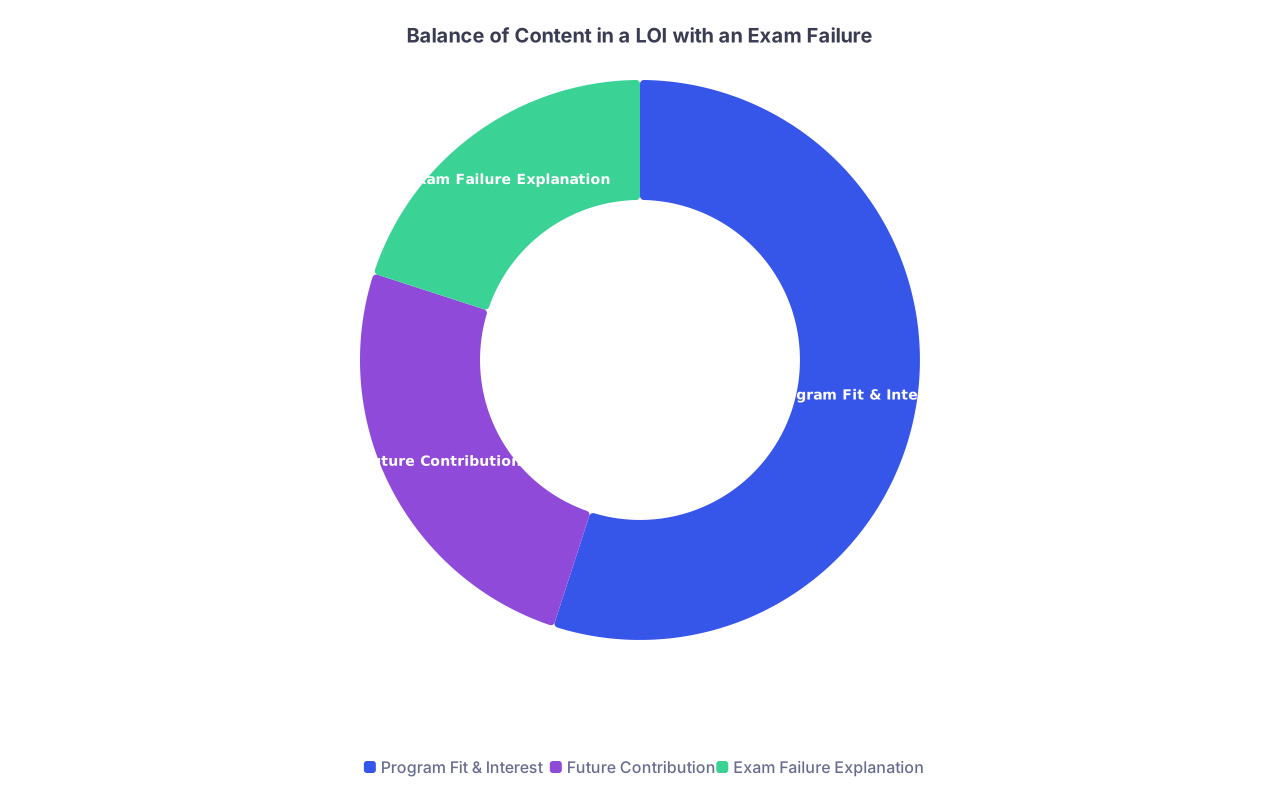
| Category | Value |
|---|---|
| Program Fit & Interest | 55 |
| Future Contribution | 25 |
| Exam Failure Explanation | 20 |
Before you hit send, ask:
- Does my LOI:
- Clearly state this program is a top choice and why?
- Address the exam failure in one focused paragraph, not the entire letter?
- Take responsibility without self-flagellation?
- Describe specific changes I made and concrete better outcomes?
- End on a confident, forward-looking note?
If any answer is no, fix that before worrying about one more adjective in your “why this program” line.
11. If you’re still anxious about mentioning it at all
One more reality check: programs already saw the failure. The LOI isn’t “reminding” them; it’s either:
- Leaving them alone with their worst assumptions, or
- Giving them a controlled, mature explanation they can use when defending you in their ranking meeting.
Imagine a PD at the rank meeting saying:
“Yes, they failed Step 1 once, but look at their Step 2, consistent clerkship performance, and the way they described how they changed their approach in their letter. I’m not worried.”
Your LOI paragraph is the script you want that PD to have in their head.
Key points to remember
- Do not hide the failure if it’s already obvious on your record and relevant; tackle it in one tight, structured paragraph in the middle of your LOI.
- Own the mistake, give brief context, describe specific changes, and point to stronger subsequent performance—no drama, no blame.
- Keep the letter primarily about fit and future contribution; the failure is a controlled data point, not your entire story.