
The typical reapplicant letter of intent is lazy. “I’m still very interested, I’ve grown a lot, please accept me this year.” That kind of letter does nothing for you.
If you are reapplying this year, your LOIs need to do one thing: prove you’re not the same candidate they already passed on.
Let me walk you through how to actually do that.
Step 1: Be Honest About Why You’re Reapplying
Before you write a single sentence to any school, you need to answer a brutal question alone in your room:
“Why did they not take me last cycle?”
Not the comforting story. The real one.
Most reapplicants fall into one or more of these buckets:
- Academics were below the median for the schools they aimed at
- MCAT lagged behind their GPA or target programs
- Application timing was late (August primaries, October/November secondaries)
- Clinical exposure was light or superficial
- Weak narrative: scattered activities, no coherent story, generic essays
- Poor or flat interviews: robotic, memorized, no reflection
- Letters mediocre or from people who barely knew them
You probably already have a hunch which one(s) apply to you. If you’re not sure, reality check yourself against your target schools.
| Metric | You | Target School Median |
|---|---|---|
| GPA | ? | 3.7–3.8 |
| MCAT | ? | 514–516 |
| Clinical hrs | ? | 150–300 |
| Non-clinical | ? | 100–200 |
| Research hrs | ? | 500+ (research-heavy) |
If your MCAT is 507 and you applied mostly to schools where the median is 515+, that’s not a mystery. If your clinical exposure was “shadowed 30 hours” and you wrote three essays about wanting to care for underserved patients, that’s a mismatch between talk and evidence.
You cannot write an effective LOI as a reapplicant until you’ve clearly named your weaknesses. Because your LOI is not a love letter; it’s an update and argument:
“Here’s where I fell short. Here’s what I did about it. Here’s why I’m now a different, stronger applicant.”
Step 2: Understand What an LOI Actually Does for a Reapplicant
Schools are wary of reapplicants who look identical year-over-year. They expect growth. They want to see it. But they do not have time to hunt for it. You have to package it for them.
A reapplicant LOI can do three specific things:
- Clarify growth since your last application (concrete, verifiable changes).
- Align your new profile to their program (why this school, now, with the experiences you’ve gained).
- Signal commitment and maturity (you responded to setback with action, not excuses).
What it cannot do:
- Compensate for zero change in your profile
- Override hard academic cutoffs
- Force a school to ignore institutional needs or class balance
If you’re sending an LOI that’s basically “still interested, nothing’s changed,” you’re wasting everyone’s time, including your own.
Step 3: Build Your “Growth Inventory” Before You Write
You need receipts. Not vibes.
Make a simple growth inventory from the day you submitted last cycle’s primary to now:
- New grades (and trends: e.g., 12 credits with all A/A– in upper-level science)
- New or expanded clinical exposure
- Non-clinical service, especially with sustained commitment
- Work experience, especially in patient-facing or high-responsibility roles
- MCAT retake and score change
- New research, posters, manuscripts, or leadership roles
- Improved communication skills (public speaking, teaching, mentoring)
- Significant life responsibilities (supporting family, full-time work, etc.) if framed well
Concrete example of what this looks like:
- Spring 2024: 16 credits, all A/A– (Biochem, Physiology, Stats, Health Policy)
- Clinical: Went from 40 hours shadowing to 350 hours ER scribe + 120 hours MA at free clinic
- Non-clinical: 150 hours with a food insecurity non-profit, weekly since last June
- MCAT: Up from 509 to 514 (CARS from 125 → 128)
- Research: 1 poster at regional conference, manuscript submitted
- Work: 30 hours/week as EMT, nights and weekends
Now you have something to write about that is not just “I’ve grown a lot and reflected deeply.” You can show it.
Step 4: Decide Where to Send LOIs as a Reapplicant
Random LOIs to every school you applied to last year is amateur-hour.
Prioritize:
- Schools that have already shown some interest in you
- Prior interview (even if you were rejected or waitlisted)
- Prior hold/“under review” status late into the cycle
- Schools whose mission now matches your experience better
- You expanded service with the homeless? Target community-heavy schools.
- You upped research 10x? Target research-heavy programs.
Some schools are explicit: “We do not consider letters of intent.” Take them at their word. For others, LOIs can matter—especially if there is a human on the other end who remembers you. That prior connection is where “I’ve grown” actually lands.
Step 5: Structure of a Strong Reapplicant LOI
You don’t need a poetic masterpiece. You need clarity.
Think in four parts:
- Anchor: who you are + last cycle context
- Growth: what’s new and specific since last time
- Fit: how that growth makes you a better fit for this school
- Commitment: clear statement of intent (if true) + professionalism
1. Anchor (Short, direct)
You must explicitly acknowledge you’re a reapplicant. Stop pretending they won’t notice.
Something like:
I applied to [School] in the 2023–2024 cycle and was grateful for the opportunity to [interview / be considered]. I’m writing as a reapplicant to share how my candidacy has changed and to reaffirm that [School] remains my top choice.
If you never interviewed, just adjust: “was grateful to be considered in last year’s cycle.”
Two sentences. Done.
2. Growth (This is your engine)
This is where most people either get vague or defensive. You will not.
You write 2–3 tight paragraphs, each grounded in specifics:
- What changed
- How much
- What you learned
- Why it matters for your readiness now
Example, not fluff:
Since submitting last year’s application, I have focused on strengthening the areas that limited my candidacy. Academically, I completed 14 credits of upper-level science (Biochemistry, Physiology, and Immunology) with a 3.9 GPA, bringing my overall science GPA from 3.42 to 3.55. This coursework, taken while working 20 hours per week, has reinforced that I can handle a rigorous medical curriculum.
I also deepened my direct patient exposure. I transitioned from brief shadowing experiences to working 30 hours per week as an emergency department scribe (320 hours to date) and 8 hours per week as a volunteer patient advocate at a community clinic (110 hours). In both roles, I have moved from passive observation to active participation—clarifying histories, documenting complex encounters, and problem-solving around social barriers to care.
Notice the pattern: numbers, roles, responsibilities, reflection.
No “I’m passionate about medicine now more than ever.” They’ll infer that from what you actually did instead of fallback clichés.
3. Fit (Connect your growth to their program)
Generic “your curriculum is excellent” language marks you as lazy.
You need 1–2 paragraphs that draw a line between your new experiences and specific parts of that school:
These experiences have also clarified why [School] is the environment where I can contribute and grow the most. Working with uninsured patients at [Clinic] has pushed me to think beyond individual encounters, and I’m particularly drawn to [School]’s [e.g., longitudinal community health curriculum] and partnerships with [X community hospital]. I want to bring my experience navigating food insecurity and housing instability with patients into that structured setting.
You mention:
- Named programs, tracks, clinics, or curricular elements
- How your new experiences plug into those
- What you will bring that you did not have last cycle
If your LOI sounds like it could be copy-pasted to 15 schools with only the name changed, it is weak.
4. Commitment (Be clear but not desperate)
If the school allows it and you mean it, say it plainly:
If offered admission, I would immediately commit to matriculating at [School]. It is my first choice.
Not “one of my top choices.” That phrase means nothing.
If you’re not ready to make that statement, don’t fake it. You can still end with:
I would be honored to train at [School] and would welcome any opportunity for renewed consideration in this cycle.
Then sign off like a professional adult. No inspirational quotes. No “this has been my dream since childhood.”
Step 6: Timing and Frequency for Reapplicant LOIs
Timing is not random. You’re trying to intersect with decision points.
Use this as a loose guide:
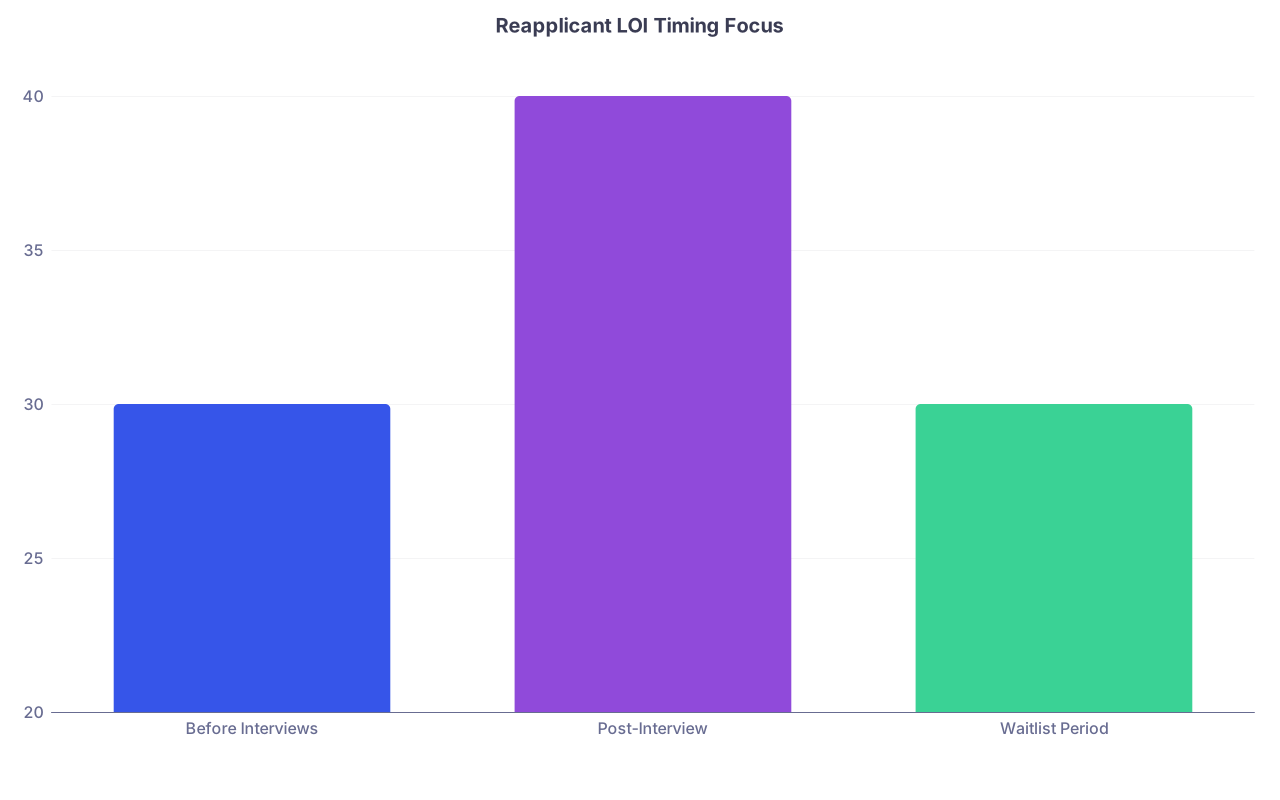
| Category | Value |
|---|---|
| Before Interviews | 30 |
| Post-Interview | 40 |
| Waitlist Period | 30 |
For reapplicants:
Interviewed last year, no interview yet this year
Send 1 LOI/update mid-season once you have real new content (e.g., after new grades or hours accumulate, usually December–January).Currently on hold / under review
One focused update/LOI 6–8 weeks after complete, or when a significant milestone hits (MCAT retake, big publication, end of a major course block).On waitlist
One LOI after waitlist notification that highlights growth relevant to starting this August (recent clinical, coursework, MCAT, employment).
Do not spam. One strong letter per school per cycle is usually enough. If you send a second, it should be because something big happened (MCAT retake, new degree, major promotion), not because you’re anxious.
Step 7: How to Explicitly Show “Real Growth” (Not Just Activity)
Schools do not care that you’re busier. They care that you’re better prepared.
So you need to frame growth in three dimensions:
- Capacity – Can you handle the workload and complexity?
- Clarity – Do you now understand what this career actually looks like?
- Character – Did you respond to rejection with responsibility and humility?
You can write to each of these without being melodramatic.
Capacity example:
Balancing a full post-bacc course load with my ED scribe role has pushed me to refine how I study and manage my time. I moved from passive rereading to active retrieval practice and structured review sessions, which is reflected in my MCAT increase from 509 to 514. I feel more confident in my ability to absorb and apply large volumes of information quickly, which I know is critical in your curriculum.
Clarity example:
When I applied last year, most of my understanding of medicine came from shadowing and secondhand stories. Working night shifts as an EMT this year has given me a more realistic view of the emotional and logistical demands of clinical practice—the fatigue, the difficult conversations, the uncertainty. I still want this career, but in a more grounded way.
Character example (do not overdo it, but do not hide it):
Not matching last cycle was disappointing, but it forced me to confront the gaps in my preparation. Rather than reapplying immediately with the same application, I chose to step back for a year to strengthen my academics and gain deeper clinical exposure. That decision has been humbling and ultimately clarifying; I am less focused on “getting in” and more focused on being ready to serve patients on day one.
That’s how you show growth. You combine what you did with what it changed about how you operate and think.
Step 8: A Concrete Before-and-After LOI Example
Let me show you what “bad” vs “better” looks like for a reapplicant LOI snippet.
Weak version (what I actually see all the time):
Dear Admissions Committee,
I am writing to express my continued interest in your institution. I applied last cycle and was unfortunately not accepted. Over the last year I have reflected deeply and grown tremendously as a person and future physician. I have continued to shadow and volunteer and remain passionate about medicine. Your school’s commitment to excellence and research is unparalleled and I would be honored to attend. Please consider my sincere letter of intent.
Sincerely…
Nothing new. No numbers. No insight. Useless.
Stronger version (same person, but specific and grounded):
Dear Members of the Admissions Committee,
I applied to [School] in the 2023–2024 cycle and appreciated the opportunity to be considered. I am writing as a reapplicant to share how my candidacy has changed over the last year and to reaffirm that [School] is my first-choice program.
Since my previous application, I have addressed two key weaknesses in my file: limited sustained clinical experience and an uneven academic record in the sciences. I completed 12 credits of upper-level biology and physiology with a 3.8 GPA, raising my BCPM GPA from 3.38 to 3.52. These courses, taken while working 25 hours per week, have helped me build more disciplined study habits and confidence in my ability to handle a rigorous medical curriculum.
Clinically, I moved from short-term shadowing to a longitudinal role as a medical assistant at [Community Clinic], where I have accumulated 280 hours since last June. In this role, I room patients, obtain histories, manage medication refills, and coordinate referrals, often for uninsured patients with multiple chronic conditions. This experience has given me a more realistic understanding of primary care and strengthened my communication skills with patients who may initially be distrustful of the healthcare system.
These changes have also clarified why [School] is where I hope to train. My work at [Community Clinic] aligns closely with your [Underserved Communities Track] and your longitudinal primary care placements at [Partner Clinic]. I would welcome the chance to contribute my experience navigating language barriers and social determinants of health to those settings, while continuing to grow under the mentorship of faculty engaged in community-based care.
If offered admission, I would immediately commit to matriculating at [School]. Thank you for your time and for reconsidering my updated application.
Sincerely,
[Name]
AAMC ID: [ID]
Same person. Same basic reality. But one version shows “I actually did the work,” the other just asks for another chance.
Step 9: Common Ways Reapplicants Sabotage Their LOIs
Let me save you from the usual mistakes.
Apologizing excessively for last cycle
One short acknowledgment is enough. You do not need a confession letter.Complaining about the process
Anything like “I know the process is competitive and sometimes arbitrary...”—delete it. They don’t want commentary on their process.Over-explaining personal hardship as the only growth
Context is fine. But if your “growth” is only “I suffered more,” with no change in skills, mindset, or academics, it lands flat.Using the same generic LOI for multiple schools
They can tell. It sounds like it. You mention no specific programs, locations, or features. You’re just begging.Writing a novel
One page, maybe 1.25 at most. Cut fluff. They are not reading a memoir in March.
Step 10: Decide If You Should Even Be Using LOIs This Cycle
Brutal but necessary: some reapplicants should not be spending energy on LOIs yet. They should be rebuilding their profile more.
If this describes you:
- No new coursework or MCAT improvement
- No significant new clinical or service hours
- Same letters, same activities, same story
- Only “change” is “I’m more determined now”
Then LOIs are not your main problem. Your problem is that you tried to reapply too soon, with essentially the same file.
In that scenario, the best “LOI strategy” is to pause, take another year, and create the growth you’d want to be able to describe. LOIs amplify what exists; they do not create it.

| Step | Description |
|---|---|
| Step 1 | Reapplying This Year |
| Step 2 | Do not send LOIs yet - build profile |
| Step 3 | Send targeted LOI with growth |
| Step 4 | Skip LOI, focus on other schools |
| Step 5 | Have you improved MCAT, GPA or clinical? |
| Step 6 | Did this school show interest before? |
| Step 7 | Does your new profile fit school better now? |

Step 11: Put It All Together in a Simple Checklist
Before you send any reapplicant LOI, ask yourself:
- Have I clearly stated that I’m a reapplicant and anchored the context?
- Have I specified concrete growth since last cycle (numbers, roles, outcomes)?
- Have I connected that growth to this school’s specific programs or mission?
- Have I kept the tone professional, focused, and under ~1 page?
- Have I avoided self-pity, complaints, or vague statements of “passion”?
- Am I sending this at a reasonable point in the cycle (not every 2 weeks)?
If you can’t check most of those boxes, you’re not ready to hit send yet.

Bottom Line
If you’re reapplying and using LOIs, do three things:
- Own your past application and show real, measurable growth—in academics, clinical exposure, or both.
- Tie that growth directly to each school’s specific programs and mission, not generic flattery.
- Write like a professional peer, not a desperate applicant—clear, concise, grounded in what you actually did, not what you wish they believed.
Do that, and your LOIs stop being noise and start being evidence. And that’s what moves the needle for a reapplicant.