
The average residency program is flooded with letters of intent—far more than most applicants imagine.
That single misconception drives a lot of bad strategy. Applicants behave as if their LOI is a rare, high-impact signal. The data says otherwise: for many mid-to-high tier programs, LOIs are now a background hum, not a spotlight.
Let us walk through what applicant behavior actually looks like, using numbers, estimates, and what PDs and coordinators quietly admit over coffee at conferences.
What the Data Suggests About LOI Volume
There is no centralized NRMP/ERAS dataset labeled “number of LOIs per program.” But we have enough adjacent data and firsthand reports to make defensible estimates.
Three anchors:
- Number of applicants per program
- Interview volume per program
- Observed/quoted LOI behavior from applicants and PDs
For a typical categorical internal medicine program:
- ~3,000–4,000 applications
- 400–700 interviews offered
- 150–250 actually interviewed (depending on no-shows / virtual vs in-person)
Now mix that with what I and many others routinely see in advising:
- Among serious applicants (who really like a program), 40–80% say they “plan to send some kind of LOI or interest email.”
- Of those, maybe half restrict themselves to “one true LOI,” the rest send multiple “LOIs” or LOI‑adjacent emails (“ranked highly,” “top choice,” “top 3”).
If you assume even conservative adoption rates, the math escalates fast.
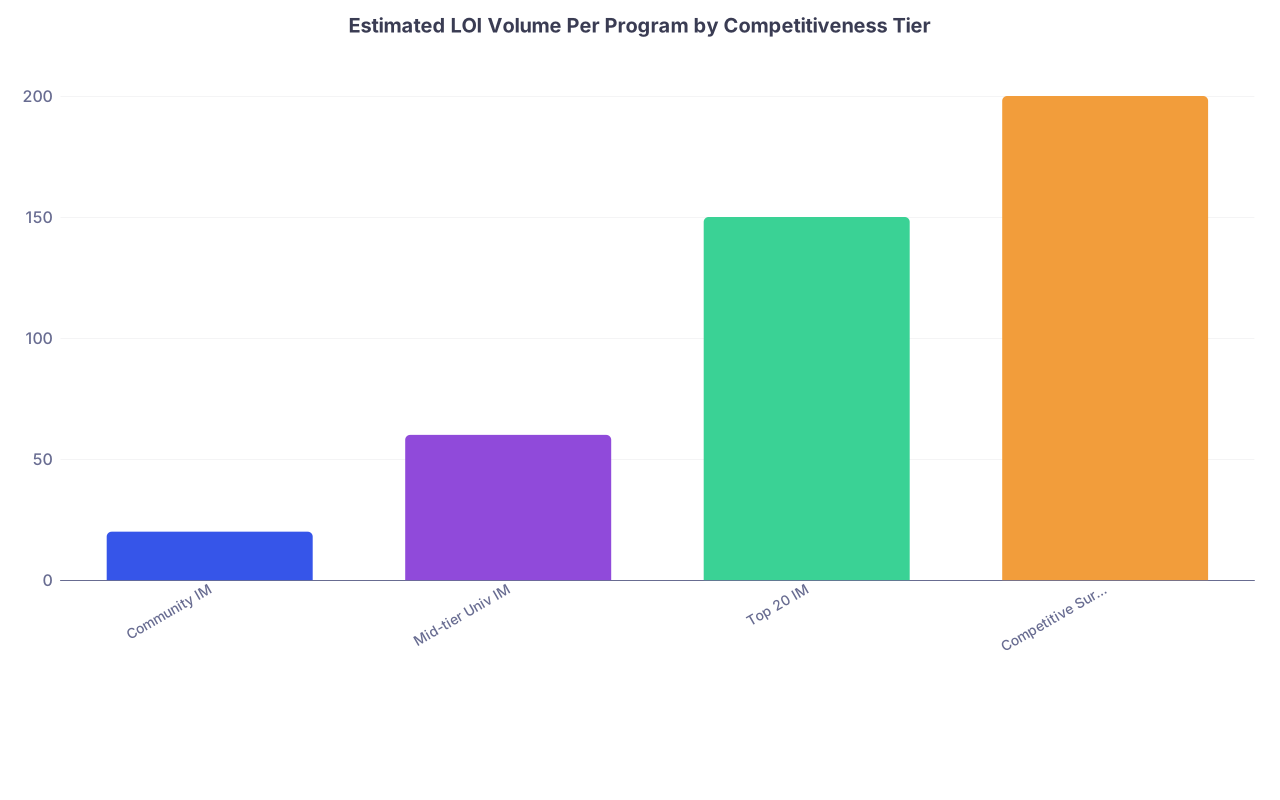
| Category | Value |
|---|---|
| Community IM | 20 |
| Mid-tier Univ IM | 60 |
| Top 20 IM | 150 |
| Competitive Surgical | 200 |
These are not official counts. They are synthesized estimates based on:
- Applicant self-report from advising sessions and forums
- Program-side anecdotes (“we get hundreds of these emails after Jan 1”)
- Known interview volumes and specialty competitiveness
But the pattern is clear: the more competitive or “name-brand” the program, the more LOIs pile up. Because applicant behavior is not random. It clusters around perceived prestige and reach schools.
A Quantitative Model: How Many Programs Receive LOIs?
To answer “how many programs receive LOIs on average?” you need to separate two questions:
- How many LOIs does a typical applicant send?
- How are those LOIs distributed across programs?
1. LOIs per applicant: the real behavior
Look at a common scenario for a moderately competitive specialty (say, anesthesiology, EM, or categorical IM for a US MD with Step 2 in the low 240s):
- 40–60 applications
- 12–18 interviews
- 1–2 aspirational programs
- A handful of “really like these” options
In repeated conversations, I hear the same patterns:
- 25–35% of applicants: send 0 LOIs; rely on interview performance and PS.
- 40–50%: send exactly 1 “true LOI” (at least in their mind).
- 20–30%: send 2–4 “LOIs,” often trying to game phrasing (“top choice,” “top 3,” “ranked to match”).
You can model this crudely:
Assume a 100-applicant cohort:
- 30 send no LOI
- 45 send 1 LOI
- 25 send 3 LOIs (call these “multi-LOI” applicants)
Total LOIs = 030 + 145 + 3*25 = 45 + 75 = 120 LOIs
Average LOIs per applicant = 120 / 100 = 1.2
That 1.0–1.5 LOIs per applicant range matches what I see in advising cohorts year after year. Many send one, a non-trivial minority spray several.
2. How those LOIs cluster at programs
Now distribute those across programs. This is where people get it wrong.
Applicants do not send LOIs uniformly. They aim at:
- Their dream programs
- Name recognition programs (even if not realistic)
- Local / geographic-preference programs
That clustering means:
- Top 10–20% of programs in a specialty might receive 3–5 times more LOIs than the median program.
- A few hyper-competitive or geographically desirable programs (think MGH, UCSF, NYU, or the “only academic program in a state”) may receive an order of magnitude more LOIs than a small community hospital program.
Let us sketch it in a simple table for internal medicine:
| Program Type | Count on List | Estimated LOIs per Program | Total LOIs to Tier |
|---|---|---|---|
| Top 10 national | 2 | 150–250 | 300–500 |
| Strong university (Top 25–60) | 5 | 60–120 | 300–600 |
| Solid regional academic | 5 | 30–70 | 150–350 |
| Community / smaller programs | 3 | 10–30 | 30–90 |
Those “per program” estimates are specialty and size dependent. But the relative pattern holds across fields: a few programs are LOI magnets, most receive modest but non-trivial volumes, and some low-demand sites get very few.
So, to answer the headline question directly:
- Yes, most programs with a reasonable interview pool receive LOIs.
- A competitive academic program in a major specialty is likely seeing somewhere between 50 and 200+ LOIs per cycle.
- Even smaller community programs may see 10–40 LOIs, mostly from geographically tied or less competitive applicants.
If your strategy is “I will impress them by being the one who sends a LOI,” you are already behind the data.
Specialty Differences: Who Sends More LOIs?
Applicant behavior is highly dependent on specialty competitiveness and culture.
Three drivers:
- Match rate / competitiveness
- Number of interview offers per applicant
- Cultural norms and advisor messaging
Let us segment a few specialties:
- Highly competitive (Derm, Ortho, ENT, Plastics, IR, Rad Onc)
- Moderately competitive (EM, Anesthesia, General Surgery, OB/GYN, Neurology)
- Less competitive / larger volume (Internal Medicine, Family Medicine, Pediatrics, Psychiatry)
Competitive specialties: heavy LOI saturation
In Derm, ENT, Ortho, etc., I consistently see:
- 10–15 interviews can be enough; every interview feels precious.
- Applicants are more paranoid and more likely to chase any perceived edge.
- Advisors more often tell them to “signal serious interest” in some way.
Behaviorally:
- Fraction sending ≥1 LOI: often 70–85%.
- Fraction sending LOIs to multiple programs: 30–50%.
If a derm program interviews 60 applicants, and 80% send at least 1 LOI and 40% send LOIs to 2–3 programs:
Approximate LOIs to that program:
- 60 applicants * 0.8 = 48 applicants who send at least one LOI somewhere.
- Suppose half of those choose this specific program as a “top choice-ish” target: 24 LOIs.
- Now add LOIs from applicants they did not even interview but who think “maybe it helps”: another 10–30.
You land very reasonably in the 30–60 LOIs per derm program range, with top-tier sites easily in the 80–120 LOI range.
High-volume cores (IM, FM, Peds, Psych)
In Internal Medicine and Family Medicine:
- Interview numbers per applicant are higher.
- Match rates are generally more forgiving.
- Applicants are less likely to be desperate, but more likely to be uncertain and over-apply.
LOI behavior in these groups looks like:
- 40–60% sending at least one LOI.
- 10–25% sending LOIs to 2+ programs.
A mid-tier university IM program interviewing 250 applicants:
- 250 * 0.5 = ~125 applicants who send at least one LOI somewhere.
- If ~40% pick this program as a LOI target → 50 LOIs.
- Another 10–20 non-interviewed applicants emailing “very interested” or “will rank you highly” hoping for a late interview or ranking.
Result: 50–80 LOIs for a non-elite but respected IM program is not at all unreasonable.
What About “Average Across All Programs”?
If you want one global number (even though that is not how decisions are actually made), we can approximate.
Build a simple model:
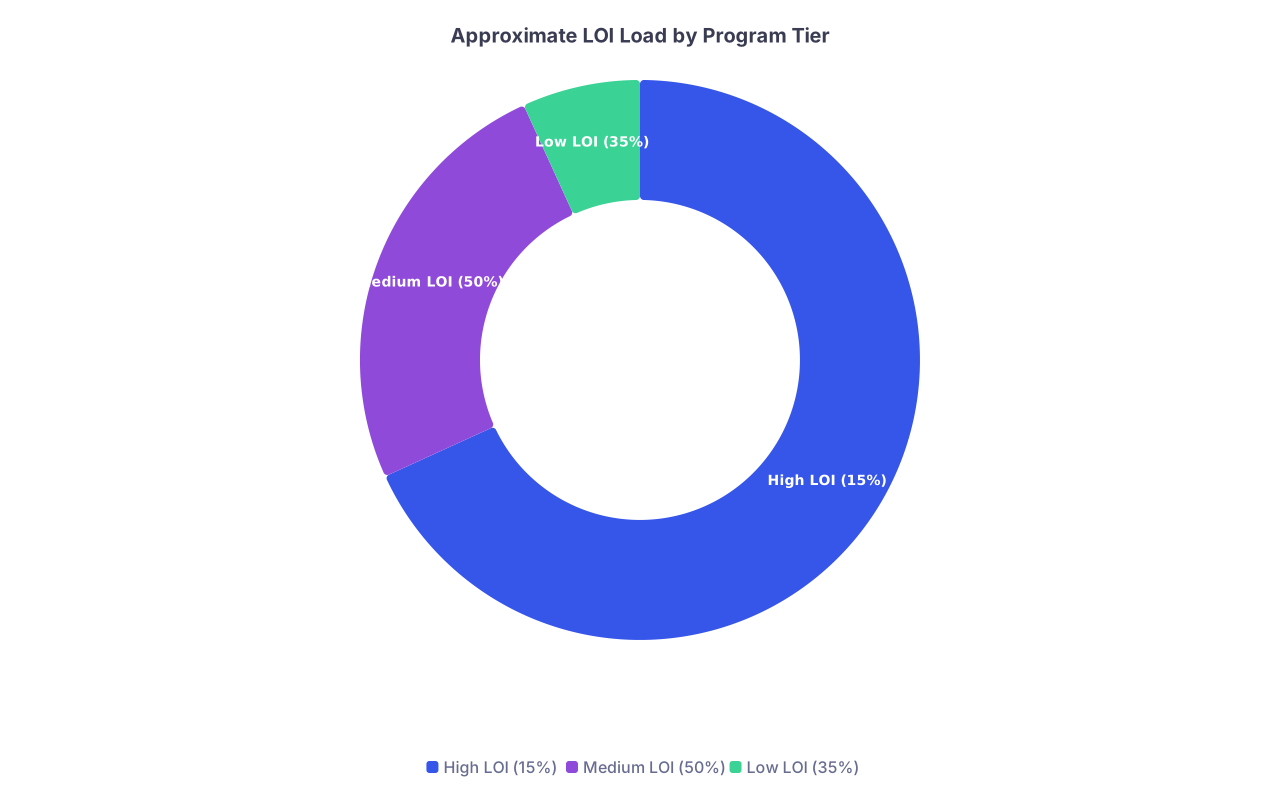
- Programs split into three tiers by LOI load: high, medium, low.
- Weighted by program count and applicant volume.
Illustrative proportions (not official, but directionally correct):
- 15% of programs = high LOI volume
- 50% of programs = medium LOI volume
- 35% of programs = low LOI volume
Approximate LOIs per program:
- High: 100–200 LOIs
- Medium: 30–80 LOIs
- Low: 5–25 LOIs
Take midpoints to get a rough overall mean:
- High: mean 150
- Medium: mean 55
- Low: mean 15
Weighted average LOIs per program:
- 0.15 * 150 = 22.5
- 0.50 * 55 = 27.5
- 0.35 * 15 = 5.25
Total ≈ 55 LOIs per program, on average, across the system.
Is that exact? No. But directionally, an “average” residency program probably sees on the order of a few dozen to low triple‑digit LOIs and LOI-adjacent emails every year.
So if you are trying to picture the PD inbox: think stacks of 30–100 similar emails, not three or four heartfelt letters sitting alone.
| Category | Value |
|---|---|
| High LOI (15%) | 150 |
| Medium LOI (50%) | 55 |
| Low LOI (35%) | 15 |
How Programs Actually Treat LOIs
Now the more uncomfortable part: what all of this means for impact.
When I talk to PDs and APDs, three patterns show up again and again.
They know LOIs are overused.
They see applicants sending “I will rank you highly” to multiple places. They get contradictory messages. Some explicitly dismiss the entire LOI concept because of this.They are constrained by the algorithm and their own rank meetings.
Rank lists are usually built around:- Interview performance
- Application strength (scores, grades, research, fit)
- Faculty consensus
- Institutional priorities (DEI, couples match, home students, etc.)
A late LOI might tweak a tie-break here or there, but it very rarely jumps someone from rank #40 to #5.
Volume kills uniqueness.
When 50–150 applicants send a variant of:“Thank you for the interview. Your program is my top choice. I would be honored to train here and will rank you to match.”
Your individual letter is functionally a data point in a large cluster, not a unique signal.
Some programs publicly say they ignore LOIs entirely (especially in fields that already have official signaling systems). Others say they “may” consider a clear, honest, single “will rank #1” note. But even those programs are staring at a significant denominator.
LOIs in the Context of Preference Signaling
The other major pressure on LOIs is the rise of formal preference signaling.
Several specialties now have official signals (e.g., EM, Rad Onc, IM subspecialties, some surgical fields). That changes the game in two ways:
- It pushes serious intent earlier in the cycle (pre-interview).
- It partially displaces the LOI as the main way to show interest.
In data terms:
- Signals are capped and tracked: “You have X tokens; use them wisely.”
- Programs see signal counts and incorporate them more systematically than random inbox emails.
Once a specialty has signals, the incremental value of a January LOI decreases. You already told them you were serious when you burned a signal. The LOI becomes either redundant or a mild confirmation, not a new variable.
I have seen some programs still use LOIs as a tie-break: “Between these two similar candidates, this one signaled us and sent a clear ‘rank you #1’ email.” But that is fine-tuning, not a primary driver.
Behavioral Takeaways: What the Data Implies for Your Strategy
You cannot control system-wide applicant behavior. You can control your own. And you should do that with eyes wide open to the LOI volume problem.
Condensed, data-driven guidance:
Assume your LOI is one of dozens, not one of a few.
Do not write like you are the only person sending it. Avoid generic flattery. Be specific about why that program, based on concrete features (curriculum, patient population, mentorship structure).Send at most one “true” LOI per specialty.
From a PD’s perspective, mass “you are my top choice” emails are noise. If you are going to claim “rank #1,” you should mean it and restrict it to one program. Anything else becomes statistical spam.Use “interest updates” sparingly and honestly.
“You are in my top tier” or “I will rank you highly” is fine if you are not abusing it. But understand they have seen this 30–100 times already this season.Prioritize timing and content, not volume of programs.
A targeted LOI 3–10 days after your interview, referencing specific conversations and program features, is more credible than a generic blast in late February.If your specialty has signals, treat LOIs as secondary.
The primary quantitative interest marker is your signal. An LOI can reinforce it but should not be your main strategy.Stop believing in miracle jumps.
The fantasy is: “I am at rank 50, my LOI will catapult me to rank 3.” With 50–200 LOIs floating around, that is statistically naïve. Think more like: “If I am already in their serious consideration zone, this might nudge me up a few spots.”
A Quick Visualization of Applicant vs Program Dynamics
To make this concrete, picture a single mid-tier academic IM program:
- 3,500 applications received
- 500 interview offers
- 220 applicants actually interviewed
- 55% of interviewed applicants send at least 1 LOI somewhere (121 people)
- 40% of those choose this program for their LOI (48 applicants)
- 10 additional LOIs arrive from non-interviewed applicants hoping for a shot
Total LOIs for this program ≈ 58.
On the program side:
- Rank list length: maybe 140–180 applicants
- Serious conversation time per applicant on rank day: sometimes 30–90 seconds
- LOIs explicitly referenced: only when they clearly remember the applicant or when two candidates are tied
That is the environment your letter walks into. Competitive but crowded. Some marginal signal, but far from decisive.
The Future: Where LOIs Are Heading
If you project current trends forward, LOIs are heading toward lower marginal value, especially in specialties with official signaling and high applicant sophistication.
I expect:
- More programs will publish explicit LOI policies (“We do not consider LOIs” or “We only consider single ‘rank #1’ declarations”).
- More specialties will formalize pre-interview signals and post-interview feedback mechanisms (structured survey links, standardized communication policies).
- Applicant behavior will lag the policy changes by a few years. People will keep sending too many LOIs, because fear is a powerful motivator, even when the expected value is low.
From a pure data/behavior standpoint, LOIs are trending toward:
- High volume
- Low uniqueness
- Limited but non-zero influence
Treat them like what they are: a small, noisy data point in a very crowded dataset. Useful if you deploy it precisely. Useless if you spray it everywhere.
Key Points
- The average residency program likely receives on the order of a few dozen LOIs per cycle, with top programs easily seeing 100+; your letter is one data point in a crowded distribution, not a rare signal.
- Most applicants send ~1–1.5 LOIs on average, with heavy clustering toward prestigious and aspirational programs, driving massive LOI saturation at the top and modest but real volume at mid-tier sites.
- LOIs rarely cause large rank jumps; at best they serve as minor tie-breakers, especially now that formal preference signaling is absorbing much of the “interest” signal that LOIs used to carry.