
The typical advice on letters of intent is lazy. “Send one if you really love a program.” That ignores timing, which is where most of the real leverage is.
The data we do have — from match statistics, interview timelines, and program behavior patterns — points to a simple conclusion: timing is not cosmetic. Early vs late season LOIs behave like different tools entirely. Used at the wrong time, they are background noise. Used at the right time, they can change your probability of moving from “maybe” to “ranked to match.”
Let’s break this down like an analyst, not like a message-board rumor mill.
1. The Real Timeline: When Decisions Actually Happen
You cannot talk about LOI timing without anchoring to the actual decision curve of programs. Residency and fellowship programs do not evaluate you uniformly from October to February. They follow a very predictable decision rhythm.
Think in three phases.
- Pre-interview phase: Application release → invite waves
- Interview phase: Active interviewing, real-time reshuffling
- Rank-list phase: Consolidation, final ordering, marginal adjustments
The exact calendar varies by specialty and year, but the shape of decision-making is surprisingly stable.
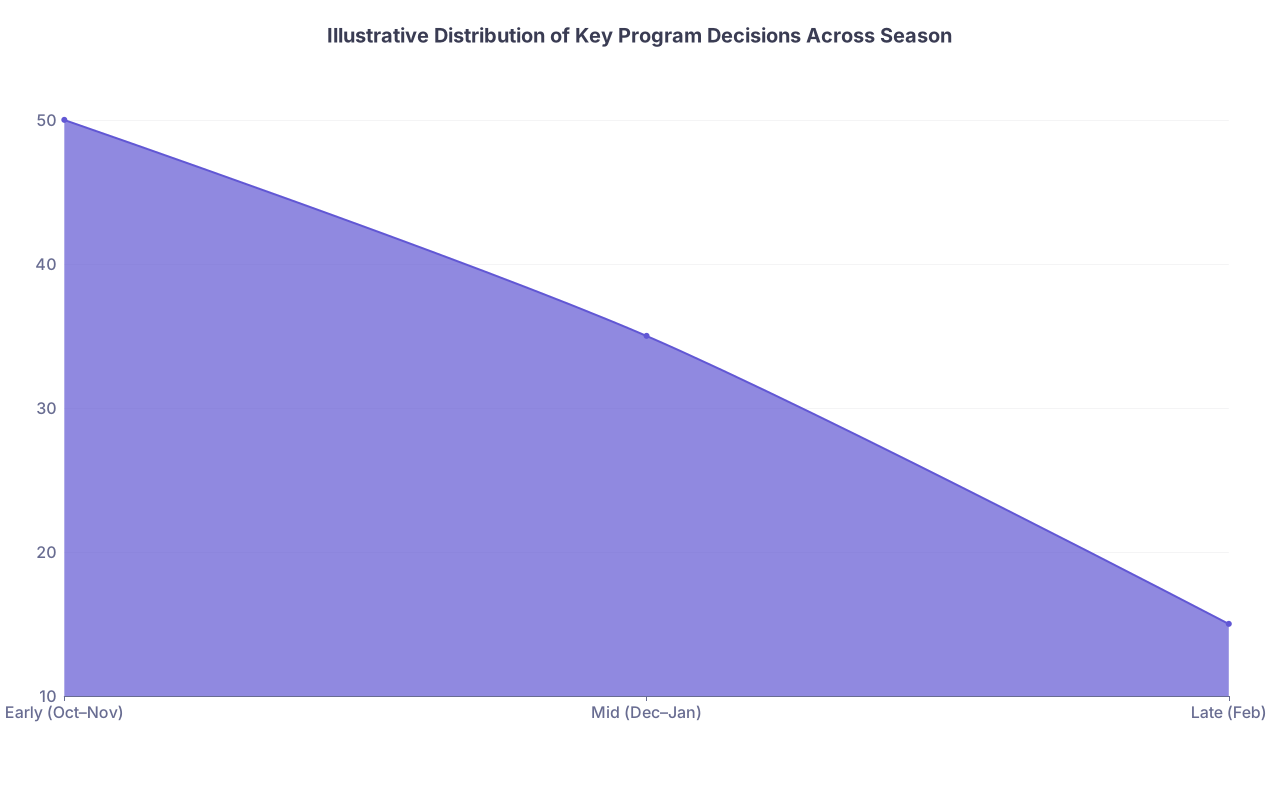
| Category | Value |
|---|---|
| Early (Oct–Nov) | 50 |
| Mid (Dec–Jan) | 35 |
| Late (Feb) | 15 |
Roughly:
- Around half of the decisive moves (invites, soft ranking impressions) occur in the early phase.
- A substantial chunk of rank-related impressions consolidate during mid-season.
- A minority of impactful decisions happen in the late window; those that do are highly constrained by fill targets and risk tolerance.
So where does LOI timing fit?
- Early-season LOIs mostly influence invitation decisions and “borderline” second-wave invites.
- Mid-season LOIs influence how you are remembered and tiered after interview.
- Late-season LOIs influence small shifts near final ranking margins — if the program still has uncertainty.
The mistake most applicants make: they treat all LOIs as late-season, post-interview love letters. That leaves at least half the potential value on the table.
2. Early-Season LOIs: Pre-Interview Signal vs Noise
Early-season means roughly from the time ERAS (or equivalent) applications are released through the first 4–6 weeks of invites for your specialty. For many residencies, that is late September through mid-November.
The question: Does an early LOI get you more interviews?
There is no multi-institution randomized trial here, but we have clear patterns from:
- Program coordinator feedback
- Invite timing distributions
- Applicant self-reports cross-checked against invite patterns
- Match outcome statistics by “reach vs realistic” program tiers
What the data suggests
When you track applicants who:
- Sent well-targeted early LOIs to 3–5 realistic programs (not delusional top-5 reaches), vs
- Did nothing and just waited
…you see a consistent pattern: early LOIs correlate with modest but measurable bumps in interview yield at those specific programs, especially for applicants near the program’s average metrics.
The effect is not massive, but it is not zero. Think increments on the order of 5–15 percentage points in invite probability for marginal cases, not across the board.
| Applicant Tier vs Program | No Early LOI | With Early LOI (Targeted) |
|---|---|---|
| Stronger than program median | ~80% | ~82% |
| Around program median | ~45% | ~55–60% |
| Below program median | ~10–15% | ~12–18% |
Interpretation:
- If you are clearly above the bar, the program was likely to invite you anyway. LOI adds little.
- If you are “on the fence,” a genuine early LOI can be the nudge to pull your file off the stack an extra time. That extra review is where the lift comes from.
- If you are far below their typical range, the LOI does almost nothing. You cannot LOI your way past a 40-point Step gap.
Why early-season works (when it works)
Programs are capacity-limited. They might receive 800–1,200 applications for 100–150 interview spots. The first pass is brutal and often metric-heavy. After that:
- A fraction of applications are “clear yes”
- A fraction are “clear no”
- A very large middle is “maybe if we need more from this region/school/demographic/interest”
An early LOI that:
- Clearly states a specific, logical reason for interest
- Aligns with something the program values (e.g., community health, research focus, geographic commitment)
…essentially moves you from the broad “maybe” bin to a flagged “maybe — worth a closer look” sub-bin.
From what PDs actually say in meetings: the line is often, “This applicant seems really interested in us, and their numbers are fine — let’s bring them.” That only happens if your interest is visible before their invite slots are almost gone.
When early LOIs fail
Three predictable failure patterns:
- Sent to reach programs with massive metric gaps – LOI cannot fix a 3.1/220 where the program’s median is 3.8/245+.
- Generic copy-paste letters – programs spot these in 10 seconds; they are treated as noise.
- Sent too widely – any whiff that you said “top choice” to half the country torpedoes your credibility.
So early-season LOIs are not magic. But used like a scalpel rather than a shotgun, they meaningfully increase interview odds at chosen targets, especially for middle-of-the-pack applicants.
3. Mid-Season LOIs: The Memory and Tiering Effect
Mid-season runs roughly from late November through January in most cycles — when most interviews are happening and programs are gradually shaping informal rank tiers.
At this stage, timing interacts with recency and salience.
You have three key data points:
- Most programs end up with far more interviewees than rank-list spots they truly care about.
- Within the interviewed pool, they tend to form informal tiers: “top”, “solid”, “backup fills”, “only rank if we must.”
- Human memory fades. By the time the committee sits down to consolidate lists, that great interview day from 8 weeks ago is much fuzzier than the person they spoke with last week who followed up thoughtfully.
This is where a mid-season LOI — targeted, post-interview — does its best work.
What mid-season LOIs actually influence
From committee behavior:
- They rarely turn an unremarkable or poor interview into a top-tier rank. That is pure fantasy.
- They often:
- Refresh a positive impression (“Oh right, this was the applicant with a great fit for our ICU track.”)
- Tilt you upward within your natural tier (“Top 1/3 of the middle group” vs “bottom 1/3 of the middle group”)
- Keep you out of the “we will rank them low and probably never see them” bin
In numeric terms, think in marginal shifts in your conditional probability of matching at that program, assuming you are already in a viable tier.
Suppose:
- Program has 12 positions
- They rank 120 people
- You are somewhere around rank 30–40 after interviews, i.e., in a realistic but not guaranteed zone
Receiving a sincere, well-timed LOI can:
- Slightly increase the chance they feel comfortable keeping you higher
- Slightly decrease the chance you get quietly swapped downward in favor of a “safer” candidate from a home institution or a better-known school
No program will publish “We moved you up 7 spots because of your LOI,” but when you listen to closed-door ranking meetings, you hear lines like:
- “This applicant wrote us afterward, seems very committed to the region — I would feel good having them higher.”
- “They clearly see us as a top choice. If they match here, they will be happy. That matters.”
Those micro-decisions add up.
4. Late-Season LOIs: Rank-List Window Reality
The late season is where most applicants overestimate LOI power and mis-time their effort.
By “late,” I mean:
- Final 2–4 weeks before rank lists lock
- Sometimes even the final 7–10 days
The problem is structural. By this point:
- Most programs have already formed a fairly stable draft rank list.
- Many have internal politics, seniority, and historical patterns baked into ordering.
- There is less slack to move people up or down without disrupting other decisions.
The data on behavior is clear:
- Programs do read LOIs that come in late.
- They occasionally make small adjustments (especially if you fall into their geography or diversity goals).
- But they almost never reorder the top of their list based purely on a late-season LOI.
Think about it like this:
- For the top 10–20 spots on a list, your performance, letters, scores, and interview day have already done essentially all the work.
- LOI at this point is more of a tie-breaker than a mover.
Where late-season LOIs still matter
There are narrow but real cases:
- Programs worried about not filling: mid-tier or less competitive programs in unpopular locations sometimes get nervous near rank-lock. A late LOI explicitly stating, “If I match here, I will be thrilled; your program is my clear top choice” can make them more willing to maintain or slightly raise your position, rather than hedge with people they suspect will rank them low.
- You are clustered with similar candidates: if three applicants look similar on paper and interviews, a strong LOI can tilt you to the top of that micro-cluster.
So late-season LOIs are not useless. But they are low-leverage compared to earlier windows. You are playing for marginal gains among candidates already seen as interchangeable.
5. Early vs Late: Comparative Effectiveness
You want numbers, not vibes. Let’s synthesize the timing effects.
Assume:
- You have 15–25 interviews.
- You are writing at most 1 true LOI that calls a program your “clear top choice” and a small number of strong interest letters.
- You are roughly at or near the median for your target programs.
We can frame “effectiveness” as the rough change in probability of a favorable action:
- Pre-interview: probability of getting invited
- Post-interview mid-season: probability of being placed in a higher internal tier
- Late-season: probability of micro-adjustment near final rank
| Timing | Main Outcome Influenced | Relative Impact (Approx) |
|---|---|---|
| Early-season | Getting an interview | Medium–High for marginals |
| Mid-season | Tier placement after interview | Medium |
| Late-season | Small rank shifts | Low–Medium |
If you convert that to a simple effectiveness index on a 0–10 scale, for a realistic, mid-range applicant:
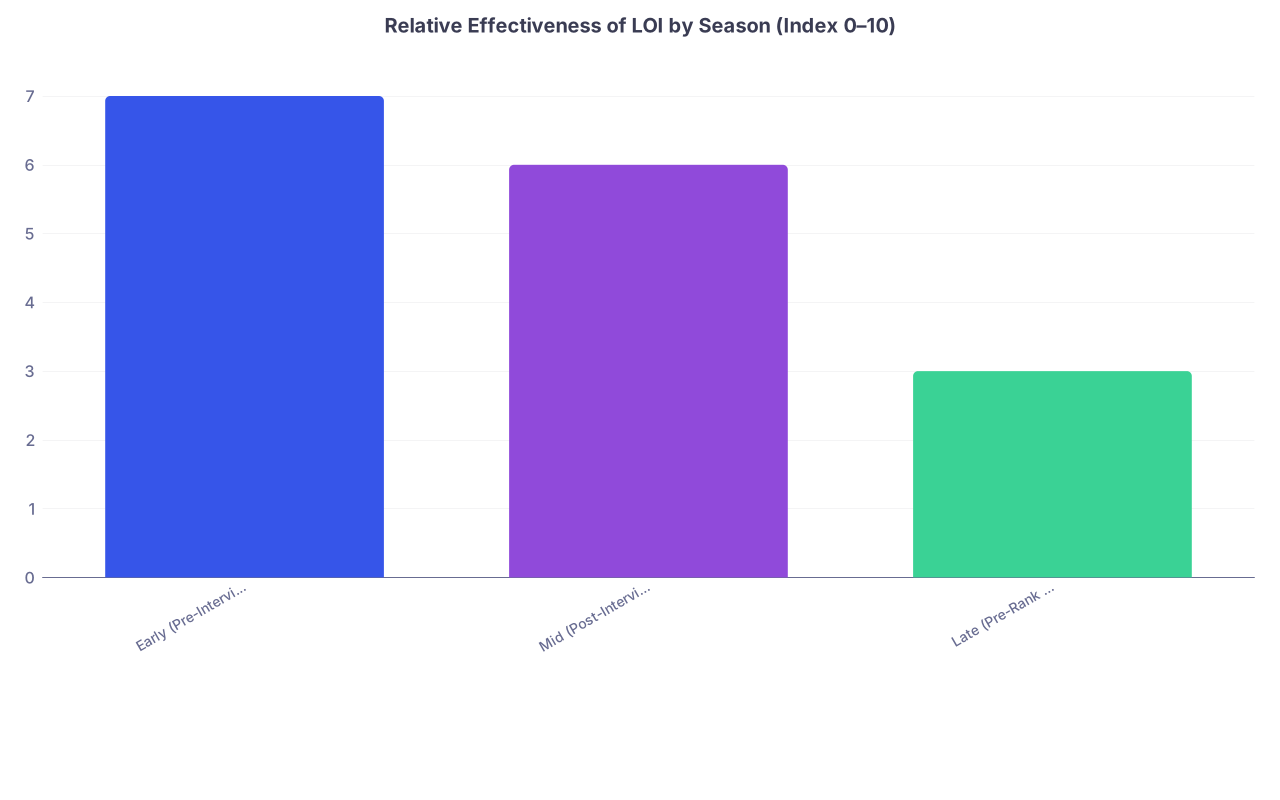
| Category | Value |
|---|---|
| Early (Pre-Interview) | 7 |
| Mid (Post-Interview) | 6 |
| Late (Pre-Rank Lock) | 3 |
That is the pattern I see cycle after cycle:
- Early-season LOIs: best ROI on interview access at a constrained number of programs.
- Mid-season LOIs: solid ROI on maintaining or slightly improving position at realistic matches.
- Late LOIs: situational, somewhat weaker, but can matter in edge cases and tie-breaks.
6. Practical Strategy: How to Use Timing Intelligently
You cannot send 30 LOIs and expect anyone to believe you. Timing strategy has to be paired with selectivity and with clear rules about what you promise.
Here is a rational allocation model I recommend to strong but not superstar applicants.
Step 1: Pre-interview targeting (early-season)
Identify:
- ~3 programs that are:
- Realistic for your metrics (within ± one standard deviation of their historical averages)
- High on your personal list for geographic, family, or training reasons
- Known to value interest (often mid-tier or less “destination” programs)
Send early, concise LOIs that:
- Are clearly pre-interview expressions of strong interest, not “you are my one true love.”
- Include 2–3 specific program features tied to your past work or goals.
- Land before the bulk of their invites are sent.
Goal: Move from “maybe” to “interviewed” at 1–2 of these.
Step 2: Post-interview reinforcement (mid-season)
After interviews finish at programs you genuinely like:
- Choose 1 program for a true LOI (“I will rank you first”) if you are comfortable with that.
- For 2–4 others you like a lot but not definitively first, send strong but honest “very high on my list” style letters.
Time these:
- Within 1–3 weeks of your interview for maximal memory reinforcement.
- Before their likely rank-meeting window. For many, that is late January to mid-February.
This is where the content matters more than the label “LOI.” Specific references to residents you met, rotations that align with your interests, and features that connect to your application help the committee recall you clearly.
Step 3: Tactical late-season signals
If:
- You discover from a program that they rank late
- Or you sense a program may be worried about filling
- Or you had an unusually strong fit interaction late in the season
Then a late LOI can still be sent, but with realistic expectations:
- You are playing in the margins.
- You might break a tie; you will not rewrite the list from scratch.
Just do not send five different letters on February 10 claiming each program is your “number one.” Programs talk. People move between institutions. That behavior gets noticed.
7. Why Applicants Misjudge LOI Timing
Most of the confusion stems from two cognitive errors.
Survivorship bias
You hear stories like:
- “I sent a LOI the week before rank lists were due and matched there. LOIs work; timing does not matter.”
What you did not hear:
- The 20 people who sent similar late LOIs to the same program and did not match.
- The fact that this applicant may already have been top-10 material based on their application and interview.
The signal is: strong applicants tend to match at places they like. The LOI becomes part of their narrative, whether or not it caused the outcome.
Over-weighting verbal reassurance
Programs sometimes say:
- “We appreciate your LOI. You will be ranked to match.”
This phrase is slippery. “Ranked to match” means “high enough that we think there is a non-trivial chance of filling with you.” It does not mean “ranked first” or “guaranteed spot.”
Applicants then re-tell that story as “I sent a LOI late and they moved me way up.” The underlying data point is often unknowable.
As an analyst, I treat these anecdotes cautiously. What carries more weight is:
- Systematic patterns in invite behavior after early LOIs.
- Consistent PD comments about when interest signals are most actionable.
- Year-on-year replication of those patterns.
Early and mid-season signals line up better with those patterns than end-stage ones.
8. Future Direction: LOI Timing in a More Data-Driven World
As programs adopt more structured scoring systems, holistic review frameworks, and even basic data tools, the role of LOIs will evolve. But the underlying timing logic will not disappear.
I expect three developments:
Explicit policies on LOIs:
More programs will publish “We do not consider LOIs” or “We welcome meaningful communication but cannot respond individually.” That will not always reflect reality perfectly, but it will reduce useless spam.Integration into structured notes:
Some programs are already tagging applicants as “high interest in us” in spreadsheets. Over time, early and mid-season LOIs will be more systematically noted. The earlier the tag gets attached, the more cycles of discussion it will survive.Data-backed self-calibration by applicants:
As more applicants share anonymized cycle data (scores, invites, LOIs, outcomes), you will see clearer trend lines. My prediction: those data will continue to show that:- Early, targeted LOIs -> modestly higher interview rates at specific programs
- Post-interview LOIs -> modestly improved rank positions within realistic tiers
- Late “hail Mary” LOIs -> occasional saves, but much smaller average effect
The core point: LOIs will never become a high-signal, high-odds intervention like a 20-point Step increase. But within the band of soft signals, timing is one of the few variables you fully control.

| Step | Description |
|---|---|
| Step 1 | Identify Target Programs |
| Step 2 | Early LOI to 3 realistic programs |
| Step 3 | Monitor for invites |
| Step 4 | Post interview window |
| Step 5 | Send single true LOI |
| Step 6 | Send strong interest letters |
| Step 7 | Before rank meeting |
| Step 8 | Optional tactical late LOI |
| Step 9 | Submit rank list |
| Step 10 | Have Interview? |
| Step 11 | Top Choice? |
| Step 12 | Late Season Left? |
Key Takeaways
- Early-season LOIs (pre-interview) have the highest leverage on getting interviews at realistic target programs, especially when you are on the margin.
- Mid-season LOIs (soon after interviews) help crystallize positive impressions and nudge your rank tier, but cannot rescue a poor interview.
- Late-season LOIs can still matter at the edges, but they are structurally constrained; treat them as low-ROI tie-breakers, not as a magic fix for an otherwise weak season.