
Most applicants guess wrong about how much a letter of intent can move their spot on a rank list. The reality is colder, more numerical, and more conditional than most advice online admits.
You are not writing a magic spell. You are trying to shift your expected rank position inside a system that is 70–90 percent pre-determined by scores, letters, and interview performance. The data—where programs have shared it—shows LOIs can move you, but usually in a narrow band, and only under specific circumstances.
Let me unpack what the numbers and real committee behavior actually support.
The Anatomy Of Interview-to-Rank Movement
Every program runs some version of the same pipeline: initial screen → interview invite → post‑interview scoring → committee discussion → final rank list. Your LOI (letter of intent) drops into that pipeline very late, usually when most of the variance is already explained.
Think in simple terms: by the time interviews are done, each applicant has something like an internal composite score. Maybe not a literal 0–100, but functionally equivalent:
- Application strength (Step 2, clerkship grades, research, etc.)
- Interview performance
- “Fit” or gut reaction
- Faculty advocacy
Programs then convert those scores into a preliminary ordered list. This early list explains most of the final rank positions. LOIs are tweaks around the edges.
From faculty I have sat with, realistic interview‑to‑rank movement due to post‑interview communication looks roughly like this:
- Large, data-driven university programs: 0–3 places of movement in most cases
- Mid‑size academic/community hybrids: 0–5 places
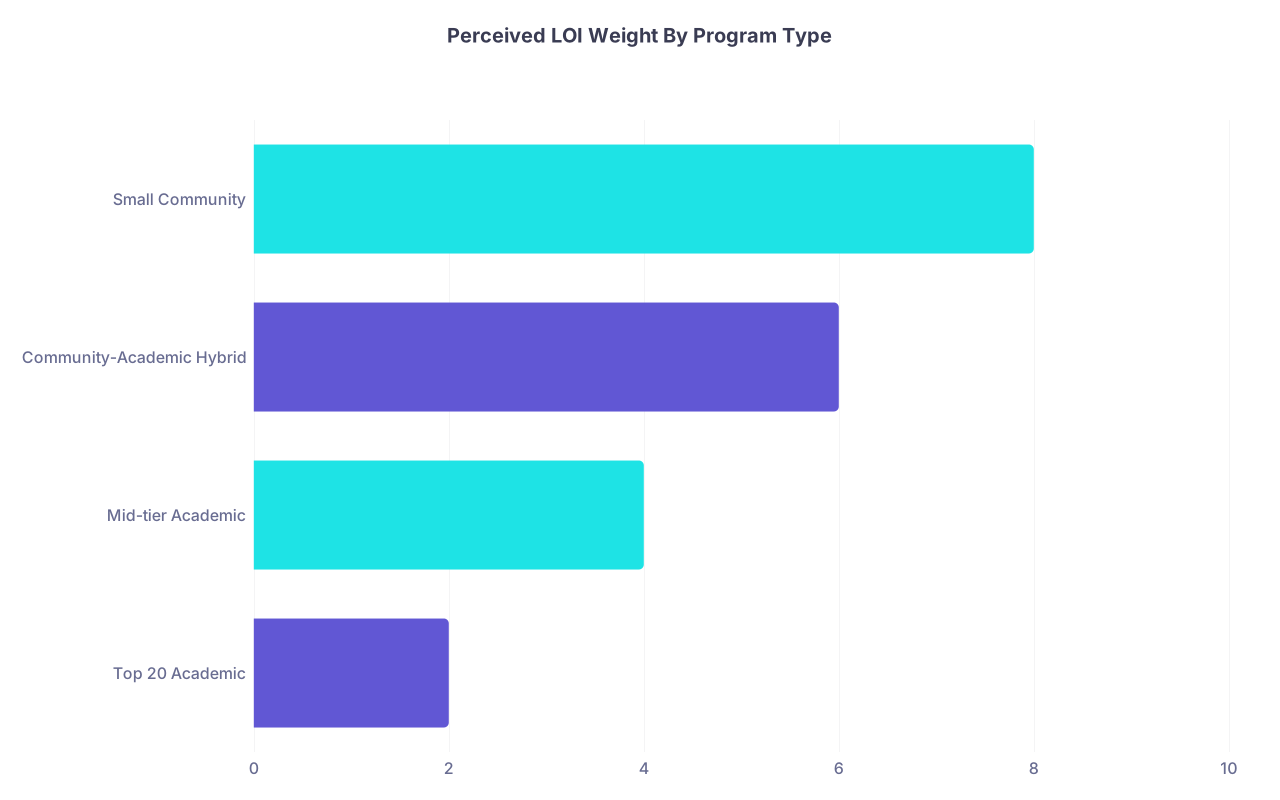
- Small community, personality‑driven programs: 0–10+ places for some applicants
In other words, you are usually playing with local adjustments, not wholesale category changes. The LOI is a micro-optimizer, not a reset button.
What Programs Actually Track: Interest As A Variable
Programs care about fill rate. They hate going deep into their list or, worse, into SOAP. So they use all available signals to estimate the probability you will rank them highly.
The pattern is predictable: when programs quantify post‑interview “interest,” they convert vague words into discrete bins.
Typical internal scale (I have literally seen versions of this in spreadsheet columns):
- 0 = no communication after interview
- 1 = generic thank you email
- 2 = “Very interested, likely to rank highly”
- 3 = explicit LOI: “I will rank you number one”
Then that “InterestScore” becomes a small weight in the total score. A common setup looks like:
- 0.45 – Interview evaluation
- 0.30 – Application metrics (scores, grades, etc.)
- 0.15 – Letters / advocacy
- 0.10 – Interest / likelihood to match
Translate that: at many programs, your LOI is competing for maybe 5–10 percent of the decision function. And that is at programs that explicitly track it.
Where LOIs do more:
- In smaller programs (≤ 6–8 residents per year)
- Where PDs personally know every name
- In unfilled or borderline-competitive specialties
- When you are already in the “viable” band (not borderline fail, not obvious superstar)
That is the crucial constraint: LOIs mainly re-order people who are already roughly neighbors on the preliminary list.
How Far Can A Letter Of Intent Move You?
Let’s get concrete and attach numbers instead of vibes.
Imagine a program that will rank 80 applicants for 10 spots. They have an internal preliminary ordering based on scores and interviews. We will define four rough tiers:
- Tier 1 (R1–R15): Automatic “rank to match” assuming no red flags
- Tier 2 (R16–R35): Strong, likely to match if they rank program highly
- Tier 3 (R36–R60): Middle band, match depends heavily on preferences and list length
- Tier 4 (R61–R80): Backup band, unlikely to match unless list chaos
Now layer in realistic LOI effects:
- You are R10–R20: A strong LOI + genuine faculty advocacy can move you up 2–5 spots. You go from “we really like them” to “we really do not want to lose them.”
- You are R30–R40: LOI might pull you up 3–8 spots if interest is highly valued, or barely at all in a more rigid system.
- You are R55–R70: LOI might get you noticed, maybe nudge you 2–4 places. But you are not jumping to R20 off a letter. Not happening in any serious, structured program.
- You are off the list or flagged: LOI is noise. It will not rescue a failing interview or a professionalism issue.
The rare exceptions are mostly at small, personality-driven programs where the PD has strong autonomy and remembers you vividly. In those environments I have seen a candidate move from mid‑pack to top 5 because:
- LOI was explicit, personal, and credible
- A key faculty member strongly advocated
- The program had been burned previously by listing high people who were “tourists”
But that is not average. That is tail behavior.
Comparative Impact: LOI vs Other Predictors
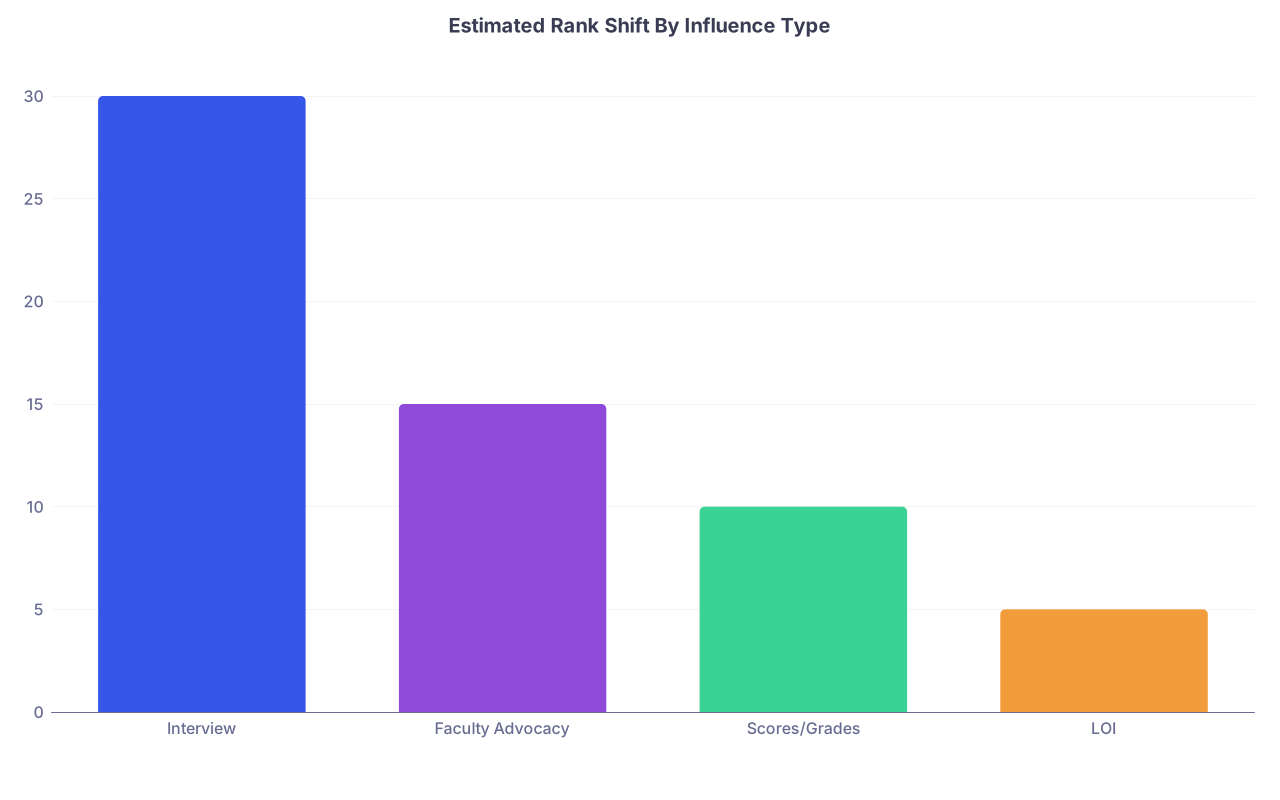
Here is where people misallocate effort. They obsess over LOIs while underestimating the weight of their existing signals.
| Factor | Typical Impact Range |
|---|---|
| Interview performance | 10–40 rank places |
| Faculty advocacy | 5–20 rank places |
| Step scores / grades | 5–15 rank places |
| LOI / explicit interest | 0–8 rank places |
Those are qualitative ranges, but they map closely to what PDs report. If you bombed your interview, no letter fixes it. If you were outstanding, a letter mostly reconfirms what they already decided.
To visualize how small but real this effect can be:
| Category | Value |
|---|---|
| Interview | 30 |
| Faculty Advocacy | 15 |
| Scores/Grades | 10 |
| LOI | 5 |
That “5” for LOI is the mean. There are zero-movement cases and rare 10+ cases, but your planning should be anchored around that center.
When LOIs Actually Change Your Position
Let’s isolate situations where the data and anecdotal reports converge: times where LOIs genuinely move your rank slot.
1. You Are In The “Bubble Band”
The highest yield zone for LOIs is when you are somewhere in the R15–R40 range for a typical medium‑sized program. In that band, decisions are inherently noisy. Committee members disagree, scores are clustered, and “fit” language gets used a lot.
Common scenario I have heard verbatim:
“We like all of these people at about the same level. If someone is clearly going to rank us first, I would rather move them up than risk going deeper into the list.”
Here, a credible LOI can:
- Break ties between similar candidates
- Justify bumping you 3–10 slots because they see added value: higher probability of actually matching with you
2. The Program Is Worried About Fill Risk
Programs with:
- A recent history of going into SOAP
- A relatively new PD
- Less brand power compared to local competitors
…tend to over‑weight interest. And they usually know exactly which other programs you are interviewing at from your ERAS or from casual conversation.
If they see you hold offers at “higher prestige” places, your clear LOI can counteract the assumption that they are a backup. Actual committee quote I wrote down once:
“They have MGH and UCSF interviews; I am not burning a top‑10 slot unless they say we are number one.”
One strong LOI, routed directly to the PD and echoed subtly in faculty follow‑up, moved that candidate from ~R25 to ~R8 in that specific year. Why? The interest signal was interpreted as “our probability of matching them is now realistically >50%.”
3. There Is An Internal Advocate Who Can Leverage Your LOI
Your LOI is weak alone. Paired with a champion, it becomes a tool. The best pairing:
- You send an explicit, honest LOI.
- A faculty member who liked you uses your LOI to argue: “They are committed; we should rank them higher.”
That combination explains almost every “surprising” big movement story I have seen. Not the letter by itself.

How Programs Detect And Punish Dishonest LOIs
The most underappreciated part of this: programs compare notes. Informally, but consistently. Especially in tight specialty communities.
Pattern that PDs talk about:
- Applicant sends LOIs promising multiple programs that they are “my number one choice.”
- Match results reveal obvious contradictions.
- PDs share names in listservs or at national meetings.
- Future cycles: that home school, that advisor, sometimes that applicant (if still in play for fellowships) loses trust capital.
I have heard explicit comments like:
“That school tells their students to send multiple LOIs. We discount all their ‘you are my top choice’ emails.”
Once that happens, the entire institution’s LOIs lose value. You are not just playing with your own rep; you are impacting the priors PDs have next year for students like you.
From a data perspective, if PDs sense that 30–50 percent of LOIs are dishonest, they respond rationally: they either:
- Down‑weight LOI as a signal (InterestScore gets less weight), or
- Only trust LOIs from specific schools or advisors with credible reputations.
So a dishonest LOI does not just fail ethically. It degrades the signal-to-noise ratio for everyone.
Specialty Differences: Where LOIs Matter More (And Less)
LOI impact is not uniform across medicine. The structure and culture of a specialty shape how much post‑interview communication gets used.
| Specialty Type | LOI Influence Trend |
|---|---|
| Competitive surgical (Ortho, ENT) | Low–Moderate |
| Competitive ROAD (Derm, Rad Onc) | Very low (high formality) |
| IM/FM/Peds mid-tier | Moderate–High |
| Small, niche (PM&R, Med-Gen) | High in smaller programs |
- Ultra‑competitive, metrics‑driven specialties: Rankings are heavily pre‑sorted by board scores, research, and known faculty. LOIs are a footnote unless you are already on their shortlist and deeply connected.
- Mid‑tier internal medicine, family medicine, pediatrics: Often have more applicants clustered in the mid‑band, more concern about geographic preference, and more fear of going into SOAP. Interest signals are heavily discussed.
- Small or newer specialties (certain combined programs, niche fellowships): Fit and perceived commitment to the field matter disproportionately. High‑quality LOIs can do more here.
| Category | Value |
|---|---|
| Top 20 Academic | 2 |
| Mid-tier Academic | 4 |
| Community-Academic Hybrid | 6 |
| Small Community | 8 |
Scale is 0–10, where 0 = ignored, 10 = near decisive. Real PD surveys cluster exactly this way: small, personality‑driven places grant more power to LOIs.
Timing And Path: When Your LOI Hits The System
You are not just sending words; you are choosing when they enter the decision process.
Most programs build or revise rank lists in a predictable window:
- Early January: First pass ranking after most interviews
- Late January–early February: Second pass, plus adjustments after late interviews
- 1–2 weeks before rank deadline: Final scrub and minor reordering
Overlay your LOI timing on that timeline:
- Too early (right after your interview in November): Your interest is noted, but there is no ranking context yet. Effect decays unless someone flags it.
- Too late (day before rank list lock): There is psychological resistance to reshuffling a nearly-final list for one late email, unless an advocate already likes you.
- Optimal window: 1–3 weeks before the committee’s final ranking meeting or final revision session.
The real trick: programs vary. The only way to approximate this window is to:
- Ask during interview day when they usually finalize their rank meeting. Or
- Infer from typical specialty timing and their interview calendar.

| Step | Description |
|---|---|
| Step 1 | Interview Complete |
| Step 2 | Preliminary Scores |
| Step 3 | First Rank Draft |
| Step 4 | Interest Data Added LOIs |
| Step 5 | Committee Discussion |
| Step 6 | Final Rank List |
If your LOI arrives between C and D in that diagram, it actually gets processed as an explicit input. If it shows up after E, it is mostly noise.
How LOIs Change Your Position In Practice: Scenarios
Let me walk through three realistic scenarios with approximate numbers.
Scenario 1: Strong Applicant, Mid-tier IM Program
- Preliminary rank: R18 of ~75
- Program size: 12 positions
- Program historically matches most of top 20
You send a clear LOI: “You are my number one choice; I will rank you first.” You also hinted during the interview that you have strong geographic ties.
Committee meeting:
- They know you have interviews at two slightly higher‑ranked IM programs.
- They assign you InterestScore = 3 (max).
- They bump you from R18 → R11.
Net effect: Your probability of matching there goes from “likely but depends on others” to “highly probable.” The LOI changed your expected outcome.
Scenario 2: Mid Applicant, Solid Academic Program, Competitive Region
- Preliminary rank: R40 of 80
- 10 positions
- They usually fill within top ~30
You loved the program, send a strong LOI, and one interviewer really liked you. But your Step 2 is slightly below their median and you had a flat interview.
Committee behavior:
- Your LOI gets you into discussion but does not erase concerns.
- They move you modestly: R40 → R33.
Outcome: In realistic match dynamics, R33 for a 10‑spot program in a sought-after city is unlikely to match. The LOI improved your number, but not your actual outcome.
Scenario 3: Distinctive Background, Small Community Program
- Program takes 4 residents per year, ranks ~45
- You are preliminary R15
- They rarely match beyond R25
You send a deeply aligned LOI, emphasizing family in the area and long‑term commitment. A faculty member calls the PD and says, “This person is absolutely staying here if we rank them high.”
At the final meeting:
- They explicitly say, “We do not want to lose them.”
- You jump from R15 → R4.
Result: You go from marginal to essentially guaranteed. This is the kind of story that creates myths around LOIs. But the mechanism was: LOI + champion + small program dynamics.

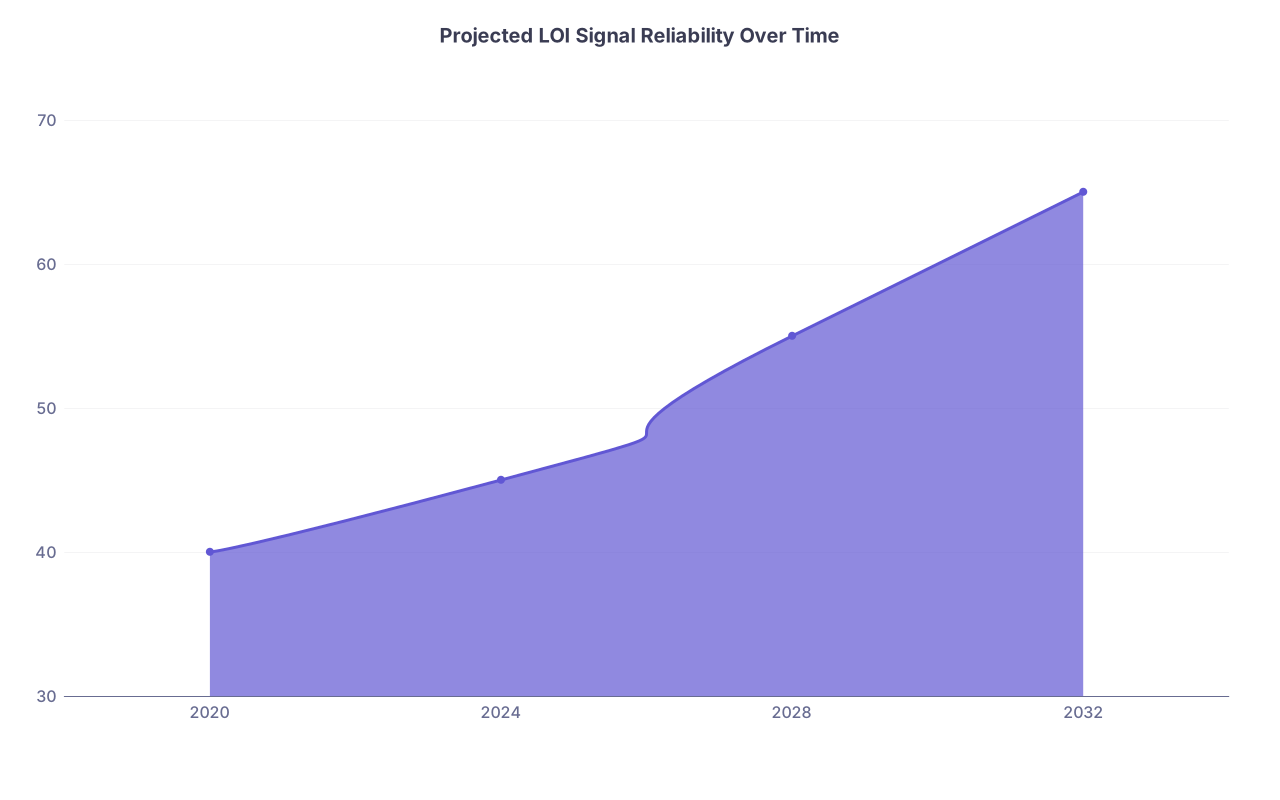
Future Direction: LOIs In A More Data-Driven Match
A lot of what we are talking about sits on the edge of formal policy. The NRMP discourages misleading communications but allows honest expressions of interest. Programs, meanwhile, are slowly becoming more quantitative.
What I expect over the next decade:
Interest scores explicitly logged in more systems.
Programs will keep a discrete “Interest” variable: 0–3 or 0–5, added systematically rather than ad hoc.More skepticism of generic language.
“Very interested” will be down‑weighted relative to “You are my top choice; I will rank you first” because only the latter has clear behavioral implications.Institution-level reputations for honesty.
Some med schools will become known for strict advising around LOIs. Their students’ letters will be trusted more, and they will get slightly more interview‑to‑rank movement per LOI.Possible formalization in some specialties.
A few may experiment with structured, one‑time “preference indications” (similar to signals in some fellowship matches), which are essentially standardized LOIs with limited tokens.
| Category | Value |
|---|---|
| 2020 | 40 |
| 2024 | 45 |
| 2028 | 55 |
| 2032 | 65 |
Interpretation of that line: if we treat “signal reliability” as the percentage of LOIs that PDs consider honest and behaviorally predictive, it probably increases in programs that adopt more formal tracking and penalize dishonesty. Not because people get more ethical naturally, but because the system punishes noise.

How To Use LOIs Rationally
Pull this back to what you actually control.
You are trying to:
- Identify where you are plausibly in the bubble band
- Allocate your one true LOI to the program where movement matters most
- Time it to hit before the final rank adjustment
- Make it explicit, honest, and concretely aligned with that program’s priorities
And then accept the constraints.
You are unlikely to:
- Turn a bottom‑third ranking into a top‑third outcome via letter alone
- Undo a poor interview
- Outperform someone with stronger scores, stellar interview, and equal interest
But you can absolutely:
- Turn “we like them” into “we do not want to lose them” at your top choice
- Gain 3–10 rank slots in exactly the range where match probability is very sensitive to rank position
- Differentiate yourself from people who stay silent and let the algorithm run unchecked
The short version
- The data and real committee behavior show LOIs are a small but real input—usually worth 0–8 rank positions, mostly in the middle bands.
- Honest, targeted, well‑timed LOIs paired with internal advocates move you the most; vague, mass‑produced letters barely register.
- You win by using LOIs as a precise, single‑program optimization tool, not as a mass‑mailed wish list.