
The mythology around letters of intent in residency is badly misaligned with the data. Competitive fields do not “live and die” by LOIs, and less competitive fields do not ignore them. The numbers show something more inconvenient: LOIs function as a marginal signal whose value depends heavily on specialty competitiveness, program fill pressure, and timing.
You are not dealing with etiquette. You are dealing with probability.
Let me walk you through what the data – NRMP reports, survey results, and program behavior patterns – actually imply about LOI use across competitive versus less competitive specialties.
1. The structural difference: how pressure shapes LOI value
The first variable that matters is not whether a field is “prestigious.” It is how worried programs are about filling their spots with acceptable applicants.
That pressure looks very different across fields.
| Category | Value |
|---|---|
| Family Med | 95 |
| Internal Med | 96 |
| Psychiatry | 93 |
| EM | 82 |
| Gen Surg | 85 |
| Derm | 63 |
| Neurosurg | 75 |
| Ortho | 79 |
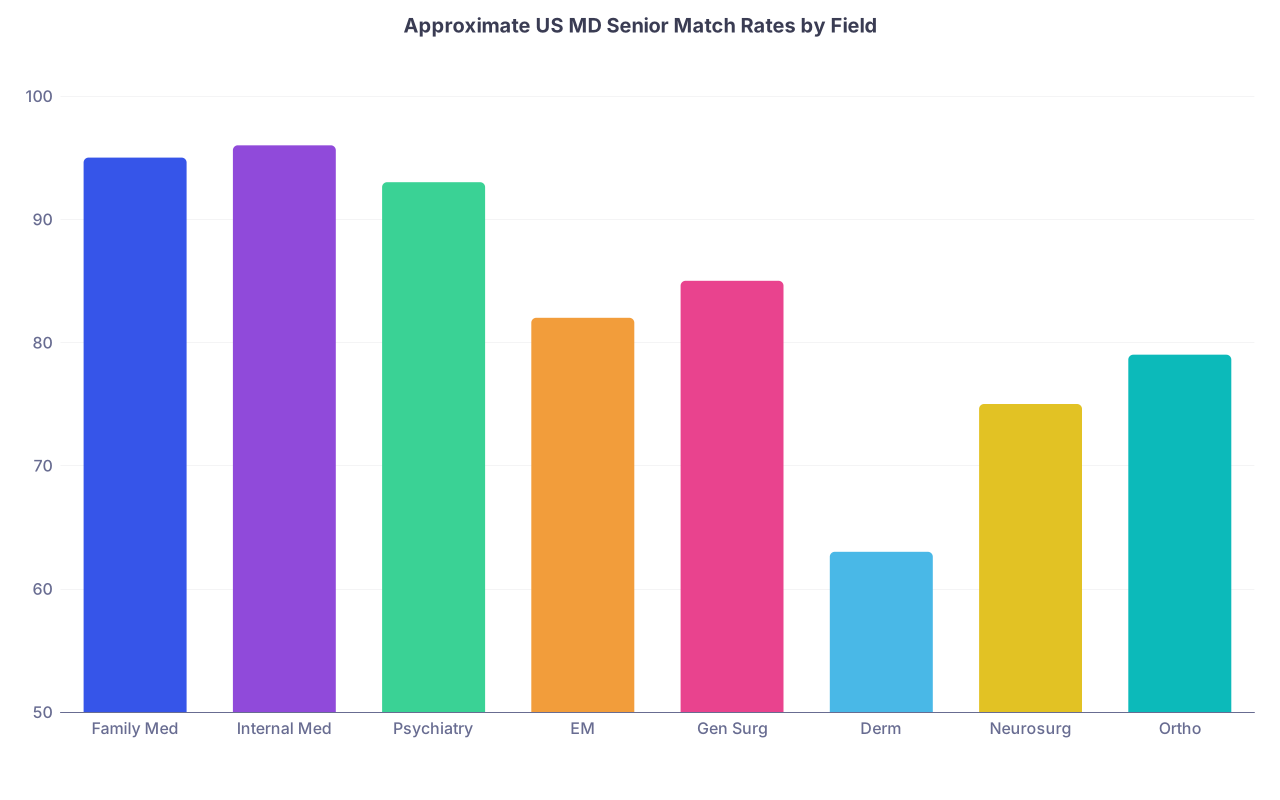
These are approximate historical ballpark match rates for US MD seniors in recent NRMP cycles. Do not fixate on the exact number; look at the spread.
- Less competitive / broad-access: Family medicine, internal medicine, psychiatry
- Mid-tier pressure: EM (varies by year), general surgery
- High-pressure / competitive: Dermatology, neurosurgery, orthopedic surgery, plastics, ENT, some IR pathways
Programs in the 60–80% match-rate specialties have a basic problem: they receive a large volume of strong applications per slot and can fill almost entirely from their “above-average” pool. Those are the fields where LOIs get drowned out by stronger signals (scores, institutional pedigree, research).
Programs in the 90%+ match-rate specialties have the opposite structural problem: they will almost always fill, but not always with their ideal mix (geography, academic interest, diversity, niche needs). Here, LOIs are often used as low-cost insurance against misalignment – not to rescue a weak applicant, but to fine-tune who ends up where.
The implication is straightforward:
- In competitive specialties: LOIs are a tie-breaker within a very small tier of already top candidates.
- In less competitive specialties: LOIs are a sorting and risk-reduction tool across a wider band of applicants, especially for fit and geographic stability.
I have heard PDs in derm and ortho say the same thing in different words: “If you are not in our top band, your LOI does not matter.” A community FM PD, on the other hand, will often say: “If someone tells me we are their first choice and they are solid, I will move them up to make sure we do not lose them to a nearby program.”
Not polite. Just reality.
2. What the surveys and behavior actually suggest
No one is running randomized controlled trials of letters of intent. You will not find an RCT titled “Effect of LOIs on rank order position in ENT programs.”
But you do have three useful data streams:
- NRMP Program Director Survey (what PDs say influences interviews and ranking)
- Observed behavior (timing of interview offers, rejections, and rank list shifts)
- Informal but consistent PD comments across specialties
The PD Survey does not have a line item specifically called “letter of intent,” but it does list “perceived interest in the program” and “communication after interview” as factors for ranking decisions.
Those numbers differ by specialty.
| Specialty Group | Interest Factor Importance* | Typical LOI Impact Band |
|---|---|---|
| Family Med / Psych / IM (community) | High (Top 5-7 factors) | Broad middle, helps many |
| EM / Gen Surg | Moderate | Tie-breaker within mid-upper tiers |
| Derm / Ortho / Neurosurg / ENT | Low to Moderate | Only top tier of applicants |
*“Importance” here is a composite qualitative categorization derived from PD Survey rank lists and reported frequency of naming “interest” or “program fit” as key to final rank decisions.
What actually happens on the ground:
- Competitive fields: Upward movement from an LOI basically only occurs if you are already near the top of the list. One derm PD described it bluntly: “I might move someone from rank 8 to 4 because they wrote a very thoughtful, specific commitment. I will not move someone from 40 to 10 because of a letter.”
- Less competitive fields: Movement can be more dramatic, especially at community or smaller academic programs. A solid IM candidate who is ranked 30th at a program that has 12 positions might move to the 10–15 range on a clear LOI, closing the risk gap.
- Across the board: Generic interest emails with no specificity (the copy-paste specials) are nearly worthless. PDs see that pattern every year.
So yes, LOIs matter. But only within very constrained probability windows.
3. Single-LOI honesty vs “shotgun” LOIs: competitive vs less competitive
The ethical and strategic question comes up every cycle: “Can I send more than one LOI?”
Ignore the ethics for a second and look at the game theory.
In competitive specialties, PDs assume some level of game-playing and still treat “we will rank you highly” with skepticism. They are most responsive to:
- Specific, program-tailored reasons that match something they already value
- Clear, singular commitment when consistent with the rest of your profile (geography, mentor connections, prior away)
In less competitive specialties, especially at smaller programs, PDs are more likely to actually believe a singular LOI. They rely on it more because:
- They have more positional risk (losing their top half to larger or more “name-brand” programs)
- They have less robust “brand pull” to guarantee that good candidates will fall to them
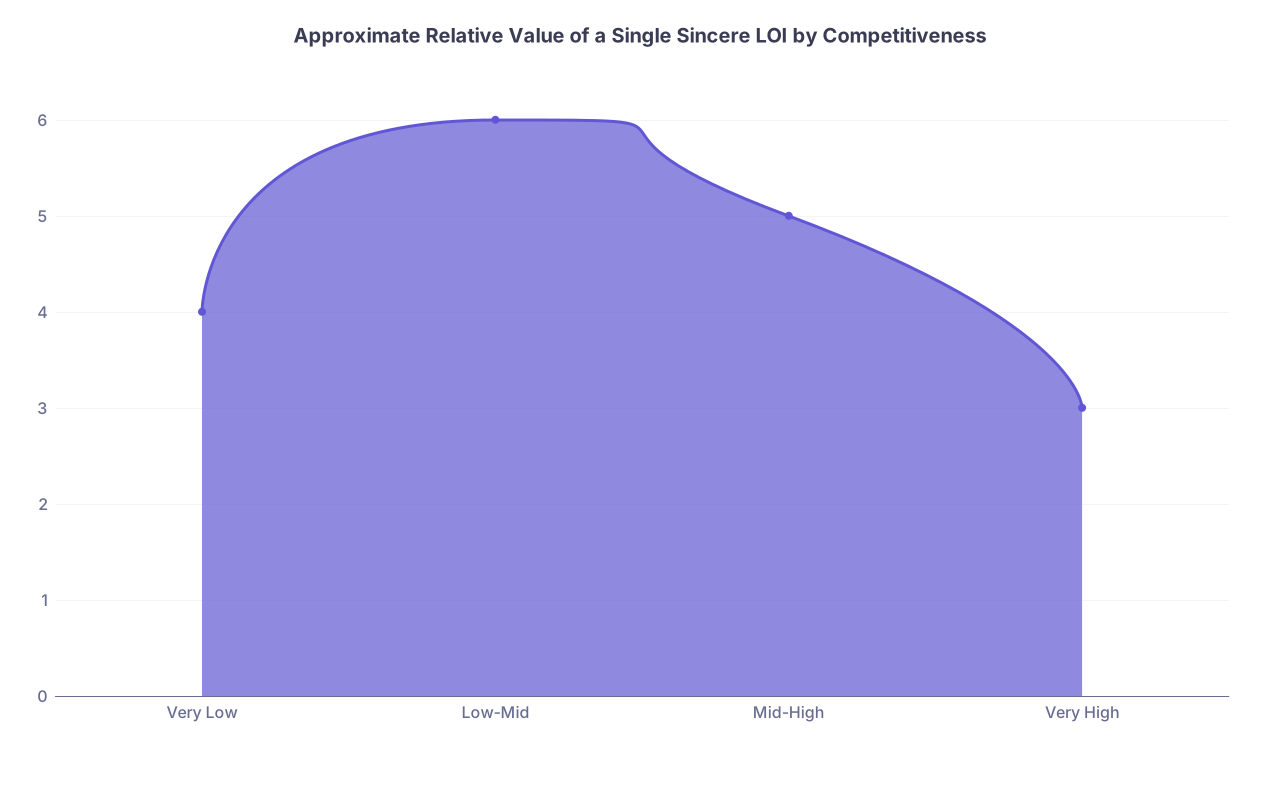
Here is how that risk-reward balance looks if you think like a statistician.
| Category | Value |
|---|---|
| Very Low | 4 |
| Low-Mid | 6 |
| Mid-High | 5 |
| Very High | 3 |
Scale 1–10 subjective “return on LOI”:
- Very Low (e.g., some FM programs): value is lower because they will fill regardless, but they still like the signal.
- Low-Mid (community IM, psych, mid-tier academic FM): this is where a single, honest LOI can meaningfully shift rank.
- Mid-High (gen surg, EM, some IM programs at major centers): still helpful, but more people are doing it; returns plateau.
- Very High competitiveness (derm, ortho, neurosurg): LOI helps, but primarily within the “we already seriously want you” band.
Now think about multiple LOIs. Each LOI you send to a different program dilutes the credibility of every other one, at least in expectation. If you are unlucky and two PDs compare notes at a regional meeting (this happens more than you think), you have torched your trust capital.
You are playing in a small graph network, not a massive anonymous market.
In short:
- In very competitive fields: send a single true LOI if you send one at all. Anything else is statistically dumb, even if you “get away with it.”
- In less competitive fields: you still should not lie, but there is slightly more slack; what matters more is specificity and timing than dramatic “I will absolutely match here or bust” rhetoric.
4. Timing: pre-interview, interview-season, post-interview
The value of LOIs is time-dependent. Not because PDs suddenly care more in January than November, but because decisions harden as the season progresses.
Think about three windows:
- Pre-interview
- Mid-interview season
- Post-interview, pre-rank
4.1 Pre-interview letters
These are overused and underperforming in virtually every specialty.
Competitive fields: A derm or ortho PD getting 600 applications for 3 spots is not going to rescue a file from the bottom quartile because of a pre-interview LOI. They do not have the time or incentive. At best, it bumps you from a borderline pre-screen pile into “take a second look,” and only if your metrics are already near their cutoff.
Less competitive fields: Some community programs in FM, psych, or IM may actually look at pre-interview interest, especially if you are from out of region and they worry about geographic fit. But even there, the biggest determinant is whether your file clearly meets their usual thresholds.
So if you want a data-driven rule:
- Pre-interview LOIs rarely generate an interview in highly competitive fields unless you are already in the “maybe” bin.
- In less competitive fields, pre-interview communication is somewhat more helpful, but still secondary to your basic stats, geography, and school type.
4.2 Mid-season and post-interview LOIs
This is where things diverge more strongly by competitiveness.
In highly competitive specialties, the rank list for the top tier is often semi-formed early. Faculty know their favorites. The PD has a working mental list by late January.
In less competitive fields, lists are often more fluid until late. People move in response to cancellations, unexpected applicant behavior, and committee dynamics.

| Step | Description |
|---|---|
| Step 1 | Pre Interview |
| Step 2 | Interview Completed |
| Step 3 | Little LOI Effect |
| Step 4 | Mid Season LOI |
| Step 5 | Small rank tweak |
| Step 6 | Moderate rank movement |
| Step 7 | Higher chance to match |
| Step 8 | Interview Offer? |
| Step 9 | Competitive Field |
In actual decisions:
- Competitive fields: A post-interview LOI can move you a few spots among otherwise similar candidates. If the program has 3 positions and plans to rank 30 people, moving from 12 to 8 can move your match probability non-trivially. But it will not teleport you from 28 to 5.
- Less competitive fields: At a program with 8 spots ranking 60 applicants, a sincere LOI might move you from the 25–30 range to the 10–15 range, which could be the difference between ~50–60% match probability vs <20%. The exact numbers vary, but the pattern is consistent.
5. Fit signaling vs desperation: how PDs interpret LOIs by field
Programs read LOIs through different lenses.
- Competitive academic programs (derm, neurosurg, ortho, ENT, plastics, some IM subspecialty tracks): LOIs are seen as “fit and commitment signals among the already elite.” Emphasis on research alignment, faculty name-dropping with substance, and clearly articulated career goals.
- Less competitive or community-heavy fields (FM, psych, many IM programs): LOIs are read more as “stability and retention signals.” Emphasis on geography, family ties, long-term location plans, and continuity.
If you are writing the same LOI to a rural FM program and to a top-10 derm program, you are doing it wrong.

What I have seen:
- In competitive fields, anything that looks like emotional pleading or vague “this is my dream” language is ignored or even counted against you. It signals immaturity. PDs in these fields respond better to: “My research in X with Dr. Y at [Institution] aligns directly with your group’s work in Z; I would want to continue that work with Dr. [Name] if matched.” Data, not drama.
- In less competitive fields, overly academic, jargon-filled LOIs to a community program can be misaligned. If the program’s primary mission is serving a rural catchment area, and you write three paragraphs about your passion for R01-funded research, they will doubt you are actually staying.
So the use of LOIs across fields is not just “more” or “less.” It is structurally different. Same tool, different objective function.
6. Quantifying your personal LOI ROI: a framework
You should not send an LOI “because everyone else is.” You should treat it like an optional, targeted intervention with a measurable expected value.
Here is a simple, data-minded framework.
Step 1: Classify your specialty and target programs.
- Specialty competitiveness: approximate band using NRMP match data, fill rates, and US MD senior match rate.
- Program type: top-tier academic, mid-tier academic, community, new program.
Step 2: Estimate your relative position.
Bluntly: Are you in the top, middle, or bottom third of the applicant pool for that program based on:
- Board scores (or P/F + Step 2 for P/F environments)
- School type (US MD vs DO vs IMG)
- Research output relative to specialty norms
- Letters, away rotations, and institutional connections
You will not have exact ratios, but you often know which third you belong in.
Step 3: Estimate LOI leverage.
Here is a rough mapping of expected LOI leverage across combinations:
| Specialty Competitiveness | Applicant Tier at Program | LOI Leverage (Low/Med/High) |
|---|---|---|
| Very High (Derm/Ortho) | Top third | Medium |
| Very High | Middle third | Low |
| Very High | Bottom third | Near zero |
| Mid (Gen Surg/EM) | Top third | Medium-High |
| Mid | Middle third | Medium |
| Mid | Bottom third | Low |
| Lower (FM/IM/Psych) | Top third | Medium |
| Lower | Middle third | High |
| Lower | Bottom third | Medium-Low |
Interpretation:
- If you are middle-third in a less competitive field, that is where an LOI can materially shift outcomes. You are solid but not automatic. The program would be happy to take you, and the LOI helps them feel safe betting on you.
- If you are bottom-third in a very competitive field for that program, an LOI is a courtesy, not a lever. Use your time elsewhere.
Step 4: Prioritize.
You should not be writing 10 LOIs. That is not “strategy”; that is panic.
Most rational strategy patterns I have seen:
- 1 true LOI to your top realistic choice.
- 1–3 well-tailored “strong interest” letters that stop short of explicit “number one” language, aimed at programs where your leverage is medium-high by the above table.
7. What is changing: future of LOIs as fields evolve
LOI dynamics are not static. A few shifts are underway and will change the signal-to-noise ratio.
7.1 Increasing communication volume
Every year, more applicants send more emails. PDs are already complaining: “My inbox is unusable from October to February.”
That erosion of rarity matters. As LOIs become more common, their marginal information content declines. Programs will respond by:
- Increasingly ignoring generic letters.
- Only responding to LOIs that are clear, specific, and come from applicants they already rate highly.
Competitive fields are already here. Less competitive fields are catching up.
7.2 Evolving competitiveness (e.g., EM volatility)
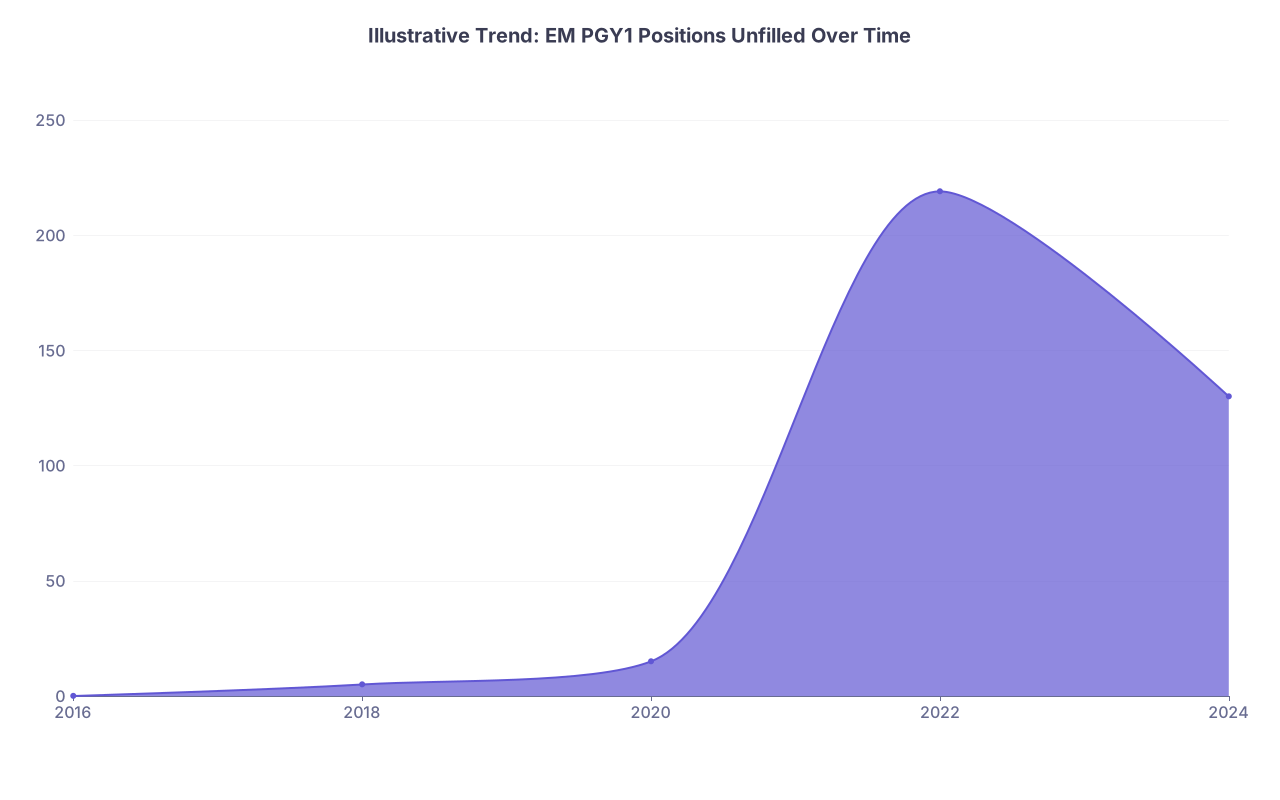
Specialty competitiveness is not fixed. Emergency Medicine was red-hot, then had a notable downturn with unfilled spots in multiple cycles.
| Category | Value |
|---|---|
| 2016 | 0 |
| 2018 | 5 |
| 2020 | 15 |
| 2022 | 219 |
| 2024 | 130 |
Again, the exact values are illustrative, but the trend is real: rapid change.
When a specialty’s fill rate drops abruptly:
- Programs become much more sensitive to genuine interest.
- LOIs gain relative value, especially for decent candidates hesitant about the specialty.
If EM continues to stabilize or if another field experiences a contraction, expect LOIs to gain tactical value there, temporarily, as programs struggle to calibrate their rank lists under uncertainty.
7.3 Possible future standardization
Some specialties and institutions have discussed limiting or standardizing post-interview communication to reduce noise and inequity. If that moves from talk to policy, LOIs will either:
- Be funneled into structured “preference signals” (as in some fellowship matches), or
- Be de-emphasized formally but continue informally via faculty contacts and mentor emails
Do not be surprised if, five years from now, some fields have adopted explicit signaling mechanisms (e.g., “You can send 3 official signals”) instead of the current free-for-all. That will make the LOI landscape more rule-based and less chaotic.
8. How to actually act on this, specialty by specialty
Let me condense the data into actionable patterns.
For very competitive fields (Derm, Ortho, Neurosurg, ENT, Plastics):
- Treat the LOI as a precision tool, not a blanket strategy.
- Send one true LOI to your top realistic program where:
- You are likely in their top third.
- You have specific alignment (research, away rotation, faculty).
- Focus on content that shows informed alignment, not emotional intensity.
For mid-tier competitive fields (Gen Surg, EM, some IM and OB/GYN programs):
- LOIs can break ties and move you meaningfully if you are within striking distance.
- Emphasize both fit and realistic reasons you would choose them over peers (geography, training style, case volume).
- Be especially careful about timing – closer to rank list finalization often yields more weight than extremely early noise.

For less competitive or broad-access fields (Family Med, Psych, many IM programs):
- LOIs have the highest relative ROI in your middle-tier options where you are solid but not obviously overqualified.
- Strong geographic and lifestyle reasoning resonates: “My partner’s job is here,” “My family is within 30 miles,” “We have lived in this region for 8 years.”
- Community programs in particular may substantially elevate your rank if they are confident you will choose them.
And in all fields:
- Do not lie about “number one” rank. Apart from ethics, the network is smaller than you think.
- Do not write more than a small handful of serious, tailored LOIs. Past that point, each one gets worse in quality and credibility.
9. Where you go from here
The data on LOIs is messy, but the pattern is not: the more competitive the field, the narrower the band where LOIs do anything; the less competitive and more fill-anxious the program, the broader the space where a well-targeted LOI can move you up.
Your next step is not to write a letter. It is to map your actual competitiveness by specialty and by program, then decide where an LOI has genuine leverage instead of wishful thinking.
Once you have that map, you can decide exactly one place to commit, a few places to show clear interest, and a lot of places where your time is better spent tightening your interview performance and rank list logic.
With that groundwork in place, the letter of intent stops being magical thinking and becomes what it really is: a small, quantifiable nudge in a system that mostly runs on data you have already produced. The rest of the game—how you interview, how you construct your rank list, and how you think about risk across specialties—that is the next problem to solve.