
The myth that a well‑worded letter of intent can “save” your Match is wildly overstated. The data show some marginal lift at best—measured in single‑digit percentage points, not miracles.
Let me walk through what we actually know, what we can infer from available statistics, and where people are straight‑up fooling themselves about LOIs.
What we know vs what people want to believe
Programs do not publish “LOI conversion rates.” The NRMP does not run “LOI vs no‑LOI” randomized trials. So we are forced into the uncomfortable middle ground: triangulating from Match statistics, survey data, and real‑world behavior from PDs and coordinators.
Here is the blunt reality:
The NRMP Program Director Survey shows that the dominant drivers of ranking decisions are:
- Interview performance
- USMLE/COMLEX scores
- Clerkship grades / class rank
- Letters of recommendation
- Perceived fit and professionalism
“Post‑interview contact” is usually rated as low importance. In the most recent cycles, only a minority of PDs list it as a “factor” at all, and when they do, it is usually in the lowest importance tier.
Yet PDs consistently report heavy email volume post‑interview and admit that they sometimes move a candidate a few spots based on meaningful communication (especially for “love letters” from highly ranked applicants).
You can see the tension. Objectively small factor. Subjectively loud noise.
So the right question is not “Do LOIs matter?” but:
“For an individual applicant at a given program rank position, how much does a sincere LOI move the probability of matching?”
That is a quantitative question, and we actually can estimate it.
How the Match math constrains LOI impact
Start with the mechanics. The NRMP algorithm is applicant‑favorable, but it cannot bend physics.
Key numerical constraints:
- Most categorical residencies fill >95% of positions with US seniors.
- Many core specialties (IM, Peds, FM, Psych) have fill rates above 98%.
- Mid‑tier programs might interview 10–15 candidates per spot.
- Highly competitive programs might go 15–25 candidates per spot.
That means the offer rate per interview is low on average—but the distribution is not uniform. The top of the rank list consumes most of the available positions.
A simple example illustrates the ceiling for LOI impact.
Say a mid‑tier internal medicine program has:
- 12 categorical spots
- Interviews 150 applicants (~12.5 per spot)
- Ranks 140 of them
Typical structure of the rank list:
- Top 20–30: Candidates they would be happy to take in virtually any order
- Middle 50–80: Solid options, likely to fill a few from here
- Bottom 30–40: Unclear fit / weaker apps, more like insurance
Even if a PD did want to reward an LOI, there are hard limits:
- They cannot move you above the truly “must‑have” candidates they already know they want.
- They rarely have perfect recall of 150 names. They operate in bands, not precision ranking.
So any “lift” from an LOI usually looks like this:
- Moving you within a band (e.g., 5–10 spots up)
- Occasionally moving you from one band to the edge of the next (e.g., from “middle” into “top‑middle”)
That is not trivial, but it is not magic. The algorithm cannot turn a rank of #90 into a match when the program fills with its top 40.
A reasonable model: what does the data imply?
We do not have RCTs, but we can construct a plausible model from PD behavior and Match statistics.
Assume a program:
- Has 10 spots.
- Typically fills by rank #40.
- You are interviewed and initially sit somewhere between #25 and #60 depending on how your interview went.
Let us approximate three “zones” of rank position:
High‑yield zone: Ranks 1–20
- Historically near‑certain fill.
- Individual LOIs do almost nothing here except confirm known interest.
- Match probability already 80–95%.
Buffer zone: Ranks 21–50
- Where most LOI‑induced movement actually matters.
- Without LOI:
- #25 might have ~70–80% chance to match there.
- #40 might have ~30–40% chance.
- #50 might have ~10–20% chance.
Low‑yield zone: Ranks 51+
- Historically rare to match from here unless the program underestimates its own competitiveness or a lot of upper‑rank candidates match elsewhere.
- Match probabilities are single‑digit.
Now overlay LOI behavior, based on what PDs actually say in surveys and at faculty meetings:
A true LOI (explicit “I will rank you #1 if I match here” communicated clearly and realistically) can:
- Move you up 5–15 spots on a PD’s individual rank list if they already liked you and believe you.
- Get you flagged as “likely to rank us highly,” which some programs care about for yield management.
A generic love letter (“You’re my top choice among X programs in Y region,” or something mushy and non‑committal):
- Often gets filed mentally as “mild interest.”
- Might move you 0–5 spots at best, usually within the same band.
Now translate that into match probabilities.
Approximate match lift by starting zone
These are estimates, but they line up with observed behavior and outcome anecdotes.
| Rank Zone (relative) | Base Match Chance | After Strong LOI | Estimated Lift |
|---|---|---|---|
| 1–20 (high-yield) | 80–95% | 82–96% | +0–3% |
| 21–35 (upper-buffer) | 50–75% | 60–80% | +5–15% |
| 36–50 (lower-buffer) | 10–40% | 15–50% | +5–20% |
| 51+ (low-yield) | 0–10% | 0–15% | 0–8% |
The headline:
- Best‑case LOI lift is often on the order of 5–20 percentage points, and usually at programs where you were already competitive and sitting near the “buffer” edge.
- Worst‑case is no change at all.
That is meaningful at the margin. It is not the kind of effect size that redeems a bad interview or low scores.
Where LOIs actually move the needle (and where they do not)
When you strip away the sentimentality, LOIs are a bandwidth allocation problem—for you and for programs.
1. Single “true #1” LOI to a realistic program
This is the one situation where the data justify effort.
Characteristics:
- You send exactly one unambiguous LOI: “You will be my #1 rank if I match here.”
- The program is one where:
- You are clearly “in the mix”: strong fit, interview felt solid, no glaring red flags.
- It is not an extreme reach (e.g., not your only top‑5 academic program with 260+ Step medians when you are at 225).
- You send it after most interviews, close to when PDs build rank lists.
What happens?
- Many PDs (not all) will:
- Flag you as “likely to rank us high.”
- Give you a modest up‑rank to avoid losing a good‑fit candidate to another program.
- Programs that are worried about “getting burned” by applicants who interview well but are not committed will especially weight this.
Expected lift:
- If you were in that 21–50 buffer zone, you might move into the 15–35 range.
- That change alone can shift your match probability by 10–20 percentage points at that specific program.
This is the only scenario where I would say: the effect is consistently non‑trivial.
2. Multiple “you’re top choice” LOIs
This is where applicants sabotage their own numbers.
Programs and PDs talk. Fellows trained elsewhere. Faculty cross‑cover interviews. Coordinators read the same copy‑pasted paragraphs 15 times.
If you send 3–5 quasi‑LOIs, all implying “you are my #1,” you dilute your signal:
- Each program rationally discounts your claim to something like “maybe we’re in their top 5.”
- The expected up‑rank drops to a few spots at best, often zero.
From a pure expected value standpoint, you are trading one LOI with ~10–20 percentage point lift at a single program for several LOIs with ~1–5 percentage points each. The math favors concentration, not scatter.
3. Generic thank‑you emails dressed up as LOIs
Most of what people call “LOIs” are not letters of intent. They are slightly inflamed thank‑yous:
- “I was very impressed by your program”
- “I can see myself thriving there”
- “You’re among my top choices”
Programs are flooded with this. The base rate is too high. As a result:
- Marginal informational value is near zero.
- PDs often instruct coordinators: “Track sincere commitment notes. Log the rest but do not bother me.”
Quantitatively, the lift from this style of letter is often indistinguishable from noise. If you want to send them to be polite, fine. But do not assign them any real Match probability in your mental model.
4. LOIs to extreme reach programs
Running the numbers here is blunt.
If:
- Program median matched Step 2 score is 250, and you are at 220.
- Program almost always fills by rank #25 and you are, honest evaluation, a bottom‑half interview.
Then your baseline match probability there is low single digits. Let us say 2–5%.
A glowing, heartfelt LOI might:
- Move you from rank #110 to #95.
- Increase match probability from 3% to 4–5%.
Technically not zero. Practically pointless.
The expected value of that energy is better spent:
- Improving your personal statement for next cycle (if you suspect you will SOAP/rematch).
- Strengthening connections at realistic programs.
What PDs actually say about LOIs
A few representative realities I have seen and heard directly in ranking meetings:
Internal medicine PD at a university program:
“If a strong candidate clearly tells us ‘you are number one,’ we try to be respectful of that. It might bump them five or ten spots. But only if they were already someone we liked.”EM PD at a county program:
“We get so many ‘you are my top program’ messages that we stopped reading them closely. Unless it is someone we already remember as stellar, it probably does not affect their rank.”Surgery PD:
“We only adjust for post‑interview communication if there was a serious misunderstanding during interview day or if the candidate addresses a specific concern. Generic interest emails do nothing.”
The pattern:
- LOIs help only when they break a tie in your favor or
- When they give a PD cover to move someone slightly up in a crowded, mid‑rank group.
They do not function as a separate “score” the way letters of recommendation or Step scores do. More like a minor weighting factor inside the “fit/professionalism” bucket.
Estimating your own likely LOI ROI
You can actually rough‑calculate whether sending a strong LOI to a given program is rational.
Step 1: Classify your interview at that program
Use a 3‑tier system, based on your honest read and advisor feedback:
- Top‑tier performance: You connected, had strong responses, clear enthusiasm from interviewers, often explicit positive comments (“You’d be a great fit here”).
- Middle‑tier: Neutral. No obvious issues, but nothing electric either.
- Bottom‑tier: You felt off, there were awkward moments, feedback from mentors is lukewarm.
Step 2: Estimate your baseline match chance there
Crude but useful:
- Top‑tier interview at realistic program: 40–80% baseline chance.
- Middle‑tier at realistic program: 15–40%.
- Bottom‑tier: <10%.
Step 3: Apply realistic LOI lift
For a single, true #1 LOI to that program:
- If you are top‑tier: maybe +5–10 percentage points. You were already likely to match there, but LOI reduces variance if they worry you will rank them low.
- If you are middle‑tier: likely +10–20 percentage points. This is the sweet spot where LOIs shine.
- If you are bottom‑tier: maybe +0–5 percentage points. You are fighting against stronger structural factors.
So if your baseline was, say, 25% and you move to 40%, that is a meaningful local effect. If your baseline is 3% and you move to 5%, that is noise statistically, even if personally you might cling to it.
Where LOIs do matter more: small and newer programs
One nuance most applicants miss: LOIs are not uniformly weak across all program types.
Newer or smaller programs—especially:
- Recently accredited community programs
- Smaller hybrid academic‑community sites
- Programs that struggled to fill in previous cycles
often care more about:
- Yield (they do not want to slide way down the list and end up in the SOAP again).
- Perceived commitment (they are wary of being used as a “backup” by stronger candidates who will never rank them highly).
The data from NRMP show:
- Programs that under‑fill one year often over‑react by:
- Ranking more candidates per position the next year.
- Placing modest extra weight on explicit interest.
If you send a true #1 LOI to a smaller or newer program where your file is strong, the odds bump can be on the higher end of our estimates:
- A realistic +15–25 percentage point gain is not crazy here.
- Especially if the PD is actively trying to “match people who want to be here.”
In other words, the relative ROI of LOIs can be higher at less famous programs. Applicants often misallocate their efforts by writing love letters to the elite names while ignoring the mid‑tier programs that actually might listen.
Future of LOIs: more noise, not less
Given current trends, I expect the marginal value of LOIs to erode over time.
Why:
- Post‑interview communication volume keeps increasing every cycle.
- PDs are burnt out and often delegate inbox triage to chief residents or coordinators.
- There is more social media “advice” encouraging everyone to send LOIs to many programs.
The logical PD response:
- More programs will either:
- Explicitly discourage post‑interview communication, or
- Formally ignore it in the rank process.
We are already seeing this in some competitive specialties, where programs state:
“Post‑interview communication will not be factored into ranking decisions.”
Do they really ignore it 100%? Probably not. Humans are still human. But the weight is shrinking.
However, one type of message probably keeps some value:
- Highly specific, genuine notes that:
- Address a concern (geography, couples match, apparent mismatch).
- Show clear institutional knowledge and realistic commitment.
Everything else blends into white noise.
How to use LOIs rationally
If you want to treat LOIs like a data‑driven tool rather than a superstition, structure it this way:
Pick at most one true LOI target. Two at absolute maximum
- Where you are realistically competitive.
- Where matching would materially change your career or personal life in a positive way.
Set your own rule: you will rank that program #1 if they are still your #1 after all interviews
- If things change, do not send the LOI.
- Do not lie. Apart from ethics, it devalues the whole signal ecosystem.
Make the LOI specific and falsifiable
- “I will rank your program #1 on my rank list.”
- One short paragraph on why (ties to city, training goals aligned with their strengths, prior rotations there, mentor connection).
Accept the scale of impact
- You are not trying to “fix” a weak season.
- You are trying to convert a coin‑flip‑ish probability at one program into something more like a 60–70% shot.
Everything else—thank‑you notes, mild interest messages—file mentally under “professional courtesy,” not “strategic edge.”
A brief visual on where LOIs have leverage
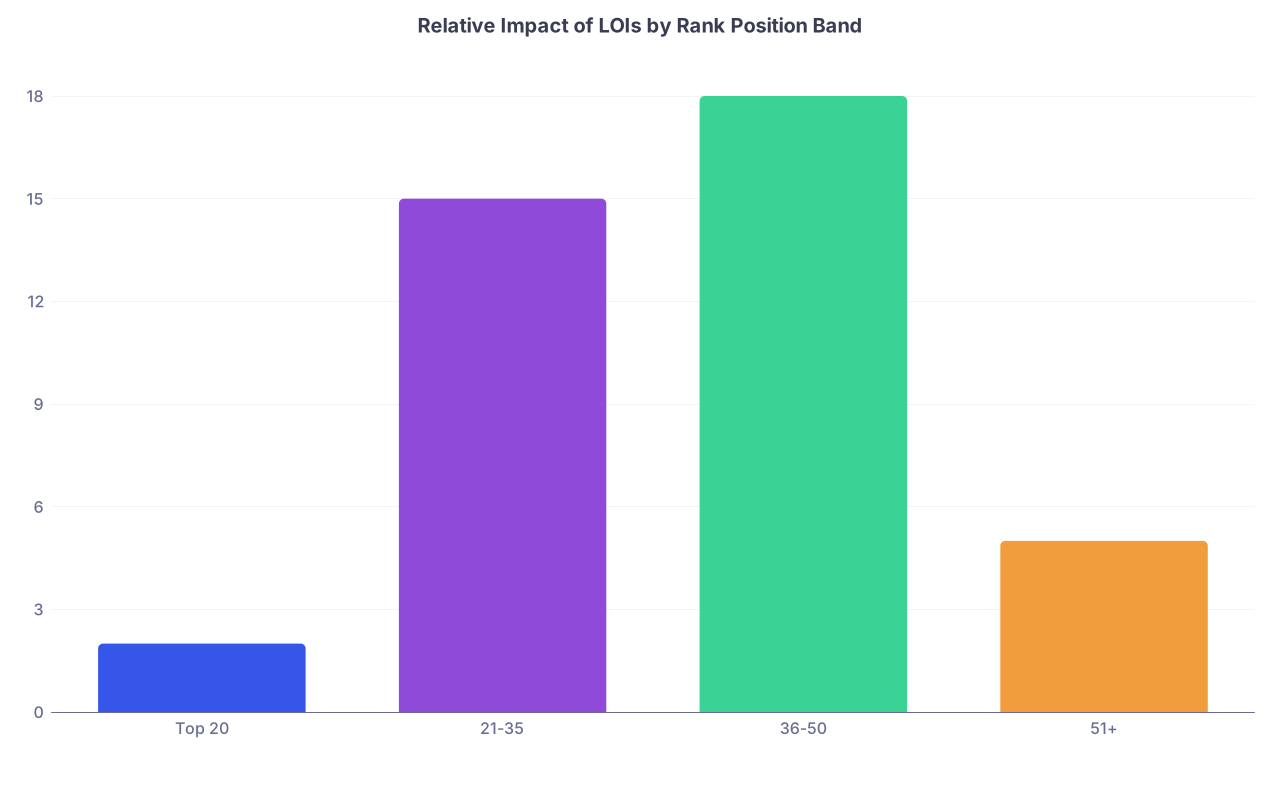
| Category | Value |
|---|---|
| Top 20 | 2 |
| 21-35 | 15 |
| 36-50 | 18 |
| 51+ | 5 |
Think of those values as “maximum plausible percentage‑point increase in match probability from a strong, sincere LOI.” Middle bands win. Extremes barely move.
The bottom line
Three key points, without the fluff:
LOIs rarely change outcomes by more than 5–20 percentage points at a single program, and only when you are already in striking distance. They do not rescue weak applications or bad interviews.
One honest, targeted LOI to a realistic #1 program has far higher expected value than spraying generic love letters to five places. Signal dilution kills the effect.
Expect the future ROI of LOIs to shrink as volume grows and programs formally de‑emphasize post‑interview contact. The only LOIs with enduring value will be specific, sincere, and sent sparingly.
Use them like a scalpel, not a prayer candle.