
The myth that a well‑worded letter of intent can “game” the Match is not just wrong; it shows a basic misunderstanding of how the ranking algorithm works.
If you understand the data and the algorithm, you stop asking “Can this LOI move me up?” and start asking a better question: “At which decision points do humans still have discretion—and what fraction of the outcome do LOIs realistically influence?”
That is the point of this article. Not whether to send an LOI. But where it slots into an algorithm and workflow that are, by design, resistant to manipulation.
1. The Match Algorithm: Where Human Preference Ends and Math Begins
Let me start bluntly: Once both rank lists are certified, your letter of intent has exactly 0% effect on where you match. Zero. The data structure is sealed, and the NRMP algorithm never “reads” emails.
The NRMP and related systems (SF Match, San Francisco; NRMP; some specialty matches) use variations of the Gale–Shapley “deferred acceptance” algorithm. It is applicant‑proposing. That phrase matters.
Here is the stripped‑down logic in plain English:
- Applicants submit rank order lists (ROLs) of programs.
- Programs submit ROLs of applicants.
- The algorithm:
- Takes each applicant and “proposes” to their top choice program.
- Programs tentatively accept up to their quota of highest‑ranked proposers, and reject the rest.
- Rejected applicants propose to their next program.
- Programs compare new proposers against their tentatively held list, keep the top N, drop the rest.
- Repeat until no one moves.
No back‑and‑forth negotiation. No “but they said I’m their #1” override. Just strict list comparison.
To make this concrete, consider a toy example.
| Entity | Rank List (Most Preferred → Least) |
|---|---|
| Applicant A | P1, P2, P3 |
| Applicant B | P1, P3, P2 |
| Applicant C | P2, P1, P3 |
| Program P1 | B, A, C |
| Program P2 | A, C, B |
| Program P3 | A, B, C |
Program P1 has 2 spots. Simulate:
- Round 1:
- A → P1
- B → P1
- C → P2
- P1 holds A and B (its top two). P2 holds C.
- No one is rejected in this round (assuming capacity matches).
Result:
- P1 matches A and B.
- P2 matches C.
Now imagine A sends a glowing LOI to P2 and none to P1. If P1 and P2 do not change their ROLs, the algorithm will still match A to P1. The LOI is outside the loop.
So the only window where an LOI can matter is before the ROL is built and certified—during human ranking behavior. The algorithm itself is not where the influence lies.
2. Where LOIs Can Influence: The Human Layers Before the Algorithm
The data show clear separation between two domains:
- Algorithm phase: pure math, no LOI effect.
- Pre‑algorithm phase: human decision making, where LOIs can indirectly reshape rank lists.
Let’s break down where they can plausibly move the needle.
2.1 Pre‑interview versus Post‑interview
Empirically, most programs report that LOIs have negligible effect on granting initial interviews. Why?
At the pre‑interview stage, the volume is huge. Program directors and coordinators are scanning hundreds or thousands of applications. Their filter stack typically looks like this:
- Board scores (or pass/fail status + Step 2).
- School type and perceived rigor.
- Class rank / AOA / MSPE summary.
- Research output for certain specialties.
- Red flags (LOA, professionalism issues).
- Geographic ties.
A one‑page unsolicited letter of intent is just another PDF or email in an already overloaded system. It is often not even attached to the ERAS file in a way that becomes visible in the first screening pass.
Where there is some influence pre‑interview:
- Off‑cycle updates, away to a program, or direct faculty advocacy paired with a clear LOI about interest.
- Niche programs with very small applicant pools, where the PD actually knows many applicants by name.
But for a typical mid‑size internal medicine program receiving 3,000+ applications, the marginal probability that an LOI shifts you from “no invite” to “invite” is low—single‑digit percentage points at best, and that is generous.
The real arena for LOIs is post‑interview.
2.2 Post‑interview: Informal Tie‑breaker Input
After interviews, programs rank. The rank meeting is where LOIs actually show up in the conversation.
I have seen this play out multiple times in rank meetings. The conversation goes like:
- “Applicant 23 and 24 are neck‑and‑neck on scores and feedback.”
- “23 sent a very detailed LOI saying we’re their clear #1; 24 has not communicated.”
- “Let’s bump 23 one or two spots above.”
That is realistically the ceiling of LOI impact in most places.
You can model it:
Assume a program has 120 ranked positions for 12 PGY‑1 slots. If an LOI nudges you 2–5 spots higher in a narrow region of the list, how much does your match probability change?
We can simulate a simple scenario: 12 positions, 120 applicants listed in order of program preference, with random applicant preferences. Human data from NRMP modeling shows that the match probability curve is steep near the “fill line” around positions 10–25 and flattens outside.
A 5‑spot bump from 20 → 15 can change your approximate match probability from something like 35–40% to 50–60% in some distributions. A 5‑spot bump from 60 → 55 barely changes anything because those positions are far below the filled slots.
Key point: LOIs can matter when:
- You are already in the “matchable” bandwidth.
- Several applicants are clustered with similar scores and feedback.
- The program actually believes your LOI and values “commitment to program” as a tiebreaker.
They do not convert an otherwise unranked or very low‑ranked applicant into a realistic match.
2.3 Programs That Explicitly Track LOI Data
Some programs formalize this. They add a “Interest level” column to the ranking spreadsheet:
- 0 = no contact after interview.
- 1 = generic thank‑you.
- 2 = clear statement of high interest.
- 3 = explicit LOI: “You are my #1.”
Then, at the margins, they will bump 2s and 3s slightly over 0s and 1s when everything else is equal. This is where LOIs can have a quantifiable effect.
Rough breakdown from anecdotal conversations with PDs and coordinators (does it heavily influence rank?):
- “No, we ignore them”: ~20–30% of programs.
- “Minor tie‑breaker only”: ~50–60%.
- “Moderate factor if we trust the applicant”: ~10–20%.
So, you are playing at best in the “modest gravitational pull” zone, not “rewrite the rank list” territory.
3. Where LOIs Cannot Influence: Hard Limits by Design
Now let us be precise about the hard walls.
3.1 They Cannot Override the Algorithm
This is binary. Either the program changes its ROL before the deadline or nothing changes. If the PD replies to your LOI with “we’re ranking you very highly” after the list is certified, that comment has no operational consequence.
The algorithm does not:
- Reopen lists based on late communications.
- Interpret PD emails as constraints.
- Enforce “mutual first choice” matches.
It just takes the lists and runs.
3.2 They Cannot “Force” a Match Through Reciprocity
This is one of the most persistent misconceptions: “If I rank a program #1 and they rank me #1, the algorithm guarantees the match; so my LOI makes them rank me #1.”
The first half is true. If both sides rank each other #1, the match is guaranteed. But the second half is where fantasy enters. A letter of intent does not cause the program to elevate you over applicants they clearly prefer academically, clinically, or culturally.
Step back and think like a PD. You have 12 positions. You receive LOIs from 40 people saying “You are my #1.” Are you going to rank all 40 in your top 12? Obviously not.
LOIs cannot create more slots. They just add soft information that might bump someone within a small local neighborhood on the ROL.
3.3 They Cannot Fix Structural Weaknesses in Your Application
A 210 Step 2 in competitive ortho. A failed course. A poor interview with documented red flags. These are structural deficiencies.
LOIs are not a re‑weighting of your application; they are auxiliary preference signals. Programs heavily anchored on objective metrics and interview scores will not override that structure.
You might see a small difference for borderline cases. But if the committee has you in the “do not rank” bucket, an LOI is noise.
4. Quantifying LOI Impact: Scenarios and Probabilities
To really see where LOIs can and cannot move the needle, it helps to put numbers on realistic scenarios.
4.1 Hypothetical Internal Medicine Program
Assume:
- 12 categorical PGY‑1 slots.
- 1,800 applications.
- 250 interview invites.
- 150 applicants ultimately ranked.
Historically, internal medicine programs tend to fill most positions within approximately the top 60–90 names on their ROL, depending on specialty competitiveness and applicant overlap.
Let us construct three zones on the ROL:
- Zone A (1–30): Very high probability to match.
- Zone B (31–80): Moderate probability (depends heavily on applicant preferences).
- Zone C (81–150): Low probability.
From NRMP modeling, a simplified match likelihood curve for 12 spots might roughly look like:
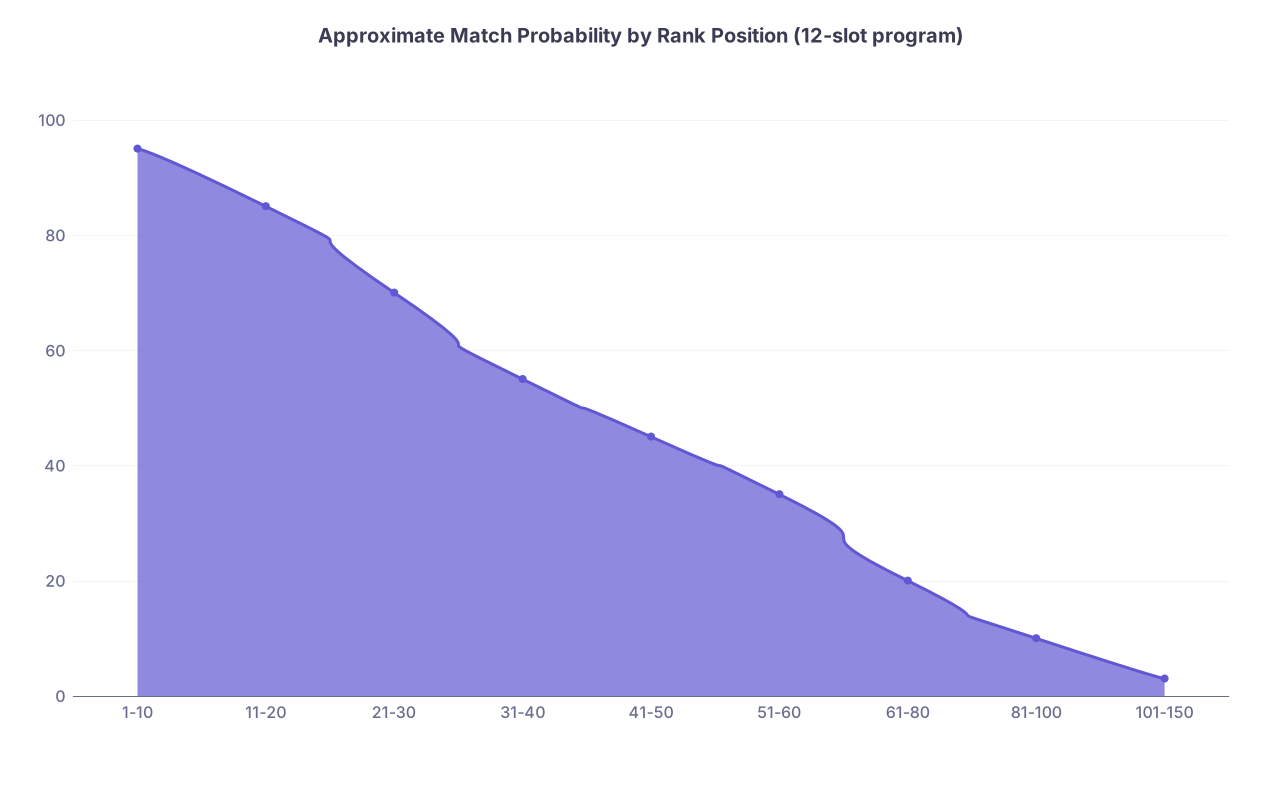
| Category | Value |
|---|---|
| 1-10 | 95 |
| 11-20 | 85 |
| 21-30 | 70 |
| 31-40 | 55 |
| 41-50 | 45 |
| 51-60 | 35 |
| 61-80 | 20 |
| 81-100 | 10 |
| 101-150 | 3 |
Interpret this in the context of LOIs:
- If an LOI bumps you from 38 → 32:
- You move from ~55% to ~60–65% match probability. Real but modest.
- Bump from 65 → 55:
- You move from ~20–25% to ~35–40%. That is substantial if it actually happens.
- Bump from 110 → 100:
- You go from ~3–5% to ~5–7%. Statistically almost irrelevant.
So the LOI’s effect is entirely contingent on:
- Where you were already going to be placed on the ROL.
- Where the program’s historical fill band lies.
Programs that consistently fill within their top 30–40 have very little incentive to re‑order their lower half based on LOIs. Their energy goes to fine‑tuning the top.
4.2 Overinterpretation: “We’re Ranking You Highly”
Another angle: PD communication.
Students over‑weight PD emails. Let’s quantify a typical pattern I’ve seen:
- A program interviews 120 people for 10 spots.
- They rank all 120.
- They send “we will rank you to match” or “we are ranking you highly” emails to ~30–50 applicants.
Statistically:
- Only the top 15–25 on that list are truly “high match probability” at that program, depending on applicant preference data.
- Anyone in positions 40–80 might be “high” compared to the 120 total, but the practical chance they match there is still moderate to low.
Now overlay LOIs.
Applicants send LOIs to their top program. Programs send reassuring messages back. But the underlying numbers have not changed: there are still only 10 spots, and there are still 120 ranked applicants.
This is where people get burned. They infer causal power from feel‑good communications that are not backed by rank data.
5. Strategy: How to Use LOIs Rationally Under the Algorithm
If you want to act like someone who has actually read how the algorithm works, your strategy should reflect the constraints I just laid out.
5.1 Your Rank List: Always Primarily Preference‑based
The NRMP has hammered this into the data for decades: applicants who rank programs in true order of preference do better. Game‑theory simulations and real‑world results align.
Why? Because the algorithm is applicant‑proposing. It is designed such that misrepresenting your preferences generally hurts you or at best does nothing.
Yet every year, someone does this:
- “Program A told me I’m ranked to match, Program B did not reply to my LOI, so I’ll rank A over B even though I like B more.”
From a data standpoint, this is irrational. You are anchoring on noisy pre‑Match communications instead of stable preferences. Error bars on such PD assurances are large.
So first rule: build your ROL as if LOIs did not exist. Then use LOIs to slightly alter their ROL, not yours.
5.2 Where to Send a “True” LOI
If you buy the argument that LOIs mostly act as tie‑breakers, the optimal placement is obvious:
- Your genuine #1 program that is realistically attainable.
Two key qualifiers there:
- Genuine: sending multiple “You are my #1” LOIs is both unethical and statistically stupid. If programs cross‑check (and some do informally), your credibility drops to zero.
- Realistically attainable: if you barely scraped an interview at an ultra‑reach program and every signal you got there was lukewarm, the expected value of an LOI is lower than at a solid target where you felt a strong mutual fit.
In real numbers: if Program X is a reach where your baseline match probability might be <10%, and Program Y is a strong target where your baseline is ~40–50%, a 5–10 percentage point LOI bump at Y is far more meaningful than at X.
5.3 Secondary “Interest” Letters
What about programs that are not #1 but high on your list? Some applicants send softer “letters of interest” to ranks #2–4:
- “I am ranking you very highly.”
- “You are one of my top choices.”
These are not traditional “LOIs” but they serve a similar function as weak preference signals. Again: modest tie‑breaker impact at best, but in close calls that modest impact may matter.
From a data perspective, though, over‑broadcasting these dilutes the signal. If a PD hears through the grapevine you told three programs they are “among your very top,” the informational value of that statement collapses.
Keep your strong signals scarce.
6. The Future: Signaling, Data Integration, and Algorithm Tweaks
The future of LOIs will not be driven by more eloquent emails. It will be driven by structural changes to how interest is signaled and documented inside the matching systems.
6.1 Preference Signaling Tokens
We already see this in some specialties: limited “signals” or “tokens” you can assign to programs to indicate particular interest, visible in ERAS.
These are essentially formalized LOIs with constraints:
- You might have 5–30 signals, depending on specialty.
- Programs can sort or filter based on “signaled” vs “not signaled.”
The data show that signaling significantly increases odds of an interview at a signaled program, especially in highly competitive specialties. Studies in otolaryngology and dermatology have demonstrated measurable effects on interview rates for signaled versus non‑signaled programs.
But note: these are upstream of the Match algorithm. They affect:
- Who gets interviews.
- Possibly subtle ranking differences.
The core NRMP deferred acceptance engine is unchanged. You are just reshaping input preferences.
As signaling expands, the informal LOI may become less important pre‑interview and slightly less chaotic post‑interview, because programs will have cleaner, standardized data on declared applicant interest.
6.2 Tighter Integration of Communications into Rank Workflow
Some future EMR‑style integrations are obvious:
- Rank spreadsheets with auto‑pulled metadata: signal status, geography fit, research alignment, and communication tags (thank‑yous, LOIs).
- Dashboards showing “high interest applicants” overlayed with interview performance and board scores.
In that environment, LOIs could become a more structured variable: a checkbox with standardized categories instead of free‑text emails. That tends to reduce the freewheeling impact of charismatic writing and increase the focus on quantifiable behaviors.
But even then, you are not changing the algorithm. You are only adding another categorical feature to the pre‑algorithm ranking model.
6.3 Algorithm Changes? Unlikely in the Short Term
I occasionally see speculation about changing the algorithm to incorporate mutual top choices or weighted interest scores.
From a game‑theory and fairness standpoint, that is dangerous. The current applicant‑proposing deferred acceptance algorithm has strong optimality and stability properties. Tampering with its core to reward “declared mutual interest” would:
- Invite strategic misrepresentation.
- Punish honest applicants who rank sincerely but do not play signaling games.
- Increase legal and ethical risk for match organizations.
So if you are betting, assume the algorithm stays structurally the same while inputs and signaling tools evolve.
7. Bottom Line: Where LOIs Actually Fit
Strip away the anecdotes and drama, and the role of LOIs in the ranking algorithm ecosystem is pretty clear.
Condensed:
The algorithm itself is immune to LOIs. Once rank lists are certified, no letter, email, or phone call changes where you match.
LOIs operate only in the human pre‑algorithm layer. They can nudge your position within a narrow band on a program’s ROL, mostly as a tiebreaker among similar applicants who are already likely to be ranked.
Your rational strategy: rank programs strictly by true preference, send a single genuine LOI to your realistic #1, and understand that you are playing for small percentage gains at the margins—not rewriting the outcome.