
Only about 20–30% of residency applicants ever send a “true” Letter of Intent (LOI) to any program, yet almost 100% of online advice makes it sound mandatory.
That gap matters. Because when you look at match data, survey results, and program behavior, the numbers are clear: there are many scenarios where not sending an LOI is rational, strategic, and frankly preferable.
Let me walk through this without the usual fluff. You are not going to “LOI” your way out of a weak application. And you are not going to impress seasoned program directors by carpet-bombing half your rank list with “You’re my #1” emails. The data points in a different direction.
What the Data Actually Says About LOIs
Start with what we know from reasonably good data sources: NRMP Program Director Surveys, applicant surveys from large advising services, and anecdotal but consistent reports from PDs.
Three key data points:
- A majority of programs do not heavily weight post-interview communication.
- LOIs rarely move an applicant from “no chance” to “ranked to match.”
- Overuse or dishonest LOIs can backfire more than silence.
From the 2023 NRMP Program Director Survey (varies by specialty, but the pattern is consistent):
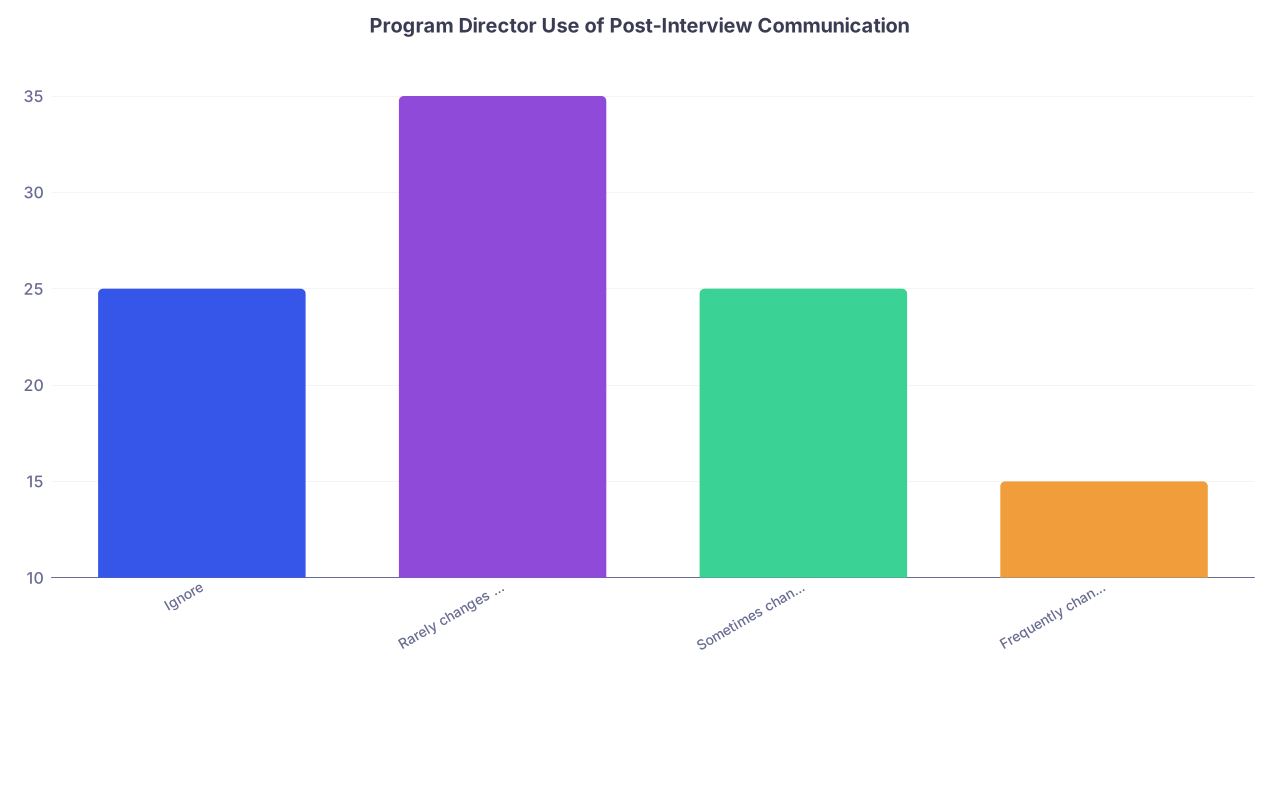
- Around 60–75% of PDs say they pay “some” attention to post-interview communication.
- Only ~15–25% report that post-interview communication “frequently” changes how they rank an applicant.
- Letters of intent are one subset of that, and most PDs explicitly mention skepticism about “you’re my #1” language.
So you are playing in a space where, in the best case, maybe 1 in 4 programs is open to being influenced much at all by an LOI. And even there, it is usually about small adjustments: moving someone slightly up or down a rank list, not dragging a weak file into competitive territory.
| Category | Value |
|---|---|
| Ignore | 25 |
| Rarely changes rank | 35 |
| Sometimes changes rank | 25 |
| Frequently changes rank | 15 |
Roughly: 25% ignore it, 35% say it rarely changes anything, 25% say sometimes, 15% say frequently. That is not a high-yield intervention. It is more like a “tiebreaker” at best.
So if that is the reality, sending an LOI should be treated as a scarce resource, reserved for specific use cases. And in many situations, not sending one is absolutely reasonable.
The Myth of the “Required” LOI
A lot of applicants act as if the match algorithm reads your emails. It does not. The algorithm is blind to your LOIs. Only human beings on the program side can change your fate, and they do that by adjusting your rank position… if they care.
Here is why the “you must send an LOI” narrative is overblown:
- The match already protects applicants. If you truly rank a program #1 and they like you enough, you are matched there regardless of whether you sent an LOI.
- LOIs are a noisy signal. Programs receive dozens saying “you are my top choice” for the same 4–8 spots.
- PDs develop skepticism. I have heard versions of: “We got more #1 LOIs than interviewees,” or “Everyone loves us until they match somewhere else.”
So the base rate for “honest, credible LOI that moves the needle” is low.
This is exactly why not sending one can be data-driven:
- You avoid being lumped in with obviously performative messaging.
- You maintain credibility if you ever communicate with that program in the future (SOAP, fellowship, etc.).
- You reserve your emotional and time budget for higher-yield moves (improving Step 2, targeted updates, better interviewing).
The correct question is not “Should I send an LOI?” It is “Do my probabilities improve enough in this specific scenario to justify sending one?” Often, the answer is no.
When Not Sending an LOI Is Perfectly Rational
Let’s get concrete. Here are the conditions where, based on available data and how programs actually operate, not sending an LOI is fully justified.
1. You Do Not Have a Clearly Dominant #1 Program
Data from applicant surveys suggest only about 40–50% of applicants feel they have an obvious, emotionally and practically clear #1 by the end of interview season. The rest have clusters of 2–4 programs they would be happy with.
If you are in that 50–60% without a crystal-clear #1, sending a “you are my top choice” LOI to any single program is either dishonest or premature. Both are problems.
The data shows:
- Dishonest LOIs erode trust. PDs routinely compare notes at national meetings and via informal channels. Multiple programs in the same city getting the same “you are my #1” message is not rare, and it is noticed.
- Premature commitments often age badly. Applicants change their mind after second looks, family discussions, or reviewing call schedules more carefully.
In that situation, not sending any LOI and simply ranking your programs in authentic order is completely reasonable. Your rank list is the only binding signal in the system.
2. Programs Explicitly Say LOIs Will Not Affect Ranking
Many programs now include a version of this line:
“Post-interview communication, including letters of intent, will not influence our rank list.”
When a program says that, you should take them at their word. Why?
- They have legal and ethical pressure to avoid games that bias the match.
- They are signaling an internal policy. Staff and PDs are often instructed to ignore or at least not operationalize LOIs.
- Historically, programs that publish such statements do so to reduce inequity and noise, not as a smokescreen.
Could one attending or APD still be swayed? Possibly. But the expected effect size is small. You might move from rank 35 to 34 on a 120-person list. It does not change your match probability much.
In those cases, a simple, sincere thank-you email after the interview is enough. No LOI needed.
3. Your Application Signals Are Much More Powerful Than Any LOI
Look at what PDs say they actually care about. From NRMP PD survey data, the top-ranking factors (varies by specialty, but again, pattern is consistent):
- Step 2 / Level 2 scores
- Clerkship grades and MSPE
- Letters of recommendation
- Interview performance
- Fit and professionalism on interview day
Post-interview communication is typically mid-pack or lower.
If you are in one of two buckets, LOIs mostly become noise:
You are already highly competitive for that program
- Top third of their interview pool by scores and grades.
- Strong home or away rotation performance.
- Explicitly strong feedback to your dean or mentors.
In this scenario, your match odds are already high if you rank them #1 or near the top. An LOI may add marginal value, but it is not required. A generic, polite thank-you covers professional courtesy.
You are clearly below their usual metrics
- Your Step 2 is 10–15 points below the program’s typical matched cohort.
- No home/away rotation at that institution.
- Mediocre or generic letters.
For these cases, PDs rarely say, “Scores are low, but the LOI was very nice, move them up 20 spots.” It does not happen. They protect their board pass rate and perceived quality with hard metrics.
If the objective data is already decisively for or against you, an LOI is low-yield. Skipping it is rational.
4. You Are Not Willing to Rank That Program #1 (Honestly)
This one is simple. A “Letter of Intent” that does not include the line “If matched here, I will attend; you are my top choice” is not an LOI. It is just a “letter of interest.”
If you do not actually intend to put the program as #1 on your rank list, then sending an LOI is either:
- Dishonest, or
- A misuse of the term “LOI” that PDs are frankly tired of decoding.
In that case, you have two options:
- Send a sincere “update/interest” email without the “you are my #1” language.
- Say nothing beyond the standard post-interview thank-you.
Both are fine. Silence is often better than muddy, semi-committal language that programs have to parse.
5. Programs Are Swamped and You Risk Being Noise
Big-name programs in competitive specialties (Derm, Ortho, ENT, Plastics, some IM subspecialty-heavy academic centers) often interview 120–200+ applicants for 5–20 spots.
You are one of many.
Their internal process usually looks like this:
- Immediate scoring after interview day based on structured rubrics.
- Consensus meeting to create tiers (A, B, C bands).
- Minor adjustments as new information arrives (e.g., Step 2 released, major professionalism flags, glowing follow-up from a trusted faculty member).
In that structure, a generic LOI from “just another strong applicant” in the middle band is not moving you from Band C to Band A. At best, it might nudge you within a band.
Programs with that scale often receive 50–150 LOIs and “interest” emails in a 4–6 week window. Many PDs bluntly admit they skim or batch-delete most of them.
Probability of meaningful impact? Very low. Not sending one is reasonable. If you have a real connection (research mentor on faculty, home med school ties), a targeted note from the mentor often has higher impact than anything you send yourself.
Situations Where Silence Beats a Weak LOI
There are times when not only is an LOI unnecessary, but sending one actively hurts you. I have watched this happen.
Overpromising and Under-Delivering
Applicants sometimes send LOIs to a program as “#1” and then match elsewhere. PDs remember. Especially in smaller specialties.
The damage is not about the match that year; it is reputational:
- Your name may come up again when you apply for fellowship.
- Your med school advisor’s credibility drops if multiple students from that institution play games with LOIs.
- Some PDs start reading all LOIs as fiction because the false signal rate is so high.
If you are not 100% certain a program is your true #1, do not call it that. You are better off silent than marked as untrustworthy.
Copy-Paste or Obviously Generic LOIs
Programs can see through mass-produced language. If you are sending the same template to multiple places with minor edits, they can tell. Some red flags:
- “[Program Name] is my top choice because of your strong clinical training and supportive environment.” (That describes 75% of programs’ websites.)
- Getting the city or institution name wrong (yes, this happens more often than you think).
- Referencing features that are not unique (“your large academic hospital,” “strong research focus”) without specifics.
A weak LOI may downgrade you from “neutral” to “mildly unimpressive.” In that case, again, silence would have been better.
No New Information, Just Anxiety
A good rule: if your post-interview communication contains 0% new information and 100% anxiety, do not send it.
Examples of low-value content:
- Repeating that you are “very interested” without any specificity.
- Re-summarizing your application or personal statement.
- Asking thinly veiled “where am I on your list?” questions that PDs are not allowed to answer.
Programs already have your ERAS file, your scores, your personal statement, and their interview notes. An LOI that adds nothing but emotional pressure is more likely to irritate than help.
Comparing Strategies: LOI vs. No LOI
Let’s contrast two broad strategies and what the data suggests about them.
| Strategy | Typical Use Case | Potential Upside | Risk Level |
|---|---|---|---|
| Strong, single LOI | Clear #1 program, close fit | Moderate | Low |
| Multiple LOIs | Several “#1” claims | Very low | High |
| Targeted updates | Specific, data-based improvements | Moderate | Low |
| No LOIs, thank-you only | No clear #1, or low LOI impact | Low–moderate | Very low |
The data and PD commentary consistently support this:
- One honest LOI to a true #1 can modestly help at some programs.
- Multiple “#1 LOIs” are reputationally toxic.
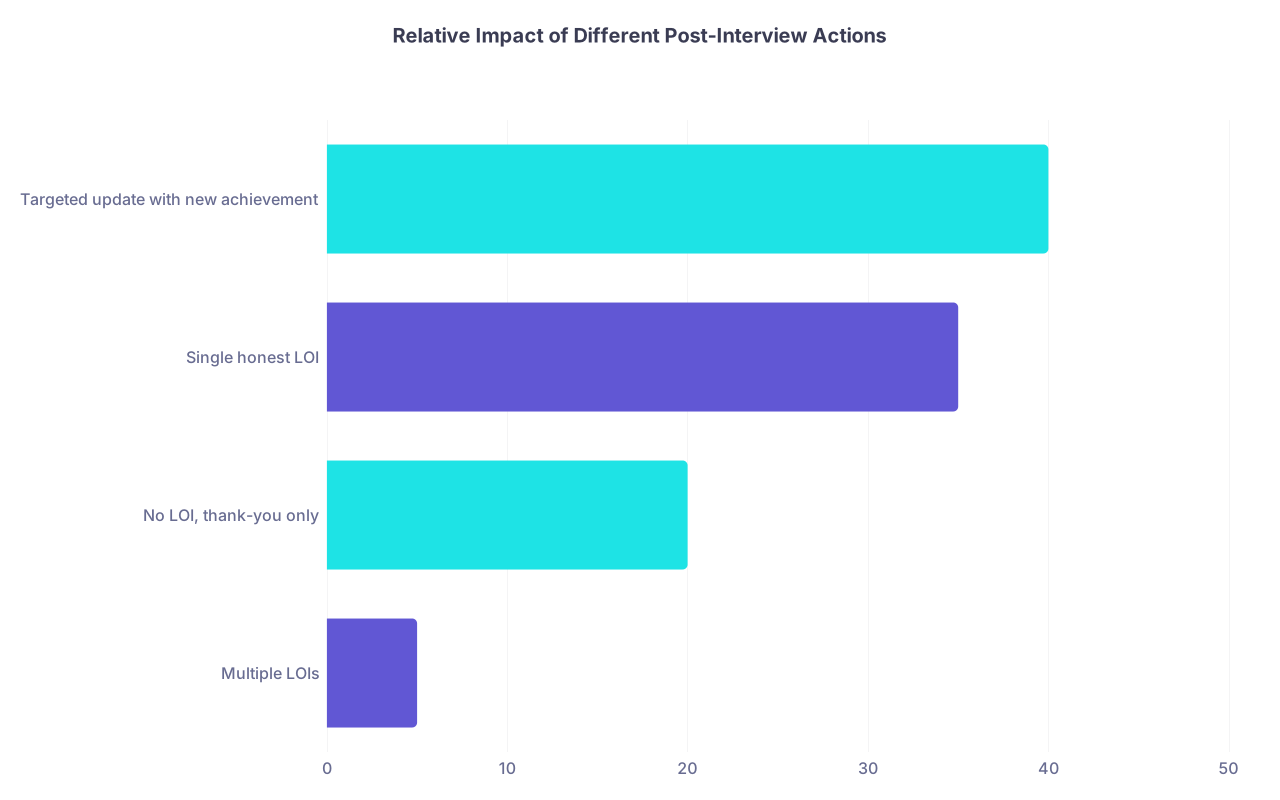
- Targeted updates (new Step 2 score, publication, award) often have more objective impact than any LOI.
- “Thank-you only, no LOI” is a safe baseline and does not meaningfully harm your chances.
| Category | Value |
|---|---|
| Multiple LOIs | 5 |
| No LOI, thank-you only | 20 |
| Single honest LOI | 35 |
| Targeted update with new achievement | 40 |
If we normalize impact on a 0–100 scale, multiple LOIs are near zero or even negative. A single honest LOI and targeted updates are where the small but real upside lives. And the “no LOI, just professional communication” approach beats trying to game the system with multiple conflicting promises.
The Future: LOIs Will Likely Matter Less, Not More
Look at the macro trends in medical education and residency recruitment:
- Step 1 pass/fail has already pushed more emphasis to Step 2, rotations, and structured interviews.
- Some specialties are exploring standardized video interviews, situational judgment tests, and other tools with higher reliability than unstructured communication.
- Programs increasingly publish explicit policies about not using LOIs or limiting post-interview contact to reduce inequity.
All of this moves the system towards more structured, data-heavy evaluation, and away from “who sent the most persuasive email.” That is not idealistic speculation; you can see it in public program statements and survey responses.
My expectation over the next 5–10 years:
- More programs will state openly that LOIs do not affect ranking.
- PDs will rely even more on quantified data and structured interview scoring.
- LOIs will become primarily a courtesy or relationship-building tool, not a ranking lever.
Planning a strategy that assumes LOIs are a major differentiator is betting against the observable trajectory.
So When Is Not Sending an LOI Reasonable?
Summarizing the decision rule:
Not sending an LOI is reasonable—often optimal—when:
- You do not have an honest, unquestioned #1 program.
- The program explicitly says LOIs do not affect ranking.
- Your metrics already clearly place you in or out of their usual match range.
- You would have to lie or exaggerate to write it.
- You have nothing new or specific to add beyond “I liked you.”
- You are afraid you will send multiple conflicting LOIs.
Under those conditions, the expected value of an LOI is near zero or negative. A concise thank-you, a well-constructed rank list, and improved objective data (Step 2, research, rotations) are far better uses of your effort.
The data shows LOIs are, at best, a marginal signal in a system dominated by scores, performance, and structured assessments. Treat them accordingly.
Key Takeaways
- The majority of programs either ignore LOIs or let them influence rankings only at the margins; they are not a core selection tool.
- Not sending an LOI—especially when you lack a clear, honest #1 or the program discourages them—is a rational, data-aligned strategy.
- Your real leverage lies in your metrics, your interview performance, and an authentic rank list, not in flooding inboxes with promises you might not keep.