
Meta description: Learn how to verify a physician "no call" job before signing by checking contract language, backup coverage, holidays, staffing gaps, real schedules, and compensation tradeoffs so you know what "no call" actually means in practice before you commit.
"No call" is one of the sloppiest phrases in physician recruiting. I've seen it mean truly zero nights and weekends. I've also seen it mean phone triage every third weekend, holiday backup, or "you're not officially on call, but we'll need you if the service gets thin." Those are not the same job.
This guide is for you if you're job hunting, switching practices, or trying to protect family time before you sign away your schedule. Spouses and parents should care too, because vague call language becomes very real at 6:30 p.m. on a Friday.
Here's the core rule: verify when the claim is made, what they mean by it, and which documents prove it. Not after onboarding. Before your name hits the signature line.
Educational disclaimer: This article is for education only and is not legal, financial, tax, employment, or contract advice. Physician compensation, call pay, coverage expectations, scheduling obligations, and contract terms vary widely by specialty, employer, state, and practice structure. If an offer includes pay for call, backup coverage, productivity tradeoffs, or contract language that affects your schedule or income, review it with a qualified attorney and, when appropriate, a tax or financial professional before signing.
This article is for educational purposes only. It is not financial advice, not legal advice, and not tax advice. Figures vary by individual circumstances, consult a qualified professional before acting.
Myth #1: "No Call" Always Means No Night/Weekend Work
It doesn't. Not even close.
At this point you should separate the phrase into actual categories:
- No call = ideally no assigned after-hours responsibility at all
- No in-house call = you may still take phone call from home
- No bedside call = you may still review charts, answer consults, or supervise remotely
- Infrequent call = they're using "no call" as marketing, which is bad form
- Backup coverage only = you're "not on call" until someone quits, gets sick, goes on leave, or the group grows
That's the trick. Recruiters often describe the emotional feel of the job, not the operational reality. "It's basically no call" is not a schedule. It's a vibe. And vibes don't protect your weekends.
Common coverage models that get mislabeled:
Shared call across a large group Sounds light. Can still mean several weekends a year.
Cross-coverage Another service covers you most nights, but you cover them during gaps, holidays, or vacations.
Consult-only expectations No admissions, no in-house rounds. Fine. But if you're fielding urgent phone calls at night, that is still call.
Unscheduled backup The most dangerous one. "Only if needed." Needed by whom? Defined how? How often last year?
The risk isn't theoretical. I've watched physicians sign "lifestyle" jobs and then discover they were expected to answer patient messages on weekends, take holiday coverage, or absorb service-line call after a colleague left. That's how resentment starts. It's also how family plans blow up and ethical misunderstandings creep in. If you're responsible, you need to know exactly when that responsibility begins.
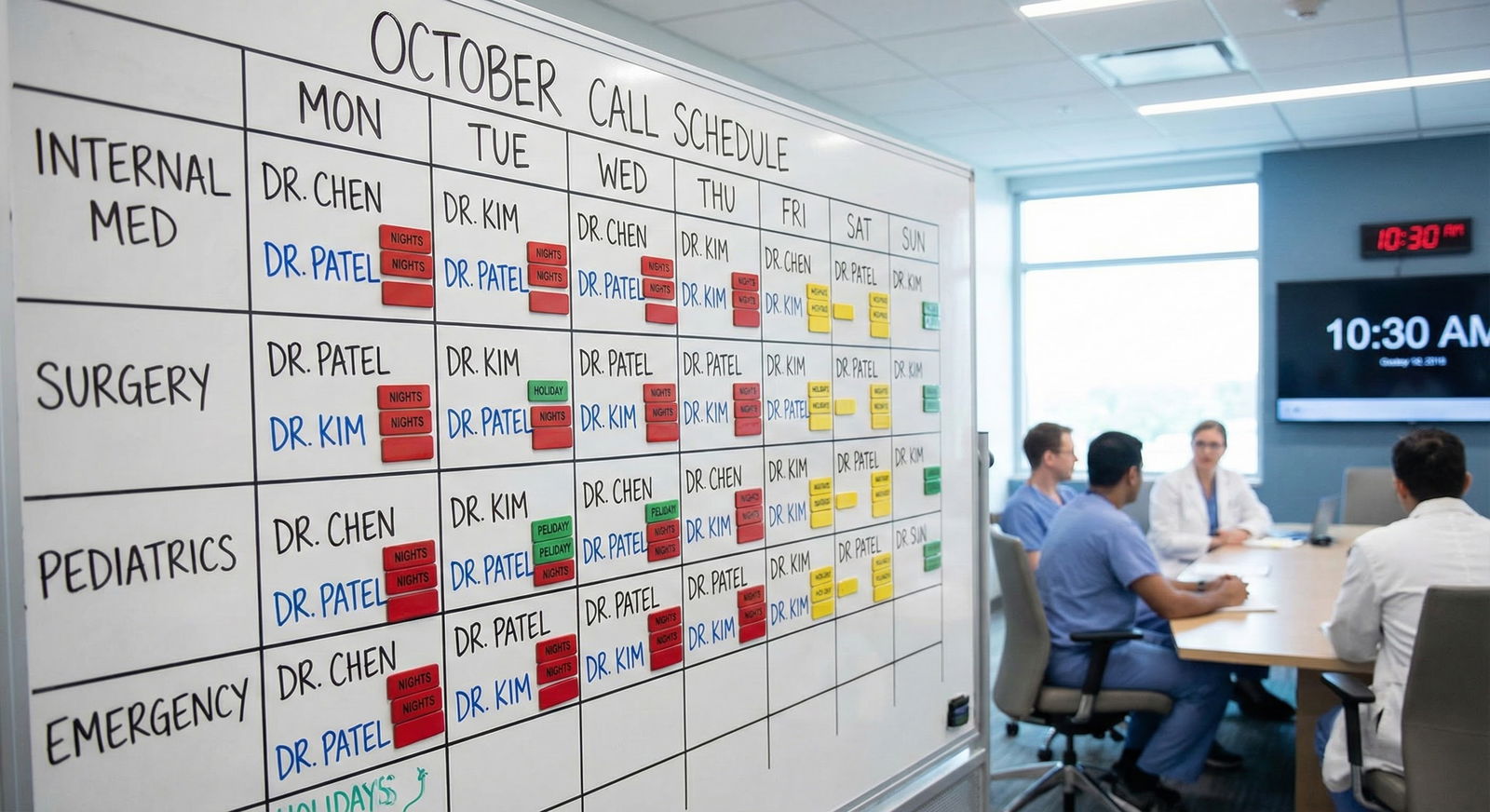
Myth #2: If They Said "No Call," It's Guaranteed in Writing
Usually? No.
Verbal reassurance is cheap. A recruiter says, "There's no call." A medical director says, "We don't really do call here." Then the contract says nothing useful. Or worse, it includes a mushy clause like "Physician will participate in coverage responsibilities as reasonably assigned."
That sentence is how "no call" quietly becomes call.
At this point you should care about three things:
- Is call defined?
- Is frequency stated?
- Does the contract match operations?
Why writing matters:
- Staffing changes
- New service lines open
- Someone goes on leave
- The "temporary" backup system becomes permanent
- Leadership changes and suddenly "team-based flexibility" appears
Words like reasonable efforts, occasional coverage, as needed, and shared professional responsibilities are magnets for abuse. Not always malicious. Sometimes just lazy. But lazy contract language can wreck a good lifestyle job.
Look for:
- A specific statement that call is not required, if that's the promise
- A definition of whether phone triage, remote consults, holiday backup, and weekend coverage count
- Any clause allowing future reassignment of call duties
- Schedule governance: who assigns coverage, how far in advance, and how exceptions are handled
<chart-data-api config='{"type":"bar","title":"How '"No Call"' Can Translate Into Real Work","labels":["True no call","Infrequent call","Shared rotating call","Backup phone coverage","Holiday/weekend coverage"],"datasets":[{"label":"Typical shifts or obligations per month","values":[0,2,5,3,2]},{"label":"Clarity when verified in writing (%)","values":[80,72,78,60,68]},{"label":"Clarity if only verbal (%)","values":[25,22,20,18,15]}],"yAxisLabel":"Relative comparison"}'>
Timeline Guide: When to Verify Before Signing (Month-by-Month)
My rule is simple: verify early, verify again, and verify right before signing. If an offer discussion starts today, your first call questions should happen in the first 1-2 weeks. Then you circle back again 48-72 hours before signature. That last pass catches the nonsense.
At this point you should think in phases.
Month 0-1: Screening phase
This is where you stop the soft language.
Ask early:
- When you say "no call," what exactly is excluded?
- Any in-house call?
- Any phone call?
- Any weekend or holiday coverage?
- Any backup expectations during staffing shortages?
- Can you send the call policy in writing?
Request:
- Call policy document
- Sample schedule structure
- Written summary email from recruiter or practice lead
If they act offended by basic clarification this early, good. Better to see that now than after relocation.
Month 2-3: Confirmation phase
Now you test whether operations match the sales pitch.
Talk to:
- A current clinician in the group
- The scheduler, chief, or practice manager
- A mentor who knows this practice model
Confirm:
- How the schedule is actually built
- What happened during the last staffing gap
- Whether anyone without formal call still covers inboxes, urgent questions, or holiday overflow
- Whether there is a standard calendar template
Ask for:
- Typical annual calendar format
- Holiday assignment rules
- Backup coverage policy
- If possible, the last 3 months of actual team schedule
That last request matters. Actual schedules tell the truth faster than polished promises.
Final 48-72 hours before signature
This is your lock-in window.
At this point you should compare four things side by side:
- Job posting
- Recruiter emails
- Interview statements
- Contract language
If those four don't align, stop. Don't rationalize. Don't tell yourself you're being too rigid. You're not. You're catching a preventable problem.
Week-by-Week Checklist: What to Ask, Who to Ask, What to Request
Week 1: Define the term
Ask the recruiter or medical director:
- What does "no call" exclude?
- Does it exclude:
- in-house call
- phone call
- remote consults
- holiday coverage
- weekends
- Is there any circumstance where I'm expected to cover after hours?
Your goal this week: get the definition.
Week 2: Get frequency and triggers
Ask:
- Who assigns call or backup coverage?
- What happens if the team is short-staffed?
- What counts as an emergency?
- What happened the last time someone left, went on leave, or the schedule broke?
Your goal this week: get the real-world trigger points.
Week 3-4: Request documents
Request:
- Formal call policy
- Coverage model summary
- Typical annual calendar template
- Last 3 months of actual schedules, if available
- Contract language showing whether any call responsibility exists
Your goal this week: get the paper trail.
If they can't produce documentation but insist the job is stable, I read that as disorganization at best and misdirection at worst.
Day-by-Day: The Final 72 Hours Before You Sign
This is the part people rush. Don't.
Day -3: Put your questions in writing
Send one clean email. Bullet points. No vague "just checking." Ask for direct answers.
Example topics:
- Is call truly zero?
- Are holidays included or excluded?
- Any backup phone responsibility?
- Any temporary call expectation during staffing gaps?
- Does the contract reflect this exactly?
At this point you should force specificity. "Should be minimal" is not an answer.
Day -2: Verify with someone who lives the schedule
Get on the phone with:
- a current clinician
- the scheduler
- the practice manager
Ask for the actual calendar template and posting cadence.
Questions:
- How far in advance is the schedule posted?
- Who gets contacted first when someone calls out?
- Has anyone in this role done unexpected after-hours work in the past year?
That last question is gold. I've seen more truth come out from one scheduler in five minutes than from three polished interviews.
Day -1: Read the contract like a cynic
Now line up the contract against everything you've been told.
- "No call" in recruiting materials, but coverage language in contract
- No routine call, but required professional availability
- No assigned call, but holiday coverage buried elsewhere
- Undefined terms like "reasonable" or "as needed"
If anything conflicts, require an addendum. Not a wink. Not a verbal promise. A written fix.
What to Do If They Won't Provide Clarity
Here's my position: if they won't clarify, don't reward that with a signature.
This is not where you "trust your gut." Guts are for interviews. Contracts need evidence.
Decision rules:
- If call frequency is unknown: pause
- If holidays or weekends are vaguely excluded: pause
- If "reasonable efforts" replaces clear limits: pause
- If verbal and written terms don't match: do not sign
At this point you should choose one of four moves:
Request an addendum Define call type, frequency, exclusions, and staffing-gap rules.
Negotiate a cap If true zero isn't possible, set a maximum and define compensation or relief.
Move to a different team or service line Sometimes the problem is local, not institutional.
Delay start until clarified Annoying? Yes. Better than starting a job under false assumptions.
Summary: A "No Call" Offer Is Only Real After Verification
"No call" is not a benefit until it's defined, quantified, and documented. That's the standard. Not recruiter charm. Not hopeful interpretation.
At this point you should remember the timeline:
- Early in the offer phase: define the term
- Week by week: verify frequency, triggers, and backup rules
- Final 48-72 hours: make the contract and operations match
Your win condition is simple:
- call type clearly defined
- frequency stated, including worst case
- holidays/weekends addressed
- backup coverage rules stated
- contract language aligned with what you were told
- written confirmation in hand
If they won't give clarity, you are not being difficult. You're doing due diligence. Frankly, that's what a careful physician is supposed to do.