
It’s 2:37 a.m. You’re on “q4 short call” that was supposedly “very manageable” on interview day. You’ve already admitted six patients, your senior is slammed, and you just realized you’re still pre-rounding in your head because sign-out is in four hours and nobody’s going to do your notes for you.
You’re staring at the workroom whiteboard thinking:
“This is not what they sold me. At all.”
And now your brain is off to the races:
Did they lie? Am I just weak? Can I get out? Will I screw my career if I say something? What if every other program is this bad and I just need to suck it up?
Let’s talk about that exact nightmare. Because it happens. More than people admit on interview day.
First: Are You Actually Being Misled, Or Is This “Normal PGY1 Hell”?
This is the first ugly question, and it sucks, but you have to ask it.
Programs love soft language:
“Home call mostly.”
“Short call is actually like 5 p.m.”
“Nights are front-loaded but not bad.”
Then July hits and suddenly:
- “Home call” = you’re on the phone all night and charting at 3 a.m. anyway.
- “Short call” = you stay until 10 p.m. regularly.
- “Nights not bad” = 6 nights in a row, cross-covering 60 patients.
Sometimes that is how the specialty runs. Sometimes they just straight-up undersold it.
Here’s how I think about whether you were truly misled:
You were likely misled if:
- What residents universally told you on interview day (“we rarely stay past 7”) is wildly different from what everybody is experiencing now (“we all stay till 10–11, every time”).
- They gave you specific numbers/phrases: “no 24s,” “q8 call,” “4–5 nights per month,” and your reality is nothing close to that.
- Multiple interns and even some seniors quietly say, “Yeah… that’s not how they described it to us either.”
You probably weren’t misled (just crushed by PGY1 reality) if:
- The schedule on paper matches what you’re working, but you underestimated how destroyed you’d feel.
- Call frequency is accurate but the intensity is rough (everyone is drowning, not just you).
- You heard “intern year is tough here but it gets much better PGY2,” and seniors genuinely seem happier and more functional.
The distinction matters because it affects your options. But emotionally? It all feels like betrayal. You picked “lifestyle-friendly” and you’re crying in the stairwell at 3 a.m.
You’re not weak. You’re sleep-deprived and disillusioned. That’s different.
Step One: Get Clarity Before You Blow Anything Up
Your brain is probably already at, “I need to transfer. Or quit. Or go do derm.”
Slow down.
You need facts before big decisions. Right now, everything is colored by exhaustion.
First, talk to people quietly and specifically:
A trusted senior resident.
Not the chief who eats lunch in the PD’s office. Someone who’s straight with you. Ask real questions:- “Is this how it usually is on this service?”
- “Did they describe call this way when you interviewed?”
- “Does it get better PGY2 or is this the vibe of the whole program?”
Other interns.
If everyone’s shocked, you’re not imagining this. If everyone says, “Yeah, this is what I expected,” maybe your expectations were off. That doesn’t make your misery fake, but it changes the strategy.Check what’s written.
Pull the offer letter, program brochure, or that slide deck you screenshotted from the recruitment webinar. Look for specific call language. Sometimes it’s vague on purpose. Sometimes they really did put “no 24-hr call” in writing while you’re literally on a 28-hr stretch.
You’re trying to answer three questions:
- Is this a systemic pattern or just a brutal rotation?
- Did they actually misrepresent, or did they just use vague, glossy language?
- Is there a path to a more livable reality within this program?
You need those answers before going nuclear.
The Quiet, Low-Risk Moves You Can Make Right Now
Before we talk transfers and GME and lawyers (yeah, we’ll go there), there are smaller moves that can help, even if they don’t fix the dishonesty piece.
1. Reality-check your rotation mix
Intern year is wildly uneven. One brutal block can trick you into believing “this is my life for 3 years.”
Ask senior residents:
- Which rotations are death?
- Which are actually okay or even chill?
- Does the second half of the year ease up?
If they say, “Cards and night float are terrible, but clinic blocks and electives are fine,” you might be in the worst possible block right now. That still sucks. But you may not want to blow up your residency during its absolute low point.
2. Investigate duty hour violations – quietly
If they promised “no 24s” and you’re logging 28s, or “80 hours max” and you’re doing 90–100, that’s a different category: that’s not just bad vibes, that’s an ACGME problem.
Make sure you:
- Log duty hours accurately. Don’t lie to “protect the program.” They’re not protecting you right now.
- Track your own hours in a note on your phone in case the official system feels sketchy.
- Compare with co-interns: are they also pushing past 80 but logging 78 every week out of fear?
If the culture is “we don’t log violations,” that’s a huge red flag. Programs get twitchy if the ACGME starts asking questions, and they know it.
3. Ask about schedule adjustments without making it accusatory
You can have a low-key, non-confrontational conversation with a chief or APD along the lines of:
“I’m committed to the program and I know intern year is hard, but my call schedule feels very different from what I had understood on interview day. I’m concerned about sustainability. Is there any room to adjust or redistribute call, or is this just how this block runs?”
You’re not accusing them of fraud. You’re flagging “sustainability” and “different from what I understood,” which is code for: I remember what you promised.
Sometimes programs genuinely don’t realize how lopsided the intern call distribution is until someone says it.
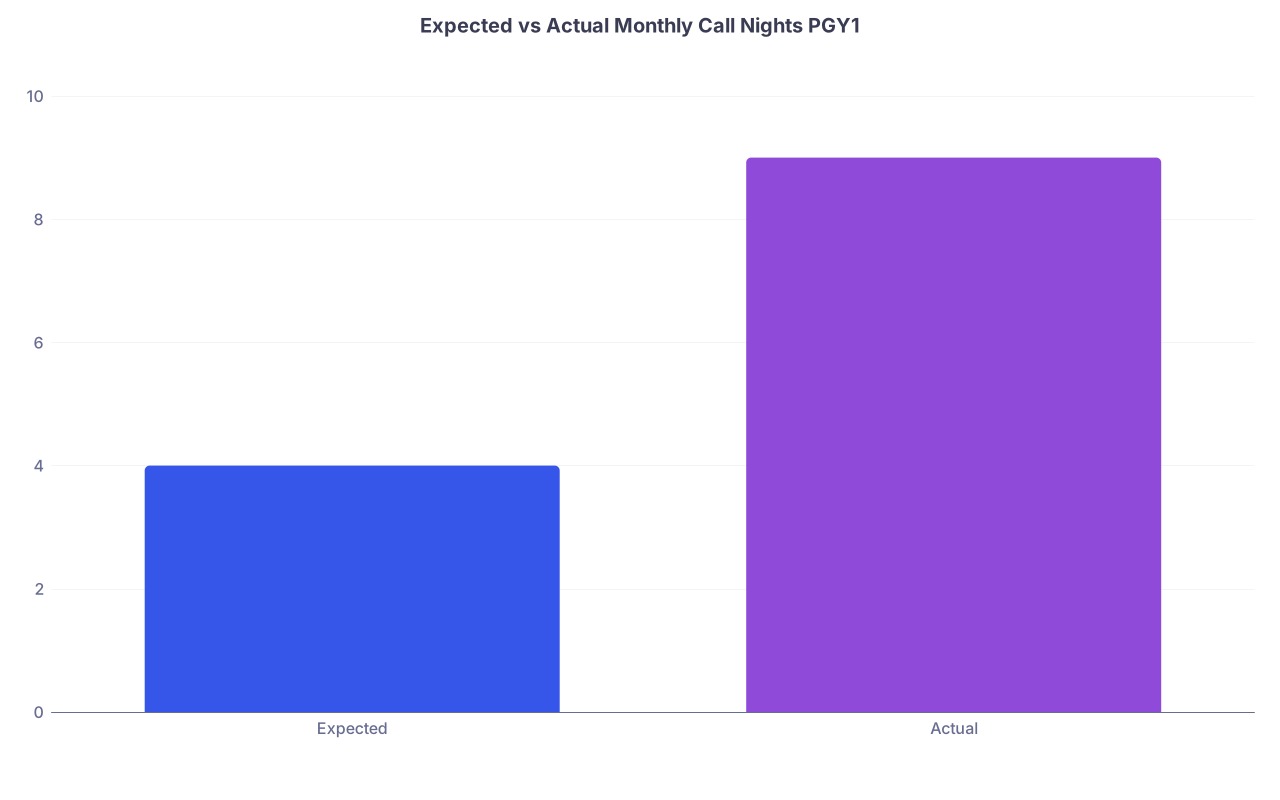
| Category | Value |
|---|---|
| Expected | 4 |
| Actual | 9 |
When It’s Actually Dishonest: What Are Your Real Options?
Let’s say you’ve checked with seniors, looked at the documents, and yeah. They pretty much sold a fiction.
Now what?
Option 1: Stay, but change how you think about it
Brutal honesty: a lot of people do this. They feel misled, they’re angry, but they grit their teeth and finish because:
- They’re locked into a visa situation.
- Specialty transfer would cost them years.
- They actually like the specialty but hate the current block.
- Moving would wreck partner/family logistics.
If you decide to stay, don’t gaslight yourself about what happened. Call it what it is: they sugar-coated or lied. That’s on them, not on you being “too sensitive.”
What you can do:
- Target the safest rotations for recovery and protect those like gold.
- Set a hard internal boundary: you’re here for X years, then you’re done with this kind of environment.
- Use electives later in residency to position yourself for a more humane attending job (outpatient-heavy, hospitalist with defined shifts, whatever fits your specialty).
Is it ideal? No. But it’s a rational survival plan.
Option 2: Try to fix it from inside (carefully)
This is the “resident representative / committee” path.
If other residents also feel misled, sometimes:
- You bring concerns through your resident council or program evaluation committee.
- You collectively push for transparency in recruitment materials for next year.
- You push for call redistribution or extra support on notorious services.
I’ve seen this work in some internal medicine and peds programs. They didn’t eliminate call, but they turned terrifying 28-hr stretches into night float systems, or added an extra cross-covering resident.
The risk: if the culture is toxic, complaining gets labeled as “not a team player.” That’s real. You know your program’s vibe better than I do.
Option 3: Talk to the PD like an adult who is not bluffing
If things are truly out of line with what they said, and you’re seriously contemplating leaving, you can have a direct conversation.
Something like:
“I want to be candid. The call schedule and workload are significantly different from what was described to me during recruitment. I feel misled, and I’m struggling both physically and mentally to see how I can sustain this. I’m trying to understand if there is a realistic path within this program that aligns better with what was presented, or if I should be thinking about other options.”
You are signaling: I might actually leave. Not as drama, but as reality.
A good PD will:
- Acknowledge the mismatch.
- Offer ideas: moving rotations, altering schedule next year, connecting you with someone who transferred before.
- At least not act shocked that someone is struggling with call.
A bad PD will:
- Minimize everything: “Everyone feels that way at first.”
- Gaslight: “We never promised that,” even when they did.
- Threaten subtly: “Residency transfers are very frowned upon. It wouldn’t look good for you.”
If they go the gaslight route, that tells you a lot.

Option 4: Explore transferring to another program or specialty
This is the nuclear-feeling option, and your anxious brain probably has it pegged as: “If I try to transfer and it fails, I’m blacklisted forever.”
Reality: transfers are messy but not impossible.
Situations where I’ve seen transfers happen:
- IM to another IM program after a toxic intern year.
- Surgery to anesthesia/IM/FM after realizing the lifestyle was completely misrepresented.
- Ob/Gyn to FM after being crushed by call and culture.
The big pieces:
- You’ll usually need your current PD’s support (or at least not active sabotage).
- You might repeat a year, especially if you switch specialties.
- You’ll probably move mid-year or at the traditional July start.
This is where documenting misrepresentation can actually matter. If you can calmly say: “I was explicitly told [X] about call and it’s actually [Y], and it’s not sustainable,” other PDs sometimes understand that you’re not just flaky — you were sold something false.
You don’t have to commit to transferring just to quietly ask around:
- Reach out to a trusted mentor from med school.
- Ask if they know any PDs who are open to transfers.
- Explain you’re exploring, not declaring.
| Option | Pros | Cons |
|---|---|---|
| Stay | No extra delay, stability | Continued misaligned expectations |
| Transfer | Better fit possible | May repeat year, move cities |
| Switch specialty | Aligns with lifestyle values | Big identity shift, more years |
Option 5: Use GME / ombuds / ACGME channels when it’s truly bad
If the call lies are linked with duty hour violations, retaliation, or patient safety issues, you’re in a different arena.
You have a few layers:
- GME Office at your institution
- Resident ombudsman or physician well-being office
- Anonymous ACGME complaints
This is when:
- You’re consistently >80 hrs with no attempt to fix it.
- You’re being told to falsify duty hours.
- Residents who speak up are punished with worse schedules or bad evals.
I’m not going to sugarcoat it: blowing the whistle can make things tense. But programs are legitimately scared of ACGME scrutiny. If they’re egregious, sometimes that’s the only language they understand.
If you go this path:
- Keep a factual log of shifts, violations, emails, and who said what.
- Stick to verifiable stuff: “On X date, I was on duty from 5 a.m. to 9 a.m. the next day” is better than “It feels inhumane.”
- Consider talking to a trusted faculty member outside the program first to sanity-check your plan.

| Step | Description |
|---|---|
| Step 1 | Realize call mismatch |
| Step 2 | Talk to seniors and co interns |
| Step 3 | Survive rotation, reassess later |
| Step 4 | Talk to chief or APD |
| Step 5 | Monitor over few months |
| Step 6 | Meet with PD |
| Step 7 | Consider transfer or GME/ombuds |
| Step 8 | Stay with clear boundaries |
| Step 9 | Systemic issue? |
| Step 10 | Any improvement? |
| Step 11 | Still unsustainable? |
The Emotional Part Nobody Really Talks About
Under all the logistics and policy, there’s you at 3 a.m. feeling like an idiot for believing what they said on interview day.
The self-talk gets dark:
- “I should’ve seen through the sales pitch.”
- “Everyone else seems to handle this; I’m just not tough enough.”
- “If I leave, I’m a failure. If I stay, I’m miserable. Great options.”
A few things I want to say directly:
Recruitment is sales.
Programs sell. Hard. They cherry-pick the happiest residents, soften the call descriptions, and run a highlight reel. You were not stupid for believing them. You were operating with the info you had while exhausted and terrified during fourth year.You’re allowed to care about your life.
Wanting a humane call schedule doesn’t make you less dedicated or less of a “real doctor.” That macho “if you cared about patients you wouldn’t care about sleep” thing is outdated nonsense.Changing your mind is not failure.
If you decide, “This specialty or this program is not what I signed up for,” that doesn’t erase your work or your abilities. It means you got more data and updated your plan. That’s what we’re trained to do clinically, but somehow we shame ourselves for doing it in our careers.You don’t have to figure it out tonight.
You’re making life decisions on a sleep-deprived brain. Give yourself a real timeline: “I will reassess after this rotation,” or “I’ll gather information for 2 months before deciding.” Constantly re-deciding every night at 2 a.m. is torture.

But I Picked a “Lifestyle-Friendly” Specialty. Why Is Call Still Killing Me?
This is the particularly bitter part if you went for something supposed to be on the “most lifestyle friendly specialties” list.
Even in those:
- There can be brutal call during residency even if attending life is decent.
- Programs can hide behind phrases like “rare” or “occasional” that aren’t technically lies but are emotionally misleading.
- Some departments are understaffed, so “home call” becomes pseudo-in-house.
Intern year in a “lifestyle” field can still look like:
- 6–8 nights a month.
- A couple of 24-hr equivalent shifts packaged as “long call” or “weekend coverage.”
- Call that trashes your sleep so much that “off” days are basically just recovery.
So no, you didn’t “screw up” by choosing the wrong field. You’re just discovering that “lifestyle-friendly” at the attending level doesn’t automatically mean cushy residency.
But that also means: your long-term life may still be much more livable even if residency feels awful right now. That matters when you’re deciding whether to stay or go.
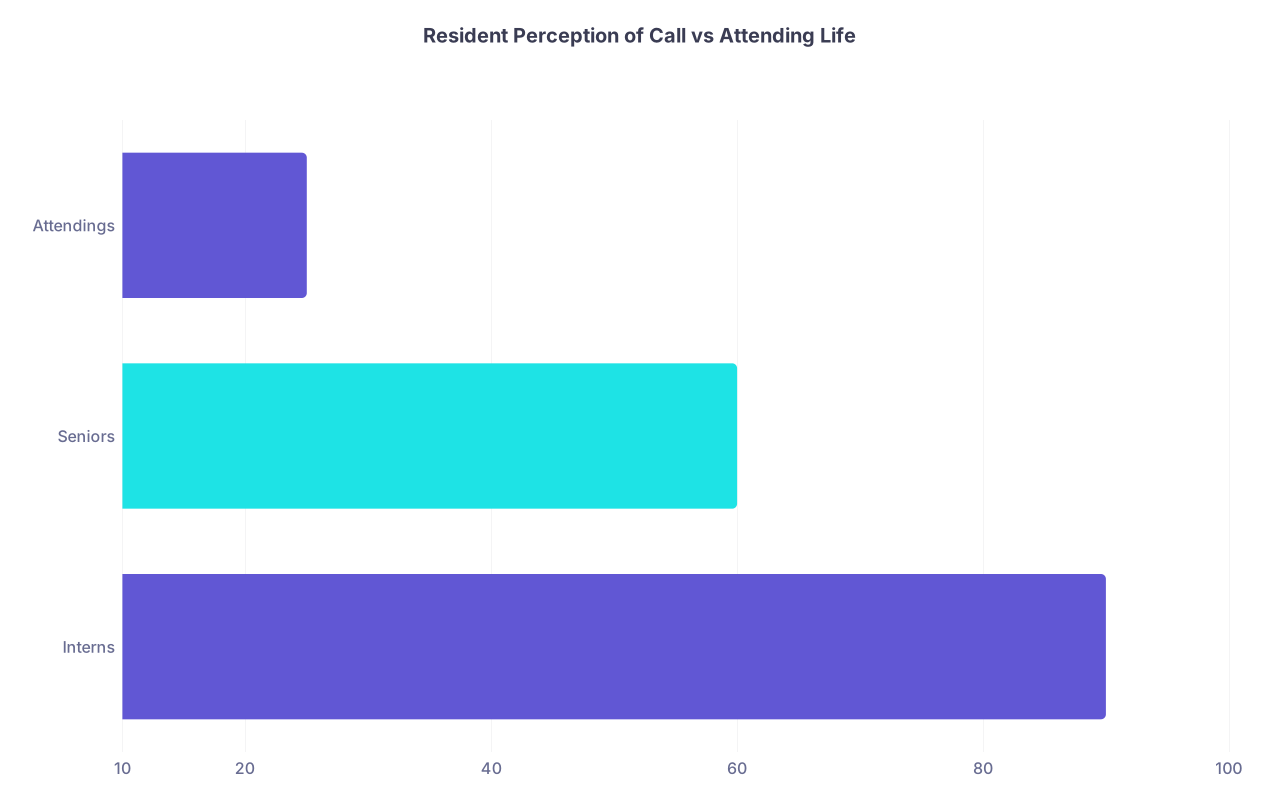
| Category | Value |
|---|---|
| Interns | 90 |
| Seniors | 60 |
| Attendings | 25 |

FAQ (Exactly 6 Questions)
1. If my program clearly misled me about call, can I break my contract and just leave?
You can leave, but it’s not like quitting a gym membership. You’re bound by an employment contract, state licensure issues, and GME rules. People do resign mid-year, but it can cause gaps in your training record and make future PDs cautious. The more strategic way is usually: gather documentation, have serious conversations with your PD and GME, and try to secure another spot before you walk away. Leaving with no plan is emotionally tempting but professionally risky.
2. Will other programs even want me if I say I’m transferring because of call?
Some will, some won’t. The key is how you frame it. “They lied to me about call and I bailed” sounds flaky. “The reality of the call structure was very different from what was described during recruitment, and I realized I need a program with X/Y features to be safe and sustainable” is more mature. PDs know some programs oversell; they’ve heard it before. You need to sound thoughtful, not impulsive.
3. What if my co-residents are all coping fine and I’m the only one drowning?
That doesn’t automatically mean you’re weak. Different people have different sleep needs, support systems, and mental health baselines. Some are quietly falling apart and just better at looking composed. Focus less on “everyone else is fine” and more on: are you dangerously sleep-deprived, making mistakes, or spiraling mentally? That’s when it doesn’t matter what anyone else is doing—you need changes.
4. Is it worth going to GME or ACGME if I’m scared of retaliation?
The fear is real. Programs aren’t supposed to retaliate, but things like bad evals and subtle punishment happen. That’s why you go stepwise: talk to trusted seniors or faculty, then maybe the resident ombuds or wellness office, then GME. Anonymous ACGME complaints exist, but they’re best used for clear, repeated duty hour or safety violations. If it’s “culture is crappy and they oversold call,” ACGME is less likely to be your fix; that’s more about your personal stay/leave decision.
5. How long should I “wait it out” before deciding to transfer or stay?
Give yourself a defined trial, not a vague “someday.” For example: “I’ll reassess after three months, including at least one non-malignant rotation.” If every rotation, every block, feels unsustainable and nothing changes after you flag it to leadership, that’s meaningful data. If it’s mostly a couple of horrific services and seniors swear it improves, you may decide it’s worth grinding through with a clear end date in mind.
6. Am I ruining my career if I switch specialties because residency wasn’t what I expected?
No. Plenty of people switch—surgery to anesthesia, OB to FM, IM to radiology, etc. You’ll take a hit in time and maybe pride, but not in overall career viability. Program directors care more that you can explain your decision clearly and demonstrate you’re not running from any difficulty, just from a bad fit or misrepresented reality. You’re allowed to choose a life you can actually live in.
Key takeaways:
You’re not crazy for feeling misled or overwhelmed by call; recruitment is sales, and intern year is brutal. Get specific information from seniors, documents, and your own logs before you make big choices. Then decide—consciously—whether you’re staying and surviving with boundaries, trying to change things from inside, or planning an exit toward something that actually matches the life you signed up for.