
You are not “stuck” in a miserable specialty because of one intern year. The idea that your first residency choice is a life sentence is outdated and frankly harmful.
If your intern year has convinced you that you need a more lifestyle-friendly specialty, you can pivot. You just need a clear plan, ruthless honesty, and tight execution.
Let me walk you through it step by step.
Step 1: Get Laser-Clear on What “Lifestyle-Friendly” Actually Means for You
“Lifestyle-friendly” is vague. That vagueness will burn you if you pivot blindly.
You have to define it in numbers and specifics:
- How many hours per week are you willing to work on average?
- How many nights per month?
- How many weekends?
- How much call (home vs in-house, q4 vs 1–2 times a month)?
- How much control do you want over your daily schedule?
- What income floor do you need to feel comfortable?
- How much procedural work do you want vs cognitive work?
Write this down. Literally.
Then map it to the specialties that often deliver better lifestyle in practice, not on paper.
Commonly lifestyle-friendlier specialties (in most markets):
- Dermatology
- Radiation Oncology
- PM&R (Physical Medicine & Rehabilitation)
- Pathology
- Diagnostic Radiology
- Interventional Radiology (better than surgical fields, still intense)
- Anesthesiology (variable but can be highly lifestyle-friendly in certain practice models)
- Allergy & Immunology
- Occupational Medicine
- Outpatient Psychiatry
- Outpatient-focused Family Medicine / Internal Medicine (with strong boundaries)
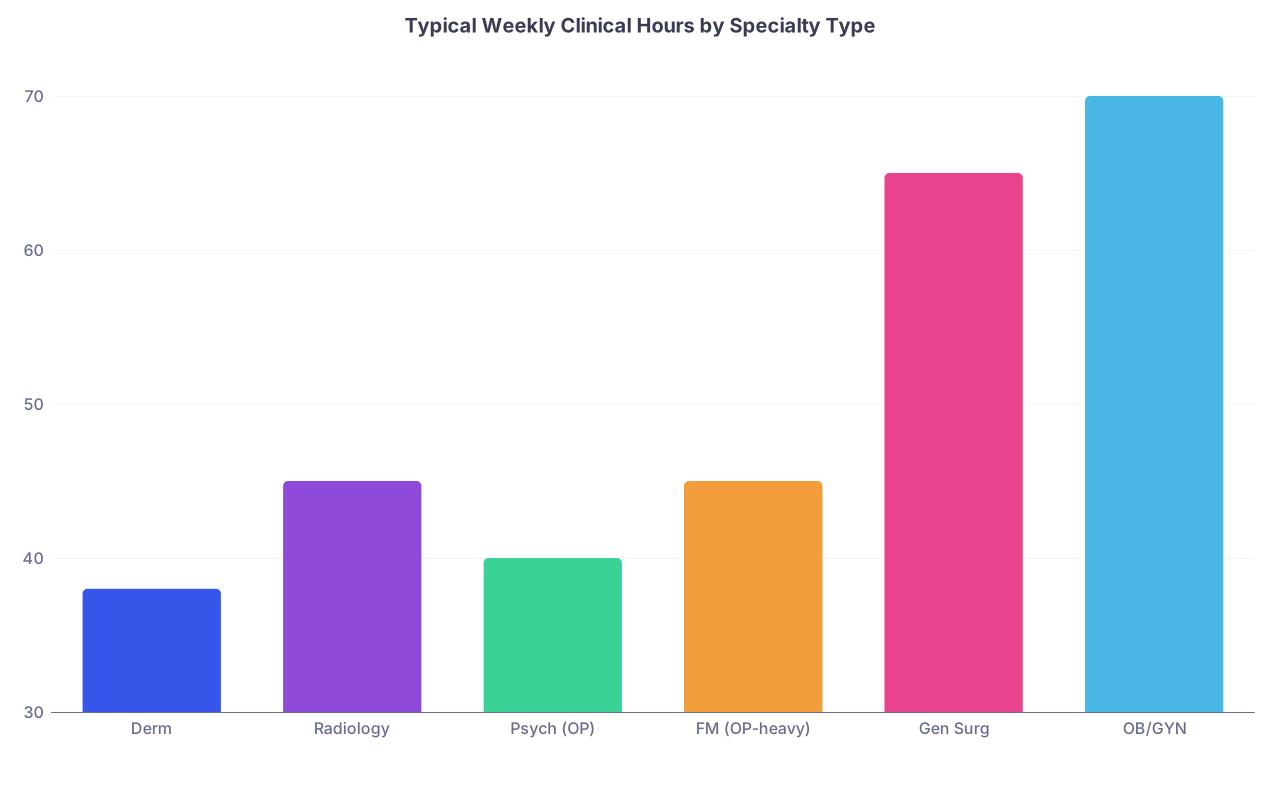
| Category | Value |
|---|---|
| Derm | 38 |
| Radiology | 45 |
| Psych (OP) | 40 |
| FM (OP-heavy) | 45 |
| Gen Surg | 65 |
| OB/GYN | 70 |
Are these numbers perfect? No. But they reflect what I see repeated across graduates, job postings, and real contracts.
Now add one more layer: what do you actually like doing?
Ask yourself:
- Did you enjoy outpatient continuity clinics more than wards?
- Do you like image-based problem solving?
- Do you like procedures but hate the chaos of the OR?
- Do you like talking to patients all day or would you rather focus on data and decisions?
You are not just escaping misery. You are choosing a place to land.
Step 2: Reality-Check What Is Actually Possible from Where You Stand
Your current position matters. A lot. You cannot ignore it.
You need to know:
- Your current specialty and program type (university vs community, reputation)
- Your exam performance (USMLE/COMLEX; Step 1 pass/fail era still cares about Step 2)
- Your year in training (PGY-1 vs PGY-2)
- Visa status if applicable
- Prior research or exposure to target fields
Here is the blunt truth: some pivots are very realistic; some are extremely uphill.
| Current -> Target | Relative Difficulty | Notes |
|---|---|---|
| IM -> Outpatient Psych | Easier | Shared foundation, demand high |
| IM -> Allergy/Immunology | Moderate | Needs fellowship, competitive |
| Gen Surg -> Anesthesia | Moderate | Common pivot |
| Gen Surg -> Dermatology | Hard | Research + strong scores |
| IM -> Radiology | Moderate-Hard | Scores matter, but doable |
| IM/FM -> PM&R | Easier-Moderate | Often open to switchers |
| OB/GYN -> Pathology | Moderate | Narrative + letters key |
You need a brutally honest self-assessment:
Scores reality check
- Step 1 (if numeric) below ~230 or Step 2 below ~235–240 makes ultra-competitive fields like derm or rad onc very difficult without insane compensating strengths.
- For lifestyle but mid-competitive fields (radiology, anesthesia, PM&R, psych), solid but not stellar scores are fine if the rest of your app is strong.
Training year
- Easiest time to pivot: During PGY-1 or early PGY-2.
- By PGY-3 and beyond, it gets harder logistically and financially, but not impossible, especially if you are jumping to a field with advanced positions.
Program reputation and support
- A PD who will advocate for you can make the difference between a smooth pivot and a trainwreck.
- A toxic PD can sabotage you quietly. You must assess this before you speak.
Do not skip this reality check. I have seen residents waste a year chasing derm with mediocre scores and no research because “lifestyle.” That is fantasy, not planning.
Step 3: Decide Your Pivot Strategy: Re-Apply vs Transfer vs Fellowship
There are three main pathways to a more lifestyle-friendly career:
- Re-apply to a new residency (start over or change tracks)
- Transfer into another program or specialty mid-training
- Use fellowship to “pivot” within or adjacent to your current field
You need to pick a primary path and a backup.
3.1 Re-applying to a New Residency
This is the cleanest on paper, messiest psychologically.
Best suited if:
- You are early (PGY-1 year, prelim year, or transitional year)
- You are in a preliminary year already (IM, surgery)
- You absolutely do not want to practice your current specialty at all
Key considerations:
- You may lose a year or two of training time.
- Some specialties give advanced positions (PGY-2 start) which can credit your prior year.
- You will need new letters and a narrative that does not make you sound flaky or unstable.
Common realistic examples:
- PGY-1 gen surg prelim → Anesthesiology PGY-2 spot
- Categorical IM intern → Diagnostic Radiology PGY-2 or PM&R PGY-2 spot
- Categorical IM intern → Categorical Psychiatry PGY-1 or PGY-2 with credit
3.2 Transferring Mid-Training
This is where you leverage your existing PGY year(s) and move laterally or into an advanced spot.
Best suited if:
- You are in a core training field (IM, surgery, transitional)
- You have decent standing in your program
- You are not trying to jump into the top 1–2 most competitive fields
This path often uses:
- Off-cycle or unfilled positions
- Networking via program directors
- Direct emails to specialty program coordinators and PDs asking about unexpected vacancies
3.3 Pivoting via Fellowship
You may not need to leave your base specialty.
Example pivots:
- Internal Medicine → Allergy/Immunology (mostly outpatient, great lifestyle in many practices)
- Internal Medicine → Endocrinology (clinic-heavy, often reasonable lifestyle)
- Internal Medicine → Rheumatology (outpatient, fewer emergencies)
- Psychiatry → Outpatient-only or subspecialties (sleep, forensics, etc.)
- FM/IM → Occupational Medicine (clinic hours, low call)
This route is for you if:
- You are already halfway through residency
- You can tolerate finishing your current training
- Your degree plus a lifestyle-friendly fellowship gets you to an acceptable day-to-day life
Step 4: Time Your Move – The 12–18 Month Timeline
If you want to pivot, you cannot wing the timing. Graduate medical education runs on fixed cycles.
Here is a basic timeline if you are in intern year and want to change for the next cycle:
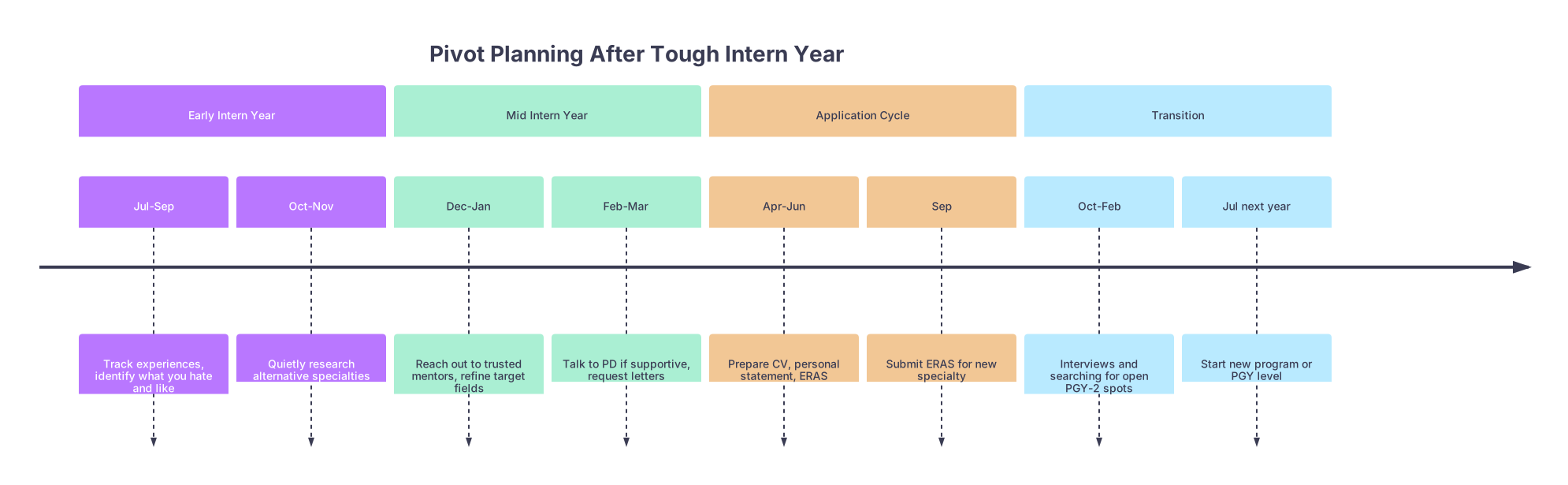
| Period | Event |
|---|---|
| Early Intern Year - Jul-Sep | Track experiences, identify what you hate and like |
| Early Intern Year - Oct-Nov | Quietly research alternative specialties |
| Mid Intern Year - Dec-Jan | Reach out to trusted mentors, refine target fields |
| Mid Intern Year - Feb-Mar | Talk to PD if supportive, request letters |
| Application Cycle - Apr-Jun | Prepare CV, personal statement, ERAS |
| Application Cycle - Sep | Submit ERAS for new specialty |
| Transition - Oct-Feb | Interviews and searching for open PGY-2 spots |
| Transition - Jul next year | Start new program or PGY level |
If you are later in training, you shift this pattern earlier and aim for:
- Off-cycle PGY-2+ positions
- The next available fellowship match cycle
The key is simple: you should be actively planning your pivot at least 9–12 months before you want to start the new position.
Step 5: Control the Narrative – What You Tell Programs (And Your PD)
Programs are not just evaluating your CV. They are evaluating your stability and judgment. If you present as “burned out, hates everything, wants an easy life,” you will not match your way out of this.
You need a tight story. Three parts:
What you learned from your current specialty
- “My intern year in general surgery has given me a strong foundation in acute care, procedural skills, and working in high-stress environments.”
Why it is not the right long-term fit
- “However, I realized that the constant in-house call and unpredictable hours are not compatible with the way I want to practice long-term. I find myself more engaged when I am focused on hemodynamics, perioperative physiology, and acute decision-making rather than longitudinal surgical management.”
Why the new specialty is a logical, positively framed fit
- “Anesthesiology aligns with my strengths in acute physiology, calm decision-making in stressful situations, and my desire for a practice that balances intense clinical focus with more predictable time away from the hospital.”
This is not about trashing your current field. It is about showing maturity and self-awareness.
Talking to Your Program Director
This conversation can go great or terribly. You need to stage it.
First, test the waters with a trusted faculty member.
Ask confidentially: “How supportive is our PD usually with residents exploring other specialties?” If you hear horror stories, you approach more cautiously.When you meet the PD:
- Be clear you are not impulsively quitting.
- Emphasize you want to complete your current obligations professionally.
- Frame this as a long-term career alignment, not you “giving up.”
Concrete script starter:
“I want to talk about my long-term career plans. Intern year has made me realize that while I have learned a lot here, I see my long-term fit in [new specialty]. I want to be completely transparent and ask for your guidance and, if possible, support as I explore that path for the next application cycle. I am committed to finishing this year strongly and representing our program well.”
If they are supportive, fantastic. You can ask for:
- A letter focusing on your work ethic and clinical performance
- Connections to PDs in the new field
- Approval for electives in the target specialty
If they are not, you still behave professionally, but you rely more on:
- Letters from other attendings
- Mentors outside your program
- Rotations or observerships in the new field
Step 6: Build a Convincing Application for Your Target Lifestyle Specialty
You are no longer an MS4. Your application must show:
- Clinical competence in real-world residency work
- A genuine understanding of and alignment with the new specialty
- A track record that says “low risk, high reliability”
Here is how to build that in 6–12 months.
6.1 Strengthen Your Clinical Story
You need concrete evidence that you are not running away from work. Examples:
- Strong evaluations during intern rotations
- Specific comments on teamwork, reliability, and teachability
- Examples of stepping up on call or with difficult patients
Ask attendings for specific feedback and, when appropriate, letters that highlight:
- How you handle responsibility
- How you function under stress
- How you interact with nurses and other residents
6.2 Get Direct Exposure to the New Specialty
You must show programs that you understand what daily life actually looks like in your target field.
Ways to do this:
- Formal elective rotations in the new specialty
- Shadowing or informal time in clinics, the reading room, endoscopy, lab, etc.
- Short research or QI projects in the field
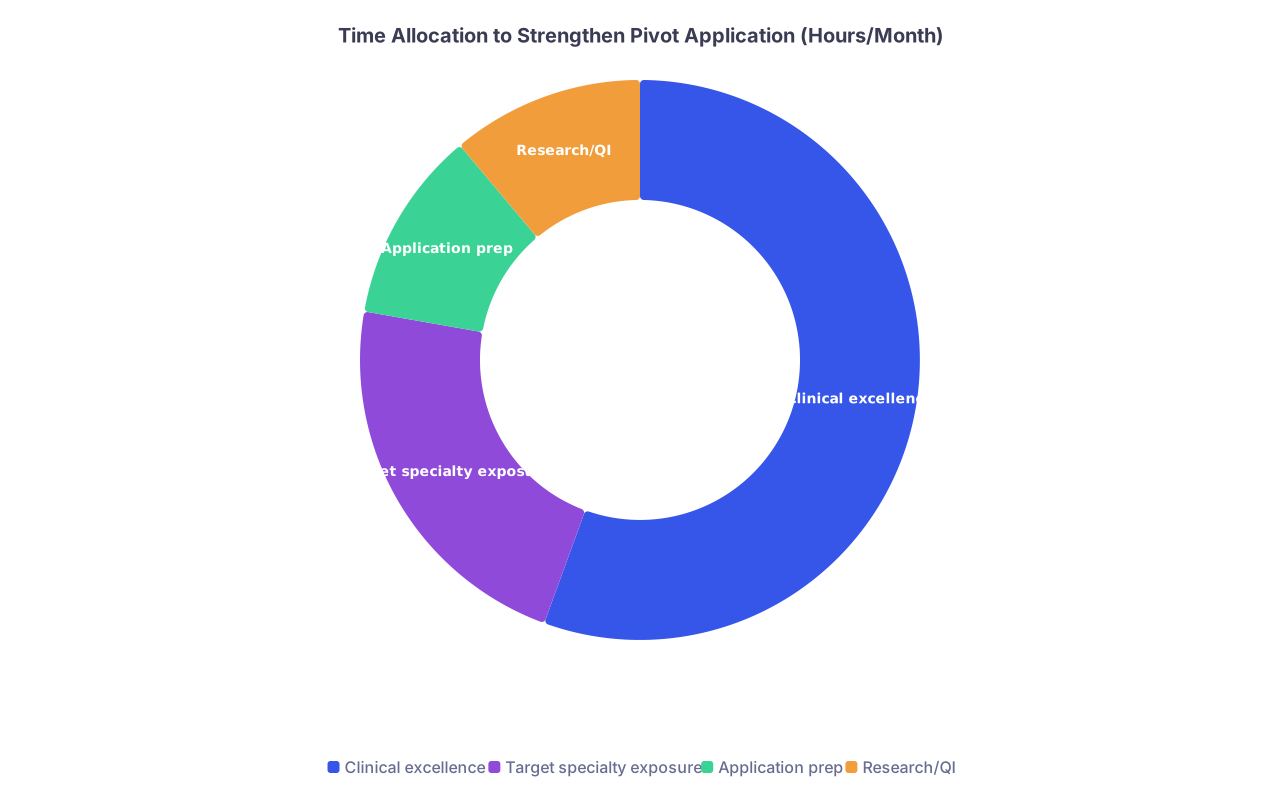
| Category | Value |
|---|---|
| Clinical excellence | 50 |
| Target specialty exposure | 20 |
| Application prep | 10 |
| Research/QI | 10 |
You do not need a 3-year research portfolio unless you are chasing derm or rad onc. But you do need some signal that this field is not a random choice.
6.3 Letters of Recommendation
This is where many residents fail. You need:
- 1 letter from your current PD (if at all possible)
- 1–2 letters from attendings in your current program
- 1–2 letters from attendings in your target specialty
The ideal mix:
- A PD letter that says “excellent resident, no professionalism concerns, I support this pivot.”
- A letter from target specialty faculty that says “this resident has the mindset and skills to thrive in our field.”
If your PD is unsupportive, then you double down on strong faculty letters and use an associate PD or department chair if feasible.
6.4 Personal Statement for a Pivot
Do not write like an MS4 discovering medicine. You are a resident. You have more data now.
Focus on:
- Concrete experiences from intern year that taught you what you value
- Specific aspects of the new specialty that attract you (not generic “work-life balance”)
- Maturity: understanding tradeoffs, not chasing a fantasy 9–3 job
Bad:
“I realized I need better work-life balance.”
Better:
“Consistent 80+ hour weeks with frequent in-house call made it clear that I function best in a practice where intense focus alternates with protected time away from the hospital. I want to be fully present both for my patients and my family, and I know I cannot sustain that in my current field long term.”
Step 7: Target the Right Programs and Paths
Not all programs are equally friendly to switchers. Some love them; some avoid them.
You want to prioritize:
- Programs that have previously accepted residents who switched in
- Community and mid-tier academic programs with staffing needs
- Programs with open PGY-2 or off-cycle positions
Look for clues:
- NRMP data and program websites sometimes highlight “non-traditional pathways”
- Ask directly during informal emails: “Have you had residents transfer in from other specialties before?”
For lifestyle-friendly specialties, your best bets by “acceptance of switchers” generally look like:
| Specialty | Switcher-Friendliness | Typical Entry Level |
|---|---|---|
| PM&R | High | PGY-2 |
| Psychiatry | High | PGY-1/2 |
| Anesthesiology | Moderate-High | PGY-1/2 |
| Diagnostic Radiology | Moderate | PGY-2 |
| Pathology | Moderate-High | PGY-1/2 |
| Allergy/Immunology | Moderate | Fellowship (post-IM/PD) |
Step 8: Protect Your Mental Health and Finances During the Pivot
You are not just changing schedules. You are changing your life path. That is stressful.
8.1 Mental Health
Signs you are in danger zone:
- You cry in your car before shifts more than once a week
- You fantasize about quitting medicine entirely, not just pivoting fields
- You are self-medicating with alcohol, benzos, or other substances
- You feel numb or detached most of the time
This is not “toughing it out.” This is you needing help.
Concrete actions:
- Use your institution’s confidential counseling or employee assistance program
- See an outside therapist who knows physician burnout and career transitions
- Consider time-limited medication support through a psychiatrist if needed
Do not let pride cost you your health.
8.2 Financial Reality
A pivot can mean:
- Extra years of residency at lower pay
- Delayed attending income
- Moving cities (again)
You have to run the numbers:
List your:
- Loan burden
- Fixed monthly costs (rent, car, etc.)
- Dependents (family, children)
Consider:
- Will you need moonlighting once allowed to stabilize finances?
- Are there geographic areas where cost of living + target specialty jobs are favorable?
Many lifestyle-friendly specialties still pay very well relative to the general population. You are not dooming yourself financially by adding one more year of training if it buys you 30 years of a sustainable life.
Step 9: Plan for the Long-Term Reality, Not the Fantasy
A lifestyle-friendly specialty can still become miserable if:
- You join a toxic group
- You say yes to every extra shift
- You have no boundaries and cannot say no to admin demands
So you start protecting your future self now.
When you get to the job-search stage, you ask hard questions:
- Actual average weekly hours, not “it varies”
- Call burden: home vs in-house, post-call days protected?
- How many FTEs vs how much work? Are they understaffed?
- Schedule control: can you cluster days, request certain clinics, etc.?
Think like this:
- Radiology can be 7-on/7-off telerad heaven. Or brutal overnight volume factory.
- Outpatient psych can be 4 days a week, no call. Or 5 days, high no-show, constant admin headaches.
- PM&R can be mostly clinic with blocks of procedures. Or endless inpatient rehab weekends.
The specialty is only half the story. The job structure and your boundaries are the other half.
Step 10: A Simple, Concrete 90-Day Action Plan
You are overwhelmed. That is normal. So I will give you something small but concrete.
Clarify your target list (Week 1–2)
- Narrow to 1–2 realistic lifestyle-friendly specialties based on your scores, year, and what you actually like.
- Write a one-page comparison of each (hours, training length, competitiveness, your pros/cons).
Find one mentor in each target field (Week 2–4)
- Email one faculty per field: “I am a PGY-1 in [X]. Considering [Y]. Can I have 20 minutes to ask about your specialty and pathway?”
- Be prepared with focused questions.
Schedule exposure (Week 4–8)
- Arrange an elective, observership, or regular half-day sessions in the target specialty.
- Show up early, engage, ask for feedback.
Start building your story (Week 8–12)
- Draft a rough pivot personal statement (no perfectionism).
- Identify 2–3 attendings who can speak to your work ethic and clinical skill.
- Ask them explicitly if they would feel comfortable supporting you with a strong letter if you decide to pursue [target specialty].
While you are doing this, keep doing good work in your current role. No one wants to recruit a resident who checked out halfway through.
Open the notes app on your phone or a blank document right now and write three headings:
- “Lifestyle I Actually Want”
- “Realistic Target Specialties”
- “People I Can Talk To This Month”
Fill each with at least three bullet points. That is your first move out of a miserable intern year and into a career you can actually live with.