
The myth that “lifestyle specialties do not burn out” is nonsense. They burn out differently. And more quietly.
If you are in a so‑called “chill” specialty—derm, radiology, ophtho, anesthesia, PM&R, pathology, maybe even outpatient-heavy fields like allergy or rheum—and you are burned out, you are not broken. You are just mismatched: workload, expectations, and support all out of sync.
You do not need another mindfulness lecture. You need a plan. A tight, 90‑day recovery game plan that fits residency reality: call, notes, boards, attendings who “need this done now,” and a schedule you do not fully control.
Here is how to fix it, step by step.
Step 0: Diagnose the Burnout You Actually Have
Burnout in “lifestyle” fields often hides. You are not doing 28‑hour calls q4. You are “supposed” to be fine. That makes the shame worse and delays any real intervention.
Start with a blunt self-assessment. Today. Not next week.
The 10-Minute Reality Check
Take 10 minutes, no phone, no pager. Answer these honestly (yes / no):
- Most days, do you feel emotionally flat or detached from patients or work?
- Do you feel more irritated than you used to by small tasks, pages, or messages?
- Have you caught yourself thinking “I do not care” about something you know you should care about?
- Do you dread specific rotations or attendings to the point that it ruins your day off?
- Do you find yourself scrolling, gaming, or binge-watching to “escape” until you fall asleep?
- Has your sleep worsened (difficulty falling asleep, staying asleep, or waking up tired)?
- Are you avoiding studying or reading for your specialty because you “cannot stand it”?
- Have you thought “I chose the wrong specialty” at least weekly for the last month?
- Do you feel trapped—like you cannot change anything about your schedule or setup?
- Have you seriously thought about quitting medicine or this program?
Score it:
- 0–2 yes: normal stress range.
- 3–5 yes: moderate burnout. You need structured changes.
- 6–10 yes: high burnout. You need changes plus backup (program, mental health, possibly medical leave).
We will build a 90‑day plan either way, but high burnout means you do not do this alone.
Step 1: Map Your Actual Burnout Drivers (Not the Generic Ones)
Lifestyle specialties have consistent patterns. The drivers are different from surgery or EM.
Look at how this plays out by specialty:
| Specialty | Top Burnout Drivers |
|---|---|
| Dermatology | Cosmetic vs medical mismatch, productivity RVU pressure, social media comparison |
| Radiology | Isolation, relentless volume, fear of misses, worklist never empty |
| Ophthalmology | Clinic overbooking, OR delays, high procedural pressure |
| Anesthesiology | Early starts, case turnover chaos, production-line grind |
| PM&R | Under-resourced teams, admin battles, vague role definition |
| Pathology | Monotony, diagnostic pressure, limited feedback, isolation |
Your first job: build your personal burnout map. Do this once, in writing.
The 5‑Column Burnout Map
Grab a sheet of paper and make 5 columns:
- Situation
- Trigger
- Thought
- Feeling (1–10 intensity)
- What actually makes it better/worse
Example for a radiology resident:
- Situation: 3 pm, huge worklist, attending says “we are behind, speed up.”
- Trigger: Seeing 40+ unread CTs.
- Thought: “I will never catch up; I am unsafe.”
- Feeling: Anxiety 8/10, dread 9/10.
- Better/Worse: Better when attending verbally prioritizes. Worse when I silently push and skip breaks.
Do this for 5–10 situations from the last 2 weeks. Patterns will jump out:
- Certain attendings.
- Certain types of work (late add-on biopsies, cosmetic clinics, spine MRIs, etc.).
- Certain times (post-call, late afternoon clinic, pre-OR).
We are going to build your 90‑day plan around these patterns, not vague “self-care.”
Step 2: 90-Day Framework – What “Recovery” Actually Looks Like
You cannot fix everything in 90 days. You can absolutely:
- Reduce your burnout score by 30–50%.
- Regain some sense of control.
- Build 3–4 durable habits that protect you on even the worst rotations.
- Create leverage with your program so they see you as a problem-solver, not a complainer.
The framework:
- Days 1–7: Stabilize and declutter.
- Days 8–30: Fix daily structure and micro‑habits.
- Days 31–60: Tackle rotation-specific stressors and boundaries.
- Days 61–90: Optimize, consolidate, and decide what bigger change (if any) you want.
Think of it like a staged rehab program, not a spa week.
Days 1–7: Stabilize and Declutter Your Life Support Systems
Your first week is not about being “better.” It is about stopping the free fall.
1. Sleep: Non-Negotiable Constraints
You are not going to hit perfect 8‑hour nights on call months. But you can set hard minimums.
- Set an absolute floor: 5.5–6 hours on worst days, 7–8 on better days.
- Use a 2‑alarm system:
- Alarm 1: “Wind-down start” (30–60 minutes before sleep goal).
- Alarm 2: “Non-negotiable lights out.”
On nights when your brain will not shut up:
- Keep a pad next to bed. Write a 3‑item “worry list” and a 3‑item “tomorrow list.”
- No phones in bed. Yes, really. Charge it across the room.
2. Cut One Major Energy Leak Outside Work
In lifestyle fields, you rarely have zero time. You have badly used time.
Pick ONE of these to cut for the next 30 days:
- Social media doom scroll > 30 minutes per day.
- Extra moonlighting you emotionally cannot afford right now.
- A non-critical committee / volunteering / side gig.
- Unstructured “I just say yes to everything” social time.
You are not quitting forever. You are buying back 3–5 hours a week for recovery.
3. Clean Up the Bare Minimum at Home
Living in chaos makes burnout worse. You do not need a Pinterest kitchen. You need less friction.
Do a 1‑hour “friction sweep”:
- Throw away obvious trash from your room, car, and work bag.
- Make one “don’t think about it” food setup:
- Example: Greek yogurt, granola, nuts at home.
- Protein bars, nuts, and instant oatmeal in your locker.
- Prep 2 go-to outfits (scrubs + backup) so mornings are brainless.
You are designing your environment for a fogged brain.
Days 8–30: Rebuild Your Daily Structure (Inside Residency Reality)
Now we fix the part that actually wears you down: the shape of your days.
1. Create a 3‑Block Day Template
Every day in any “chill” specialty has three natural blocks:
- Block A: Early work (clinic start, first cases, first reads).
- Block B: Midday grind (peak volume, turnover, pages).
- Block C: Late day / wrap-up (notes, add-ons, last patients).
Build a default template like this:
Block A – Aggressive Focus, Low Chat
- Radiology: First 90–120 minutes, you batch-read and dictate without checking your phone.
- Derm: See and staff the first 4–6 patients as efficiently as possible, minimize small talk with staff.
- Anesthesia: Lock in pre-op assessments and first cases with a strict checklist.
Goal: Start ahead, not behind.
Block B – Protected Micro-Breaks and Boundaries
You are getting crushed here. So we add structure:
- Every 90–120 minutes, you take a 3–5 minute real break:
- Leave the reading room / OR / clinic room.
- Water, bathroom, 10 deep breaths, quick stretch.
- If you have control over schedule, cluster tasks:
- Radiology: Read all CT abdomens, then all chest X-rays, instead of random hopping.
- Derm: Batch procedures then follow-ups, not mixed chaos when possible.
- Anesthesia: Use turnover to reset physically—do not just scroll the phone while standing.
Block C – Clean Exit Protocol
Even in “good lifestyle” programs, late creep is real.
Create a 15–20 minute “last block” checklist:
- List remaining tasks: notes, messages, sign-outs.
- Decide: what must be done today vs what can be done early tomorrow.
- Close charts ruthlessly:
- Template smart phrases.
- Dictation over typing if it is faster.
- Physically leave work when tasks hit “acceptable,” not “perfect.”
You will feel guilt the first few days. That is fine. Walk out.
2. Introduce the 10-10-10 Reset
Burnout is cumulative. You need a daily reset that is short and repeatable, not aspirational yoga retreats.
Every day, non-negotiable:
- 10 minutes of movement (walk, stairs, basic bodyweight).
- 10 minutes of identity work (reading or learning something that makes you feel like a future attending, not just a cog).
- 10 minutes of real rest (no screens: eyes closed, music, or quiet).
How it looks in real life:
Radiology PGY‑4:
- 10 min stairs between reading room and cafeteria.
- 10 min reading a single journal article abstract + figures.
- 10 min lying on couch with music at home before sleep.
Derm PGY‑2:
- 10 min walk around hospital campus after clinic.
- 10 min skimming an atlas section on conditions seen that day.
- 10 min on balcony just sitting, no phone.
You are retraining your nervous system to get out of permanent “on” mode.
3. Use Micro-Boundaries With Attendings
You are not going to “fix the system” in 90 days. You can set micro‑boundaries that are hard for any reasonable attending to argue with.
Examples:
- “I can stay another 15 minutes to finish these two charts, but after that I need to head out because I am back early tomorrow.”
- “For my learning, can we prioritize which cases I should focus on and which I can safely leave for the staff at the end of the day?”
- “I am noticing I am getting slower after 4 pm; is it okay if I focus on fewer but higher-yield studies so I do not compromise accuracy?”
In radiology and pathology especially, having the conversation framed as “accuracy and patient safety” is powerful. No one wants you rushing dangerous reads at 5:45 pm just to hit an arbitrary volume.
Days 31–60: Attack Rotation-Specific Burnout and Rebuild Agency
Now you go from basic survival to solving the problems that are actually unique to your specialty and program.
Specialty-Specific Fixes: What Actually Works
Let us get concrete.
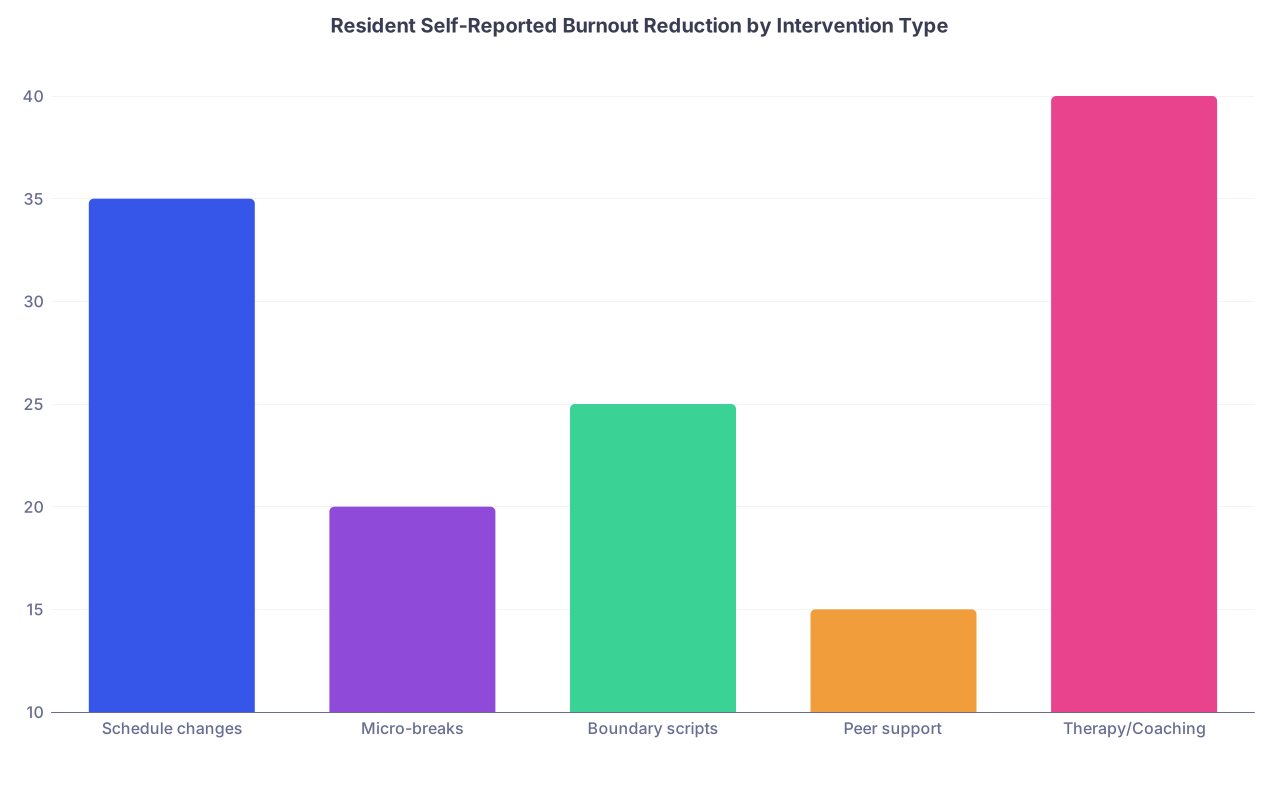
| Category | Value |
|---|---|
| Schedule changes | 35 |
| Micro-breaks | 20 |
| Boundary scripts | 25 |
| Peer support | 15 |
| Therapy/Coaching | 40 |
(Approximate relative effectiveness, from published data and real program experience. Therapy/coaching and schedule modifications change the game. But you probably cannot get a full schedule redesign tomorrow. So we stack smaller wins.)
Dermatology
Common problems:
- Overbooked clinics, cosmetic upsell pressure, “RVU culture.”
- Feeling like a procedure robot, not a physician.
90‑day tactical fixes:
Template like a maniac.
- Smart phrases for common diagnoses, counseling, and procedures.
- Pre-built photo documentation templates.
Control the room time.
- Use staff to handle non-clinical tasks (forms, photos, referrals).
- Timebox: “I have 8 minutes for this visit; let us focus on the main concern.”
One clinic boundary.
- Ask your PD or clinic director: “I am overwhelmed with overbooks; can we cap add-ons per half day for 4 weeks as an experiment?”
- Frame as: “I want to maintain quality of care and not burn out early in training.”
Radiology
Common problems:
- Infinite worklist misery.
- Fear of missing something.
- Isolation in the reading room.
Tactical fixes:
- Prioritization with attending at the start:
- “Can we review how you would triage this list so I match your priorities?”
- Structured feedback.
- Once a week: ask one attending for 10 minutes of targeted feedback on your reads. That single investment massively reduces uncertainty stress.
- Break protocol with justification.
- “I am going to take a 5‑minute break every 90 minutes; I have noticed I read more accurately and steadily when I do that.”
Anesthesiology
Common problems:
- Relentless early mornings.
- Turnover chaos.
- Feeling like a “service” not a learner.
Tactical fixes:
- Pre-op clustering.
- The afternoon before, spend 15–20 minutes organizing next-day cases with a short checklist so the morning chaos is less chaotic.
- Protected debriefs.
- Ask attendings for 3‑minute post-case “what you did well / what to improve.” Keeps you engaged as a learner, not a task-doer.
- Short physical reset between long cases.
- Walk out of the OR for 2 minutes on relief. Water, stretch. Do not just sit in the corner on your phone.
Ophthalmology, PM&R, Pathology
The themes are similar: clinic or lab volume, little control, not enough structured teaching.
For all three:
- Build one weekly “development” block of 30–60 minutes where you either:
- Read specifically about cases you saw.
- Practice skills (slit lamp exams, ultrasound, EMG interpretation, slide review).
- Work on a small scholarly project.
You are rebuilding your sense that you are progressing, not just enduring.
Build a 15-Minute Weekly Review Ritual
Once a week, same time (Sunday evening works):
- Burnout score (0–10) for the week.
- One thing that made work better.
- One thing that made work worse.
- One change you will test next week (tiny).
That is it.
Write it down. After 4–6 weeks, you will have a record. You will notice that two or three changes account for most of your improvement.
Days 61–90: Consolidate, Get Support, Decide on Bigger Moves
By now, if you have actually done the first steps, you should be seeing something:
- Slightly less dread before work.
- Slightly more control over your day blocks.
- Less collapse into useless screen time.
Now you make it durable and decide: Do I tweak my environment, or do I need a bigger change?
1. Formalize Your Personal “Burnout Guardrails”
You are going to write a 1‑page “Owner’s Manual” for yourself as a resident in this specialty. Not a manifesto. Guardrails.
Sections:
Non-negotiables:
- Minimum sleep hours.
- Maximum number of consecutive late days before you rearrange something.
- One day per week with no work email/EMR.
High-risk patterns for you:
- “When I do more than X extra shifts, I crash.”
- “Back-to-back cosmetic clinic days drain me more than they should.”
Fast fixes that always help:
- “10-minute walk + 10-minute reading always resets me.”
- “Talking to one co-resident about a bad case cuts shame in half.”
This is not theoretical. It guides your decisions on picking electives, moonlighting, research, even vacations.
2. Use Your Program—Strategically
You pay with your life for this training. Use the infrastructure.
Meeting with Your PD or Mentor
You are not going in to say “I am burned out, fix this.” You are going in with data and proposed changes.
Outline:
- Open with: “I want to be transparent so I can train sustainably. Over the last X months, I have noticed these specific patterns…”
- Present 2–3 concrete burnout drivers (from your map).
- Present what you have already tried (the 10-10-10, day templates, micro-boundaries).
- Then propose 1–3 small, realistic adjustments, for 2–3 months:
- Slight reduction in overbooks.
- Temporary limit on nights/weekends.
- Specific elective or research block sooner rather than later.
You are showing:
- Insight.
- Initiative.
- Willingness to experiment, not demand.
Most halfway decent PDs will meet you halfway when you show you have already done your part.
3. Bring in Professional Backup if Needed
There is a point where more self-optimization is just rearranging furniture on a sinking ship. Use mental health resources if:
- Your burnout score stays ≥7/10 after 4–6 weeks of consistent changes.
- Suicidal thoughts, even passive.
- Substance use creeping up to cope.
No bravado here. Burnout in “easy” specialties often gets missed or mocked. That just means people wait longer to get help.
Confidential options:
- Institution’s mental health services (often free, off-record).
- External therapist or physician coach.
- Peer support groups.
If someone suggests a short medical leave and you feel massive resistance, ask yourself: “If my best friend were in my state, would I tell them to power through or step back?”
You already know the answer.
4. Decide on Bigger Moves (Or Not)
By day 90, you should have enough signal to decide:
- Is this specialty fundamentally wrong for you?
- Is it this program?
- Or was it an acute mismatch of schedule, expectations, and boundaries that you can now manage?
Here is a rough decision grid.
| Pattern After 90 Days | Likely Issue | Next Step |
|---|---|---|
| Much better with small changes | Local environment | Stay, keep refining guardrails |
| Mild improvement, still miserable daily | Program culture | Consider transfer or fellowship escape path |
| No improvement, deep regret | Specialty misfit | Explore switch with trusted mentor |
| Worsening, dark thoughts | Severe burnout/depression | Immediate professional help, possible leave |
No, you do not “owe” the specialty your suffering because it is “lifestyle-friendly.” You owe your patients a version of you that is not hollowed out.
One Example: A 90-Day Turnaround in Radiology
Let me make this concrete with a real-world style scenario I have seen.
Starting point: PGY‑4 radiology resident. Burnout 8/10. Dreads going in. Constantly behind on the worklist. Thinking about quitting medicine entirely.
Days 1–7:
- Sleep floor set at 6 hours.
- Social media deleted from phone. 1-hour friction sweep at home.
- Simple breakfast and snack system set up.
Days 8–30:
- 3‑block day template implemented.
- 10-10-10 daily reset (stairs, read 1 case-related article, couch time).
- Micro-boundary: 5-minute breaks every 90 minutes, with attending notified once: “I find I read more accurately if I step away briefly a few times a day.”
Days 31–60:
- Weekly 15-minute feedback session with one attending.
- Ask PD to avoid stacking the two worst rotations back-to-back; they agree.
- Starts reading with a more experienced resident twice a week for 30 minutes to compare workflows.
Days 61–90:
- Burnout down to 4–5/10.
- Feels more confident, less terrified of misses.
- Decides to stay in radiology but avoid high-volume private-practice style fellowships; leans toward academic neurorads with more teaching and protected time.
No magic. Just a disciplined series of small, realistic interventions that fit into real residency schedules.
Quick Process View: Your 90-Day Game Plan

| Step | Description |
|---|---|
| Step 1 | Day 0 - Self Check |
| Step 2 | Days 1-7 Stabilize |
| Step 3 | Days 8-30 Daily Structure |
| Step 4 | Days 31-60 Rotation Fixes |
| Step 5 | Days 61-90 Consolidate |
| Step 6 | Refine Guardrails |
| Step 7 | Discuss Transfer or Changes |
| Step 8 | Explore Specialty Switch |
| Step 9 | Professional Help / Leave |
| Step 10 | Decision Point |
Closing: What Actually Fixes Burnout in “Chill” Specialties
You do not fix burnout with vibes and meditation apps. You fix it with structure, boundaries, and actual support.
Keep three things in focus:
- Burnout in lifestyle specialties is real, and it is often quiet. Diagnose your specific drivers, not the generic ones.
- Ninety days is enough to change your trajectory. Tighten sleep, reclaim small pockets of time, and redesign your day blocks. Then hit the rotation‑specific stressors with surgical precision.
- Your guardrails matter more than the brand of your specialty. Protect your minimums, get strategic with your program, and be willing to seek help—or make bigger moves—if your 90‑day experiment tells you this setup is not salvageable.
You are not weak for burning out in a “chill” field. You are human. Now act like a professional about it and run the recovery plan.