
The biggest mistake lifestyle-specialty residents make is assuming time freedom equals career security. It does not. Not unless you build a non-clinical portfolio on purpose.
If you are in dermatology, radiology, anesthesia, ophthalmology, PM&R, or another “lifestyle-friendly” field, you are sitting on a massive strategic advantage: more control over your schedule compared with surgery or acute care. Most people waste it. You do not have to.
This is the playbook I wish more residents followed: how to systematically build a non-clinical portfolio while you train in a lifestyle specialty, so that by the time you finish residency or early attendinghood, you have real options. Not vague “maybe I’ll do admin or consulting someday” fantasies.
Step 1: Decide What Your Non-Clinical Portfolio Is Actually For
“Non-clinical work” is too vague. You cannot build a portfolio around fuzziness.
You need to pick 1–2 lanes where you want to be visibly useful. Not 7. Not “anything that comes up.”
Here are the main non-clinical lanes physicians in lifestyle specialties realistically build into:
- Medical education (curriculum, teaching, assessment, simulation)
- Administration / leadership (operations, quality, strategy)
- Clinical informatics / data / AI / radiology IT
- Industry (pharma, medtech, devices, diagnostics)
- Consulting (strategy, operations, revenue cycle, clinical pathway design)
- Media / content / brand (writing, podcasting, social, YouTube)
- Entrepreneurial (startups, products, niche clinical/para-clinical services)
You do not need a perfect choice right away. But you must have a working hypothesis so you can say “yes” and “no” correctly.
Ask yourself three blunt questions:
What parts of my day do I actually enjoy that are not direct patient care?
Examples:- Teaching the intern
- Tweaking workflow in the EMR
- Building slide decks
- Explaining complex topics simply
- Reading/writing about evidence
When I picture myself 10 years out, what problems do I want to be paid to solve?
Concrete, not fluffy. “Make prior auth less terrible” counts. “Help people” does not.Which of these paths lines up best with my specialty’s strengths?
Radiology → imaging AI, product design, telerad workflow
Derm → aesthetics industry, skincare products, digital consult platforms
Anesthesia → perioperative optimization, safety, simulation
Ophtho → devices, imaging systems, surgical product design
PM&R → rehab tech, wearables, disability/return-to-work consulting
Write down one “primary hypothesis lane” and one backup.
Example:
- Primary: Clinical informatics / AI in imaging (for a radiology resident)
- Backup: Medical education with focus on imaging interpretation curriculum
This clarity dictates what projects you chase, which courses you take, and how you present yourself online.
Step 2: Map Your Current Assets Like a Consultant Would
Before you add more, inventory what you already have. Most residents underestimate their existing raw materials.
Create a 1-page snapshot with four columns:
- Skills
- Proof
- Gaps
- Immediate opportunities
| Category | Current Assets | Gaps Identified | Immediate Opportunities |
|---|---|---|---|
| Skills | Teaching, slide creation, writing | Data analysis, formal leadership | Join curriculum committee, write review |
| Proof | 2 teaching evals, 1 poster, small blog | No first-author paper, no talks | Turn poster into paper, give local lecture |
| Gaps | No online presence, no niche defined | No industry exposure | Start niche blog, attend derm industry event |
You want to know:
- What can I already do well that is transferable?
- Where is there zero evidence I can do what I claim I want to do?
- What small things can I do this quarter to start closing visible gaps?
Treat this like an internal audit. Be brutal. “Interested in X” with zero output does not count.
Step 3: Build a Tight, 2-Year Non-Clinical Project Plan
You are in residency or early attendinghood. Time is not unlimited. So you need a short, aggressive, realistic plan.
Think in 6-month blocks over 2 years. Four blocks. Each block gets:
- 1 primary project
- 1 supporting activity
- A very small list of concrete outputs
Example for a PGY-3 anesthesia resident targeting perioperative informatics / QI:
Block 1 (Months 1–6)
Primary project: Join OR efficiency committee, volunteer to own a discrete project (e.g., turnover times in one service line).
Supporting: Complete a basic data analytics course (Coursera, Udacity, etc.).
Outputs:
- One QI proposal document
- Before/after data collection started
- Slide deck presented locally
Block 2 (Months 7–12)
Primary: Lead implementation and analysis of the project.
Supporting: Submit abstract to ASA / local meeting on early results.
Outputs:
- Abstract submitted (accepted or not is less important than submitted)
- Internal report with clear metrics
- Co-authored or first-authored poster
Block 3 (Months 13–18)
Primary: Turn project into a manuscript or a more polished case study.
Supporting: Shadow your hospital’s CMIO or QI director for several half days; ask about career paths.
Outputs:
- Draft manuscript or formal white paper
- Recommendation letter from someone non-clinical (QI, data, admin)
Block 4 (Months 19–24)
Primary: Start a second, smaller project in a related area (e.g., pre-op clinic workflow).
Supporting: Present at grand rounds or resident conference on “Building Data-Driven OR Workflows.”
Outputs:
- 1–2 talks
- Second project started with clear scope
At the end of 2 years, you are no longer “interested in informatics.” You are the anesthesia resident who:
- Led 2 data-driven projects
- Presented work internally and externally
- Understands basic analytics
- Has non-clinical mentors who can vouch for you
That is a portfolio.
Step 4: Pick One Primary Non-Clinical Vehicle Per Year
Lifestyle specialty or not, your time is fragile. Rotate your emphasis instead of trying to do everything every year.
Pick one major non-clinical vehicle per year:
- Year 1: Local projects + targeted coursework
- Year 2: Academic output + speaking
- Year 3 (late residency or early attending): Public presence or industry exposure
You can still do bits of the others, but only one gets “main quest” status at a time.
Typical Vehicles You Can Rotate Through
Academic / QI vehicle
- QI projects
- Protocol development
- Research that actually solves workflow problems
Education vehicle
- Course or module design
- Simulation scenarios
- Board review content
Digital / public vehicle
- Blog or newsletter
- YouTube channel
- Focused Twitter/LinkedIn presence
Industry / consulting vehicle
- Advisory boards (start small and local)
- Pilot projects with startups
- Paid or unpaid consulting on narrow expertise
Trying to launch a podcast and write three papers and run a startup while on call is how you end up mediocre at everything and burned out.
Stick to one major build per year.
Step 5: Use Your Lifestyle Specialty’s Advantages Deliberately
Different “lifestyle” fields have different leverage points. Use them instead of pretending all specialties are interchangeable.
Dermatology
- Advantage: Predictable clinic schedules, elective nature of much work, strong product and aesthetics industry.
- Best portfolio angles:
- Skincare / aesthetics industry consulting
- Consumer product formulation advice
- Telederm / digital triage algorithms
- High-yield visual education content
Tactical moves:
- Offer to help attendings update pre-/post-care instructions, turn that into patient-facing and industry-facing materials.
- Publish mini case-based visual series (on a secure platform or anonymized) that shows your ability to teach pattern recognition.
Radiology
- Advantage: Deep integration with technology, imaging AI explosion, remote work options.
- Best portfolio angles:
- AI / machine learning validation and workflow integration
- Informatics, PACS optimization, reporting structure design
- Teleradiology protocols, quality and safety
Tactical moves:
- Volunteer to be “resident liaison” for any new AI tool being trialed in your department.
- Keep a private log of workflow problems and potential tech fixes. This becomes content for talks, blog posts, or product conversations.
Anesthesiology
- Advantage: Systems-level view of perioperative care, ICU overlap, patient safety orientation.
- Best portfolio angles:
- Perioperative optimization and pathways
- OR efficiency consulting
- Patient safety, simulation, crisis resource management
Tactical moves:
- Join or start a simulation scenario review group; help write or update scenarios and debrief guides.
- Tie your QI project to dollars: case delays, cancellations, length of stay.
Ophthalmology
- Advantage: Device-heavy specialty, imaging-rich, outpatient surgery.
- Best portfolio angles:
- Device usability and workflow testing
- Digital patient education experiences (animations, AR)
- Vision tech / assistive device consulting
Tactical moves:
- Work with industry reps not just as “lunch people” but as data sources: What metrics do they care about? What outcomes make their tools look good?
- Design a structured way to collect outcomes and satisfaction, then publish or present.
PM&R (Physiatry) and Other Rehab-Focused Fields
- Advantage: Natural intersection with tech (wearables, exoskeletons, neurorehab), multidisciplinary teams, long-term outcomes.
- Best portfolio angles:
- Rehab tech research or user testing
- Return-to-work or disability consulting
- Outcomes-focused program design
Tactical moves:
- Partner with PT/OT colleagues on a metrics-focused outcomes project.
- Approach one startup in rehab tech with a short, specific proposal: “I can help you test X in Y patient population at Z clinic.”
Point: your specialty gives you “natural” access and credibility somewhere. Exploit that.
Step 6: Build Visible Proof, Not Just Experience
Experience is what you feel. Portfolio is what others can see.
You are aiming for artifacts in four categories:
Written
- Papers (yes), but also:
- White papers, internal reports
- Public blog posts or LinkedIn articles
- Protocols and guideline documents
Spoken
- Talks at local grand rounds
- Specialty society presentations
- Guest lectures for med students, nurses, PAs
Digital
- A clean, simple personal site or Notion page
- GitHub (if you do data/informatics)
- A focused Twitter/LinkedIn feed that reflects your lane
Structural
- Committees you actually contributed to
- Programs or workflows you helped design or fix
- Curricula you created or materially revised
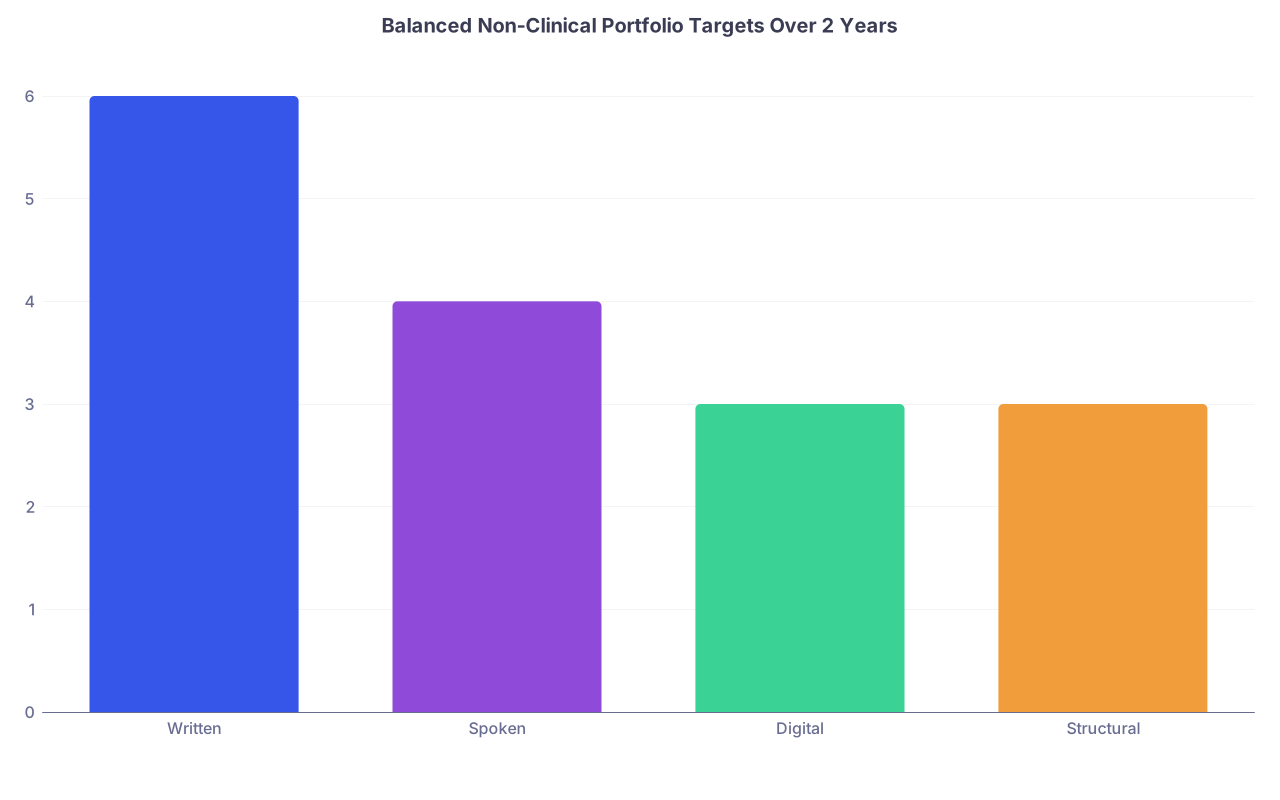
| Category | Value |
|---|---|
| Written | 6 |
| Spoken | 4 |
| Digital | 3 |
| Structural | 3 |
By end of residency or early attendinghood, a strong non-clinical portfolio might include:
- 3–6 written artifacts (mix of academic and non-academic)
- 3–5 talks (some internal, 1–2 external)
- 1 consistent digital presence (does not have to be huge, just coherent)
- 2–3 structural contributions (committees, programs, workflows)
This is not insane. It is one good non-clinical action every 1–2 months.
Step 7: Use a Simple Weekly System So This Does Not Die in the Call Room
Ambition dies in unstructured weeks. You need a simple, no-nonsense system.
Here is one that actually survives residency schedules:
Pick “non-clinical hour blocks” in advance every week.
- On lighter weeks: two 90-minute blocks
- On heavy weeks: one 60-minute block or nothing (and that is fine)
Assign each block a single task from your 2-year plan. Bad: “Work on portfolio.”
Good: “Draft 2 slides for OR efficiency talk” or “Outline blog post on AI triage biases.”Track progress in a single-quarter view.
- One Notion page, Google Doc, or paper tracker
- Columns: Month, Project, This Week, Done
Monthly review (20–30 minutes). Ask:
- Is my main lane still correct?
- Am I producing actual artifacts or just consuming content?
- What is the next visible output I can commit to?

| Step | Description |
|---|---|
| Step 1 | Set 6 month goal |
| Step 2 | Break into monthly milestones |
| Step 3 | Schedule weekly blocks |
| Step 4 | Produce small artifacts |
| Step 5 | Monthly review |
| Step 6 | Still right lane |
You do not need a project management PhD. You need a calendar and the discipline to protect one block a week more often than not.
Step 8: Make Yourself Legible to the Outside World
Non-clinical opportunities do not come from vibes. They come from clarity.
You want people to be able to answer two questions about you easily:
- What kind of non-clinical problems does this person solve?
- What proof do they have that they can do it?
That means you need:
A One-Sentence Non-Clinical Positioning Line
Examples:
- “I am a radiology resident focused on validating and integrating imaging AI into real clinical workflows.”
- “I am a PM&R resident interested in outcome-focused rehab program design and rehab tech evaluation.”
- “I am a dermatology resident building practical patient education tools and skincare content grounded in evidence.”
You use this sentence:
- On LinkedIn header
- On your about page
- In cold emails
- At conferences when someone asks, “So what do you work on?”
A Simple, Public Landing Page
Minimalist is better. One page with:
- 2–3 sentences about you (clinical and non-clinical lanes)
- Bulleted list of projects or outputs with links where possible
- Contact info
Think: “evidence gallery,” not “life story.”
Once this exists, every new artifact you create has somewhere to live. It compounds.
Step 9: Use Conferences and Social Media Like a Professional, Not a Fan
Lifestyle-specialty residents often go to conferences as tourists. Social media as consumers. You are going to use both surgically.
Conferences
Pick 1–2 conferences per year that line up with your non-clinical lane. Not just the big generic specialty meeting.
Example:
- Radiology + AI → RSNA, SIIM
- Derm + industry → AAD plus 1–2 industry-led focused meetings
- Anesthesia + QI → ASA plus perioperative summit
Your goals are:
- Submit something (poster, presentation, even a workshop idea).
- Schedule 3–5 short meetings or coffees ahead of time with people in your lane.
- Ask each person one focused question:
- “If you were me, wanting to end up where you are, what 2–3 portfolio pieces would you build in residency?”
You leave with names, ideas, and a reality check, not just a bag of brochures.
Social Media
Pick one main platform:
- LinkedIn for industry/consulting/leadership
- Twitter (X) for academic / policy / commentary
- YouTube for education/content lanes
You are not trying to be an influencer. You are trying to make your lane visible. Once per week is enough:
- Share a 3–5 line insight from your project work
- Summarize a paper from your lane
- Show a before/after of a workflow or educational tool (de-identified, naturally)
Over 1–2 years, that is 50–100 small signals that you exist and that you do a specific kind of work.
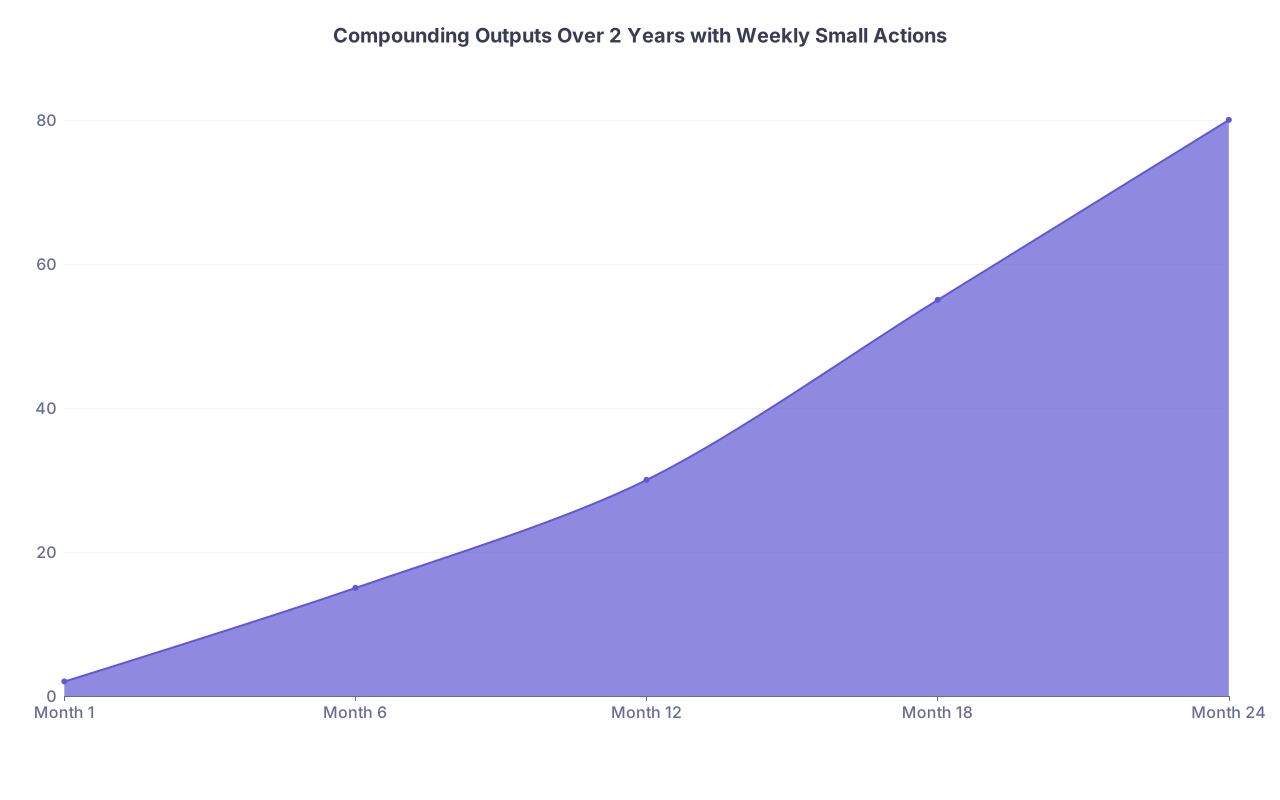
| Category | Value |
|---|---|
| Month 1 | 2 |
| Month 6 | 15 |
| Month 12 | 30 |
| Month 18 | 55 |
| Month 24 | 80 |
Step 10: Protect Yourself from the Two Big Traps
There are two ways this all blows up.
Trap 1: Becoming the Department Workhorse
You get a reputation for being “organized” or “interested” and suddenly:
- You are on 5 committees.
- You are “helping” with 3 research projects.
- You are producing zero owned artifacts that show your lane.
Solution:
For every new request, ask:
“Does this directly support my primary lane or give me a visible artifact I control?”
If not, 80–90 percent of the time, you say no.Demand clear deliverables for yeses:
- First-author opportunity
- Named role (not generic “help”)
- Defined end date
Trap 2: Hiding Behind Training Forever
“I’ll focus on this after boards.”
“Once fellowship is done.”
“Once I am an attending.”
Then it is “after I settle into the new job.” You know the script.
Solution:
Start embarrassingly small now:
- One 800-word blog post
- One internal talk
- One clearly scoped 3-month QI project
Use time-bound experiments:
- “For the next 90 days, I am a person who writes one public post a week.”
- “For this semester, I am leading one small data project in the OR.”
You do not wait for the perfect block of free time. You grab the 60–90 minute windows and chain them together.
Step 11: Convert Portfolio into Optionality
The whole point of a non-clinical portfolio is leverage. Not random busywork.
By the time you are finishing residency or early attendinghood in a lifestyle specialty, a strong non-clinical portfolio should let you realistically pursue options like:
- 0.8 FTE clinical with 0.2 FTE non-clinical (paid) at your institution
- Part-time clinical plus:
- Industry role (medical director, advisor)
- Academic track heavily weighted to education or QI
- Consulting retainer with a few stable clients
How this actually happens:
You show your department chair or group leadership your portfolio, not just your CV:
- “Here are 2–3 projects, talks, and results.”
- “Here is the kind of non-clinical work I am already doing informally.”
- “Here is a proposal for a formal 0.1–0.2 FTE role around X.”
You talk to industry or external partners before you need them:
- “Here is a page of what I work on.”
- “Here is how I have used tool X in real workflows.”
- “If you need physician input on Y, here is what I can offer.”
You keep your clinical skills solid.
- Non-clinical opportunities land better when everyone knows you are competent clinically and not running from the bedside out of fear.

Your lifestyle specialty schedule then becomes what it should have been from the start: a foundation that lets you mix clinical work you enjoy with non-clinical work that scales, pays differently, and ages better.
The Core Moves, Boiled Down
Three points you should walk away with:
Pick a lane and build proof, not vibes.
Decide what kind of non-clinical problems you want to be paid to solve, then spend 2 years generating artifacts—projects, talks, writing—that prove you can solve them.Use your lifestyle advantage intentionally.
Your specialty gives you relatively more control over time. Trade a small, consistent slice of that time for structured non-clinical projects instead of letting it evaporate into generic “rest and scroll.”Make yourself legible and scarce.
One clear positioning line, one simple landing page, and a trail of visible work turn you from “another lifestyle specialist” into “the derm / rads / anesthesia / ophtho person people call for X.”
Do that, and your non-clinical portfolio stops being a side hobby. It becomes your leverage.