
The way people talk about “0.8 FTE” in lifestyle specialties is dangerously naive.
Residents whisper about it like a cheat code: work four days a week, keep your salary, protect your sanity. Attendings toss it out in recruitment dinners: “Plenty of our docs are 0.8 or part‑time, very family‑friendly.” Program directors smile and nod. Nobody spells out the bill.
Let me tell you what really happens behind those conversations.
The Mirage of “Lifestyle” in Lifestyle Specialties
You’re looking at things like dermatology, outpatient psych, rheum, allergy, PM&R, maybe EM and radiology depending on the practice setup. These are the specialties people label as “lifestyle friendly.”
Here’s the first uncomfortable truth: “Lifestyle friendly” usually describes the full‑time structure (predictable clinic hours, fewer middle‑of‑the‑night traumas), not the power balance between you and the group.
In academic and private groups I’ve watched:
- Full‑time derm attendings seeing 30–35 patients a day, 5 days a week.
- Psych attendings carving out 0.8 FTE but still carrying a heavier panel than the full‑timer down the hall because “you’re more efficient.”
- Radiologists “0.7” but doing a full day of admin and call that somehow never makes it into the FTE calculation.
The lifestyle looks good on paper. Until you see who’s picking up open slots, who’s covering call, and who’s getting pushed out of promotion tracks.
0.8 FTE is not “four days for 80% of the work.” In many places it quietly becomes “four days for 90–100% of the work and 80% of the pay.”
What 0.8 FTE Really Means in Different Lifestyle Specialties
Let’s get specific. The tradeoffs look very different in derm vs EM vs psych.
| Specialty | 0.8 FTE Common Reality |
|---|---|
| Dermatology | 4 clinic days, same panel, admin pushed into off time |
| Psychiatry | 4 days scheduled, patient complexity unchanged, messages spill over |
| Allergy/Immunology | Slightly fewer sessions, same call and admin expectations |
| Outpatient PM&R | Procedures packed into fewer days, similar throughput expectations |
| Emergency Medicine | Fewer shifts but same nights/weekends/holiday rotation |
Dermatology: Four Days, Same Machine
In derm, “0.8” is usually sold as four clinic days instead of five. What they do not say during the interview dinner: the overhead pressure doesn’t fall by 20%. The expectation to “keep your panel happy” doesn’t fall by 20%. And cosmetic revenue targets definitely do not fall by 20%.
What I’ve actually seen in multiple derm groups:
- Panels unchanged: You keep the same number of patients because “continuity.”
- Admin time hidden: Path reviews, portal messages, refills, surgical planning all quietly migrate into your “day off.”
- Cosmetic add‑ons: You’re strongly encouraged to “just come in a half‑day” on your off day for cosmetics. Off the books, suddenly you’re working 0.9+ FTE.
Junior attendings go 0.8 thinking they’ll be home with kids on Fridays. Six months later they’re home physically but on the laptop from 9–12 and 8–10 most Fridays, picking through MyChart, signing off results, messaging MAs.
That’s not part-time. That’s an unpaid admin day.
Psychiatry: The Emotional Math Does Not Scale Down
Psych is an emotional bandwidth specialty. Cutting 20% of your time does not reduce 20% of the complexity.
What committee chairs and division chiefs don’t spell out:
- Panel expectations: Groups hate closing panels. They’d rather you compress visits than truly reduce volume.
- Crises don’t care about FTE: Your sickest patients will still land in your inbox on your “off” day.
- Documentation burden: Same preauthorization fights, prior auths, disability paperwork, collateral calls. Less time.
Result: a lot of 0.8 psych attendings walk around feeling like they’re failing both at work and at home. They’re “part‑time” on payroll but full‑time in mental load.
A common quiet workaround I see: they work 0.8 on paper but actually just refuse extra committees, teaching, and leadership roles. They protect personal time by opting out of academic politics, which has its own long‑term cost.
Allergy, Rheum, PM&R: The Hidden Creep of “Just One More”
These are classic “clinic‑based, controllable lifestyle” specialties. Here’s the catch: they're RVU‑sensitive. Groups track production closely.
What happens when you go 0.8:
- Schedule compression: They strip you of one clinic session but keep your per‑session patient counts maxed.
- Procedure packing: In PM&R and rheum, every procedural block gets loaded into your limited days. You leave feeling destroyed.
- “Flexibility tax”: Because you “only” work 4 days, you become the go‑to person to move your clinics when there’s a system need. Your flexibility is used against you.
One PM&R attending I know dropped to 0.8 expecting breathing room. A year later she showed me her overtime logs: she was doing the same number of injections and EMG studies as before, just at a more frantic pace crammed into fewer days.
Effective hourly pay? Down. Burnout? Up.
EM and Radiology: Shift-Based, But Not Lifestyle Utopia
EM and some radiology groups are the only places where part‑time can be more honest. Shifts are discrete; if you don’t sign up, you’re not there. That’s the theory.
Reality:
- Nights/weekends do not prorate cleanly. Several EM groups I know require part‑timers to carry the same proportion of undesirable shifts as full‑timers. You work fewer total hours but the same percentage of nights and holidays as everyone else.
- Benefits cliffs: Many groups peg benefits at 0.8 or higher. If you go below, you get brutalized on health insurance costs. So people hang at 0.8 to stay “benefit‑eligible,” even when 0.6 is what they actually want.
- Informal stigma: In radiology, the “0.8” doc often loses access to subspecialty niches, leadership, or plum reading lists. The full‑timers quietly prioritize each other.
So yes, you can do 0.8 in EM or rads and genuinely work fewer hours. But you will often pay a price in schedule brutality and career capital.
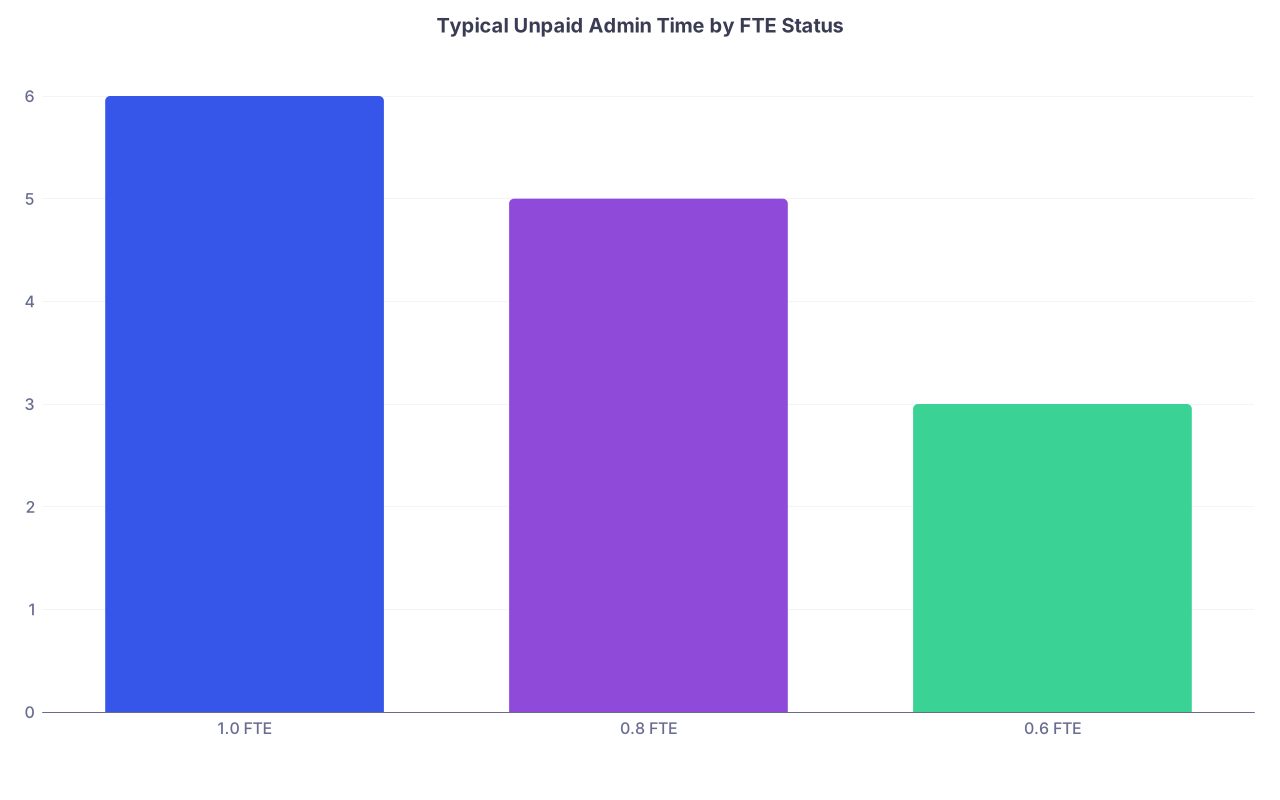
| Category | Value |
|---|---|
| 1.0 FTE | 6 |
| 0.8 FTE | 5 |
| 0.6 FTE | 3 |
That chart is the pattern I keep seeing: the decrease in paid time outpaces the decrease in unpaid admin load.
Pay, Benefits, and the Numbers Nobody Walks You Through
You see “0.8 FTE” and your brain does simple math: 80% of salary, 80% of work, 80% of benefits.
The math you should do is nastier.
The Pay Cut Is Not the Real Hit
A 20% pay cut on a $300k job is $60k. That stings, but here’s what everyone forgets: part‑time physicians almost always get cheated on time efficiency.
You lose:
- Economies of scale in your schedule. You still have start-up and shutdown costs to each clinic day—prep, reviewing labs, inbox—and that overhead doesn’t shrink.
- Marginal time. The most flexible parts of your week (evenings, extra half-days) get eaten by spillover work. For free.
In pure dollars per true hour worked, many 0.8s are making less per hour than their 1.0 colleagues.
The Benefits Cliff That Bites Later
Most hospitals and large groups set benefits thresholds at 0.75 or 0.8 FTE. Hit that line and you stay in the good pool. Drop below and you get hammered with:
- Higher health premiums
- No employer retirement match or decreased match
- Lost disability coverage or worse terms
This is one of the few real reasons 0.8 FTE is so popular instead of 0.6. Not lifestyle. Benefits engineering.
And long‑term, the retirement effect is real. If you run 0.8 instead of 1.0 for 10–20 years, compound growth on those missing contributions translates to hundreds of thousands less in retirement assets by your 60s. I’ve watched senior part‑timers panic around age 58 when they finally do that math.
Academic Promotions and “Soft Punishments”
In academic lifestyle specialties—derm, psych, PM&R—going officially part‑time often quietly moves you into a different mental category for leadership.
Common behind‑closed‑doors logic in promotions committees and department meetings:
- “She’s 0.8, so she’s not really looking for leadership.”
- “He doesn’t have the bandwidth for vice‑chair; he’s part‑time.”
- “We should give this role to someone who’s here more of the time.”
Nobody writes this into policy documents. They just make those decisions repeatedly. Over five to ten years, it shows up as: fewer titles, fewer stipends, fewer stepping stones to influence.
If you’re truly fine opting out of leadership, that might be acceptable. But it shouldn’t be a surprise.
Schedule, Call, and the Politics of “Fairness”
Here’s where things get messy—because this is where people lie to you, sometimes without realizing they’re lying.
At the recruiting stage, you’ll hear phrases like:
- “Call is shared equitably among FTE.”
- “We try to be flexible with our part‑time docs.”
- “We really value work‑life balance.”
What those actually mean depends ruthlessly on your local group culture.
Call Coverage: Pro‑Rated in Theory, Rigged in Practice
In lifestyle specialties, “call” can be pager backup, consult duty, or just being reachable.
This is the pattern I’ve seen:
- On paper: Call is pro‑rated by FTE. So if full‑time carries 1:8 call, a 0.8 doc lands around 1:10.
- In reality: People trade, people get sick, people take leave. The “flexible” part‑timer, especially without young kids, ends up “helping out” more often.
- Over time: The call ratio drifts. When someone leaves and you’re under‑staffed, the part‑timer gets leaned on “just until we hire someone.”
A 0.8 PM&R attending showed me her call logs over two years. Her written agreement said 0.8 share. Her actual number of weekends and nights was almost identical to her 1.0 colleagues because she was the “nice” one who didn’t push back.
That’s not bad luck. That’s a system working exactly as designed—lean on whoever has the weakest boundaries.
Clinic Schedules: Your “Day Off” Is Never Pure
In outpatient lifestyle specialties, true blank days are rare.
Common tricks:
- “Just one follow‑up”: Clinic schedulers slide in that single follow‑up on your off day because the patient “can only do Fridays.”
- “Urgent add‑ons”: You become the “overflow” for urgent stuff on your off day, especially if you live close.
- Meetings and M&M: Department meetings, quality conferences, and mandatory trainings are scheduled for the group’s convenience, not your FTE. Your “day off” gets punctured by a 1–2 hour meeting in the middle.
Now you’ve got a ruined day. Not a useful work day, not a real rest day. Just mediocre for both.
That’s one of the biggest hidden tradeoffs 0.8s complain about after a year: the fragmentation of time. You lose the clean separation that makes a schedule truly livable.

| Step | Description |
|---|---|
| Step 1 | Negotiate 0.8 FTE |
| Step 2 | Start with 4 clean days |
| Step 3 | Admin drifts to off day |
| Step 4 | Occasional patient add ons |
| Step 5 | Regular meetings on off day |
| Step 6 | Feel effectively full time |
Culture: How Your Colleagues Will Really See You
No one talks about this honestly on interview day, but you will feel it within six months.
The “Less Committed” Label
I’ve sat in partner meetings where someone said, about a 0.8 colleague:
- “She’s great clinically, but she’s not all in.”
- “He’s more focused on his hobbies; we need someone hungry for this leadership role.”
- “She’s not here Fridays, so we shouldn’t assign her this project.”
Are they technically wrong? They see you less. They experience the impact of your absence. From their perspective, you’re a little less available, a little harder to plug into everything.
You need to be very clear in your own head: if you go 0.8, you are voluntarily trading some perceived “commitment points” for time. Do it eyes open.
Mentorship and Sponsorship Shrink
Senior people tend to invest most in whoever they think will be visible, promotable, and influential. The 1.0 rising star who says “yes” a lot gets pulled into cool projects. The 0.8 often gets quietly bypassed.
This is especially true in academic lifestyle specialties. You might get enough to progress, but you will often be left out of the “inner circle” projects that launch major careers.
If you’re fine being solid, well‑liked, and never famous in your field—that’s a valid choice. But it’s a choice. Not an accident.
When 0.8 or Part‑Time Actually Works Well
I’ve been harsh so far because the rose‑colored version you hear as a resident is worse than useless. But part‑time and 0.8 can work. I’ve seen it work beautifully—just not by accident.
The success stories usually have the same ingredients.
1. Ruthless Boundary Clarity
The physicians who make 0.8 work long‑term treat it like a contract they’re willing to defend.
They:
- Refuse patient add‑ons on their off day unless it’s genuinely emergent.
- Delegate ruthlessly. MAs and nurses own inbox triage; the doc steps in only when truly necessary.
- Say no a lot to committees, extra teaching, or “quick” projects that bleed into free time.
They are not loved by every administrator. But they’re respected, and more importantly, they protect the reason they went part‑time to begin with.
2. Group Culture That Actually Means It
There are rare groups—usually physician‑owned practices or unusually healthy academic departments—where leadership truly values different FTE models.
You’ll see:
- Clear, written policies on call pro‑rating, meetings, and admin expectations.
- Part‑time physicians in visible leadership roles, not just in the “mommy track.”
- Administrative infrastructure to support reduced schedules: job sharing, robust nursing support, flexible panel management.
If you don’t see those things during your interview, they probably don’t exist. Culture does not magically appear after you sign.
3. Personal Financial Stability
The happiest part‑timers I know all had one thing in common: they didn’t need every dollar they were giving up.
They had:
- Paid off (or aggressively paying down) student loans
- Reasonable housing costs
- A partner with stable income, or a lifestyle pegged well below double‑doc inflation
They weren’t trying to do 0.8 and still live like a 1.2 FTE household.
If you’re graduating with $350k+ in loans and a coastal mortgage in your near future, you can still go part‑time. But the financial stress will eat up a lot of the mental bandwidth you thought you were buying.

Reading Between the Lines During Residency and Job Hunting
Since you’re still in training or early career, here’s what you should actually be asking and looking for when people promise you “flexible 0.8 options.”
Ask, bluntly, in a private moment with a trusted attending or recent hire:
- “For your 0.8 physicians, how many hours a week are they actually working including inbox and notes?”
- “Which leadership roles are currently held by people under 1.0 FTE?”
- “Are any of your partners transparently 0.6–0.8 FTE and still on track for partnership/promotion at the same pace?”
- “What % of their full‑time patient load do your 0.8s carry?”
- “On average, how many nights/weekends of call do your 0.8s do vs your 1.0s?”
Then shut up and watch the body language. The hesitation will tell you more than the words.
Also, talk to the 0.8s when they’re alone. Not at the recruitment dinner with leadership at the table. Catch them in the hallway, ask for their email, or request a confidential quick call. Ask: “What do you wish you had known before going 0.8 here?”
You’ll either get a shrug and “honestly, it’s been great” (rare, but it happens). Or you’ll get a long exhale and the real story.