
The fastest way to destroy a “lifestyle specialty” is to sign the wrong contract.
You can choose dermatology, radiology, anesthesia, outpatient psychiatry, lifestyle‑friendly IM subspecialties—all the right moves—and still end up with a schedule that feels worse than a trauma surgery call pool. The culprit is almost always the same: a contract full of quiet landmines you did not recognize.
I have watched otherwise smart residents sign deals that looked fine on the surface—“No nights, no weekends, competitive pay”—and then spend the next three years trying (and failing) to claw back control of their time. The mistake is not reading the contract. The mistake is not knowing which clauses matter and how they quietly erase the flexibility you thought you were buying with your specialty choice.
Let me walk you through the big ones that wreck lifestyle in supposedly cushy fields: derm, ophtho, allergy, outpatient psych, radiology, anesthesia, some hospitalist gigs, and concierge/primary care.
1. The Non‑Compete That Turns Your City Into a Cage
Non‑compete clauses are where lifestyle goes to die—especially in outpatient-friendly fields where your practice is built on patient relationships and local referral patterns.
The mistake: treating the non‑compete as “boilerplate” instead of a high‑stakes constraint on your future mobility and time freedom.
Common patterns I see:
- Dermatology associate signs a 2‑year, 30‑mile non‑compete. Practice becomes toxic. She wants to leave. Only realistic options: uproot the family or commute 90 minutes each way for 2 years. Lifestyle specialty, destroyed.
- Outpatient psychiatrist joins a group with a 1‑year, 50‑mile non‑compete tied not just to specific offices but “any location where the practice provides services or intends to provide services.” They open a telepsych line statewide. Suddenly, he cannot see patients anywhere in the state after leaving.
Watch for these red‑flag formulations:
Radius + Time Too Big
Anything like “25–50 miles for 2–3 years” in a dense metro area is excessive.
In lifestyle specialties, groups often push the envelope precisely because they know you value staying local.“Any Location Where Employer Does or Intends to Do Business”
This wording is lethal. It lets them expand the restricted area after you sign.Covers All Forms of Practice
Some contracts prohibit:- In‑person clinical work
- Telemedicine
- Locums
- Consulting
- Separate side business (e.g., cosmetics, aesthetics, teleradiology) That is not protection of their practice. That is control over your income.
Tied to Termination “For Any Reason”
Including if they terminate you without cause. Yes, that happens.
Here is how to protect yourself:
- For outpatient lifestyle fields (derm, ophtho, allergy, outpatient psych, primary care):
Aim for short (≤ 1 year) and tight radius (5–10 miles) limited to specific clinic addresses. - Insist the non‑compete:
- Applies only if you voluntarily leave.
- Is void if they terminate you without cause or breach the contract.
- Does not include telemedicine or non‑clinical work.
- In states starting to restrict non‑competes for physicians, do not assume the law will save you. Groups still write them in and enforce them until challenged.
Non‑competes are the opposite of flexibility. Treat them that way.
2. Scheduling Clauses That Sound Reasonable but Own Your Calendar
Lifestyle specialties live or die by scheduling details. A contract that merely says “full‑time employment” with vague language about call, shifts, or clinic hours is asking for abuse.
The mistake: focusing on “no nights, no weekends” in the interview, then signing a contract that does not reflect any of that in actual text.
Here is how they get you:
- “Physician agrees to work hours reasonably required for the proper care of patients and the operation of the practice.”
Translation: whatever we say this month. - “Call responsibilities to be shared equitably among physicians.”
Equitably means nothing if they keep hiring part‑timers, NPs, or people who refuse certain shifts. - “Schedule subject to change at Employer’s discretion.”
That sentence is doing more work than the rest of the document combined.
In derm, ophtho, allergy, outpatient psych, outpatient primary care, the trap is expansion. You sign on for:
- 4 clinic days + 1 admin day
- No evenings
- No weekends
Then the group quietly adds:
- 1 late‑evening clinic
- One Saturday a month
- “Urgent add‑on” blocks that extend your day
And your contract? It only says “full‑time” and “reasonable hours.”
Lock in the right details:
- Define full‑time in writing:
- “Full‑time shall mean 36 scheduled patient‑facing hours per week plus up to 4 hours of administrative time.”
- Spell out clinic days and range:
- “Physician will work 4 clinic days per week, Monday through Friday, no more than 2 evenings (after 5 pm) per month, and no regular weekend clinics.”
- Add limits on schedule changes:
- “Any permanent change to regular schedule requires mutual written agreement.”
- For hospital‑based lifestyle fields (radiology, anesthesia, some hospitalists):
- Define shift types (day, evening, night, weekend).
- Cap total nights/weekends per month in writing.
- State whether post‑call days are guaranteed and protected.
If it matters to your lifestyle, it must be written. Verbal assurances are worse than useless; they lull you into signing something unenforceable.
3. Sneaky RVU and Bonus Structures That Force You to Overwork
A lifestyle specialty stops being lifestyle once the only way to make a sane income is to see unsafe volumes.
Residents consistently underestimate how hostile some compensation structures are to flexibility. The problem is not RVUs themselves. It is the thresholds, guarantees, and claw‑backs tied to them.
The mistake: being hypnotized by a high “potential” income number and ignoring the productivity requirement buried two pages later.
Typical pattern:
- Base salary looks fine: say $300k for an outpatient specialty.
- Then you notice: base is guaranteed only for year 1. Year 2–3 you shift to:
- Lower base ($200–220k)
- Plus RVU bonus only after hitting a high threshold
- Hidden twist: overhead allocations, billing lags, “productivity adjustments” the group controls.
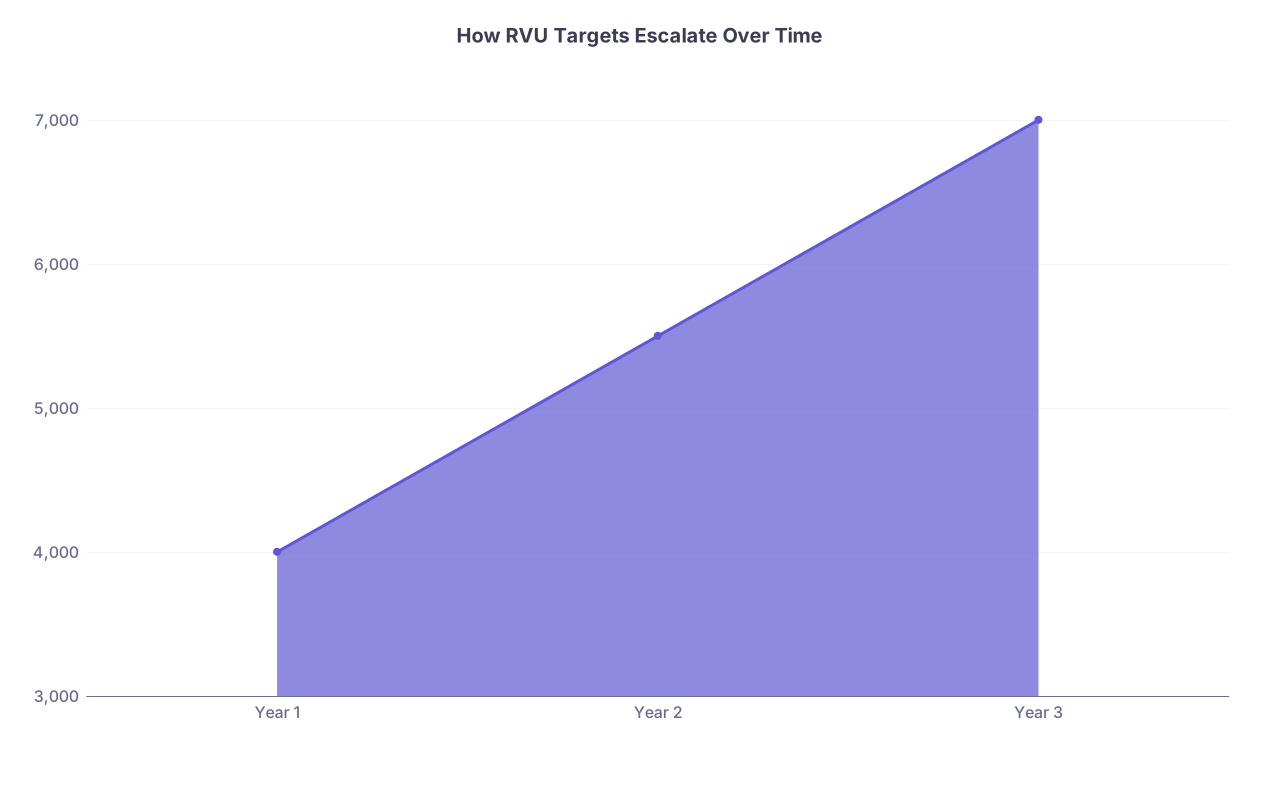
| Category | Value |
|---|---|
| Year 1 | 4000 |
| Year 2 | 5500 |
| Year 3 | 7000 |
In reality, that cheerful talk of “Most of our physicians easily make $450k” translates into:
- Double‑booked clinics
- Squeezing in add‑ons during lunch
- Charting at home every night
- Zero control over your panel size or visit length
Red flags in compensation language:
- “Base salary is an advance against future productivity.”
That means they can claw back if you do not hit targets. - RVU threshold set above current physicians’ actual production.
If your future partners are all at 5,500 RVUs and your bonus starts at 6,500, you know exactly what is coming. - Group controls scheduling, templating, and new patient allocation—but you shoulder all the downside if they do not fill your schedule.
If you care about lifestyle, you do not want a structure that punishes you for saying no to:
- Extra half‑day clinics
- Weekend “special events”
- Cosmetic or elective sessions added purely for revenue
You want:
- A guaranteed base that lets you live comfortably at reasonable volumes.
- A transparent bonus structure with realistic, written RVU targets (and historical data to verify).
- No claw‑back of base salary if volumes are low due to factors outside your control (referrals, staffing, clinic moves).
Ask to see actual production data of current physicians at your proposed FTE and schedule. If they refuse, that is a data point. A bad one.
4. Call and Coverage Language That Expands Without Limit
One reason people pick radiology, anesthesia, EM with smart scheduling, some IM subspecialties, or outpatient specialties is better control over call. You can wreck that advantage with one sloppy clause.
The mistake: accepting vague call language because “they promised it is light.”
Look for these traps:
“Shared Equitably” Without Numbers
That gives them freedom to:- Add hospital coverage
- Pick up new facilities
- Lose partners
…and you get to “share” whatever is left.
Mandatory Cross‑Coverage Across Multiple Sites
You sign for one hospital or clinic, then they acquire 3 more. Contract says you cover “all current and future locations.” Flexibility gone.No Cap on Call Frequency or Intensity
Reasonable now does not mean reasonable after two partners leave.
For lifestyle fields:
- Allergy/Immunology: you should not be quietly inheriting 24/7 call for some legacy inpatient consult service.
- Ophthalmology: weekend call for multiple hospitals, plus trauma and retina call, can get ugly fast if your group is short-staffed.
- Radiology: “backup call,” “beeper call,” and telerad coverage can quietly turn into nearly continuous availability.
You want written guardrails like:
- “Call will not exceed 1 in 6 weekdays and 1 in 6 weekends without Physician’s written consent.”
- “Physician will not be required to cover more than X hospitals.”
- “Any substantive increase in call burden requires mutual written agreement and corresponding compensation adjustment.”
If they respond, “We can’t put that in writing, but we would never abuse call,” that is your warning. If it is so true, they should be willing to write it down.
5. “Any Other Duties as Assigned” – The Garbage Clause
This line looks harmless. It is not. It is the legal equivalent of “we reserve the right to dump anything we do not want to staff on you.”
The mistake: accepting open‑ended duties in a specialty where you picked the field specifically to avoid certain types of work.
I have seen:
- An outpatient psychiatrist contract that quietly allowed the group to assign inpatient weeks “based on business needs.”
- A derm contract that allowed cosmetics clinics, nursing home wound care rounds, and even coverage at a medspa the owners also ran.
- A radiology contract with language broad enough to allow mandatory administrative positions with no additional pay.
In lifestyle specialties, scope creep kills your control over your days. The more avenues for “assigned duties,” the more surprises you sign up for.
You want your contract to clearly define:
- Primary practice setting(s)
- Types of services you will provide
- Explicit exclusions (e.g., “Physician will not be required to provide inpatient coverage, ED call, or nursing home rounds without mutual written agreement.”)
If they insist on keeping “any other duties as assigned,” narrow it:
- Tie it to your specialty and training.
- Exclude major setting changes (outpatient to inpatient, day to night, local to multi‑city).
Ambiguity always favors the party that wrote the contract. Not you.
6. Restrictive Outside Work / Moonlighting / Side‑Gig Clauses
Lifestyle specialties attract physicians who value autonomy. Many want:
- Part‑time options
- Telemedicine side work
- Cosmetics/aesthetics on the side
- Consulting, speaking, content work
Then they sign a contract that bans all outside professional activity. Completely.
The mistake: ignoring outside work language because “I am just going to focus on this job for a few years.” Then, when you want flexibility, you are locked down.
Watch for:
- Absolute prohibition: “Physician shall not engage in any outside professional activities, paid or unpaid, without Employer’s prior written consent.”
- Overbroad definitions: counting any medical‑related work, no matter how indirect.
- Non‑compete language that extends to telehealth, coaching, consulting, or even owning a related business.
You are signing up for 2–3 years (or more) of your life. You may not know what you will want yet. That is exactly why you keep doors open.
Reasonable protection for the employer looks like:
- No competing clinical work within a certain radius.
- Moonlighting needs approval only if:
- During scheduled hours
- Competes for the same patients
- Uses their resources or branding
Unreasonable is:
- Banning telehealth consults for out‑of‑state patients on your own time.
- Blocking you from building a cosmetic or aesthetics side practice not overlapping with their core business.
- Claiming ownership of anything you create (courses, content, IP) outside of work.
If lifestyle and flexibility matter, you want a contract that treats you as a professional, not property.
7. One‑Sided Termination and “Trapped for 3 Years” Problems
A contract can look okay on non‑compete, schedule, and comp—and still trap you—if you cannot exit cleanly when reality does not match the sales pitch.
The mistake: ignoring who can terminate, how, and with what notice.
Variant I see too often:
- Employer can terminate you “without cause” with 30 days’ notice.
- You can only terminate:
- At the end of the term
or - With “good cause,” defined so narrowly it is basically unusable.
- At the end of the term
That is asymmetry. They keep all optionality. You get none.
For lifestyle specialties, this matters because:
- You often move for a job (new city, spouse’s work, schools).
- The whole appeal is quality of life. If it is bad, you need an exit you can actually use.
You want:
- Mutual “without cause” termination:
- Either party can end the agreement with written notice (60–120 days is typical).
- Clear process for:
- How patients are transitioned
- Tail insurance (who pays, when, under what circumstances)
- Reasonable penalties (ideally none) for leaving early.
And be very careful with forgiveness/loan programs:
- “Sign‑on bonus becomes a loan if physician terminates within 3 years.”
- “Forgiveness schedule” that front‑loads repayment obligations in year 2–3.
Those can keep you in a job long after it has stopped being good for your life.
| Issue | Red-Flag Clause Example | Better Clause Example |
|---|---|---|
| Non-compete | 2 yrs, 30+ miles, all future sites | ≤1 yr, 5–10 miles, only listed locations |
| Schedule | “Hours as reasonably required” | Defined clinic hours, days, and max evenings/weekends |
| Call | “Shared equitably” | Hard caps on frequency and sites |
| Termination | Employer 30 days, physician only for cause | Mutual 60–120 day without-cause termination |
8. Malpractice and Tail Insurance: The Silent Future Bill
You can have the perfect schedule and still blow up your future flexibility by ignoring malpractice and tail coverage.
The mistake: assuming “the group will handle it” without reading the actual words.
Lifestyle fields often use claims‑made policies. If you leave the job, you need tail coverage—often a 5–6 figure one‑time cost—to cover old claims filed later.
Common trap:
- “Employer will provide malpractice coverage during employment.”
Sounds good. - No mention of tail.
Guess who pays when you leave? You.
In high‑income lifestyle specialties (derm, ophtho, outpatient psych settlements, some interventional pain), tails are not cheap. If you are on the hook for it, that can:
- Delay your ability to leave.
- Force you to stay until you negotiate tail payment at a new job.
- Make part‑time or locums transitions financially painful.
You want clear language:
- Who pays for tail coverage upon:
- Voluntary departure
- Termination without cause
- Termination with cause
- Retirement
- Ideally:
- Employer pays tail if they terminate you without cause.
- Tail cost is shared or covered if you complete the full initial term.
If they refuse to budge, you factor that into your total compensation and flexibility calculation. A “great” salary loses its charm when there is a $90,000 bill waiting at the exit.
9. “We’ll Fix It Later” – The Most Expensive Sentence You Can Believe
One last, universal mistake: trusting promises that are not in the contract.
I have heard every one of these:
- “We never enforce the non‑compete.”
- “We never change schedules without talking to people.”
- “Yes, we expect you to work 4 days a week, not 5.”
- “The RVU thresholds are just formalities; everyone hits bonus.”
If they never enforce it, there is no reason they cannot soften it in writing. If they refuse, that tells you what will happen when ownership changes, revenue dips, or new partners arrive.
Lifestyle specialties are especially prone to this because the marketing of the specialty is lifestyle. That creates a false sense of security. Residents think, “It is derm/rads/psych, it will be fine.” Then they sign whatever is put in front of them.
Do not do that.
Get:
- The actual contract.
- Enough time to review (do not let them rush you with “exploding offers”).
- A physician‑side contract attorney, ideally one who has seen multiple deals in your specialty and region.
And be willing to walk. The most powerful protection you have is saying, “No, this does not work for me.”

| Step | Description |
|---|---|
| Step 1 | Receive Contract |
| Step 2 | Identify Red Flag Clauses |
| Step 3 | Negotiate Changes in Writing |
| Step 4 | Compare Other Offers |
| Step 5 | Sign Contract |
| Step 6 | Walk Away and Protect Flexibility |
| Step 7 | Can They Be Revised? |
| Step 8 | Revised Contract Acceptable? |
FAQ (Exactly 4 Questions)
1. I am a PGY‑3 considering outpatient psych. What is the single worst clause to ignore?
The non‑compete. Outpatient psych is heavily relationship‑based, and groups know it. A broad non‑compete (long duration, big radius, including telehealth) can force you to uproot your entire life if the job goes bad. Everything else—comp structure, schedule—can often be fixed with negotiation or a job change. A nasty non‑compete makes that job change painful or impossible locally.
2. My potential employer says they “never enforce” their non‑compete and it is just a formality. Can I rely on that?
No. That line is almost a cliché at this point. Even if the current leadership means it, your contract will outlive them. Ownership can change. Financial pressure can change incentives. If they genuinely do not care about enforcing it, they should be comfortable narrowing or removing it in writing. If they refuse, they are preserving the option to enforce it when it benefits them, not you.
3. How much call is reasonable to put in writing for a lifestyle specialty?
It varies by field and local norms, but “reasonable” is not a number. You want explicit caps. Examples: outpatient ophtho might cap at 1 in 6 weekends of call; radiology could specify no more than X night shifts per month and Y weekends; outpatient specialties (derm, allergy, primary care) often have no true call beyond phone triage—so clarify that and limit after‑hours expectations. The point is not the exact ratio. The point is that it is written and cannot be unilaterally expanded.
4. Is it overkill to hire a contract review attorney for my first job if I am going into a lifestyle specialty?
Not if you care about your actual lifestyle. The more “desirable” the specialty, the more leverage employers think they have and the more aggressive some of them are with non‑competes, RVU thresholds, and outside‑work restrictions. A few hundred to a couple thousand dollars for a seasoned physician contract attorney can easily save you years of being trapped in a bad situation or tens of thousands in tail coverage and lost flexibility. It is not overkill; it is basic self‑defense.
Key points to remember:
- Lifestyle specialties do not guarantee lifestyle. Your contract does—or destroys it.
- Non‑competes, vague schedule/call clauses, and lopsided termination terms are the main flexibility killers.
- If a promise matters to your day‑to‑day life and freedom, get it in writing—or be ready to walk away.