
The biggest mistake students make about “lifestyle-friendly” specialties is thinking they can decide in MS4 and somehow backfill the roadmap. You cannot. If you want derm, ophtho, rads, anesthesia, PM&R, or a chill hospitalist life, you start building that outcome in MS1.
Below is your year‑by‑year, then month‑by‑month, then week‑by‑week playbook.
I will assume you are aiming for lifestyle‑friendly fields like:
- Dermatology
- Ophthalmology
- Radiology (diagnostic or IR-adjacent)
- Anesthesiology
- PM&R
- Certain outpatient IM/neurology/family tracks
Same rules apply for all of them: good scores, targeted mentors, strong letters, smart scheduling.
Big Picture: 4‑Year Strategy
At this point, before we dive into years, you need the skeleton.
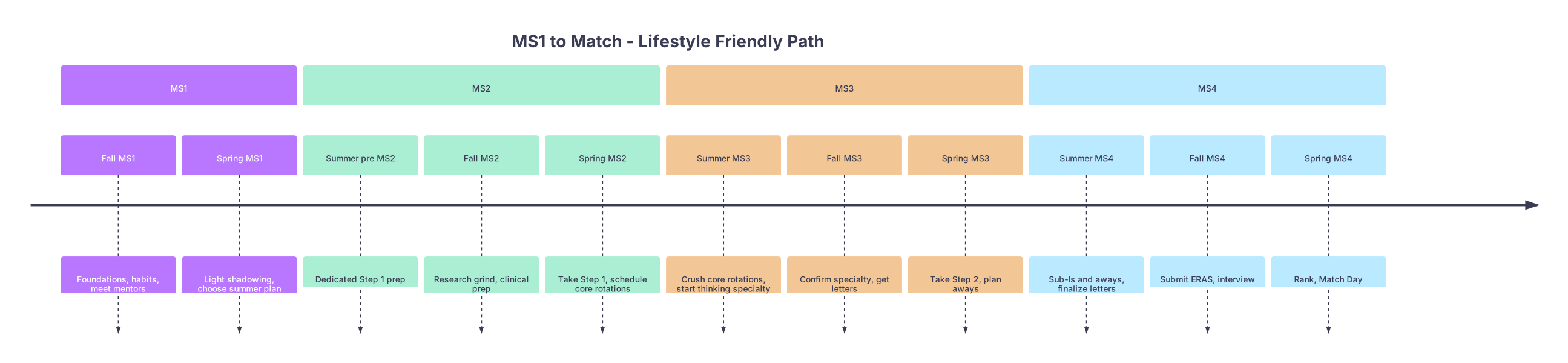
| Period | Event |
|---|---|
| MS1 - Fall MS1 | Foundations, habits, meet mentors |
| MS1 - Spring MS1 | Light shadowing, choose summer plan |
| MS2 - Summer pre MS2 | Dedicated Step 1 prep |
| MS2 - Fall MS2 | Research grind, clinical prep |
| MS2 - Spring MS2 | Take Step 1, schedule core rotations |
| MS3 - Summer MS3 | Crush core rotations, start thinking specialty |
| MS3 - Fall MS3 | Confirm specialty, get letters |
| MS3 - Spring MS3 | Take Step 2, plan aways |
| MS4 - Summer MS4 | Sub-Is and aways, finalize letters |
| MS4 - Fall MS4 | Submit ERAS, interview |
| MS4 - Spring MS4 | Rank, Match Day |
You will adjust as your school calendar shifts, but the sequence stands.
MS1: Build the Engine, Not the Brand
MS1 Fall (Aug–Dec): Set the Floor
Your only job this semester: set your baseline so you can choose a lifestyle specialty later instead of getting forced out by weak performance.
By November MS1, you should:
- Have a consistent study system for exams and boards (Anki, question banks, set schedule).
- Be in the top third of your class or trending there. Honors vs HP now is not about ego; it becomes leverage later.
- Have at least one faculty member who knows your name and face, ideally in a lifestyle field.
Concrete moves:
Weeks 1–4:
- Lock in your note system (Anki vs outlines).
- Sample board-style resources but do not go insane. One question bank is enough.
- Go to 1–2 specialty interest group meetings: derm, ophtho, rads, anesthesia, PM&R. You are not committing; you are scouting.
Weeks 5–8:
- Office hours with at least one preclinical faculty. Ask blunt questions:
- “Who here mentors students into derm/rads/ophtho?”
- Email one resident from a lifestyle specialty:
- “Can I shadow a half day this semester? I am early MS1 just trying to see what your day looks like.”
- Office hours with at least one preclinical faculty. Ask blunt questions:
Weeks 9–16:
- One shadowing half‑day per month. No more. Burnout in MS1 is amateur hour.
- Start a running “specialty log” in a simple doc: things you actually like/dislike during shadowing. You will forget later.
At this point you should not be doing research at the cost of grades. A 3.2 GPA with a weak Step 1 + 4 mediocre case reports is dead weight.
MS1 Spring (Jan–May): Choose a Direction, Not a Destination
By March MS1, you should have:
- Narrow interest list to 2–3 lifestyle fields
- A concrete summer plan (research vs clinical vs Step work)
- One potential letter writer brewing (someone who would recognize you at the grocery store)
Month‑by‑month:
January–February:
- Continue crushing exams.
- Shadow 1–2 more half‑days, ideally different specialties (e.g., one PM&R clinic, one anesthesia OR day).
- Attend at least one departmental grand rounds (derm, rads, ophtho, anesthesia, PM&R). Stand up, introduce yourself briefly to the program coordinator or a faculty at the end.
March: Decide summer:
If you are gunning for competitive lifestyle (derm, ophtho, rads):
- Secure a research spot in that department or a close cousin (for derm: allergy/immunology/oncology can work; for rads: neuro/onc, etc.).
- Email early: “I am an MS1 interested in [field]; do you have any projects a motivated student could join this summer?”
If you are leaning less cutthroat lifestyle (PM&R, anesthesia, some IM/family):
- Research helps but is not mandatory. Clinical experience, Step prep, and honors matter more.
- Summer could be: light research + board foundations + rest.
April–May:
- Finalize summer schedule.
- Do not volunteer for 80‑hour weeks in a lab. Aim for:
- 20–30 hrs/week research
- 10 hrs/week early board foundation (light QBank / Anki)
- Real time off.
MS1 Summer: First Real Fork in the Road (Jun–Aug)
At this point you should be behaving like a junior colleague, not like an undergrad volunteer.
If doing research (derm/ophtho/rads/PM&R/anesthesia):
Week 1–2:
- Clarify deliverable: abstract, poster, paper, or “we’ll see someday” (if it is the last, get on another project).
- Schedule standing weekly check‑ins with your mentor.
Week 3–10:
- Work 20–30 hours/week. Aim to be the student who sends the “I cleaned up the data and drafted the methods” email unprompted.
- Keep a CV log of everything: title, dates, your exact role.
All summer:
- 8–10 hrs/week of light Step 1 prep:
- Focus only on getting comfortable with the style of board questions.
- No “dedicated” yet. This is about familiarity, not mastery.
- 8–10 hrs/week of light Step 1 prep:
If not doing research:
- Work part‑time, volunteer, or rest.
- Still do 5–8 hrs/week of board-style questions.
- Do one more short shadow experience in a lifestyle field you have not seen.
Bottom line: by August before MS2, you want at least one credible line on your CV pointing toward a lifestyle field, and you want your study engine warmed up for real board prep.
MS2: Converting Potential Into Numbers
This is the year where lifestyle-friendly options either stay open or start closing quietly.
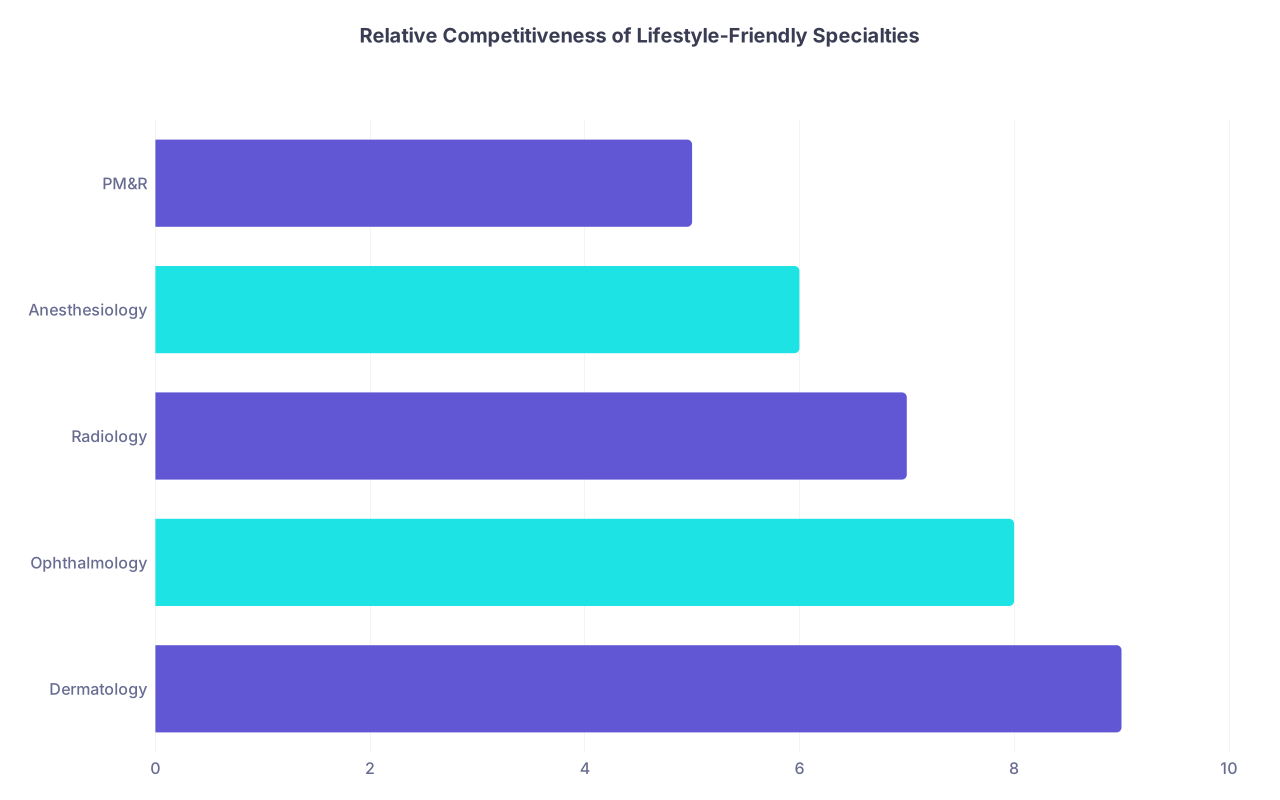
| Category | Value |
|---|---|
| Dermatology | 9 |
| Ophthalmology | 8 |
| Radiology | 7 |
| Anesthesiology | 6 |
| PM&R | 5 |
(Scale 1–10: higher = more competitive. These are relative, not absolute.)
MS2 Fall (Aug–Dec): Board Prep + Output
By October MS2, you should:
- Be in a structured Step 1 plan
- Have at least one research deliverable in progress (abstract/poster/manuscript) if derm/ophtho/rads is in play
- Have met at least one program director or senior faculty in your field(s) of interest
Month‑by‑month:
August–September:
- Lock in Step 1 resources:
- One primary QBank
- One main content resource
- Map a weekly schedule:
- 10–15 hrs/week boards
- Rest for class
- Meet with your research mentor: “What can we realistically submit by [date]?”
- Lock in Step 1 resources:
October–November:
- Increase QBank volume.
- If your school allows, join another small project in your field of interest. Do not chase 5 projects at once. Two that finish are better than five that die.
- Attend a departmental conference again, this time as a known face. Re‑introduce: “I am the MS2 who worked on [project] with Dr. X.”
December:
- Short diagnostic NBME.
- If your score is weak, adjust: more questions, less fluff.
- Plan dedicated: exact dates, resources, daily question targets.
At this point you should have an honest idea of whether ultra‑competitive lifestyle fields (derm/ophtho) are realistic or a higher‑risk bet. You do not have to decide yet, but you should know the odds.
MS2 Spring + Dedicated (Jan–Jun): Numbers and Logistics
This window determines which doors stay open.
January–March: Ramp + Schedule
January:
- Increase to 15–20 hrs/week Step 1 prep.
- Finish manuscript drafts or abstracts. You do not want active projects hanging over dedicated.
February–March:
- Register for Step 1 with a target date that leaves you enough time before MS3 rotations start.
- Meet with your specialty mentor:
- Ask bluntly: “With my grades and current trajectory, how realistic is [derm/rads/ophtho/anesthesia/PM&R] here?”
- Start thinking MS3 rotation order:
- Lifestyle‑friendly match strategy often means front‑loading rotations where letters matter (medicine, surgery, neuro) before you apply.
Dedicated (4–8 weeks depending on school):
- Daily schedule:
- 2–3 blocks of QBank
- Focused review of weak systems
- One NBME weekly toward the end
Do not stack research, shadowing, or side projects here. I have watched multiple students miss Step benchmarks and then wonder why derm/rads imploded later.
After Step 1 (if pass/fail, still matters for your knowledge base):
- Take 1 week off. No guilt.
- Then pivot immediately to MS3 prep: basic procedural skills, SOAP notes, expectations for core rotations.
MS3: This Is Where Lifestyle Gets Won or Lost
Now you are on the wards. Your reputation and letters start.
Rotation Order Strategy
If you want a lifestyle-friendly specialty, your priorities are:
- Honors in key core rotations
- Strong clinical letters
- Enough exposure to your target field early enough to decide on away rotations and letters
| Goal Specialty | Ideal First 3 Rotations | Rationale |
|---|---|---|
| Dermatology | IM → Surgery → Neuro | Builds strong medicine foundation, early surgical exposure |
| Ophthalmology | Surgery → IM → Neuro | Early OR experience, neuro‑ophth overlap |
| Radiology | IM → Surgery → Neuro | Broad pathology, helps with imaging understanding |
| Anesthesiology | Surgery → IM → ICU/Neuro | Early OR and perioperative care |
| PM&R | IM → Neuro → Psych | Neuro and functional focus |
You cannot always control order, but you should request strategically.
MS3 Early (Jul–Oct): Crush Cores, Start Tasting
By the end of your first 2–3 rotations, you should:
- Have at least one attending who would write you a strong, detailed letter
- Have begun comparing real life on the wards with your “lifestyle fantasy”
Monthly focus:
First 12 weeks (typically 2 rotations):
- Show up early, leave late, be useful. Not cute, not flashy. Useful.
- Ask residents quietly: “Which faculty here write great letters?” Then work with them.
- Log clinical stories that match lifestyle fields:
- For derm: interesting rashes, autoimmune disease.
- For ophtho: neuro/ophtho overlap, vision loss.
- For rads: imaging that changed management.
- For anesthesia: complex OR cases, airway challenges.
- For PM&R: functional recovery, stroke rehab.
Weeks 13–20:
- Do at least a 2‑week elective or selective in your target field if your school allows MS3 electives.
- If not, arrange informal shadowing on lighter rotations (one evening or weekend half‑day).
At this point you should be moving from “I think derm is cool” to “I have seen the clinic days, the documentation, the call; I can picture myself doing this.”
MS3 Mid (Nov–Jan): Decide and Commit
By January MS3, you should have:
- A primary specialty target (and one realistic backup if your primary is derm/ophtho/rads)
- A short list of programs where you could do aways or Sub‑Is
- At least 1 strong letter already secured or promised
Practical steps:
On your target specialty rotation (or a strong related core if you do not get it yet):
- End of week 3: ask for feedback. If good, ask about a letter:
- “I am strongly considering [specialty]. If I continue at this level, would you be comfortable writing me a strong letter?”
- If they hesitate, do not force it. Move on.
- End of week 3: ask for feedback. If good, ask about a letter:
Use nights/weekends on lighter rotations to:
- Update CV
- List possible away rotation sites (for derm/ophtho especially)
- Research which programs are lifestyle‑friendly in reality (resident blogs, word‑of‑mouth, case numbers, call schedules).
MS3 Late (Feb–Jun): Lock Letters, Plan Aways, Prepare for Step 2
This is transition sprint time.
By June MS3, you should:
- Have 2–3 letter writers locked in (1–2 from your target field, 1 from a core rotation like IM or surgery)
- Have away rotations requested/scheduled (if doing them)
- Have your Step 2 date reserved
Month‑by‑month:
February–March:
- Finish remaining cores with maximum effort; even if you think you are going into derm, a scathing eval on surgery will haunt your Dean’s letter.
- Meet with your target specialty’s program director or clerkship director:
- Ask: “Given my performance, what can I still do in MS4 to be a strong candidate for a lifestyle‑friendly position here or somewhere similar?”
April–May:
- Submit VSLO/away applications (for derm/ophtho/anesthesia/PM&R where aways are common or helpful).
- Schedule Step 2 for June–August, leaving at least 4–6 weeks of real prep time around rotations.
June:
- Start Step 2 prep seriously.
- If you are doing an early Sub‑I in your chosen field, treat it like a month‑long interview. Because it is.
MS4: Execution and Optics
Now you are not building the engine—you are driving it in front of program directors.
MS4 Early (Jul–Sep): Sub‑Is, Aways, Step 2, ERAS
At this point you should be treating every day like someone is deciding whether they want you as a colleague at 3 a.m. for the next 3–4 years.
Sub‑Is / Aways (Jul–Aug ideally):
You get 1–3 months to impress. Use them:
- Show up early. Always prepared.
- Be the resident’s shadow, not the attending’s groupie. Residents talk.
- Take ownership of a few patients or tasks and follow through mercilessly.
For lifestyle specialties:
- Evaluate real lifestyle at that program:
- How often do residents stay late?
- Do they have time for conferences, family, outside hobbies?
- Ask seniors privately, “Are you happy here?” Watch their face, not just their words.
- Evaluate real lifestyle at that program:
Step 2:
- If you have not taken it yet, this is your last major lever.
- For competitive lifestyle specialties, a strong Step 2 can offset an average Step 1 or a weaker school brand.
- Take it before ERAS submission if you need it as a positive signal.
ERAS prep (Aug–Sep):
- Personal statement: pick one specialty and write with conviction. Lifestyle talk is fine, but do not say, “I want derm because I like 9–5 and no call.” Talk about sustainable career, long‑term patient relationships, outpatient focus.
- Program list:
- For derm/ophtho/rads: cast wide. 60–80+ applications is normal.
- For anesthesia/PM&R: you can be more targeted but do not get cocky.
MS4 Mid (Oct–Jan): Interviews and Ranking for Lifestyle
Interviews are your chance to verify whether a “lifestyle-friendly” specialty is actually lifestyle‑friendly at that program.
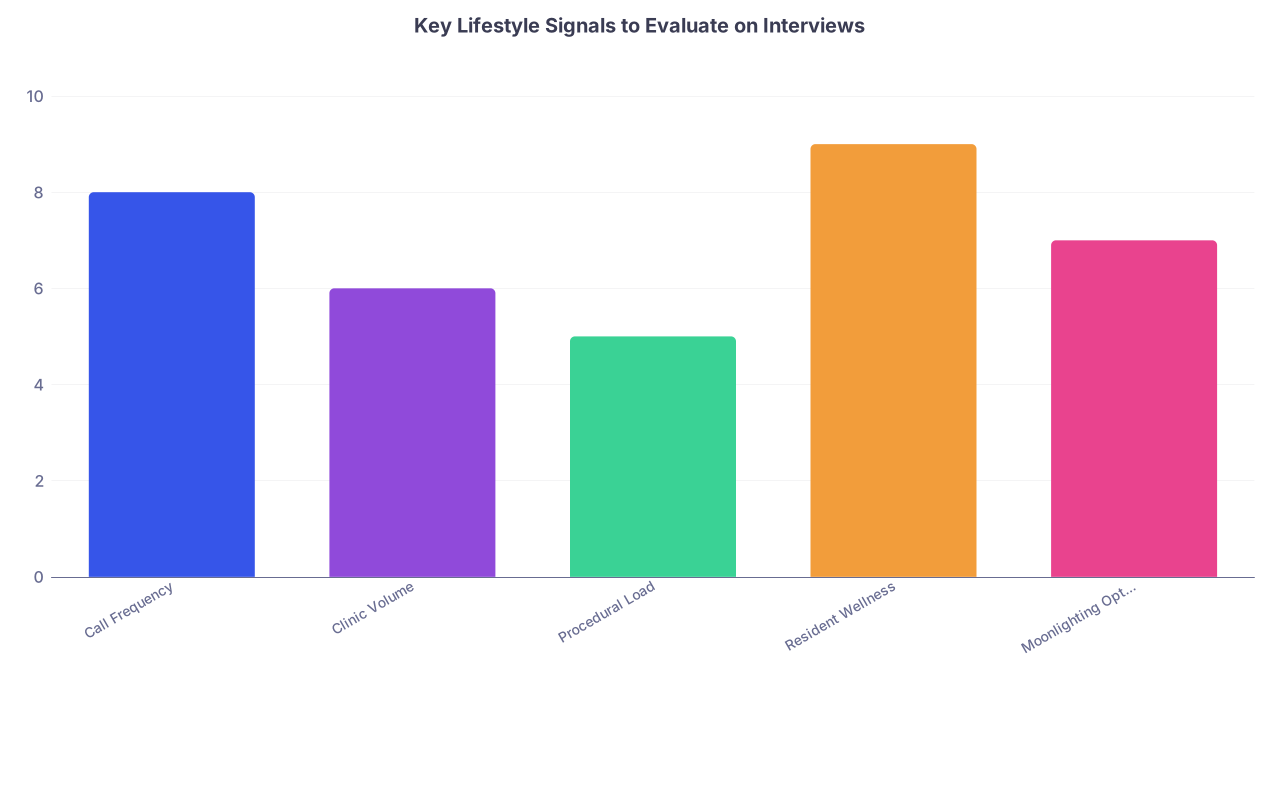
| Category | Value |
|---|---|
| Call Frequency | 8 |
| Clinic Volume | 6 |
| Procedural Load | 5 |
| Resident Wellness | 9 |
| Moonlighting Options | 7 |
(Scale 1–10: importance when deciding if a program truly supports lifestyle.)
On interview days:
Ask residents, in a private moment:
- “What is your typical workweek like in hours?”
- “What rotations are the worst and how often do they happen?”
- “Do people actually take their vacation?”
Listen for:
- Uniform, honest answers vs. nervous laughter and deflection.
- Mention of systems that protect time: float nights, real days off after call, protected didactics actually honored.
Keep a post‑interview log that night:
- Hours expected
- Call schedule
- Resident mood
- City cost of living
- Your gut feeling, scored 1–10
MS4 Late (Feb–Mar): Rank and Close
By this point, your active work is mostly done. You are arranging the options you already built.
On your rank list:
- Prioritize programs where:
- Residents seem actually happy and not just surviving
- Leadership is transparent about schedules and expectations
- Outpatient vs inpatient balance aligns with your version of “lifestyle”
Do not rank a malignant program highly just because it is “prestigious” in a lifestyle specialty. Burning out in derm is still burning out.
Quick Year‑by‑Year Checklist

| Year | By End of Year You Should Have… |
|---|---|
| MS1 | Solid grades, 1–2 shadowing experiences, summer plan, first research or clinical exposure in a lifestyle field |
| MS2 | Strong Step 1 result (or solid foundation), 1–2 projects with deliverables, 1–2 mentors in target fields |
| MS3 | Honored key cores, confirmed specialty choice, 2–3 strong letter writers, Step 2 date set |
| MS4 | Successful Sub‑Is/aways, completed Step 2, ERAS submitted, realistic rank list favoring true lifestyle programs |
Final Thoughts: What Actually Matters
Three points to keep front and center while you move through MS1–MS4:
- Lifestyle starts with leverage. Strong scores, solid evals, and real mentors give you options. Options let you say no to bad programs and yes to lifestyle‑friendly ones.
- Decide early enough to act. You do not need to lock in derm vs rads in MS1, but you do need to build the kind of profile that keeps those doors open by the end of MS2.
- Judge programs by residents, not brochures. On rotations and interviews, pay attention to how residents live, not what the website promises. Your future 5–10 years will look more like them than like any mission statement.
If you follow this timeline—honestly, without self‑sabotage—you will not just “hope” for a lifestyle‑friendly match. You will be positioning yourself for it from day one.