
The honest answer: most outpatient clinicians are seeing too many patients per day for any reasonable “lifestyle” claim to be true.
If you’re serious about a lifestyle-focused outpatient job, you’re not aiming for the numbers many systems quietly expect (24–30+ a day). You’re aiming far lower. And you need to be intentional about it, or the system will gladly eat your time, your evenings, and your spine.
Let’s break this down like adults.
The Real Range: What’s “Reasonable” vs “Normal”
Here’s the core framework I use when talking to residents and early attendings:
- Under 12 patients/day: Boutique, concierge, or heavily procedure/admin-protected. Great lifestyle, often lower W2 if employed.
- 12–16/day: Excellent lifestyle, true ability to think, teach, and not chart all night.
- 16–20/day: Reasonable for most lifestyle-focused outpatient jobs if:
- You have decent support (MA, RN, maybe scribe, good templates), and
- Slot lengths aren’t absurd (15-minute new, 10-minute complex geri? Hard pass).
- 20–24/day: This is where “lifestyle” starts to crack. Many docs survive here, but they’re doing notes at home and feel it.
- 24+ per day: This is volume-focused, productivity-driven work. Call it what it is. You can still have a life, but it won’t be what most people think of as a “chill” outpatient job.
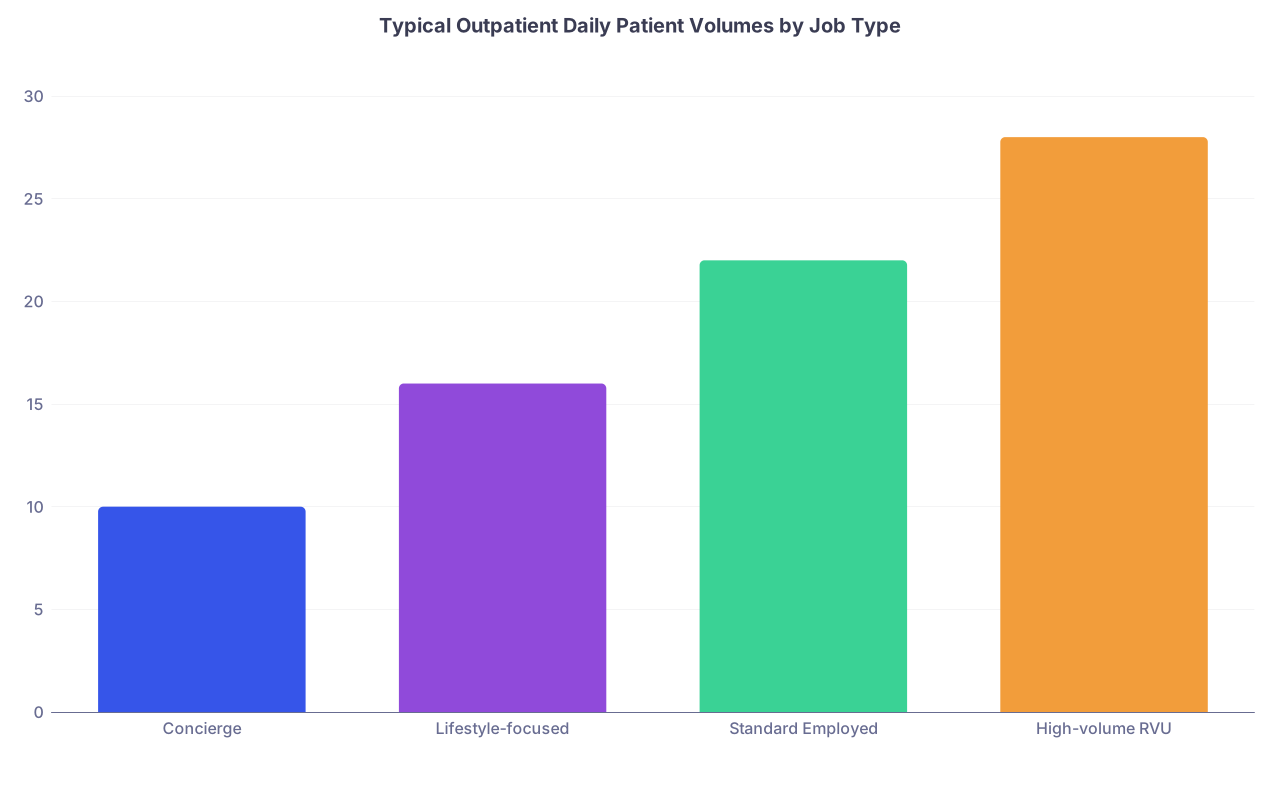
| Category | Value |
|---|---|
| Concierge | 10 |
| Lifestyle-focused | 16 |
| Standard Employed | 22 |
| High-volume RVU | 28 |
For a truly lifestyle-friendly outpatient role, the sweet spot for most physicians is 14–18 patients per full clinic day.
That number assumes:
- 20–30 minute follow-ups,
- 40+ minutes for new patients,
- and actual buffer time.
Once you push past ~18, you start stealing from somewhere: documentation quality, patient connection, your lunch, your kids’ bedtime, or your spine.
It Depends on Specialty – But Less Than You Think
People love to say, “Well in [insert specialty], 25 a day is easy.” Sometimes true. Often delusional.
Here’s a rough, real-world comparison for lifestyle-oriented outpatient jobs when set up sanely, not productivity-maxed:
| Specialty | Reasonable Lifestyle Target | Absolute Upper Limit Before Lifestyle Suffers |
|---|---|---|
| Family Medicine / IM PCP | 14–18 | 20–22 |
| Outpatient Psych (med mgmt) | 8–14 | 16 |
| Outpatient Neuro | 10–14 | 16–18 |
| Rheumatology | 12–16 | 18–20 |
| Endocrinology | 12–16 | 18–20 |
| Allergy/Immunology | 14–18 | 20–22 |
| Derm (mostly quick visits) | 22–28 | 30+ |
Are there outliers? Sure. A dermatologist doing mostly quick acne/rash follow-ups can see 30+ and still get home early. A psychiatrist doing 3–4 90-minute therapy+med visits can have a cushy day on “only” 6 patients.
But here’s the principle you should anchor on:
The more cognitive + complex + undifferentiated the visit, the fewer patients per day your job can handle and still be “lifestyle friendly.”
Primary care, outpatient neuro, rheum, geriatrics, complex psych? Don’t try to play derm’s numbers game.
Time Math: How Many Patients Actually Fit in an 8-Hour Day?
Let’s do actual math, because administrators love to pretend hours are fictional.
Say you have an 8-hour clinic day (480 minutes).
Now subtract:
- 30–60 minutes lunch (if you bother to take it)
- 30–45 minutes for inbox, messages, refills, forms
- 15 minutes wasted in EMR logins, hallway consults, “quick questions”
You’re left with maybe 360–390 usable patient-facing/charting minutes.
Now ask:
How long is a typical follow-up visit realistically?
- PCP: 20–30 minutes if you’re actually addressing chronic disease + preventive + 1–2 acute complaints
- Psych: 20–30 minutes for med checks, much longer for therapy-style sessions
- Neuro/Rheum/Endo: 20–30 minutes, often with long histories and complicated meds
How many new patients do you see per day?
- New PCP/Neuro/Rheum: 40–60 minutes each
- New Psych: 60–90 minutes
If you’re doing mostly 20-minute follow-ups with a couple 40-minute news, and maybe 30–45 minutes protected for inbox:
- 4 new patients x 40 minutes = 160
- 10 follow-ups x 20 minutes = 200
- Inbox/admin = 40
- That’s 400 minutes, and your “day” is basically full.
That’s 14 patients.
This is why I call 14–18 the realistic lifestyle range.
The only way you get to 24+:
- 10–15 minute slots,
- minimal complex patients,
- hyper-efficient workflow,
- and/or you’re finishing notes at home or during “lunch.”
Red Flags in Job Ads and Interviews
You can tell a lot from how a job talks about daily volume. Here’s what I tell residents to look for.
Phrases that should make you suspicious:
- “Our physicians typically see 20–25 patients per day.”
- “Full schedule is 22–24 patients, but many do more.”
- “Templates are 15 minutes for all follow-ups.”
- “We don’t limit the number of issues per visit.”
- “Most doctors finish their notes at home in the evening.” (Yes, people actually say this.)
Phrases that are more lifestyle-aligned:
- “We cap at 14–18 patients per full day.”
- “30-minute follow-ups; 60-minute new visits.”
- “Protected admin time built into templates – not an afterthought.”
- “We expect you to be done charting by the end of the day.”

| Step | Description |
|---|---|
| Step 1 | Job Ad Mentions Volume |
| Step 2 | Likely Lifestyle-Friendly |
| Step 3 | Moderate Lifestyle |
| Step 4 | High Volume - Lifestyle Risk |
| Step 5 | Patients per Day <= 18? |
| Step 6 | Admin Time Protected? |
During interviews, ask directly:
- “How many patients per day are your happiest physicians seeing?”
- “How many patients per day are your highest RVU physicians seeing?”
- “What’s the template for new vs follow-up? How long are slots?”
- “How much unpaid inbox/admin work do physicians typically do at home?”
If they dance around those questions, the answer is: more than you want.
How Support Staff Changes the Number
You’re not a one-person factory (or you shouldn’t be). The support structure makes or breaks “reasonable volume.”
If you want lifestyle, you care about three things more than your base salary:
- Scribes
- MAs/RNs actually doing MA/RN work
- A rational inbox system
Here’s how I think about it:
With no scribe, weak MA support, clunky EMR:
- PCP lifestyle range is maybe 12–14/day before you’re buried.
With solid MA (rooming, med rec, vitals, vaccines, forms), okay EMR, no scribe:
- PCP lifestyle range moves to 14–18/day.
With scribe + strong MA + reasonably tuned EMR/shortcuts:
- You can sometimes tolerate 18–20/day without wrecking your life, especially if patient complexity is moderate.

Questions to ask:
- “Who handles refill protocols? Do I have to touch every routine refill?”
- “Who does prior auths and forms? Is that physician-only or team-based?”
- “Are messages triaged by nurses or do they go straight to my inbox?”
- “Do I have scribe support? Full-time, part-time, or none?”
If everything routes through you, your realistic lifestyle capacity drops. Hard.
Specialty-Specific Reality Checks
A quick sanity check by specialty, focused on lifestyle outpatient roles:
Primary Care (FM/IM outpt)
If you want a genuine lifestyle job:
- Aim for 14–18/day, 30-minute follow-ups, 45–60-minute new patients.
- Protected admin time is non-negotiable, especially if panel is large or complex.
If someone tells you, “Our docs see 24–26 and are happy,” translate that to:
- They’re charting at home, or
- They’ve massively cut corners on what’s addressed per visit, or
- Leadership’s definition of “happy” and yours aren’t the same.
Outpatient Psych
The bottleneck isn’t RVUs, it’s emotional/cognitive bandwidth.
Common sane setup:
- 60-minute intakes, 20–30-minute follow-ups.
- 8–12 patients/day is a very comfortable lifestyle target.
- 14–16/day is possible with short med checks and minimal therapy, but you’ll feel it.
If they’re pushing 20+ 15-minute visits a day, that’s an assembly line. Call it what it is.
Outpatient Neuro / Rheum / Endo
High cognitive load, complex histories, lots of outside records.
Reasonable for lifestyle:
- 10–14/day, with long new visits (45–60 minutes) and 20–30-minute follow-ups.
- 16–18/day only if strong support, good pre-visit data gathering, and structured templates.
Any place asking for “20–22 is our standard” with these specialties is trading your brain for RVUs.
Derm / Allergy
This is where numbers can be higher without automatically nuking lifestyle—if structured correctly.
Derm:
- Lots of quick follow-ups, procedures scheduled in blocks.
- 24–30/day can be fine, especially if templates group similar problems.
- But if complex derm plus cosmetics plus endless inbox… the cognitive load ramps up fast.
Allergy:
- Shots and testing handled by staff.
- 18–22/day can still feel livable if your team is efficient and visit types are predictable.
How to Decide Your Own Target Number
You shouldn’t just accept whatever number the job hands you. Have your own target going in based on what you want your life to look like.
Use this quick framework:
Start with your target lifestyle:
- Want to reliably be home for dinner, minimal charting at night?
- Want 3–4 day clinical week with academic/admin time?
Look at visit length + complexity in your specialty.
- Heavy cognitive/complex? Cap lower (10–16/day).
- Procedural/quick follow-ups? You can stretch higher (18–24/day).
Factor in support level:
- Strong support = add 2–4 patients/day to your comfortable number.
- Weak support = subtract 2–4 patients/day.
Trial and adjust:
- First 3–6 months, tell your scheduler: “Cap me at X/day.”
- After 2–3 months, ask yourself:
- Am I done charting by 30 minutes after last patient?
- How often am I doing evening/weekend catch-up?
- How’s my mood when I get home?
If the answer is:
- “I’m always catching up after hours” → drop panel by 2–4/day.
- “I’m consistently done early” → you can add 2/day if you want higher comp.
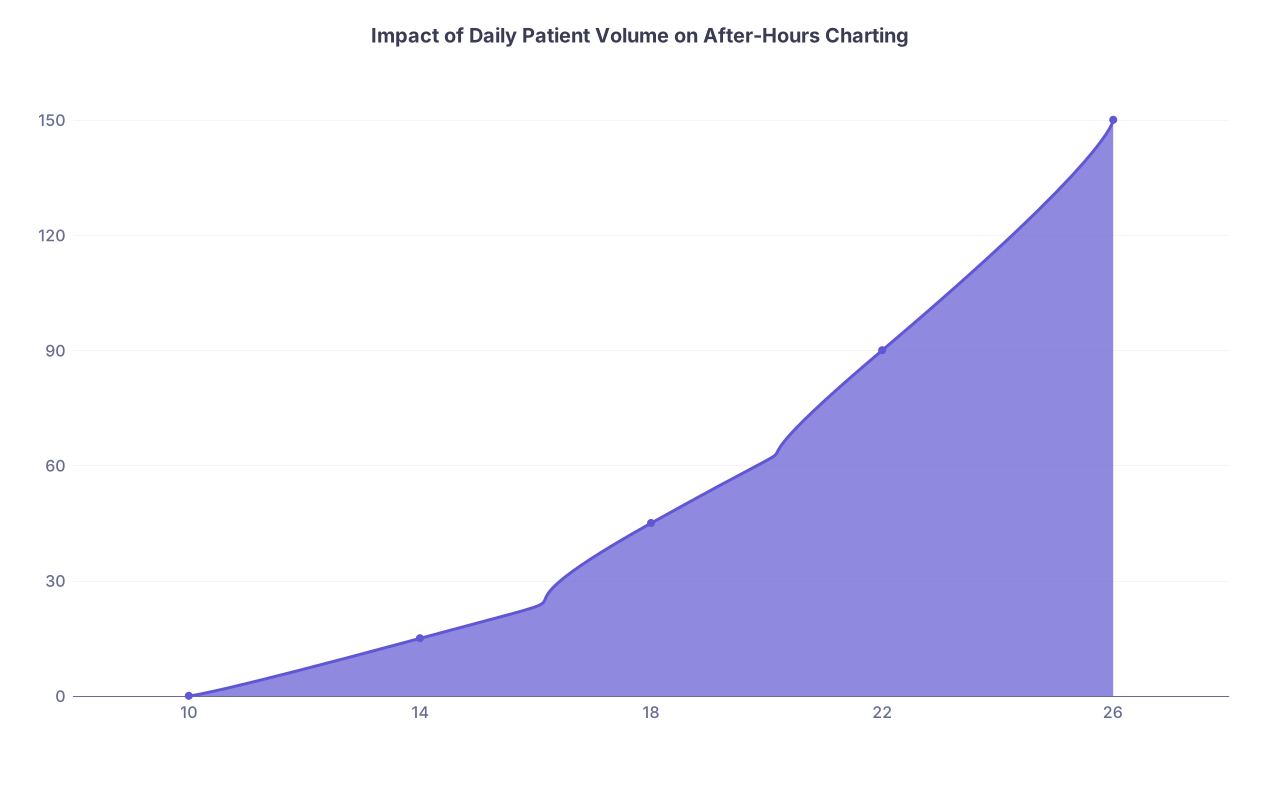
| Category | Value |
|---|---|
| 10 | 0 |
| 14 | 15 |
| 18 | 45 |
| 22 | 90 |
| 26 | 150 |
(Values = approximate minutes of after-hours charting per day for many physicians. Not scientific, but eerily close to what people report.)
Lifestyle-Friendly Job Negotiation: What to Push On
If you remember nothing else, remember this: patient volume is negotiable more often than you think, especially in non-ultra-competitive markets.
When you negotiate:
- Don’t just talk salary. Talk:
- Max patients/day
- Visit lengths (new vs follow-up)
- Protected admin time
- Scribe/MA support
- Panel size limits
You can literally say:
- “For me to be sustainable long-term, I need to cap at 16 patients per full day with at least 30-minute follow-ups and 60-minute new visits. I’m willing to accept [slightly lower base / different bonus structure] to protect that.”
Most reasonable groups would rather have a sane, stable doc at 80–90% of max productivity than another burnt-out, job-hunting machine.

Quick Reality Check for “Most Lifestyle-Friendly” Outpatient Jobs
Here’s where this all lands for the kind of outpatient roles people label as “lifestyle” (think outpatient psych, allergy, derm, some subspecialty clinics, chill primary care setups):
Reasonable lifestyle volume:
- Cognitive-heavy (psych, neuro, rheum, complex IM): ~10–16/day
- Mixed/procedural (allergy, derm, simple IM/FP panels): ~14–20/day
Big warning signs:
22/day routinely in a cognitive-heavy field
- 15-minute slots as the default for complex patients
- No mention of protected admin time or inbox support
You can absolutely have an outpatient job, make a solid income, and still have a real life. But that does not happen by accident. It happens because you draw a line on how many people you’re going to try to meaningfully care for in a single workday.
Key takeaways:
- For a truly lifestyle-focused outpatient job, a sane target is usually 14–18 patients per full day, adjusted for cognitive load and specialty.
- Support staff, visit length, and admin/inbox expectations matter as much as the raw number; 18/day with great support can feel better than 14/day with none.
- Don’t accept vague answers—ask explicitly about patient volume, visit lengths, and after-hours work, and negotiate volume just as hard as you negotiate salary.