
What happens if you match into a so‑called “lifestyle” specialty…and still hate your day‑to‑day life?
That’s the real question behind this: are you better off chasing a lifestyle specialty (derm, ophtho, psych, etc.), or picking a specialty you like and then designing a lifestyle‑friendly practice setting around it?
Here’s the answer:
If your goal is a sustainable, low‑burnout career, practice setting and job design matter more than specialty label. But your choice of specialty sets the ceiling and the floor for how good (or how bad) your lifestyle can realistically be.
So you cannot ignore either. You need both: a reasonably lifestyle‑compatible specialty and a smart practice setting.
Let’s break it down like an adult, not like a Reddit thread.
The Core Reality: Lifestyle = (Specialty) × (Setting)
Stop thinking “derm vs surgery.”
Start thinking:
Lifestyle = specialty choice × practice environment × your boundaries.
I’ve seen:
- A derm attending doing 10–11 hour clinic days, 5 days a week, running her own practice, constantly buried in admin. Technically “lifestyle” specialty. Lifestyle: terrible.
- A community hospitalist doing 7‑on/7‑off, no clinic, no procedures, predictable nights, great pay, living in a cheap city. Specialty not traditionally called “lifestyle.” Lifestyle: excellent.
- An EM doc at a low‑volume suburban shop doing 12–14 shifts/month, no nights after seniority, tons of time off.
- A cardiologist in private practice with 1:6 call, but calls are mostly advice, reasonable inpatients, and he’s out by 4:30 most days.
Same theme: setting is doing most of the heavy lifting.
But. There are hard limits:
- You will never make trauma surgery into a 9–4, Monday–Friday job with no call.
- You will never make outpatient derm into a high‑acuity, procedure‑heavy, adrenaline specialty.
So you’re picking a sandbox (specialty)…and then deciding how you want to build within it (practice setting).
What “Lifestyle Specialty” Actually Buys You
People throw around “lifestyle specialty” like it’s a cheat code. It is not. It buys you certain structural advantages; it does not guarantee happiness.
Most lifestyle‑friendly specialties share a few things:
- Predictable hours (often clinic‑based or shift‑based)
- Limited or no in‑house overnight call once you’re an attending
- More control over volume and scheduling
- Lower constant life‑or‑death stress
Commonly cited examples:
- Dermatology
- Ophthalmology
- Radiology (especially outpatient / telerad)
- Pathology
- PM&R
- Outpatient‑focused psychiatry
- Allergy/Immunology
That’s the theory. Here’s what it really gives you.
Default schedule is more humane.
A dermatologist doesn’t usually have OR cases going until 8 pm, and your phone isn’t ringing at 2 am for a STEMI.
Translation: even if you’re bad at boundary‑setting, your baseline life is more tolerable.You can ramp hours up or down.
Want 3 days/week derm clinic? That exists. Want 0.7 FTE outpatient psych with telehealth? Very doable.
Try doing that in neurosurgery without blowing up your group’s call model.Less acute chaos.
The emotional load is often more chronic‑care and elective, not constant emergencies.
That’s a major burnout buffer.
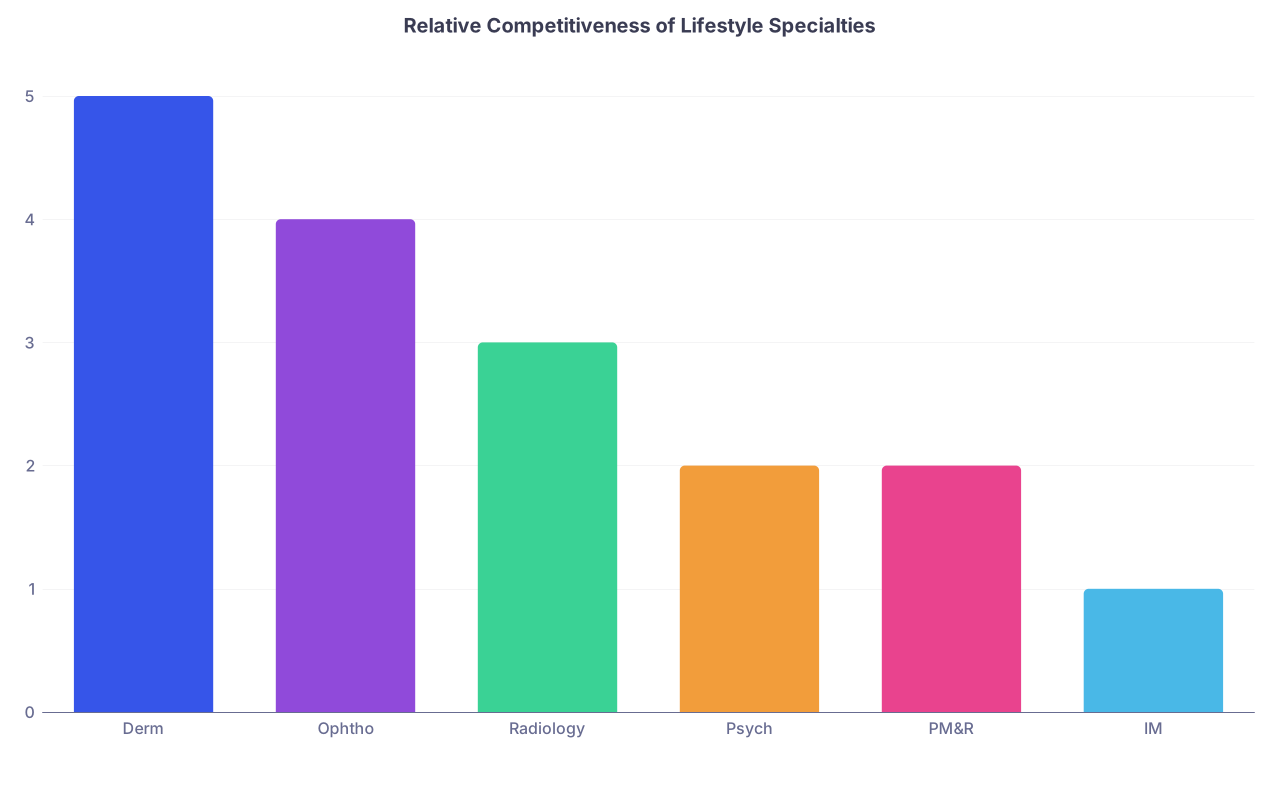
But you pay for this in training difficulty and competition.
| Category | Value |
|---|---|
| Derm | 5 |
| Ophtho | 4 |
| Radiology | 3 |
| Psych | 2 |
| PM&R | 2 |
| IM | 1 |
(Scale 1–5: 5 = very competitive; this is directional, not exact.)
If you’re going to chase a lifestyle specialty, you need to be brutally honest:
Do you actually like the work, or are you just chasing controllable hours?
Because here’s where people screw up:
- They tolerate a specialty they find boring because “it’s lifestyle.”
- They ignore the content of the work (clinical questions, patient type, pace) and focus only on schedule and pay.
- Ten years later, they’re in a “perfect lifestyle” job, completely disengaged, and wondering why they’re miserable.
What “Lifestyle Practice Setting” Actually Means
Now flip it. Say you’re drawn to something like internal medicine, anesthesia, EM, pediatrics, or even a surgical field—but you want your life back.
Your main lever is not the specialty label. It’s where and how you practice.
Lifestyle‑focused settings:
- Outpatient‑only or clinic‑heavy roles (primary care, subspecialty clinics, psych, PM&R, endocrine, rheum, GI clinic‑only)
- Shift‑based work with capped hours (EM, hospitalist, nocturnist, urgent care)
- Lower‑acuity hospitals or community settings instead of high‑volume tertiary centers
- Part‑time FTE or job‑share arrangements
- Telemedicine / remote work components
- Employed positions with robust support staff vs under‑resourced solo practice
Here’s a simple layout:
| Specialty | High-Burn Setting | Lifestyle-Focused Setting |
|---|---|---|
| Internal Med | Academic teaching hospital with heavy call | Community hospitalist 7-on/7-off |
| EM | Urban trauma center, variable nights | Suburban low-volume ED, fixed shifts |
| Psych | Inpatient unit + consults + nights | Outpatient clinic, telepsych, no call |
| Ortho | Level 1 trauma, q3 call | Community joint replacement practice |
| Anesthesia | Cardiac + transplants + in-house call | Outpatient surgery center only |
Same specialty. Wildly different day‑to‑day.
So if you’re already in residency or certain about the clinical content you enjoy, the smarter long game is usually:
Pick a specialty whose work you like → ruthlessly optimize your practice setting for lifestyle.
Rather than:
Pick a specialty you find “tolerable” but boring → pray lifestyle keeps you engaged.
So Which Matters More: Specialty or Setting?
If you force me to choose:
- For your floor (how bad can it get?) – Specialty matters more.
- For your ceiling (how good can it get?) – Setting matters more.
A reasonable way to think about it:
- Bad lifestyle specialty + great setting = tolerable, sometimes good, but fragile. One change in leadership or staffing, lifestyle collapses.
- Lifestyle specialty + bad setting = looks good on paper, feels like a grind. You start wondering if medicine was a mistake.
- Moderate specialty + thoughtful setting = usually the happiest people I’ve seen.
I’d rank them like this:
- Do you like the work itself? If no, stop. Wrong specialty.
- Can this specialty be practiced in at least one setting that gives you the lifestyle you want?
- Are you willing and able to chase that setting (geography, group type, compensation trade‑offs)?
If you can’t answer “yes” to #2, that specialty is a long‑term problem, no matter how enthusiastic you are now.
How to Actually Decide: A Simple Framework
Here’s the decision tree I walk students through.

| Step | Description |
|---|---|
| Step 1 | Start |
| Step 2 | Maximize exposure in core clerkships |
| Step 3 | Confirm you like day to day work |
| Step 4 | Research lifestyle practice settings |
| Step 5 | Target that lifestyle specialty |
| Step 6 | Identify less competitive but similar fields |
| Step 7 | Reconsider specialty |
| Step 8 | Target lifestyle-focused practice models |
| Step 9 | Know what clinical work you enjoy? |
| Step 10 | Is it a lifestyle specialty already? |
| Step 11 | Okay with competitiveness and training? |
| Step 12 | Exists in lifestyle settings? |
Now let’s make it concrete.
Step 1: Define your non‑negotiables
Not vague “good lifestyle.” Actual numbers and rules. Things like:
- Max total hours/week you’re willing to work long‑term
- Nights and weekends: acceptable frequency? Never? Occasional?
- Geographic constraints (family, spouse job, immigration)
- Income floor you need to be content
- Burnout triggers for you (constant codes, emotionally heavy cases, high patient volume)
Write this down. If you can’t state it, you’ll end up rationalizing anything.
Step 2: Match specialties to what you actually like doing
If you hate procedures and acute care, stop googling “lifestyle surgical specialties.” You’re lying to yourself.
Rough guidelines:
- Love clinic, longitudinal relationships, lots of talking:
→ Primary care, psych, rheum, endocrine, allergy, PM&R, peds subspecialties. - Love procedures but not necessarily knife‑to‑skin:
→ Cards, GI, pulm/crit (with lifestyle caveats), IR, some EM. - Love OR and high acuity:
→ Surgery fields, ob/gyn, anesthesia.
Then ask: can this be practiced in lifestyle‑oriented settings?
- Ob/gyn: tough, but some purely gyne clinics, urogyne, or hospitalist models help.
- Cards: clinic‑heavy non‑interventional or imaging‑focused roles can be okay.
- Anesthesia: ambulatory surgery centers, office‑based, pain.
- IM: hospitalist, outpatient only, concierge, part‑time, telemed, etc.
If answer is “no realistic lifestyle setting exists,” be cautious.
Specialty First vs Setting First: When Each Strategy Wins
Here’s when I’d prioritize one over the other.
Pick a Lifestyle Specialty First if:
- You genuinely love that field’s content (e.g., you’d read derm atlases for fun)
- You are competitive or can realistically become so (scores, research, letters)
- You’re okay playing the long game in training for payoff later
- You’re risk‑averse about lifestyle and want a high baseline of control
Example: You adore skin, procedures, clinic, and non‑emergent work. You’re willing to grind for derm. Smart. Go all in.
Pick a Lifestyle-Focused Setting First if:
- You’re strongly drawn to a non‑labeled “lifestyle” specialty (IM, EM, peds, anesthesia, general surgery, etc.)
- You have or can develop flexibility in location and job type
- You value meaning and interest in your work as much as schedule
- You’re realistic that you’ll need to say “no” to certain hospital systems or prestigious jobs to protect your life
Example: You love acute care and the ED environment, but not chaos 24/7. You target low‑volume community EM or urgent care, avoid level 1 trauma centers, accept slightly lower pay for fewer nights.
Common Traps You Should Avoid
I’ve watched a lot of people fall into these.
Prestige trap – Choosing an academic, high‑acuity job in a fancy system “for a few years” and never leaving. Lifestyle slowly erodes, golden handcuffs tighten.
Money trap – Saying yes to every shift, call, or side gig because the pay is seductive. Suddenly your “lifestyle” job looks like a malignant surgical rotation.
Geography trap – Deciding you “must” live in one saturated coastal city. You then give up 80% of lifestyle‑friendly jobs in your field and convince yourself “this specialty is toxic.”
Delayed boundaries trap – Telling yourself you’ll set boundaries “once I make partner” or “once loans are lower.” You’re training your colleagues that you’re always available. Very hard to walk back.
If You’re Still in Med School or Early Residency
Here’s the blunt version of what I’d do in your position.
- MS3/MS4: Prioritize discovering what kind of patients and problems interest you. Not what has the nicest coffee in the break room.
- Early residency: Pay attention to attendings who are actually happy. Ask detailed questions about their schedule, call, FTE, and why they chose that exact job.
- Anytime: Collect concrete data, not vibes.
| Category | Value |
|---|---|
| Specialty choice | 70 |
| Practice setting | 90 |
| Geography | 60 |
| FTE (0.6-1.0) | 50 |
| Your boundaries | 40 |
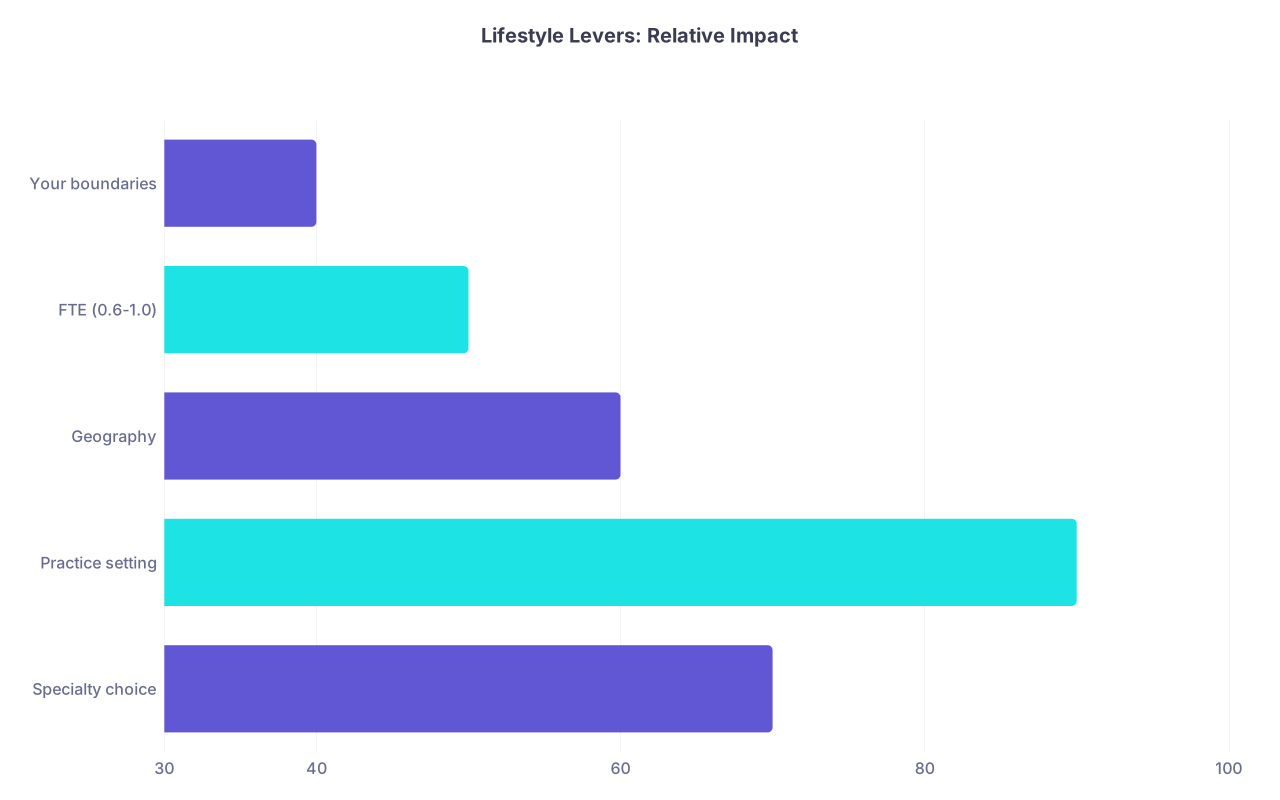
(Scale 0–100 influence. Again, directional, but you get the point: setting is huge.)
FAQs
1. If I care a lot about lifestyle, should I avoid all surgical specialties?
No, but you should be realistic. Most surgical fields will always involve:
- Early mornings
- OR days that run late
- Call that can be disruptive
However, there are more lifestyle‑friendly niches: outpatient ortho focusing on joints in a community setting, plastics with mostly elective cases, some subspecialty surgeons in non‑trauma centers. You won’t get derm‑level control, but you can avoid total chaos.
2. Is emergency medicine still considered a lifestyle specialty?
Not in the simple “good hours, low stress” sense. EM is shift‑based and you can have significant time off, which is attractive. But nights, weekends, high acuity, boarding, and system pressures are real. EM can be very lifestyle‑friendly in the right shop (low‑volume, good staffing, reasonable schedule). In the wrong shop, it’s brutal.
3. Can I “fix” a bad lifestyle specialty later by changing practice settings?
To a degree. You can move from academic to community, from trauma to non‑trauma, add more clinic and less call. But some specialties will always carry heavy responsibility, emergencies, and long hours. You can optimize; you can’t completely rewrite the nature of a field like CT surgery or transplant.
4. How much should I care about competitiveness when chasing a lifestyle specialty?
A lot. If you’re sitting on mediocre scores, no research, and average clinical evaluations, building your whole identity around matching derm or ophtho is a dangerous bet. If you love the field, absolutely try—but also identify “Plan B” specialties with similar feel and better odds (e.g., PM&R, IM subspecialties, psych with specific practice plans).
5. Is it realistic to work 0.6–0.8 FTE as a physician for lifestyle?
Yes, in many specialties and settings—especially outpatient, hospitalist, psych, EM, urgent care, telemedicine, and some academic roles. You’ll trade income and sometimes prestige. But if lifestyle and longevity matter more, it’s a very rational choice. It’s easier in some markets and systems than others, so you may need geographic flexibility.
6. What if I enjoy high-acuity, intense work but still want good lifestyle?
Then you’re playing a “precision tuning” game. Options: pick a specialty with intensity but find non‑malignant settings—e.g., EM in a moderate‑volume community ED, ICU work with reasonable schedules, surgical subspecialty in a non‑trauma center. You likely won’t have 9–4 office hours, but you can avoid misery by carefully choosing your practice environment and group culture.
7. Bottom line: Should I prioritize a lifestyle specialty or a lifestyle setting?
Prioritize this order:
- a specialty whose work you actually like,
- that has at least one realistic lifestyle‑friendly practice model,
- then obsess over finding (or creating) that specific setting.
If two specialties tie for interest, lean toward the one with better baseline lifestyle. But do not pick a specialty you dislike just because someone on a forum said it’s “lifestyle.”
Key points to leave with:
- Specialty gives you the sandbox; practice setting and boundaries determine how livable that sandbox is.
- The happiest physicians I’ve seen chose a specialty they genuinely liked, then ruthlessly optimized their practice setting for lifestyle—not the other way around.