
The myth that psychiatry is an easy lifestyle specialty is outdated—and also not entirely wrong.
Psychiatry is still one of the most lifestyle-friendly fields in medicine, but only if you pick the right practice setting and learn to say no. The demand and caseloads have exploded; the people who treat it like a 9–5 primary care job burn out fast. The ones who set boundaries and choose their jobs carefully? They’re doing just fine.
Let me break down what that actually looks like today.
The Core Question: Is Psychiatry Still a Lifestyle Specialty?
Short answer: Yes, psychiatry remains one of the most lifestyle-friendly specialties compared to surgery, EM, hospitalist medicine, OB/GYN, and most procedural subspecialties.
But there are catches:
- Outpatient private practice or well-structured group practice = very lifestyle friendly
- Inpatient units, safety-net/community mental health, and under‑resourced systems = heavy demand, less lifestyle
- Call can be light or brutal, depending completely on the job and region
- Documentation, access issues, and chronic crises can mentally drain you if you do not set limits
So psychiatry is not “chill by default.” It is “high potential lifestyle” if you’re intentional.
To make this concrete, here’s how it stacks up.
| Specialty | Typical Week | Nights/Call Burden | Schedule Control | Burnout Risk* |
|---|---|---|---|---|
| Psychiatry | 32–45 hrs | Widely variable | High in outpatient | Moderate |
| Dermatology | 32–40 hrs | Minimal | Very high | Low |
| PM&R | 40–50 hrs | Moderate | Medium | Moderate |
| Radiology | 40–55 hrs | Shifts, some nights | Medium | Moderate–High |
| Anesthesiology | 45–60 hrs | Early starts, call | Low–Medium | High |
*Burnout risk is relative, based on surveys and what physicians report anecdotally.
What Changed: Demand, Caseloads, and Expectations
Psychiatry is getting slammed by three forces at once:
- Massive increase in mental health awareness and diagnoses
- Not enough psychiatrists (especially child, geriatric, addiction)
- Systems trying to squeeze more productivity from fewer clinicians
You feel that as:
- Waitlists of 3–6 months for new patients
- Pressure to shorten visits or increase daily volume
- More severe presentations in both outpatient and inpatient settings
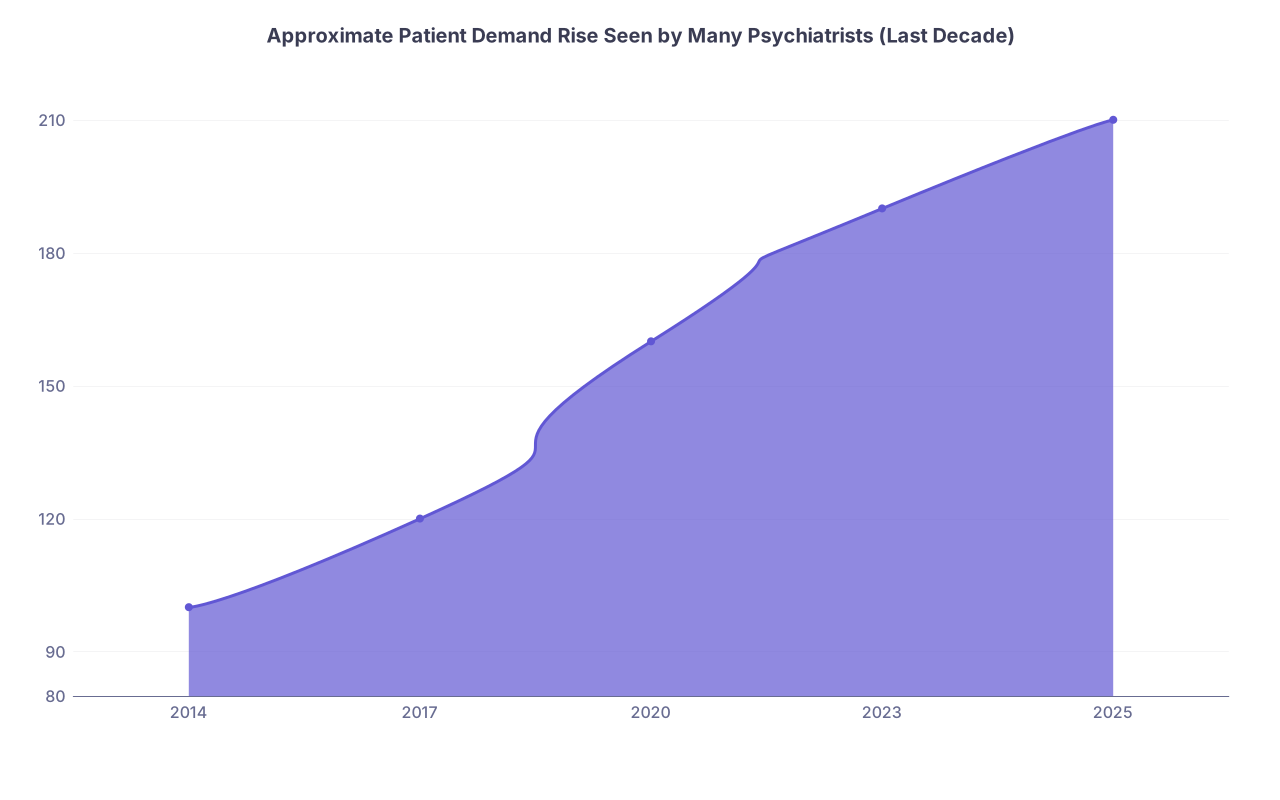
| Category | Value |
|---|---|
| 2014 | 100 |
| 2017 | 120 |
| 2020 | 160 |
| 2023 | 190 |
| 2025 | 210 |
That doesn’t automatically mean terrible lifestyle. It does mean:
- You will never be bored
- You can always find work
- If you are not careful, you can easily be overbooked, overextended, and emotionally exhausted
So the “lifestyle” label now depends less on the specialty itself and more on your job selection and boundaries than it did 15–20 years ago.
Residency Reality: Is Psych Residency Lifestyle-Friendly?
Psychiatry residency is still, on average, more humane than surgery, internal medicine, OB, or EM. But it is not cushy.
What you’ll likely see in a solid psych residency:
- PGY1: Rotations on medicine, neurology, inpatient psych, possibly ED psych consults
- Hours: often 55–70/week on medicine, 50–60 on inpatient psych
- Call: nights + weekends, but usually not as brutal as surgical fields
- PGY2: More inpatient psych, consult-liaison, maybe addiction
- Hours: 50–60 typical, some nights/weekends
- PGY3: Mostly outpatient
- Hours: often 40–55/week; call drops significantly in many programs
- PGY4: Electives, leadership, subspecialty clinics
- Hours: commonly 35–50/week, lots of control over your schedule
The big “but”: Psych residencies in safety-net hospitals or under‑resourced systems can feel like social work + medicine + crisis management 24/7. High acuity, suicidal patients, substance use, homeless populations, limited follow-up options. Very meaningful. Not very “light.”

| Step | Description |
|---|---|
| Step 1 | PGY1 - Heavy inpatient and medicine |
| Step 2 | PGY2 - Inpatient and consults |
| Step 3 | PGY3 - Mostly outpatient clinics |
| Step 4 | PGY4 - Electives and specialization |
| Step 5 | Call and nights |
So is psych residency “lifestyle”? Compared to surgery, yes. Compared to derm or radiology, less so. You’ll have more emotional load and sometimes messy schedules early on.
But after residency is where psychiatry really opens up.
Attending Life: How Lifestyle-Friendly Depends on Setting
Here’s where people get it wrong. They say “Psych is lifestyle” without asking where you’re working and how you’re being paid.
Let’s break it down by job type.
1. Outpatient Private Practice (Solo or Small Group)
This is the classic “lifestyle psychiatry” everyone dreams about—and it can still be real.
What it often looks like:
- 3–4 clinic days/week seeing 8–14 patients/day
- Mix of med management (20–30 min) and longer therapy/combined visits
- Start at 9–10 am, end by 4–5 pm
- No weekends, minimal or no call if you structure it that way
- Option for telepsychiatry days from home
Income can be strong: plenty of psychiatrists in private practice clear $300k–$500k+ depending on location, payor mix (cash vs insurance), and volume.
Lifestyle pros:
- Maximum control
- You set your own hours, vacation, and patient volume
- You can niche down (ADHD, mood disorders, perinatal, etc.)
Lifestyle cons:
- Business overhead, credentialing, billing headaches
- If you do insurance-based practice, documentation and prior auths can be annoying
- You’re always “on the hook” for your own panel unless you structure coverage or have group support
If your goal is lifestyle above all, this is the most reliable path.
2. Employed Outpatient (Hospital or Large System)
This can be excellent or terrible. Depends entirely on the culture and productivity expectations.
Typical arrangement:
- 8–5, Monday–Friday
- 45-minute new evaluations, 20-minute follow-ups (sometimes less)
- Productivity measured in RVUs or visit counts
- Protected time for notes? Sometimes. Sometimes not.
Here’s the hidden variable: systems under pressure will try to push you to 16–20+ patients/day with short slots. That’s where lifestyle dies. You’re charting at home, emotionally drained, and you start resenting clinical days.
On the other hand, I’ve seen psychiatrists in well-run systems doing:
- 10–12 patients/day
- Plenty of admin time
- Hybrid telehealth
- Light backup call only
Those jobs look like: home by 4:30, no charts at night, good benefits, stable income.
You have to ask very direct questions when interviewing:
- “How many patients per day do your psychiatrists actually see?”
- “What are the standard time slots for new and follow-up visits?”
- “How many hours a week do your psychiatrists spend charting outside clinic?”
Vague answers = red flag.
3. Inpatient Psychiatry
Still better lifestyle than most inpatient specialties, but the pace and emotional load are heavier.
Common features:
- Rounding on 10–18 patients/day
- Multidisciplinary team (nursing, social work, therapists)
- Admissions can spike your day unpredictably
- Call: often q4–q8 nights or weekends depending on staffing
Lifestyle reality:
- Hours may be 8–5 on paper, but documentation and family calls creep after 5
- Severity is high: suicidality, psychosis, aggression, substance withdrawal
- Emotional exhaustion risk is real if you do this long-term without support
Some psychiatrists use inpatient early in their attending career to build skills and then transition to outpatient or consult-liaison with more predictable schedules.
4. Telepsychiatry
This is where lifestyle psychiatry is quietly thriving.
Common setup:
- Work from home (or anywhere with secure connection)
- 4–8 hours of video visits per day
- Mix of part-time contracts, employed positions, or 1099 work
- Flexible hours (nights/weekends optional but often available for premium pay)
This can be incredibly lifestyle friendly if you:
- Guard your daily volume (e.g., cap 10–14 visits/day)
- Avoid the “tele-assembly-line” jobs where they want 20–25 short visits/day
- Negotiate control over scheduling and time slots
Demand for telepsych is still high, especially for child/adolescent and adult outpatient.
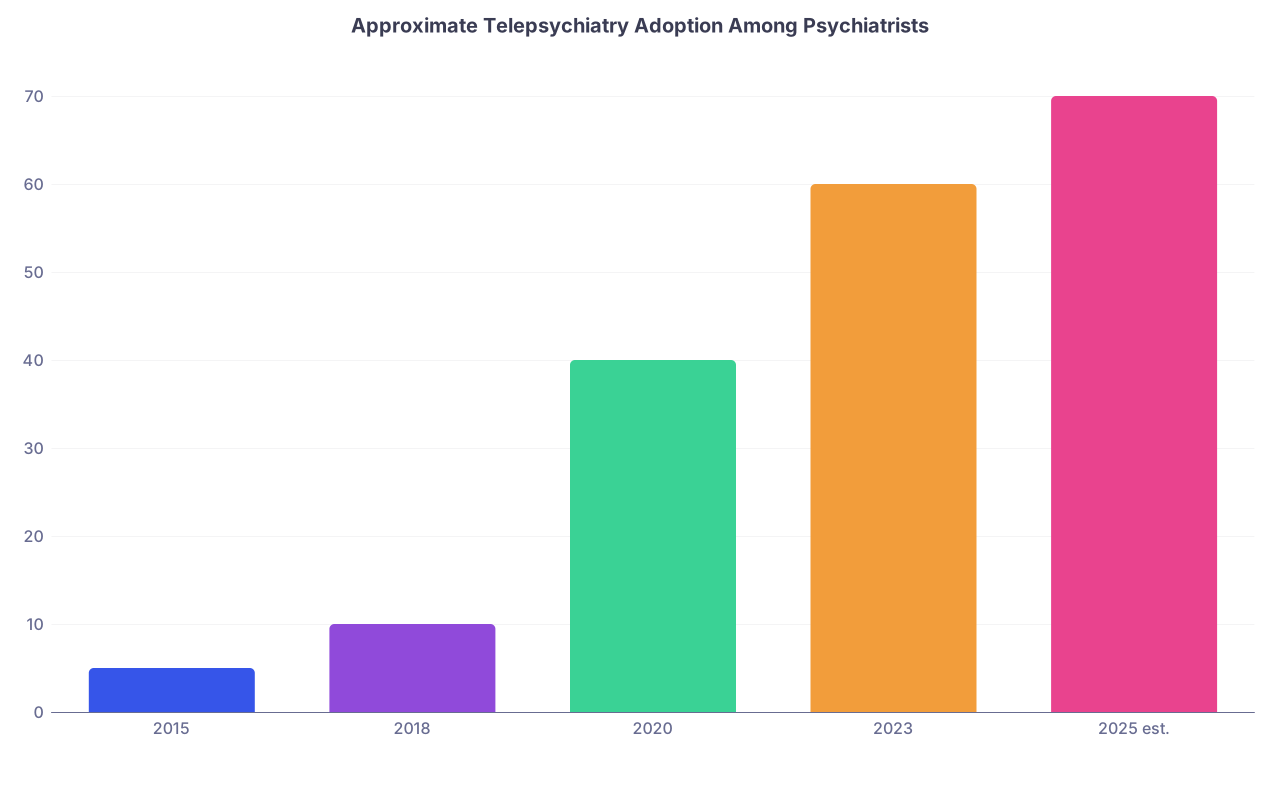
| Category | Value |
|---|---|
| 2015 | 5 |
| 2018 | 10 |
| 2020 | 40 |
| 2023 | 60 |
| 2025 est. | 70 |
The Real Lifestyle Tradeoffs: Where Psych Feels Heavy
Psychiatry’s time demands can be manageable. The emotional demands are what break people.
Here’s where lifestyle gets threatened:
Caseload intensity
- High-risk patients (suicidal, violent, highly dysregulated) day after day
- Limited community resources: you discharge someone knowing they have no real support
- Chronic trauma, addiction, poverty—this wears people down
System constraints
- Short visit times mandated by admin
- Long waitlists and angry messaging from patients who feel abandoned
- Insurance denials for desperately needed treatments
Psychiatrists who say yes to everything
- Extra patients “squeezed in” daily
- Replying to patient messages at night
- Taking on every “difficult” case because “no one else will”
Lifestyle in psychiatry is less about working fewer hours and more about:
- Reasonable caseload size
- Reasonable visit length
- Boundaries on access (messages, refills, crisis calls)
- Having a team (therapists, social workers, case management) instead of being a one‑person mental health system

Where Psychiatry Still Shines as a Lifestyle Specialty
If you’re comparing psychiatry to other “lifestyle” fields like derm, radiology, PM&R, anesthesia, here’s how it stacks up from a lifestyle angle.
Major pluses:
- Very little overnight emergency work if you avoid ED and inpatient
- Procedures are minimal, so less physical strain and fewer early‑morning OR days
- High flexibility for part-time work, telehealth, and portfolio careers (clinics + teaching + consulting)
- Easy to scale up or down your workload over your career without retraining
You also have better geographic flexibility than many specialties. Every region in the US needs psychiatrists. That gives you leverage to negotiate lifestyle.
The key is to be honest about your priorities:
- If you want maximum lifestyle + high income: outpatient, hybrid private practice/telepsych, controlled volume
- If you want mission‑driven work, complex pathology, and can tolerate more intensity: inpatient, academic, safety-net—still okay lifestyle relative to surgery or EM, but not “easy”

Decision Framework: Is Psychiatry the Right Lifestyle Fit For You?
Ask yourself some blunt questions:
- Can you handle sitting and listening to intense stories for hours every day without tuning out or internalizing everything?
- Would you rather deal with brain and behavior problems than abdominal pain, sepsis, or heart failure?
- Do you value schedule control more than procedural variety?
- Are you willing to set boundaries with admins, colleagues, and patients to protect your time and emotional energy?
If you want:
- Predictable weekdays
- Option to work from home
- Ability to reduce FTE later in life
- Solid income without 60–80 hour weeks
Then yes—psychiatry is still one of the best lifestyle deals in medicine. Just don’t expect it to be mindless or emotionally light. It’s not.

| Step | Description |
|---|---|
| Step 1 | Finish Psychiatry Residency |
| Step 2 | Consider inpatient or academic roles |
| Step 3 | Outpatient employed clinic |
| Step 4 | Private practice or group practice |
| Step 5 | Negotiate volume and schedule |
| Step 6 | Add telepsychiatry or niche focus if desired |
| Step 7 | Priority is lifestyle? |
| Step 8 | Prefer outpatient work? |
FAQs
1. Is psychiatry still considered a “lifestyle specialty” for residency applicants?
Yes, among residency programs, psychiatry is still viewed as one of the more lifestyle-friendly options. Call is usually lighter than surgery, OB/GYN, and internal medicine, especially by PGY3 and PGY4 when you are mostly outpatient. But you will work real hours, see high-acuity patients, and deal with significant emotional load. It is better than the stereotype of malignant residencies, not a four-year vacation.
2. How many hours do most psychiatrists actually work per week?
Most full-time psychiatrists fall in the 40–50 hours/week range, including charting and admin. Outpatient private practice and telepsychiatry can sit closer to 32–40 clinical hours with the rest flexible. Inpatient or high-volume clinics can creep into 50+ if you do not protect your time. Compared to fields where 60–70 hours is “normal,” psychiatry is clearly lighter, but not uniformly 9–3 short days.
3. Is burnout lower in psychiatry compared to other specialties?
Burnout rates are moderate. Lower than EM, OB/GYN, and primary care in many surveys, but not as low as dermatology or some procedural subspecialties. The main burnout drivers are emotional exhaustion, system constraints, and feeling responsible for patient crises 24/7. Psychiatrists who choose outpatient/telepsych, maintain reasonable caseloads, and work in supportive environments tend to report better work–life balance.
4. Can I do psychiatry part-time and still have a viable career?
Yes, psychiatry is one of the most flexible specialties for part-time work. Many psychiatrists work 0.5–0.8 FTE, especially later in their careers or when balancing parenting or other interests. Telepsychiatry and private practice make part-time arrangements very feasible, and your skills remain in high demand even at reduced hours. Just remember benefits and loan payoff may be slower at lower FTE.
5. If I want both income and lifestyle, is psychiatry better than derm or radiology?
Dermatology still wins for pure lifestyle + income at the top end. Radiology can also offer high pay with good schedules, but often with shift work and nights. Psychiatry sits slightly below derm in income on average, but usually offers more geographic flexibility and more remote/telehealth options. If you care most about flexible scheduling, remote work potential, and long-term adjustability of your workload, psychiatry competes very well as a lifestyle specialty—even with today’s demand and caseloads.
Key takeaways:
Psychiatry is still lifestyle-friendly, but not by default—you earn that lifestyle by choosing the right setting and enforcing boundaries. Outpatient and telepsych roles deliver the best balance; inpatient and safety-net jobs are meaningful but heavier. Demand is high, which can hurt or help you: systems will try to overload you, but you’ll always have the leverage to walk away and design the career you actually want.