The belief that “lifestyle specialties kill your leadership and academic future” is wrong. Flat‑out.
If you are strategic, choosing a lifestyle field can help your long‑term leadership career because you’ll have the bandwidth to build the right kind of portfolio instead of just surviving call.
Let me walk through what actually happens on the ground.
1. The core question: does a lifestyle field cap your ceiling?
Short answer: No. But it changes the pathway and the type of leadership or academic role that’s realistic.
There are four main “future directions” people worry about:
- Department or health system leadership (chair, service chief, CMO)
- Academic promotion (assistant → associate → full professor)
- Research careers (PI, major trials, grants)
- National influence (guideline committees, societies, advocacy)
You can reach all four from most lifestyle‑friendly specialties:
- Dermatology
- Radiology (especially diagnostic)
- Anesthesiology (yes, it’s demanding, but relatively lifestyle‑friendly vs surgery)
- Pathology
- PM&R
- Ophthalmology
- Allergy/Immunology
- Some outpatient-heavy IM or pediatrics niches (endo, rheum, outpatient cards, adolescent, etc.)
Where people get burned is not the specialty choice. It’s how they use the extra time.
If you spend those 20 “saved” hours a week doomscrolling and complaining about admin, then yes, your opportunities will quietly evaporate. If you reinvest them intentionally, you end up 10 years out as the person people call when they need a new program lead.
2. What leadership really looks like in “lifestyle” fields
Let’s be concrete. Here are real roles I’ve seen colleagues in lifestyle specialties hold:
| Specialty | Sample Leadership Role |
|---|---|
| Dermatology | Residency Program Director |
| Radiology | Chair of Quality and Safety |
| Anesthesia | Chief of Perioperative Services |
| Pathology | Lab Medical Director |
| PM&R | Rehab Hospital Medical Director |
None of these people are unicorns. They just played the long game.
Key pattern: most leadership roles in lifestyle specialties are:
- Operational (service line director, lab director, clinic director)
- Educational (program director, clerkship director)
- Quality/safety or informatics focused
- Subspecialty‑specific (e.g., “Director of Interventional Radiology”)
Academic chairs and vice‑chairs absolutely exist in these fields. Derm chairs. Radiology chairs. Anesthesia chairs. They sit on hospital boards. They influence institutional strategy. They lead national societies.
The door is not closed. The door just looks different than it does for, say, a trauma surgeon.
3. Academic promotion and research: are you handicapped?
Here’s where there’s more nuance.
Promotion in a lifestyle field
Promotion criteria depend on your institution, but generally:
- Assistant Professor → Associate Professor → Full Professor
- Evaluated on some combination of:
- Publications
- Grants / funding
- Teaching and mentoring
- Institutional service and leadership
- Reputation (talks, invitations, national committees)
Lifestyle fields give you one huge advantage: time. You’re not post‑call on a q3 schedule while trying to write an IRB. You can actually think.
The tradeoff: some lifestyle fields are less research‑heavy structurally. Example:
- Derm: research exists (especially immunology, oncology, translational), but many private‑practice-oriented departments are clinically heavy with modest research infrastructure.
- Radiology: tons of imaging and AI research, but you have to deliberately join those groups.
- Pathology: research‑rich at academic centers; quieter at community settings.
If you want a classic R01‑funded, lab‑heavy career, being in a less research‑dense department can make it harder but not impossible. You just need to pick your environment very carefully.
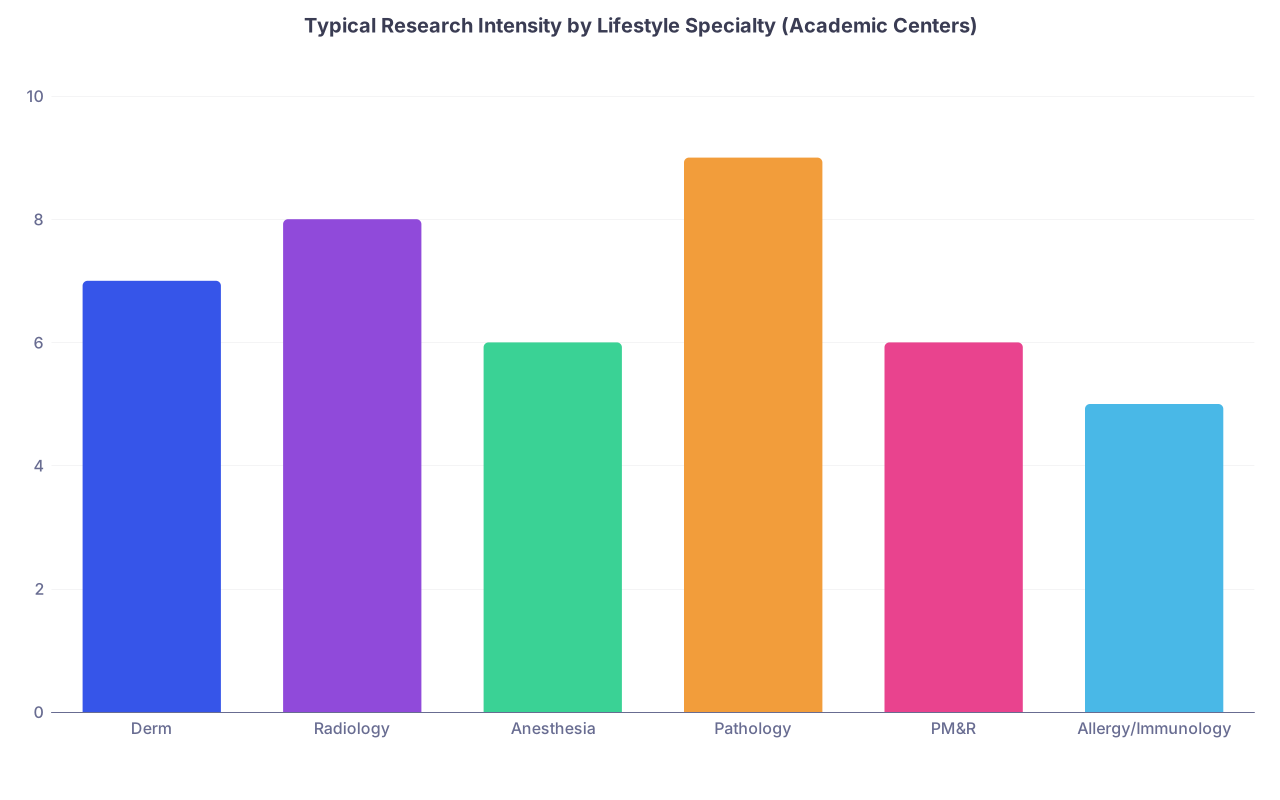
Research intensity by specialty (rough guide)
| Category | Value |
|---|---|
| Derm | 7 |
| Radiology | 8 |
| Anesthesia | 6 |
| Pathology | 9 |
| PM&R | 6 |
| Allergy/Immunology | 5 |
(Scale 1–10, based on typical academic departments. Yes, there are exceptions.)
If deep research is your goal, you’ll want:
- A large academic center with proven NIH or major funding in your area of interest
- A mentor with a track record of getting people promoted
- Protected time explicitly in your contract (20–50% depending on your goals)
You’re not limited because of “lifestyle.” You’re limited if you choose a lifestyle field and then sign with the most RVU‑driven, no‑protected‑time job you can find.
4. The real tradeoffs between lifestyle and leadership
Here’s what actually shifts when you pick a lifestyle field and aim for leadership/academia.
What you gain:
Time to build a non‑clinical skill stack
- Health policy, informatics, QI, education, administration, business degrees.
- This is gold. A radiologist with strong informatics chops becomes indispensable.
Longevity and energy
- You’re not physically wrecked at 45. You can actually say yes to new roles without burning out.
Flexibility of practice setting
- Easier to mix academic and private practice, or leave and come back.
- More outpatient or predictable schedules, so overnight leadership work (committees, writing, projects) is actually doable.
What you give up (or need to actively combat):
Perception of being “soft”
Yes, this bias exists. Surgical and acute‑care fields often see themselves as more “hardcore.”
The fix: be visibly excellent, reliable, and outcome‑oriented. Results kill stereotypes.Fewer baked‑in leadership tracks in some private practices
A big private derm group isn’t set up like an academic surgery department. “Chair” may not even be a thing.
The fix: aim at systems that actually have the roles you want (academic centers, integrated health systems).Less default research infrastructure
As above.
The fix: pick department + mentor first, city second, salary third.
5. Lifestyle vs non‑lifestyle: career trajectory realities
Let’s compare two fictional people with similar ambition.
- Dr. A: General Surgery → Surgical Oncology at an academic center
- Dr. B: Dermatology at an academic center
By mid‑career:
Dr. A may have:
- Heavy OR blocks
- 1–2 major research projects, maybe an R01 if strong
- Serious institution clout (surgeons often drive OR/hospital finances)
- Less schedule control, more emotional toll
Dr. B may have:
- High‑volume clinics with relatively predictable hours
- Niche expertise (psoriasis, derm onc, complex medical derm)
- Time to chair committees, build clinics, run trials in their lane
- More consistent lifestyle, steady progression to leadership
Who’s “more limited”? Neither. They’re playing different games. Dr. A may have more obvious “hero” status; Dr. B may quietly accumulate leadership titles and committees. At 55, Dr. B might be department chair while Dr. A is burned out and cuts back.
The ceiling is not inherently higher in non‑lifestyle fields. The burnout rate is.
6. How to deliberately keep doors open in a lifestyle field
Here’s what actually matters if you want leadership/academic options from a lifestyle specialty.
1. Choose your residency and first job like a strategist
In residency:
- Go to a place with visible leaders in your interest area:
- Education? Look for famous program directors, MedEd degrees, simulation centers.
- QI/Patient safety? Look for robust QI infrastructure and projects.
- Research? Look at NIH funding, publications, and ongoing trials.
First job:
- Prioritize:
- Title and track (tenure/clinician‑educator/clinical)
- Protected time concretely written into contract
- Mentorship structure
- Department culture around promotion (do they actually promote people?)
Do not just chase the highest salary in a pure RVU factory if you care about leadership or academia. That’s how you box yourself in.
2. Build a recognizable niche
Generalists rarely become national leaders now. You need a “thing”:
- Radiology: lung cancer screening, breast imaging, AI tools, MSK sports imaging
- Derm: complex psoriasis management, derm‑rheum overlap, skin of color, dermatopathology
- Anesthesia: perioperative medicine, regional anesthesia, cardiac anesthesia, ICU‑anesthesia bridge
- PM&R: spinal cord injury, sports, pain, TBI, neurorehab, amputee medicine
Once you have a niche, you:
- Speak at local/regional meetings
- Publish case series, reviews, or QI work
- Join relevant society committees
- Create or direct a clinic/program around that niche
That’s how academic CVs take shape, regardless of specialty.
3. Stack “translatable” leadership skills
Lifestyle fields give you the space for this. Use it.
Examples that actually move the needle:
- Quality and safety (LEAN training, QI fellowships, hospital QI projects)
- Clinical informatics (EMR optimization, imaging workflows, analytics)
- Medical education (fellowships, masters in education, curriculum design)
- Health administration (MBA, MHA, leading service lines, committee chair roles)
- Health policy or advocacy (society leadership, state or national committees)
These skills transfer across systems, roles, and even specialties.
7. Specific pitfalls that will limit you
The specialty is not the main limiter. These behaviors are.
Treating “lifestyle” as “coasting”
If your colleagues see you as the 8–4, do‑the‑minimum person, they will not put your name up for leadership. Ever.Hiding from committees and projects
Yes, meetings can be dumb. But early on, you need exposure. Pick selectively:- Avoid: endless low‑yield committees with no decision power.
- Target: curriculum committees, QI steering, hiring committees, strategic planning.
Not publishing anything, ever
In academia, pure clinicians can still become leaders, but your options narrow.
Case reports. Reviews. Education scholarship. QI publications. Something.Underestimating politics and visibility
Being excellent clinically is the floor, not the ceiling. You must be visible:- Present grand rounds
- Give local talks
- Mentor students and residents
- Show up reliably to key events

| Step | Description |
|---|---|
| Step 1 | Choose Lifestyle Specialty |
| Step 2 | Pick Academic Residency |
| Step 3 | Find Mentor and Niche |
| Step 4 | Take On Projects and Publish |
| Step 5 | Secure First Academic Job With Protected Time |
| Step 6 | Lead Programs or Committees |
| Step 7 | Promotion and Higher Leadership Roles |
8. Does a lifestyle field ever truly limit you?
There are a few specific paths where lifestyle fields can be a tougher fit:
High‑stakes operative leadership
If you dream of being “Chief of Surgery” or President of the Trauma Society, you obviously need a procedural, non‑lifestyle field.Ultra‑acute care system leadership identities
Some systems gravitate toward ED, ICU, or surgery leaders for certain roles that feel “more operational.” But even there, CMOs, CQOs, and CMIOs come from all over—radiology, anesthesia, path, IM subspecialties.Surgical device or OR‑focused industry roles
Again, you need to be in that world to lead in that world. A pathologist isn’t going to be the face of a new robotic surgical system.
Notice the pattern: these are content‑specific limitations, not “you chose dermatology so no leadership for you.”
If you want to lead in skin cancer, imaging AI, perioperative systems, lab quality, rehab delivery, or medical education? Lifestyle fields are excellent launching pads.
FAQs
1. Will choosing a lifestyle specialty hurt my chances of becoming a department chair?
Not inherently. There are derm, radiology, anesthesia, pathology, PM&R, and ophtho chairs at major institutions. What matters more is:
- Training at a strong academic center
- Building a defensible niche (clinical, research, education, or QI)
- Accumulating real leadership roles (programs, divisions, committees)
- Staying in academia long enough to move up the ladder
You will be shut out only if you choose settings with no academic structure (e.g., pure private practice with no teaching) and stay there.
2. Is it harder to get research funding in a lifestyle field?
It can be, depending on your department. Funding follows:
- Institutional research culture and infrastructure
- Your mentors’ track record
- The quality of your ideas and execution
Pathology and radiology, for example, can be very research‑heavy in academic centers (AI, molecular path, imaging trials). Derm can be strong in immunology and oncology. PM&R can thrive in outcomes and disability research. But if you land in a clinically heavy, RVU‑obsessed environment with no support, yes—funding will be harder.
3. If I pick a lifestyle specialty now, can I still pivot into major leadership later?
Yes, but you must plan for it:
- Start picking up QI, education, or admin projects in residency
- Get comfortable speaking, writing, and presenting
- Aim for an early role like assistant program director, clinic director, or QI lead
- Consider extra training (MedEd fellowship, informatics, MBA/MHA)
People become CMOs, chairs, and system leaders from lifestyle fields all the time. The pivot is through leadership skills, not heroic overnight call stories.
4. Does a lifestyle field hurt my chances in academic competitiveness (getting hired by a big‑name institution)?
No. In many lifestyle specialties, competition is actually highest at lifestyle‑friendly, big‑name places. Think: major derm or radiology departments at top academic centers. What matters is your:
- Residency pedigree
- Letters and mentorship
- Scholarly output (even modest but focused)
- Fit with a department’s specific needs
If anything, the lifestyle specialties are more bottlenecked at the residency level, not at the first job level.
5. What’s one concrete thing I should do in residency if I want leadership/academic options in a lifestyle field?
Today, identify one attending in your specialty who clearly has leadership or academic clout—program director, division chief, or respected researcher. Email them and ask for a 20–30 minute meeting to discuss their career path and ask how they’d structure your next 12–24 months.
Then do what they suggest.
Open your calendar right now and block 30 minutes this week to send that email and sketch a rough 2‑year plan that doesn’t just protect your lifestyle, but builds your future options.