
Last year, a PGY-2 in dermatology sat in my office at 8:45 p.m., still in clinic clothes, eyes shot. “Everyone keeps telling me I’m in a chill field,” she said. “Then why am I crying in my car twice a week?”
She was not weak. She was not dramatic. She was just the latest in a long line of residents who discovered the dirty little secret of “lifestyle specialties”: the marketing brochure does not match the internship.
The Lie You’re Being Sold About “Chill” Specialties
Here’s the core problem: students see the attending lifestyle and assume that’s what the residency looks like. It’s not. Not even close.
You see the derm attending who comes in at 9, leaves at 4, does Botox on the side, never takes in-house call, and spends weekends at their lake house. You don’t see the derm resident who:
- Is double-booked in clinic,
- Doing scut that should be done by MAs,
- Getting pimped by attendings who think derm is God’s gift to medicine,
- And still logging on at home to finish charts.
Same in PM&R, ophtho, anesthesia, radiology, pathology. On paper, “lifestyle.” In training? Depends heavily on program culture, call structure, and how much the service is used as a dumping ground for everyone else’s problems.
Let me walk you through how burnout actually shows up in these “chill” specialties from the inside.
The Hidden Burnout Traps in Lifestyle Specialties
Burnout is not just “too many hours.” That’s where most MS3s get it wrong.
There are five big drivers I see over and over in supposedly cush residencies:
- Chaos and lack of control over your day
- Cognitive overload with no buffer
- Toxic or dismissive culture (“You have it easy, stop complaining”)
- Mismatch between expectations and reality
- Invisible work that never stops (charts, consults, messages)
Lifestyle fields often hit 3–5 hard, even if your duty hours are technically better.
Let’s get specific.
Dermatology: “Easy Hours” With Zero Margin for Error
Derm has a reputation: high pay, few emergencies, clinic-based, lots of control. True — for attendings. For residents, the story is different at many programs.
Here’s what you do not see on the brochure:
- Clinic schedules stacked with 20–30 patients per half-day.
- Complex medical derm plus cosmetics plus inpatient consults on top.
- Attendings who want perfect biopsies, perfect notes, and strong academic output.
At one well-known academic derm program, residents told me they block “lunch” on the schedule, but everyone knows it’s just overflow charting time. You get 10–15 minutes per new patient. If the resident falls behind, staff quietly expects them to stay until everything is finished — which often means 6:30–7:30 p.m. Even if clinic “ends” at 4:30.
There’s also this extra layer: derm residents are often extremely high-achieving, perfectionistic people. They came from being top of their class and scoring 260+ on Step 1. Then they walk into situations where:
- Every rash is a diagnostic puzzle.
- Patients bring 15-page printouts from Reddit.
- Attendings expect near-instant pattern recognition.
- Every missed melanoma is a potential lawsuit.
So you get cognitive overload plus massively high stakes. Not many codes, sure. But an endless stream of judgment-heavy decisions with minimal slack.
The burnout pattern in derm is less “I’m physically destroyed” and more “persistent anxiety, perfectionism, imposter syndrome, and charting creep into evenings and weekends.” And that’s with “good lifestyle.”
PM&R: Best-Kept Secret… Unless Your Program Is a Dumping Ground
PM&R gets sold as: happy patients, rehab team camaraderie, clinic-based practice, little overnight work. Parts of that are true. But here’s what I see from the program side.
At some academic centers, PM&R is the “catch-all” for:
- Medically complicated patients no one else wants to manage long-term
- Discharge-planning nightmares
- Complex social cases that live in the hospital for weeks
You can end up spending your days:
- Fighting with case management about placement
- Fielding pages about bowel regimens and PEG tubes all day
- Managing trachs, chronic infections, and pain in patients who can’t advocate well for themselves
It is emotionally heavy. Slow-moving. Often thankless.
And then there’s off-service months. Most PM&R programs still have a big chunk of IM, neurology, ICU, or ED time. That means for 4–12 months of residency you are living someone else’s lifestyle — often worse than your IM colleagues because you feel behind in your specialty and you’re the outsider.
One PM&R resident put it bluntly: “My worst burnout wasn’t rehab. It was my medicine months. I felt useless, behind, and exhausted, then I’d go back to rehab and feel like I’d forgotten everything there too.”
The mismatch burns people. They matched PM&R for the “chill” factor, then realize 25–40% of residency is not that.
Anesthesia: Lifestyle Depends on Who Controls the Board
Anesthesia looks lifestyle-friendly because:
- OR schedule is predictable
- Cases have a start and end
- You’re not managing 20 outpatients through MyChart at 10 p.m.
But the key variable that students don’t understand is board management — who controls room assignments, start times, call, and late stay?
Some anesthesia departments are humane. Others run residents like cheap, infinitely flexible labor.
I’ve seen programs where:
- First case starts are brutally early; you’re in at 5:45 a.m. daily.
- “Out by noon” post-call is theoretical. Residents regularly stay to 3–5 p.m. finishing cases.
- You get stuck with endless add-on cases because someone has to do them and the culture is “residents don’t say no.”
- Trauma calls blow up your nights, and you’re back again the next morning half-functional.
Mix in critical care months, off-service rotations (surgery, IM, ED), and the fact that you’re always one bad airway away from disaster — and you can absolutely burn out in anesthesia despite “good hours.”
The flavor of burnout I see: emotional exhaustion from chronic vigilance. You’re constantly scanning for catastrophe. No matter how “chill” the case looks, if you slip at the wrong moment, someone dies.
We used to joke: “Anesthesia is 99% boredom, 1% sheer terror.” That 1% lands hard.
Ophthalmology: Precision, Volume, and Perfectionism
Ophtho is another one students romanticize: microsurgery, quick procedures, grateful patients, clinic-heavy practice. Again — that’s the attending view.
As a resident, especially at busy programs:
- Clinic is high throughput: think 40–60 patients per day for the team.
- Every millimeter matters in surgery. Complications are rare but devastating.
- On call, you’re dealing with eye trauma at 2 a.m., often from drunk, noncompliant, or highly emotional patients.
The hidden stressor is precision under time pressure. You’re expected to develop:
- Superb slit-lamp exam skills
- Fluency with imaging
- Speed in clinic while still documenting well
You also have the internal pressure: the stakes feel monstrous. Retinal detachments, acute angle closure, endophthalmitis. If you miss it, someone’s vision is permanently gone. There is no “we’ll adjust the meds next visit.”
In some ophtho departments, the culture is quietly brutal. Attendings who trained when residents were on 36-hour call expect the same toughness. Weakness is mocked. Complaints about work-life balance get you labeled “soft.”
You want to burn out a type-A perfectionist quickly? Put them in a zero-error-tolerance field with high volume and senior docs who tell them “You have it easy; when I was a resident…”
Radiology & Pathology: Cognitive Grind and Isolation
Rads and path are the classic “lifestyle” specialties. No nights (mostly). No patients yelling at you. High attending pay. So why do so many residents privately crash?
Because the burnout there is more existential and cognitive than physical.
Radiology residents at busy programs:
- Read an insane volume of studies per day
- Are constantly aware that misses can kill people
- Sit in dark rooms for hours with minimal movement
A PGY-3 in rads told me, “I am alone in a dark room, anxious about every miss, while clinicians dump on us when we hedge. And no one counts that as hard because I go home at 5.”
Path is similar:
- Massive cognitive load
- Error consequences are huge
- A lot of time alone with slides and a microscope
You don’t get the same social feedback loop as other specialties. Less of the “thank you for saving me, doctor” and more of “sign out cases and move on.” That emptiness adds up.
The killer? When they bring up burnout, the response they often get from other residents in the hospital is, “Cry me a river, you guys have the best hours.” So they shut up, internalize, and grind harder.
The Biggest Burnout Amplifier: Expectation Mismatch
Honestly, this is the real story behind why people in “lifestyle” specialties fall apart.
Burnout isn’t just workload. It’s the gap between what you thought you were signing up for and what you got.
If you match general surgery, you expect to suffer. You expect 80+ hour weeks, tough attendings, OR marathons. When it happens, you can at least tell yourself, “I knew this was coming.”
If you match derm, PM&R, ophtho, rads, path, anesthesia, you expect to be tired but relatively protected. So when you:
- Still cry in the stairwell after a brutal call,
- Are still in the hospital at 8 p.m. doing notes,
- Still get berated by an attending in front of everyone,
it hits twice as hard. Because you feel tricked. Or like you somehow “failed” at picking a chill specialty.
Residents will tell me: “I feel guilty being burned out; others have it worse.” That guilt is gasoline on the fire. It stops you from asking for help or setting boundaries because you’ve internalized the idea that your suffering is illegitimate.
And yes — programs use that. Consciously or not. “You’re in a good lifestyle field, you’ll be fine” is code for “we’re not changing anything for you.”
How Attending Lifestyle Distorts Your View
If you remember nothing else, remember this:
Residency ≠ attending life.
PGY years are a distorting lens.
Here’s what you don’t see as a student when you do a cush rotation with a derm or PM&R attending:
- They’ve offloaded a ton of scut and pre-charting to residents, fellows, or staff.
- They’ve negotiated their schedule over years; you will not start with that freedom.
- They cherry-pick the most interesting or best-paying patients; the rest go to residents.
- They are shielded from the worst pager chaos by layers of trainees.
So you come in starry-eyed, thinking, “This is how my life will look.” Then you’re the one:
- Pre-charting everything at 6 a.m.
- Dealing with every refill, MyChart novel, and angry phone call
- Writing the notes, placing orders, calling consults
- Staying late so your attending can go to their kid’s recital
Later, as an attending, yes — most of these specialties have significantly better ceilings on lifestyle. But you have to survive 3–4 years of training first.
That’s the part no one puts on the glossy pamphlet.
What Actually Makes a “Lifestyle-Friendly” Residency
You want to know what I look for when I’m advising students who care about burnout risk? Not the specialty label. The program behaviors.
Here’s the real checklist that matters:
| Factor | Low Burnout Reality | High Burnout Reality |
|---|---|---|
| Call structure | Predictable, protected post-call | Frequent late stay, post-call abused |
| Clinic volume | Reasonable, room for teaching | Double-booked, constant overbooking |
| Culture | Residents heard, leadership responsive | Dismissive, “we had it worse” attitude |
| Scut load | Shared, good ancillary support | Residents doing MA/clerical work |
| Off-service months | Thoughtful, clearly educational | Dumping ground, exploitative |
If you want to see how this plays out over time in so-called lifestyle fields, look at the mismatch between expectations and reality across specialties:
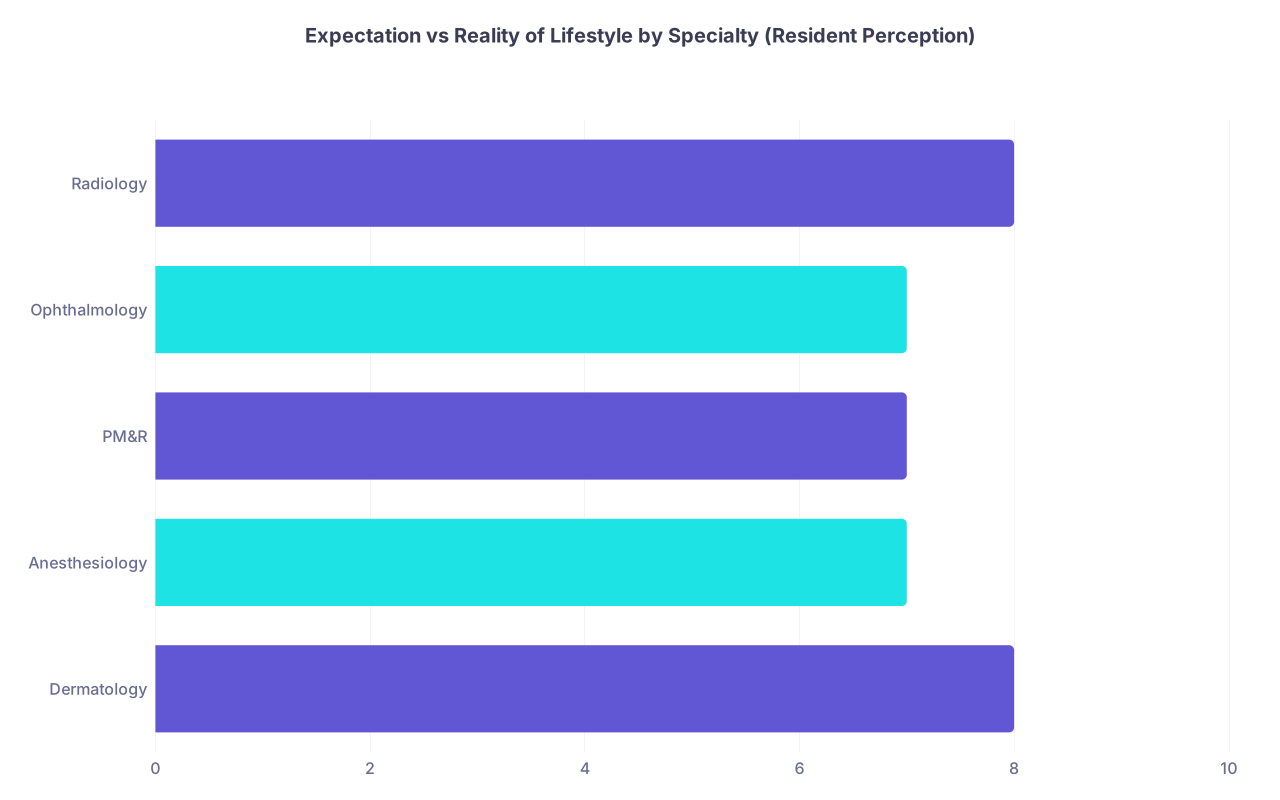
| Category | Value |
|---|---|
| Dermatology | 8 |
| Anesthesiology | 7 |
| PM&R | 7 |
| Ophthalmology | 7 |
| Radiology | 8 |
(Think of 10 as “perfect chill” expectation going in; most residents I talk to would rank their actual day-to-day during training several points lower.)
You can absolutely find derm, PM&R, ophtho, anesthesia, rads, path programs where residents are genuinely happy and burnout is manageable. But it’s not because “the specialty is chill.” It’s because leadership made specific, often painful decisions to protect residents’ time and sanity.
Most places haven’t.
How to Spot Burnout Factories During Interviews
You want concrete? Here you go. When you interview at these “lifestyle” specialties, stop asking fluffy questions about “wellness.” Watch the reactions instead.
Use your time with residents like a diagnostic test. Ask:
- “When do you typically leave on a non-call day?”
- “What percentage of attendings would you not want your friend to work with, and why?”
- “How often do you come in on your days off to catch up on notes or research?”
- “If someone is struggling, what actually happens?”
Then watch:
- Do they glance at each other before answering? Red flag.
- Do they give the “official answer” first, then a quieter, more honest one in the hallway? Pay attention to the second.
- Do upper levels seem tired and jaded or reasonably content?
And yes, talk about off-service months. If you’re entering PM&R, anesthesia, rads, or ophtho, ask:
- “Which non-core rotations are the worst, and why?”
- “Do your residents get treated fairly by those services, or as scut machines?”
Programs that burn out their “chill” specialty residents almost always show their hand here. They’ll minimize problems, blame previous residents, or claim “everyone struggles, that’s just residency” in a way that feels dismissive.
The ones that protect you will be specific. “Yeah, our ICU month used to be awful; we cut call frequency, built a night float, and got an extra NP so residents could actually learn.” That sort of answer.
Your Mental Model Needs to Change
Here’s the mindset I wish more MS3s had:
Stop asking, “What specialty is chill?”
Start asking, “What programs run a humane, sustainable training environment within that specialty?”
Some realities you cannot avoid:
- You will be tired in any residency.
- You will work when your friends in tech are at brunch.
- You will occasionally hate your job, even in derm or rads or PM&R.
But if you pick a program that:
- Respects post-call,
- Protects you from endless unpaid invisible labor,
- Doesn’t dismiss burnout because you “chose a lifestyle field,”
- And doesn’t weaponize guilt when you struggle,
you can get through residency more or less intact and then enjoy the attending lifestyle these fields are famous for.
If you ignore all that and just chase the brand-name “chill specialty” without looking under the hood, do not be surprised when you’re sitting in your car, 9:30 p.m., outside a dermatology clinic, googling “non-clinical careers for physicians” as a PGY-2.

| Step | Description |
|---|---|
| Step 1 | MS3 Sees Chill Attending Life |
| Step 2 | Assumes Specialty is Lifestyle |
| Step 3 | Matches into Lifestyle Field |
| Step 4 | Manageable Workload |
| Step 5 | High Scut and Invisible Work |
| Step 6 | Expectation Mismatch |
| Step 7 | Resident Burnout |
| Step 8 | Survive to Good Attending Life |
| Step 9 | Program Culture |
FAQ: The Stuff You’re Afraid to Ask Out Loud
1. If I care a lot about lifestyle, should I still chase these specialties?
Yes, but with your eyes open. The attending lifestyle in derm, rads, ophtho, PM&R, anesthesia, path absolutely can be excellent. Just stop fantasizing that residency in those fields is some gentle 9–5 cruise. It is not. Rank programs by resident culture and actual daily grind, not just by reputation or name. You’re picking four years of your life, not just a line on your CV.
2. Which “lifestyle” specialty burns people out the most in your experience?
The worst burnout I’ve personally seen, paradoxically, is in dermatology and radiology at a handful of hyper-academic, high-volume programs. Why? Very high expectations, lots of perfectionism, subtle but intense pressure to publish, and a culture that views complaints as weakness because “you have it easier than surgery.” That combination is lethal for certain personalities.
3. How do I know if I’m the kind of person who’ll burn out anyway, no matter what?
If you’re a perfectionist, have a hard time saying no, ruminate at night about small mistakes, and base your self-worth on grades/validation, you are higher risk. That doesn’t mean you’re doomed; it means you need to be ruthless about picking supportive programs, not just glamorous ones, and you need to practice boundaries early. The “I’ll just tough it out anywhere” crowd often cracks quietly in PGY-2.
4. Is it ever worth switching specialties if the ‘chill’ field is killing me?
Sometimes, yes. I’ve seen derm residents switch to IM, rads to EM, PM&R to anesthesia, and come out happier because the culture and fit were better, even if the raw hours were worse. Your nervous system doesn’t care about brand reputation; it cares about day-to-day reality. If your program repeatedly dismisses your struggles and there’s no path to change, transferring is not failure. It’s survival.
Three things to walk away with:
- “Lifestyle specialty” describes the ceiling as an attending, not the floor during residency.
- Burnout is driven more by program culture, expectation mismatch, and invisible work than by raw hours alone.
- When you interview, interrogate how the program actually runs and how residents really live — because the wrong “chill” specialty can still break you.