
The myth about “lifestyle specialties” is simple: people think the job postings and glossy brochures are the truth. They’re not. The schedule you’re shown is the skeleton. The real game is how attendings in these fields quietly bend that skeleton around their lives.
I’ve watched attendings in derm, rads, ophtho, anesthesia, PM&R, even outpatient psych/IM — and here’s the dirty little secret: two people with the same “1.0 FTE, Monday–Friday, no call” contract can live completely different lives. Because the smart ones design their weeks. The naive ones let the hospital or large group design it for them.
Let me walk you through how the people with actual control are structuring their weeks. Not what HR prints in the recruitment packet. What they really do.
The Core Truth: FTE Is Optional, Control Is Not
Most residents think: “Derm/ophtho/rads = good lifestyle; surgery/OB = bad lifestyle.” That’s lazy thinking. The real divide is: who controls their calendar, and who doesn’t?
In lifestyle fields, you get access to something far more valuable than “no nights.” You get negotiability.
Take a typical outpatient lifestyle specialty: dermatology in private group, radiology in a large practice, ophthalmology in a multispecialty group, outpatient psychiatry, PM&R with mostly clinic and procedures.
That “1.0 FTE, 4.5 days a week, no weekends” thing? Here’s how it actually gets used by attendings who know what they’re doing:
- They cut FTE quietly to 0.8–0.9 after 1–3 years.
- They stack clinical time into fewer, denser days.
- They off-load non-billable garbage onto others.
- They build predictable blocks: clinic, procedures, admin, “ghost” time.
And then they pretend they’re working full speed. Because on paper, they’re “busy.” On the ground, they’ve carved out room to breathe.
Dermatology: The Master Class in Calendar Control
Derm is the clearest example of how lifestyle fields actually work. Residents see “Tuesday–Friday, 8–4” and think that’s the entire story.
It isn’t.
How a Real Derm Attending Designs Their Week
Here’s what a brochure schedule might say:
- Mon–Thu: Clinic 8–4:30
- Fri: “Admin/Research”
What a senior partner at a decent private derm group is really doing:
Monday:
All clinical. High throughput. New patients, short follow-ups, rashes, acne, full skin checks. Two MAs. Scribe or voice recognition baked into the workflow. They’re seeing 30–45 patients, but they leave by 4:30. Charting is 90% done in room.
Tuesday:
Morning: Procedures. Biopsies, excisions, some cosmetics if they do them. These are high-RVU, high-margin hours.
Afternoon: Residents or PA supervision plus some built-in admin padding. Clinic might “run” until 4:30, but the last real patient is at 3:30. The 4–4:30 “slot” is an internal buffer that gets blocked off 90% of the time.
Wednesday:
Full clinic again, but more flex. They rarely start seeing patients before 8:30. They don’t tell residents this. The day technically starts at 8; first patient is 8:15 or 8:30. That 15–30 minutes is de facto admin time.
Thursday:
Cosmetics/procedures block if they’re in that game. Elective, cash-based, zero “my insurance changed” nonsense. Staff is dialed in because this is where the real money and fun is.
Friday:
The famous “Admin/Research Day.” Translation:
- Morning: half tele-derm, refill requests, path review, a couple of quick follow-ups.
- Late morning: gym, coffee with a colleague, or school drop-off.
- Afternoon: gone. Maybe they’re “charting from home” on the EMR at 2x speed with Netflix on.
A junior attending might still be in the office more on Fridays. But the more senior they get, the more that Friday becomes sacred. You don’t see this in the brochure because it would piss off the hospital.
Now the real move: within 2–3 years, that same derm attending drops to 0.8–0.9 FTE. Often by:
- Eliminating one half-day clinic
- Keeping the high-margin procedures
- Off-loading low-value follow-ups to NPs/PAs
But their take-home pay? Barely drops. Because they kept the money-maker sessions and cut the low-RVU time and the headaches.

Radiology: Shifts, Stacking, and Hidden Free Time
Radiology is marketed as “predictable shifts, no clinic.” True, kind of. But the way attendings actually design their weeks is very different from the template schedule residents see on the rotation board.
Most groups run on shifts: days, evenings, nights, weekends. What matters is not “hours per week.” It’s how those hours are arranged.
The Attending Radiologist’s Real Week
A sample academic-ish brochure version:
- Mon–Fri: 8–5 reading room
- Home call: Q4–5 weekends
- One late shift every other week
Reality in a large private group or hybrid model:
- 3–4 long day shifts (8–6 or 7–5) stacked
- 1–2 shorter admin/academic/remote reading days
- Occasional evenings or weekend shifts at a premium rate
The cunning move a lot of rads attendings pull: they trade a couple of evenings or compressed long days for entire weekdays off.
I’ve seen this repeatedly:
- Work three 10-hour weekday shifts on-site
- Pick up one 6–8 hour remote weekend or evening reading shift
- End up with 1–2 weekdays completely empty — kids, hobbies, side business, or just sleep
And yes, a huge chunk of diagnostic rads now does:
- Remote reading from home in sweats
- With a “start time” of 8 that they use to walk the dog and sip coffee, actually logging in at 8:10
- Built-in downtime when the volume dips, used for CME, investments, or planning their eventual exit
The attendings who are miserable in radiology usually share a pattern: they let the group’s default shift grid dictate everything. The happier ones negotiate:
- Which subspecialty blocks they hold (body imaging vs ER vs neuro)
- How many evenings they’ll tolerate if it buys them real days off
- A path to partial remote work after X years
Lifestyle here isn’t about “no nights ever.” It’s about stacking effort so whole days vanish from the work calendar.
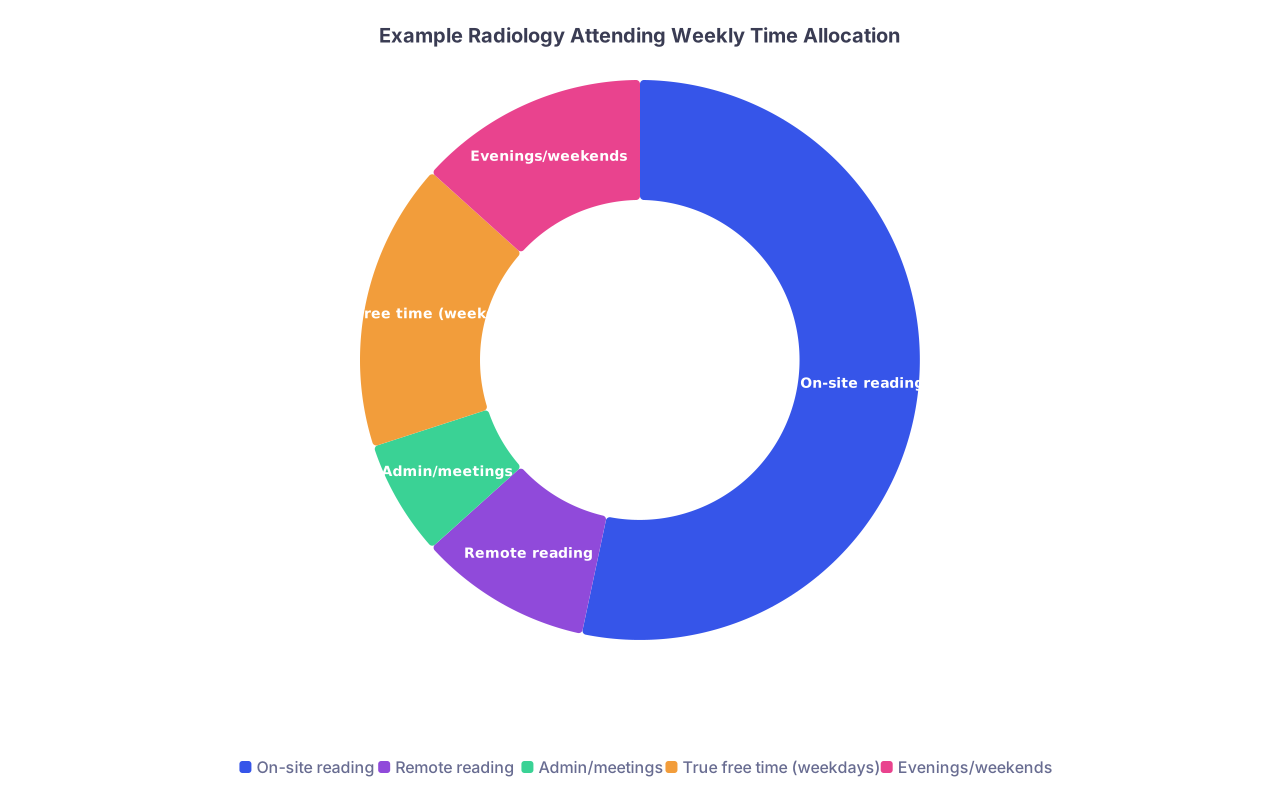
| Category | Value |
|---|---|
| On-site reading | 32 |
| Remote reading | 6 |
| Admin/meetings | 4 |
| True free time (weekdays) | 10 |
| Evenings/weekends | 8 |
Ophthalmology: OR Blocks, Clinic Density, and Quiet Flex
Ophtho gets sold as: “Clinic and OR, no nights, rare emergencies.” Which is mostly true. But the real lever in ophtho is how you arrange your OR and clinic blocks.
The naive new attending says: “Whatever clinic template you give me is fine.” The one who actually has a life says:
- I want my OR day fixed and early in the week
- I want my longest clinic days clustered
- I want at least one short day baked in
- I want admin built into the template, not added on top
A real-world week for a busy but sane cataract/refractive ophtho attending:
Monday – OR Day
- First case wheels in at 7:15–7:30
- They’re done operating by 12:30–1:00 if the staff is competent
- Afternoon: post-ops, a few quick follow-ups, maybe leave by 3:30
- By year 3, a lot of them are using Monday afternoon as soft landing: slow clinic, early exit
Tuesday – Heavy Clinic
All-day clinic, 8–4:30 or 5. New patients, refractions, pre-ops, follow-ups. Techs do half the work. They run two rooms. Everyone complains it’s “so busy,” but the day is highly structured and predictable.
Wednesday – Mixed
Morning: minor procedures and injections. Afternoon: clinic. One or two admin blocks that always “fill” with patients… unless they decide they do not.
Thursday – Heavy Clinic Again
Like Tuesday. Maybe residents or fellows see half the patients. The attending just “staffs” and signs.
Friday – Light or Off
This is where real design happens. Many senior ophtho attendings:
- Make Friday a half-day explicitly in their contract, or
- Have “research/teaching/admin” that basically means they come in late, leave early, and block off anything they don’t want to do
And because few ophtho emergencies are true “right now” emergencies (compared with, say, ruptured AAA), weekend and night calls are often home-call and tolerable, especially if it’s a group sharing the pain.
The other trick: they schedule personal life around their fixed OR days. Want a 4-day weekend? Cancel a Friday half-day and trade that clinic to a partner, keep the Monday OR (high revenue, low drama), and disappear by Monday afternoon.
Anesthesia & PM&R: Block Time and Boundary Management
Anesthesia and PM&R are interesting because they can be lifestyle-friendly, but a lot depends on the environment. I’ve seen anesthesiologists who look like they’re on a part-time schedule and others who are essentially hospitalist-surgeons with propofol.
The difference is not just the specialty. It’s how they accept or reject garbage.
Anesthesia: What Actual Lifestyle Looks Like
Lifestyle anesthesia is not trauma center, 24/7 hearts, and transplants. It’s:
- Outpatient surgery centers
- Bread-and-butter elective cases
- A group that isn’t desperate and understaffed
A well-positioned anesthesiologist’s week in a good group:
- 3–4 days in ORs with relatively predictable end times
- 1 day of either pre-op clinic, QA, or simply no scheduled room
- Call: low frequency; if they take more call, they buy themselves more weekdays off
They design their week by:
- Arguing hard about finish times — not just start times
- Avoiding the “black hole” rooms that always run over (late-addon trauma, poorly-run service lines)
- Negotiating PTO early and protecting it viciously
A lot of anesthesia attendings who seem to “work full time” are effectively at 0.8–0.9 FTE through a combination of:
- Not picking up extra shifts
- Trading certain high-burden days for more desirable, dense blocks
- Slipping out when their last case finishes, while the junior partners “help” finish the board
PM&R: Hidden Flex in a Quiet Specialty
PM&R is a chameleon. Vacation home consult service? Misery. Outpatient MSK, EMG, spine procedures, and sports? Shockingly good life if you’re deliberate.
The smart PM&R attending:
- Piles procedures (EMG, injections, RFA, etc.) into 1–2 blocks per week
- Uses midlevel providers or therapists to handle the endless follow-ups
- Schedules half-days that are genuinely half-days, not “plus 2 hours of notes”
You’ll see a week like:
- Mon: Clinic all day, ends on time
- Tue: AM procedures, PM light clinic
- Wed: Concussion/sports clinic, admin last hour
- Thu: Clinic + therapy conferences
- Fri: Half-day then actually leaves
Residents on inpatient rehab see a different world: family meetings, long mornings, slow notes. The outpatient PM&R lifestyle attendings are operating on a different planet than that.
| Specialty | Max Clinical Days | OR/Procedures Day | Typical Admin Half-Day | Common FTE After 3 Years |
|---|---|---|---|---|
| Dermatology | 4 | 1 | 0.5–1 | 0.8–0.9 |
| Radiology | 4 | N/A | 0.5–1 (often remote) | 0.8–1.0 (stacked shifts) |
| Ophthalmology | 4 | 1 | 0.5–1 | 0.8–0.9 |
| Anesthesia | 4–5 | 4–5 OR blocks | 0.5 | 0.8–1.0 |
| PM&R | 4 | 1–2 procedures | 0.5–1 | 0.8–0.9 |
How They Hide Admin Time Inside the Week
The brochure always lies about admin. It’ll say: “0.5 day per week for admin/research.” Attendings laugh at this. They know admin expands to fill any time you formally allocate to it.
So the smart ones stop listing it as a freestanding thing and start embedding it.
Here’s how:
Block First and Last Slots
They block the first 15–30 minutes of clinic and the last 15–30 as “buffer” or “admin.” Officially, it’s to “accommodate add-ons” or “same-day urgent visits.” In reality, this is their processing time: messages, lab review, signing notes before going home.Create Phantom Slots That Rarely Open
The schedule shows a 4:00 PM “new patient” slot every day that mysteriously is “reserved” or marked “hold.” Only when they desperately need volume will it be opened. Otherwise, that’s the escape valve when the day runs long.Use Midlevels as Time Shields
In derm, ophtho, PM&R, psych, and even outpatient IM, midlevels and fellows are used as time multipliers. The attending’s name is on the schedule, but the work is filtered. They walk into the room after most of the history and basic exam are done. Documentation is half-baked already. Their “full” day is less mentally dense than a PGY-2’s “light” day.Email/Admin from Anywhere
A lot of what is labeled as “admin” is just EMR inbox plus institutional nonsense. Attendings answer half of this on their phone between cases, in the car (parked, hopefully), while waiting at their kid’s practice. The actual “sitting at desk doing admin” time is maybe 1–3 hours a week if they’re efficient.

Money vs Time: How They Trade One for the Other
This is the part residents almost never see clearly on rotations. Because attendings do not talk about it openly, and definitely not in front of program leadership.
Lifestyle fields come with leverage. High demand, relatively low call burden, procedure-based or stable outpatient revenue. That means they get to play with two dials:
- Total FTE (0.6–1.0)
- Case mix / session mix (high-paying vs low-paying work)
Behind closed doors, what actually happens:
- A derm attending drops 1 half-day of low-RVU general clinic but keeps cosmetics and MOHS cases. Income barely moves. Time off jumps.
- A radiologist agrees to work one extra weekend shift per month (paid at a premium rate) and buys themselves a guaranteed weekday off every week.
- An ophthalmologist gives up one satellite clinic day with miserable patients and keeps central high-volume cataract days. Loses some gross, keeps their sanity.
- A PM&R doc increases procedures by 1 half-day per week and drops one chronic pain follow-up half-day. Revenue stays flat or improves; energy improves a lot.
You will not see this calculus explained on recruiting slides. But it is the real engine behind “lifestyle-friendly” attendings you meet who seem weirdly relaxed.
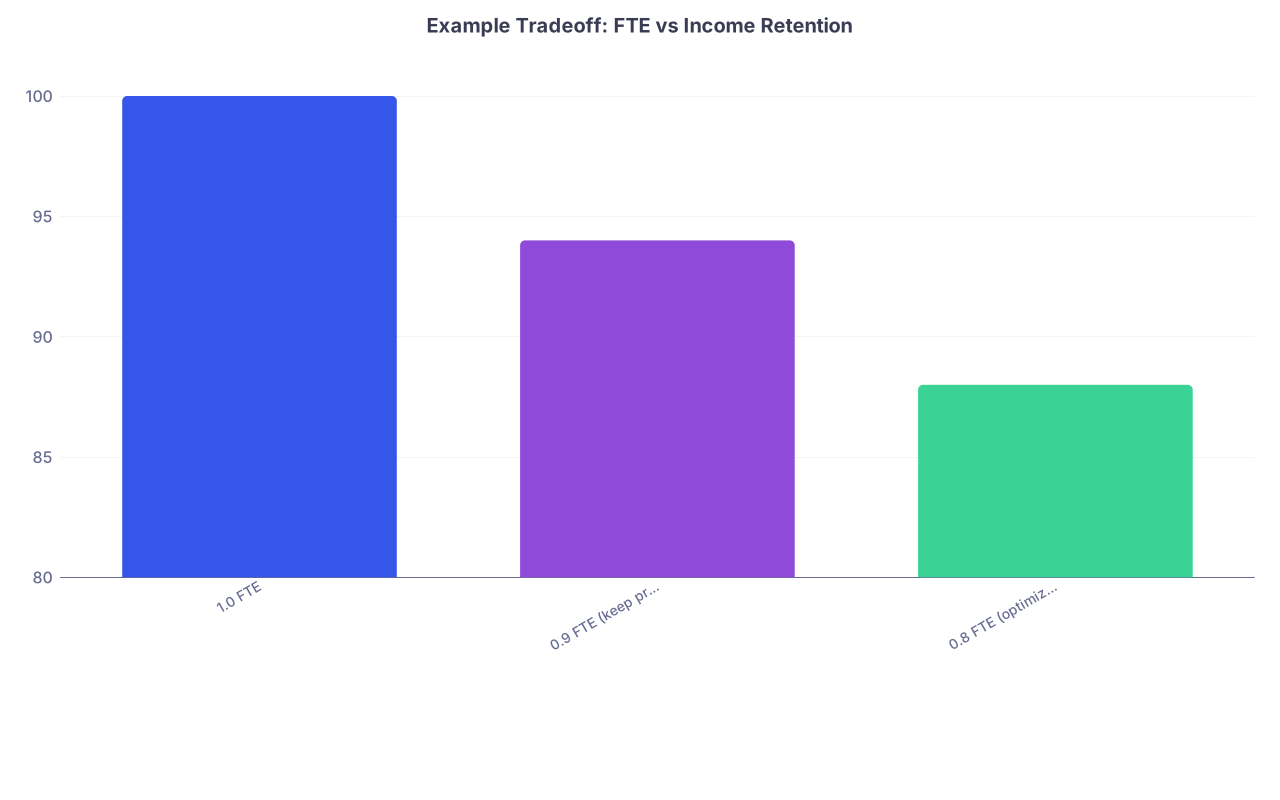
| Category | Value |
|---|---|
| 1.0 FTE | 100 |
| 0.9 FTE (keep procedures) | 94 |
| 0.8 FTE (optimize mix) | 88 |
(Those percentages are rough but not fantasy. I have seen attendings drop 20% FTE and lose closer to 10–15% income because they surgically remove the worst, least profitable work.)
Call, Nights, and Weekends: The Hidden Agreements
The lifestyle brochure line is always: “Minimal call” or “Home call only.” Residents see that and think: “Great, I’ll never suffer again.”
Reality:
- Someone is covering nights, weekends, holidays.
- The question is whether it’s you, how often, and on what terms.
What the more experienced attendings do:
- Push aggressively for transparent call schedules in writing before they sign.
- Negotiate protections: post-call days actually off, or late starts.
- Trade more frequent but predictable low-burden call for less income volatility.
For example, in ophtho or derm:
- Home call might be truly trivial: a couple of phone calls per month, occasional weekend visit to the hospital. They accept a Q5–7 call schedule like it’s nothing.
- The savvy ones coordinate vacations and call swaps months in advance so major personal events are insulated.
In rads:
- Some join groups where nights are outsourced to nighthawk services. They accept a slightly lower base or fewer bonuses in exchange for sleeping at night.
- Others volunteer for a handful of night shifts per month at an elevated rate, then block entire weeks with no clinical duties. This is the “shift-worker physician” lifestyle.
In anesthesia:
- Taking call at a surgicenter can be meaningless (phone call or rare return) vs Level I trauma call that wrecks your body. The brochure might not clearly distinguish them. Attendings absolutely do.
- The ones who care about their life trajectory steer away from the constantly-bleeding hospital setups unless they’re paid so much more that the trade actually makes sense.

| Step | Description |
|---|---|
| Step 1 | Signed Lifestyle Contract |
| Step 2 | Stack clinical days |
| Step 3 | Protect free days |
| Step 4 | Drop low value sessions |
| Step 5 | Increase density or procedures |
| Step 6 | More income per hour |
| Step 7 | Negotiate call and admin |
| Step 8 | Stable, controlled weekly rhythm |
| Step 9 | Full time or reduced FTE |
| Step 10 | High or low RVU mix |
What This Means For You in Residency
If you’re in a lifestyle-friendly specialty already — derm, ophtho, rads, PM&R, outpatient psych, anesthesia in the right setup — your biggest mistake is thinking lifestyle is automatically delivered with your diploma.
It is not.
The attendings who are constantly staying late, charting at home, burned out in fields that are supposedly cushy? They made two classic errors:
- They accepted the default template.
- They tried to be “helpful” instead of strategic.
When you’re on rotation, stop just asking: “Do you like your specialty?” Watch instead:
- Who leaves on time every day, and who never does.
- Who has one day that’s clearly lighter.
- Who has admin slotted at the fringes of clinic vs slapped on evenings.
- Who mentions FTE or “cutting back” in passing.
If an attending casually says, “I’m actually 0.8 now,” that’s the person you ask to coffee. They’ve already done the redesign you’ll need in 3–5 years.

The Real Takeaways
Let’s keep it simple.
First, lifestyle specialties don’t guarantee lifestyle. They guarantee leverage. The attendings who live well use that leverage to design their weeks — stacked clinical days, built-in admin, reduced FTE with optimized sessions.
Second, the schedule you see as a resident is the public version. The real game is the invisible blocks: phantom slots, buffer zones, midlevel shields, and “admin” that mysteriously happens on a Friday afternoon at home.
Third, if you want that life, learn from the attendings who quietly leave early, have one true half-day, or mention 0.8–0.9 FTE. They’re not lazy; they’re showing you how to bend the system before it hardens around you.