
If your partner’s job is fixed in one city, or your custody agreement locks you to a specific county, what specialties actually let you choose where you live instead of chasing jobs across the country?
Let’s talk about geographic stability. Not vibes. Not “maybe there’ll be a job somewhere.” Realistic: can-you-get-a-job-within-50-miles consistency.
You’re not just picking a specialty. You’re picking how likely it is that you can:
- Stay near extended family
- Stay in one metro so your partner can keep their career
- Avoid dragging kids through 3 relocations in 8 years
I’ve watched people ignore this. They picked ultra‑competitive, hyper‑urban specialties… then sat on the job market for a year, or commuted 3 hours each way because that was the only offer.
If you need geographic stability, you cannot afford to pretend all specialties are equal.
They’re not.
The real question: “Can I work almost anywhere and still have a decent life?”
Let me separate two things that get conflated:
- Can I eventually find a job in that city if I’m patient and flexible?
- Can I basically count on being able to work in most major metros, mid‑size cities, or even rural areas without years of waiting?
You care about #2.
To get there, you need to understand four levers:
- Supply/demand: Are there more jobs than doctors, or the reverse?
- Practice setting flexibility: Hospital, outpatient, telemedicine, hybrid?
- Urban vs rural spread: Is the specialty clustered in big academic centers or everywhere?
- Lifestyle “tax”: Some jobs are plenty available… if you accept brutal call and terrible hours.
Here’s the summary before we dive in.
| Specialty | Urban Jobs | Rural Jobs | Telemedicine Potential | Overall Location Flexibility |
|---|---|---|---|---|
| Family Med | High | Very High | High | Excellent |
| Psych | High | High | Very High | Excellent |
| IM Outpatient | High | High | Moderate-High | Very Good |
| Peds Outpatient | High | Moderate | Moderate | Good |
| Anesthesia | High | Moderate | Low | Good but market cyclical |
| EM | Moderate | High | Low | Good but lifestyle tradeoffs |
Now, let’s walk through this like you’re actually making a decision, not writing a Step 1 question.
Step 1: Be brutally specific about your constraints
“Geographic stability” is vague. Your life is not.
Here’s what you actually need to define:
Do you need to be in:
- One metro area (e.g., “we must stay in Chicago”), or
- One region (e.g., “anywhere in the Northeast”), or
- Within X hours of one city (e.g., “within 2 hours of Austin”)?
Is this constraint:
- For residency only?
- For early attending years?
- For your entire career?
Is it:
- Emotionally preferred, or
- Legally/financially locked (custody, partner’s tenure-track job, visa limits)?
If you tell me, “I must be within 45 minutes of downtown San Francisco for the next 15 years,” my list of “good” specialties changes drastically.
So keep that concrete scenario in mind as you read.
Specialties that quietly give you massive location power
These are the workhorses. Not flashy, not super Instagram‑worthy. But if you need to live where your life is, not where the job market drags you, they’re your best friends.
1. Psychiatry: The stealth S‑tier for location and lifestyle
Psych has three things going for it: insane demand, telehealth friendliness, and presence in basically every region.
Where can you work?
- Outpatient clinics in every metro
- Community mental health centers in small cities
- FQHCs and county systems
- Inpatient psych units in big and mid‑size cities
- 100% telepsych from home, licensed in multiple states
Real talk: I’ve seen psychiatrists who literally moved states for their spouse and had a job lined up within weeks. Not months. Weeks.
Lifestyle wise?
- Mostly outpatient hours if you choose
- Call is usually manageable
- No 2 a.m. OR cases or crashing patients (not in the same way as ICU)
If you think you might want to live somewhere “non‑fancy” someday—small town, exurb, low‑COL city—psych is gold. They’re desperate for you.
Where it can be tight: Ultra‑desirable, saturated metros with lots of training programs (Boston, SF, NYC) can be a bit slower to hire exactly what you want. But even there, you can often patch together telepsych + part‑time roles.
If you need geographic stability + lifestyle + relatively humane training, psychiatry is top tier.
2. Family Medicine: The Swiss Army knife for “I want to live anywhere”
If your main requirement is “I need a job basically wherever my partner’s career goes,” family medicine is absurdly flexible.
You can work in:
- Suburban outpatient clinics
- Rural health clinics
- FQHCs
- Urgent care
- Hospitalist roles in some systems (especially rural)
- Sports medicine, addiction, geriatrics, women’s health tracks
You’re employable nearly everywhere that has people and a clinic building.
Where FM shines for stability:
- Rural and small town: You will be chased. Hard. Loan repayment, sign‑on, housing help.
- Mid‑size cities: Lots of systems always need primary care.
- Larger metros: Jobs exist, though pure 9–5 no‑panel-inheritance jobs can be more competitive.
Lifestyle is what you make it. You can absolutely design a very reasonable life: 4‑day weeks, outpatient only, no inpatient, no OB. But you have to protect your boundaries and pick jobs carefully.
The tradeoff: Pay is lower than some other fields, especially if you’re dead‑set on HCOL metros. But if geographic flexibility matters more than top‑end salary, FM delivers.
3. Outpatient Internal Medicine: Slightly narrower, still very good
Outpatient IM is like family med but more adult‑only and often more urban/suburban.
You’re valuable to:
- Big hospital systems wanting primary care feeders
- Multi‑specialty groups
- VA systems
- Academic systems needing clinician‑educators
You can generally find work in:
- Any major metro
- Most mid‑size cities
- Many smaller cities, though rural might favor FM over IM
Where IM is slightly weaker than FM for location:
- True rural clinics often default to FM for full‑spectrum work
- Some jobs prefer hospitalist track if they want you to flex in/out of inpatient
But overall, if you want to live within an hour of a major city, IM gives you a healthy market.
Lifestyle flexibility is good:
- You can go outpatient only
- Call can be minimal in many places
- You can often negotiate 4‑day weeks or job shares, especially if you’re okay seeing a decent volume
4. Pediatrics (outpatient): Good, but more sensitive to city size
Outpatient peds gives decent geographic flexibility, but not as bulletproof as psych/FM/IM.
Where peds is strong:
- Growing suburban areas with lots of families
- Mid‑size cities
- Many metros with high birth rates and younger demographics
Where it’s tighter:
- Ultra‑competitive “perfect” suburbs where every pediatrician wants to live
- Very rural areas that may not have enough volume for pure outpatient peds—though some do
There’s also the reality that pediatrics is reimbursed worse than adults. So some regions are more cautious about adding more peds chairs.
Telepeds exists, but psych and adult primary care are much more tele‑friendly in practice.
If your geographic constraint is “within a 2–3 hour radius of a decent‑sized city,” peds is fine. If you’re locked to a single wealthy suburb with 10 established pediatric groups? Could be a longer wait or require compromises.
5. Emergency Medicine: High geographic spread, but with big asterisks
EM doctors are needed almost everywhere a hospital with an ED exists. Which is… a lot of places.
From a raw location standpoint, EM is solid:
- Jobs in urban, suburban, rural
- Community and academic
- Plenty of options if you’re okay with different shift mixes
But, here’s the catch you’ll never see in the glossy brochures: the EM job market has been tightening in big desirable metros. In some areas, you’re competing with residents from multiple programs plus people trying to relocate in.
If your partner must be in, say, Seattle proper, EM may not be as flexible as advertised.
What EM does give you:
- Ability to stack shifts and commute (people live in one city and do 7–8 shifts a month 3 hours away)
- Option to choose rural/community jobs where they’re thrilled to have you
- Built‑in flexibility to switch jobs without “building a panel”
Lifestyle: Mixed. Some love the blocks of time off. Night shifts, holidays, and burnout are very real.
If you define geographic stability as “I can live somewhere reasonable in my region, even if I drive a bit,” EM works. If you define it as “I must be inside a specific expensive metro and home by 6 every night,” not so much.
6. Anesthesiology: Good flexibility, variable stability
Anesthesia is present in:
- Every surgical hospital
- Many ASC (ambulatory surgery centers)
- A lot of mid‑size and small cities, plus rural hospitals
So yes, you can likely work in:
- Most metros
- Many smaller communities
- Regionally across big chunks of the country
But anesthesia markets swing. I’ve watched the same city go from “we’re desperate” to “we’re fully staffed” in 3 years.
Good for you if:
- You’re okay considering multiple nearby cities or suburbs
- Your “locked” region is large (e.g., entire state, multi‑state area)
- You’re open to private groups, hospital employment, or locums
Less ideal if your constraint is hyper‑specific and permanent to a single competitive city.
Lifestyle: can be solid, but expect early mornings, call, potential late rooms. You can sculpt a good schedule, but it’s not 9–5 primary care.
Specialties that look flexible but will trap you geographically
If you absolutely need location control, you need to be extremely careful with:
- Highly niche subspecialties
- Fields clustered in big academic centers
- Hyper‑competitive lifestyle specialties where demand ≈ supply
Translation: you want specialties where hospitals are begging, not where you’re begging hospitals.
Fields that often lock you to certain geographies:
- Dermatology
- Plastic surgery
- Radiation oncology
- Many surgical subspecialties (ENT, urology, ortho subspecialties, neurosurgery)
- Some ultra‑niche IM subspecialties (advanced heart failure, transplant, etc.)
Yes, there are derm jobs in random places. But if you must live in a specific cool coastal metro? You may wait a long time or accept a job with ugly hours or heavy cosmetic sales pressure.
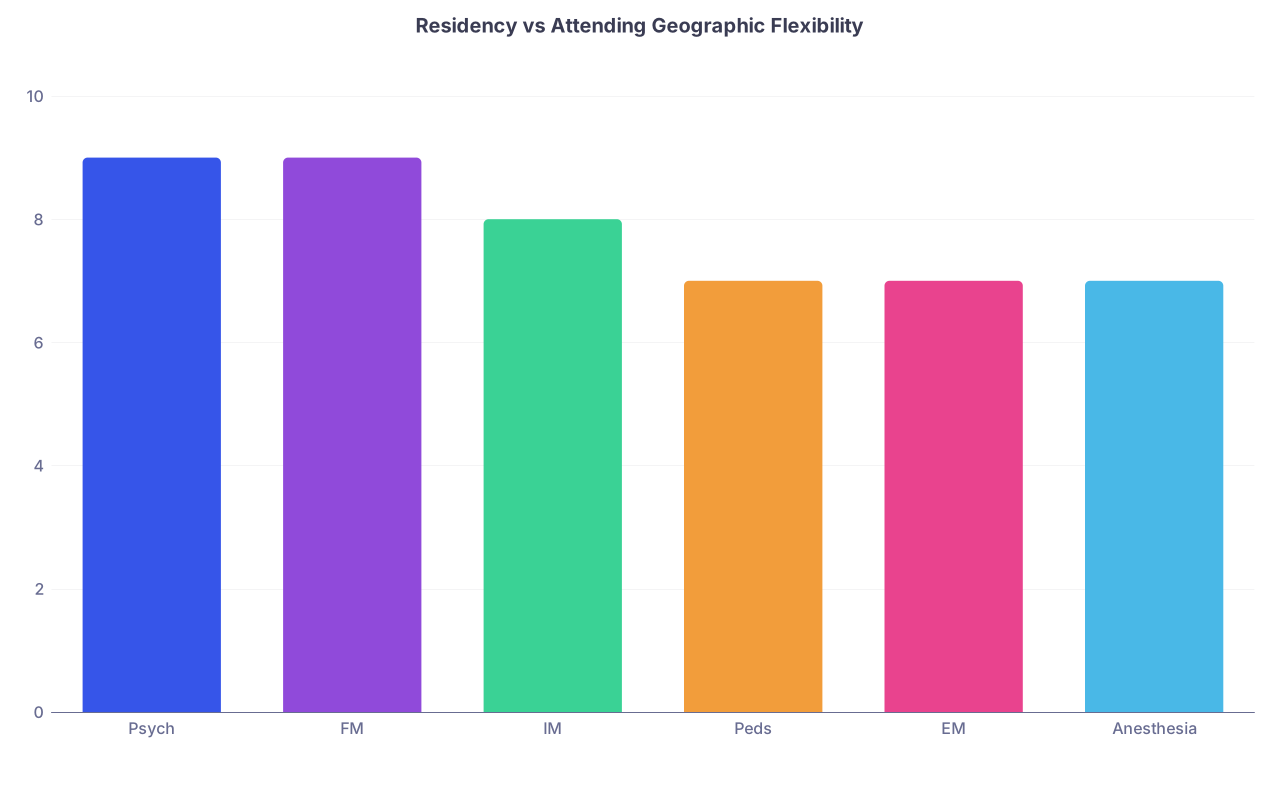
Don’t forget residency geography vs. attending geography
You’ve got two separate but related problems:
- Where can I match for residency?
- Where can I reliably work afterward?
Different specialties behave differently on those timelines.
| Category | Value |
|---|---|
| Psych | 9 |
| FM | 9 |
| IM | 8 |
| Peds | 7 |
| EM | 7 |
| Anesthesia | 7 |
(Scale 1–10, rough sense of attending geographic flexibility; psych and FM tend to have the most options in the most regions.)
Residency reality:
For psych, FM, IM, peds:
You’ll find programs in most regions of the country. If you need to be in one city, you’ll need that city to actually have multiple programs or a big one. But regionally, you’ve got choices.For EM, anesthesia:
Programs exist in many regions, but fewer total programs than primary care. If you’re geographically locked even for residency, you’ll need to be strategic early (early away rotations, strong Step scores, networking).
Game plan if you’re location‑locked for residency and beyond:
- Prioritize specialties with lots of programs in your region (FM, IM, peds, psych)
- Apply broadly within that region
- Do aways or sub‑Is at your top city’s programs
- Be blunt in your personal statement and interviews about geographic roots (programs do like people who will stay)
How telemedicine actually changes the game (and where it doesn’t)
People love to say “oh, I’ll just do telemedicine and live wherever.” That’s only half true.
Telehealth is strongest for:
- Psychiatry (especially med management, therapy integrated models)
- Some primary care follow‑up
- Certain IM subspecialties (endocrine, rheum, ID, but often adjunct to in‑person)
Much weaker for:
- EM, surgery, anesthesia, any procedure‑heavy field
- Fields where exams/procedures are the main value
Where telemedicine helps geographic stability:
- If you live near a less dense market, telehealth lets you add extra states and income streams
- If your local market is temporarily tight, you can supplement instead of moving
- If you eventually want to cut clinic days or commute, telehealth lets you reclaim time
It is not a magic bullet if:
- You must be in a single expensive city with many doctors and limited licenses
- You’re in a procedure‑heavy specialty
Psych is the clear telehealth winner. If location and remote work flexibility both matter to you long term, that’s the one that actually delivers.
How to choose if you’re early in training
Let’s assume you’re M2/M3 or an early resident and know you need geographic stability.
Here’s a straightforward decision flow.

| Step | Description |
|---|---|
| Step 1 | Need long term geographic stability |
| Step 2 | Locked to region only |
| Step 3 | Prioritize FM, IM, Psych, Peds |
| Step 4 | Strongly favor FM or Psych |
| Step 5 | Consider EM or Anesthesia with regional flexibility |
| Step 6 | Prioritize FM, IM, Psych for maximum options |
| Step 7 | Locked to one city? |
| Step 8 | City has multiple residencies? |
| Step 9 | Want procedures or shifts? |
Practical steps right now:
- Be explicit with yourself and your partner about constraints
- Shadow in at least one high‑flexibility specialty (FM, psych, outpatient IM)
- Ask attendings one simple question: “If you needed to live within 30 minutes of X city forever, how hard would that be in your field?”
- Pay attention to how many of them pause, chuckle, or say, “Honestly? Hard.”
You’re not choosing the sexiest field. You’re choosing one that lets the rest of your life exist.
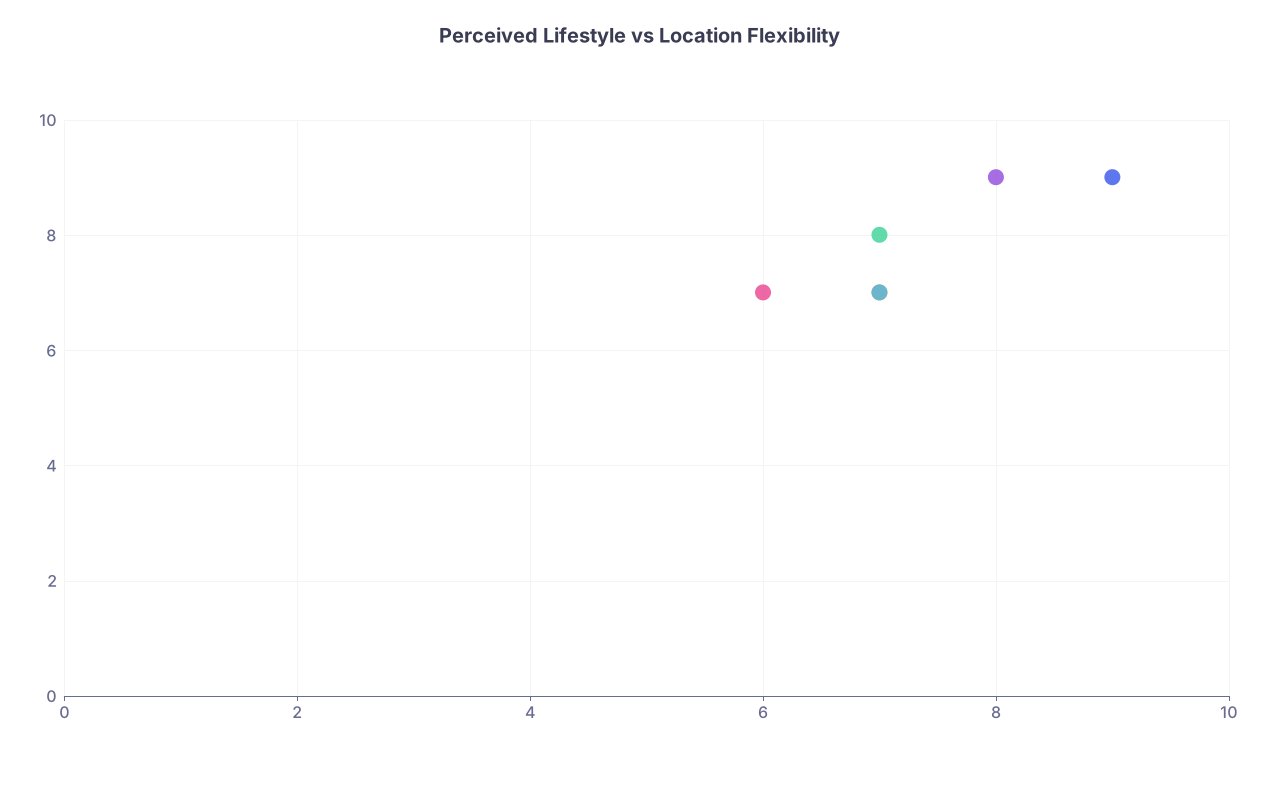
A quick comparison: lifestyle + flexibility together
Let’s throw some numbers on what people actually feel on the ground.
| Category | Value |
|---|---|
| Psych | 9,9 |
| FM | 8,9 |
| IM Outpt | 7,8 |
| Peds Outpt | 7,7 |
| EM | 6,7 |
| Anesthesia | 7,7 |
Each pair is [Lifestyle friendliness (1–10), Location flexibility (1–10)] from what I’ve seen and heard repeatedly on the trail.
- Psych: 9, 9 — top tier on both axes
- FM: 8, 9 — slight pay hit, very strong on life and location
- IM outpatient: 7, 8 — solid across the board
- Peds outpatient: 7, 7 — good, slightly tighter job markets in some places
- EM: 6, 7 — strong geographic spread, harder lifestyle
- Anesthesia: 7, 7 — lifestyle can be decent, geography good but more market‑dependent
These are biased towards outpatient/lifestyle‑oriented career configurations, obviously. You can wreck the lifestyle of any specialty if you choose the wrong job.
Common traps people fall into (and how to dodge them)
Trap 1: “I’ll just do the competitive sexy specialty and make geography work later.”
I’ve watched this fail. The person matches into a hyper‑niche surgical subspecialty, finishes fellowship, and then… the one city they must be in has zero openings. For years.
If your life has non‑negotiable geographic anchors, you do not have the luxury of pretending the market will bend to your will.
Trap 2: “I’ll be fine, I’m strong, I’ll stand out.”
So were the other 20 people trying to relocate to that same metro last year. You’re not competing against hypotheticals, you’re competing against alumni networks, internal candidates, and people already in the system.
Trap 3: “I don’t want to ‘waste’ my potential on primary care or psych.”
I’ve heard some version of this too many times. You’re not “wasting” potential by picking a specialty that lets you have a stable family, a partner with a career, kids who don’t move every 3 years, and hobbies that exist.
You’re just choosing a different kind of ambition: control over your life.
What to do this year, concretely
Let’s make this actionable. Over the next 6–12 months:
- Shadow: 1 day each in FM, outpatient IM, psych, and one “flashy” specialty you’re considering
- Ask: Every attending, “How hard was it to find a job where you and your family wanted to live?”
- Map: Pull up a map of your non‑negotiable city/region. Identify:
- How many residency programs exist in FM/IM/Psych/Peds?
- How many large systems that hire those specialties?
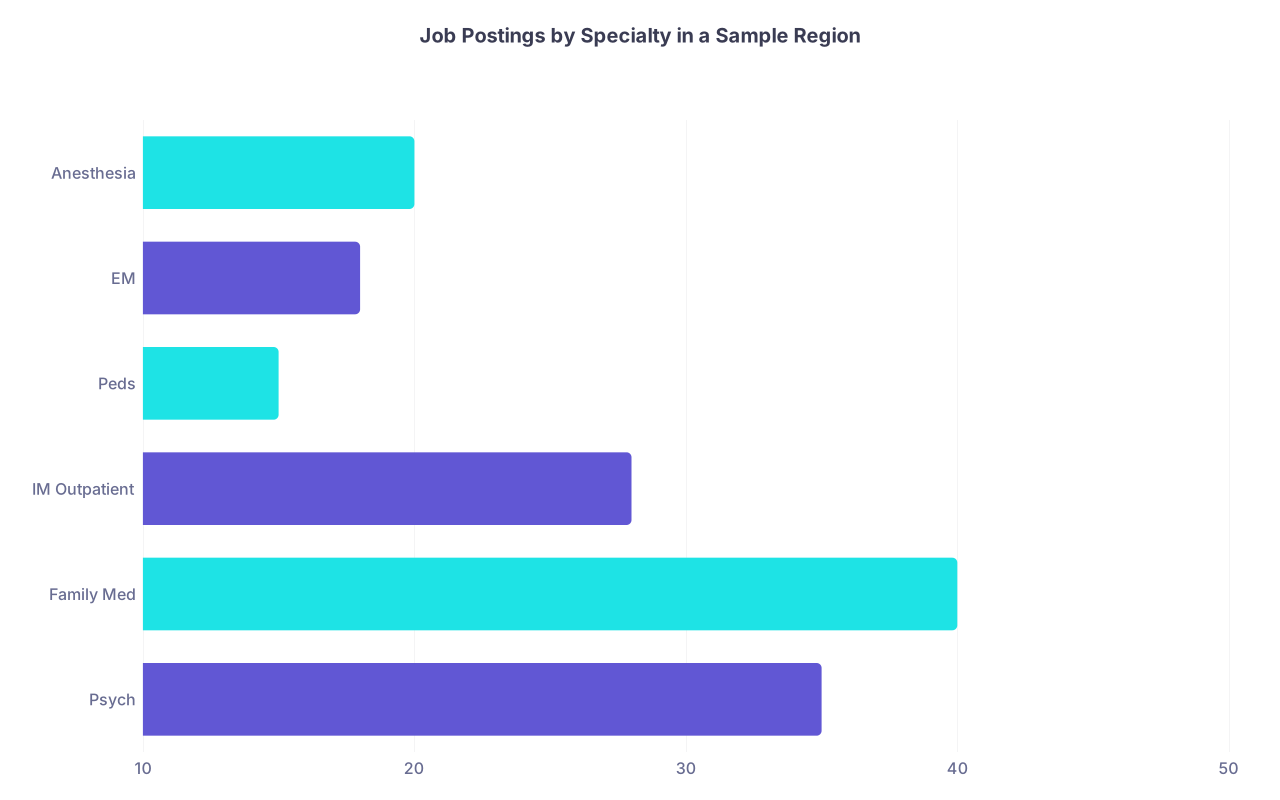
- Reality‑check: Look at job postings now for psych, FM, IM, peds, EM, anesthesia in that region (Indeed, hospital websites, specialty job boards). If it’s sparse today, assume it’ll be at least as tight when you finish.
| Category | Value |
|---|---|
| Psych | 35 |
| Family Med | 40 |
| IM Outpatient | 28 |
| Peds | 15 |
| EM | 18 |
| Anesthesia | 20 |
(Those are mock numbers, but that’s the usual pattern: psych and FM flooded, IM solid, the rest more variable.)
Do not just trust vibes. Look at actual numbers.
If you’re already committed to a less flexible specialty
All is not lost, but you need to play smarter.
- Maximize your value: Research, niche skills, reputation so you stand out when a rare local job pops up
- Network early: Electives, conferences, emails to local department chairs where you want to end up
- Be ready for stepping‑stone geography: First job within 2–3 hours of your target city, then move closer when the spot opens
- Use locums: Sometimes the only way to “be there” without a permanent job is a creative mix of locums and part‑time roles
But if you’re still early enough to choose? It’s a lot easier to pick something inherently flexible than to brute‑force a constrained one.
You’re not wrong to care about this. The system pretends geography is an afterthought, but once real life hits—partners, kids, mortgages—it becomes the main constraint.
If you need geographic stability, you should not gamble on a field that only exists in a few pockets of the country or is oversupplied in the exact city you love. You pick the specialties where your skills are needed everywhere, and the jobs chase you.
Do that right, and future‑you gets to think about things like school districts and backyard size, not whether you can find any job within a 200‑mile radius.
With that foundation in place, the next step is to line up rotations, mentors, and residency programs that match this strategy. That’s where your specialty choice stops being abstract and starts turning into concrete doors that actually open—but that’s a move for your next planning session.