
It’s 10:13 pm. Your kid finally stopped coughing and fell asleep on your chest. Your co-intern just texted asking if you can swap into a 28‑hour call this weekend “because you don’t seem that busy.” Your spouse is on nights at the community hospital across town. The dishes are still in the sink, the daycare invoice is in your inbox, and you’re staring at your phone thinking:
“I can’t do this pace for 30 years. I’m the one holding the family together. What kind of career actually works for that?”
This is for you if:
- You’re the default parent or caregiver (kids, aging parents, disabled partner).
- You’re in or near residency and specialty decisions are getting real.
- “Lifestyle friendly” is no longer a meme; it’s a survival requirement.
Let me be blunt: not all “lifestyle specialties” are actually lifestyle-friendly when you’re the primary caregiver. Some are great in theory but break down the second daycare calls and says, “Your child has a fever, you need to pick up in 30 minutes.”
You need more than low average hours. You need control.
Let’s build this in a way that actually works in real life, not on Reddit.
First: Be Honest About Your Non‑Negotiables
Before we talk specialties, you need to get very clear on your real constraints. Not what you wish they were. What they are.
Ask yourself, and write this down:
What are your fixed responsibilities?
- Daily daycare/school drop offs or pick ups?
- Bath/bedtime non‑negotiable windows?
- Therapies or doctor visits for your kid/parent on weekdays?
- Religious obligations, co‑parenting schedule, court‑ordered custody times?
What are your emergency realities?
- Who gets called first when daycare/school/assisted living calls? You or your partner?
- Do you have any backup adults locally you actually trust and can use?
- Are you in a place with strong or weak family support?
What breaks your life?
- Night float?
- 24‑hour in‑house call?
- Weekends?
- Rotating shifts?
- Unpredictable pages at 2 am?
You don’t need to avoid all of those forever. But some specialties make them a permanent feature, others make them rare or optional after residency.
This is about engineering the probability of chaos down to a level you can live with.
What “Lifestyle Friendly” Actually Means When You’re the Caregiver
Forget the glossy averages like “Derm: 45 hrs/week.” Those numbers hide all the nuance that matters to you.
For a primary caregiver, the real lifestyle variables are:
- Schedule predictability – Can you reliably say, “I’ll be free after 4:30 most days” and not be a liar to your kids?
- Call structure – Is there call? From home or in house? Can you trade or reduce it? Is it mostly phone?
- Shift vs clinic vs OR – Shifts end. OR days do not. Clinics are in‑between.
- Part‑time/0.8 FTE viability – Can you go 3–4 days/week without being punished financially or professionally?
- Geographic flexibility – If your partner’s job or your parents’ needs move you, can your specialty follow?
- Outpatient vs inpatient mix – Inpatient = more nights/weekends/holidays.
- Coverage culture – If you have a sick kid, will colleagues bail you out without hatred?
Lifestyle is not just hours. It’s leverage, flexibility, and how much you get punished when life explodes.
The Short List: Specialties That Actually Play Well With Caregiving
Here’s how I’d rank specialties specifically for someone who expects to remain the primary caregiver long‑term, assuming you’re willing to be a bit strategic about practice setting.
| Specialty | Predictability | Nights/Weekends Post-Training | Part-Time Friendly | Geographic Flexibility |
|---|---|---|---|---|
| Dermatology | Very high | Rare | Excellent | High |
| Psychiatry | High | Variable by niche | Excellent | High |
| Outpatient FM | High | Limited if clinic-only | Good | Very high |
| Outpatient IM | High | Limited if clinic-only | Good | High |
| PM&R | High | Some call, often light | Good | Moderate |
Now let’s talk details and the traps people do not tell you about.
Dermatology: The Gold Standard (If You Can Get There)
If you’re already set on derm or have a realistic shot, it’s absolutely one of the best caregiver‑compatible paths.
Residency reality:
- Usually clinic‑heavy. Fewer nights and weekends than medicine/surgery.
- Still full‑time; still work. You will be tired. But the wild overnight calls? Much less.
- You can usually negotiate around pregnancy, pumping, childcare more easily than in, say, general surgery. Culture tends to be more accepting of “life.”
Attending life:
This is where derm really shines for caregivers.
- Outpatient, mostly weekday office hours.
- You can build a 4‑day workweek practice without too much drama.
- Call is often phone‑only and not that frequent. Serious emergencies are rare.
- You can specialize in cosmetics, medical derm, peds derm, patch testing, etc.—none of which typically destroy your nights.
The trade‑off: insanely competitive to get into, and some practices still try to squeeze “RVU monsters” out of everyone. You’ll need to pick your group carefully.
You’re the caregiver? Look for:
- Group practices with multiple partners where call is widely shared.
- Clear maternity/paternity leave policies already used by real people.
- The option to start 0.8 FTE from day one if you can afford it.
If you’re earlier in the pipeline wondering whether it’s “worth going for derm” given your caregiving role — yes, if you can handle the front‑loaded grind, the back‑end payoff for family life is massive.
Psychiatry: Underrated for Caregivers if You Build It Right
Psych has gotten more competitive, but it still has terrific long‑term flexibility.
Residency reality:
- Compared to IM/surgery, night call is lighter and often decreases rapidly after PGY‑1.
- A lot of programs have night float systems and outpatient blocks.
- Inpatient months can still be rough—suicidal admits at 3 am don’t care that daycare opens at 7:30—but the overall call burden is usually more humane.
Attending life:
You can design psych around your caregiving in multiple ways:
- Pure outpatient clinic (hospital‑based or private group).
- Cash‑pay telepsych from home (huge for parents).
- Niche work like perinatal psych, autism evals, ADHD, geriatric psych—often very schedulable.
You decide if you want:
- No nights/weekends by going pure outpatient.
- More money but more disruption via ER or inpatient consult roles.
And yes, 0.6–0.8 FTE is not only possible but common. Many psych groups are thrilled to have a solid part‑timer.
Watch out for:
- County/state jobs with rigid schedules and mandatory call.
- “Community mental health” setups that sound 9‑5 but actually bury you in crisis work and documentation.
If you’re the caregiver, outpatient psych + some telehealth days can be a lifesaver when you get the mid‑day “your child has a fever” call. You can sometimes reshuffle, do phone visits, and not annihilate your entire panel.
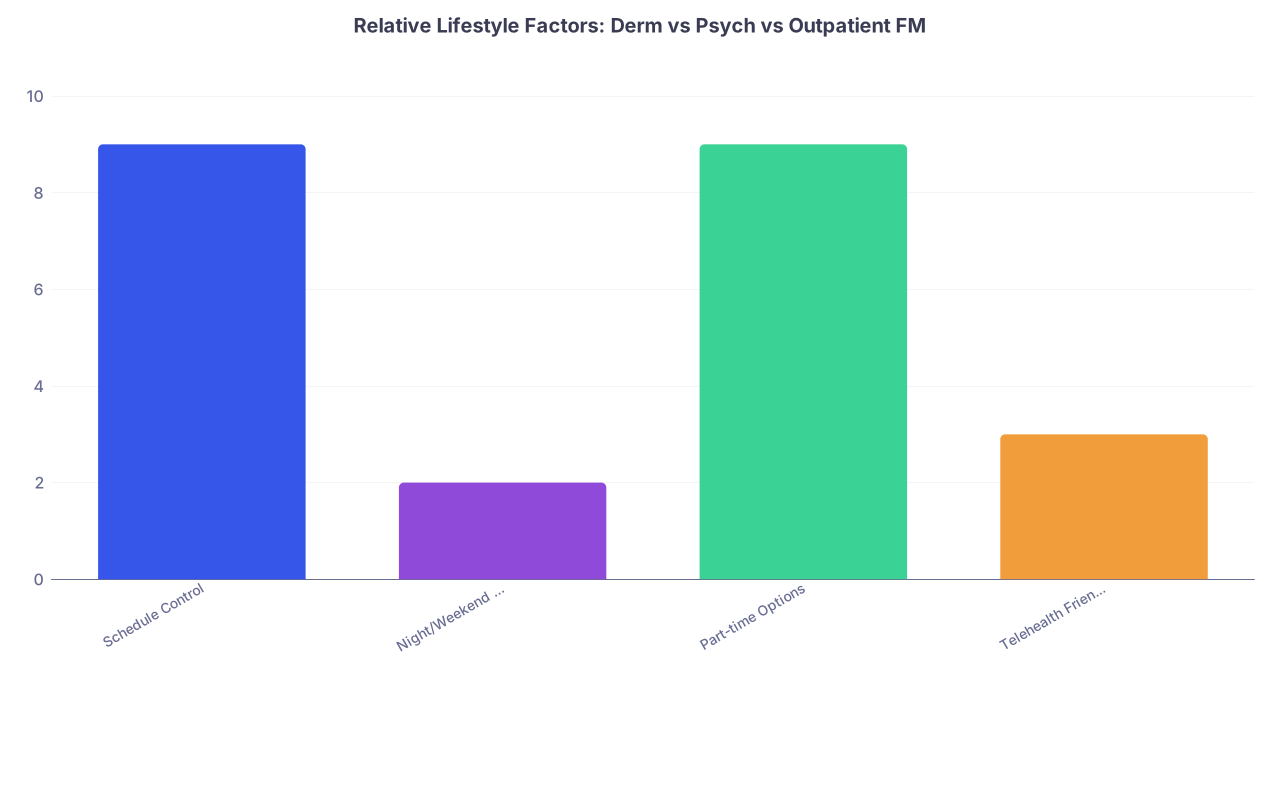
| Category | Value |
|---|---|
| Schedule Control | 9 |
| Night/Weekend Burden | 2 |
| Part-time Options | 9 |
| Telehealth Friendly | 3 |
(Scale 1–10, where 10 = most lifestyle-friendly. For comparison: Psych would be roughly 8/3/9/9, Outpatient FM maybe 7/4/7/7.)
Outpatient Family Medicine & Internal Medicine: Workhorses You Can Tame
If you want broad clinical practice and decent lifestyle, outpatient FM or IM can absolutely work for a primary caregiver. But you must be intentional.
Residency reality (FM/IM):
- You will do nights. You will do inpatient. You will do weekends. It will be rough, especially with kids.
- The difference: it’s time‑limited. Post‑residency, you can move to pure outpatient and leave the admissions behind.
While in residency as the caregiver, you need to:
- Be vocal with chiefs/program director about schedule needs early.
- Swap strategically: give up holidays or “good” rotations to avoid childcare catastrophes on ICU months.
- Use all your institutional support: parental leave, lactation breaks, GME childcare stipends if they exist.
No, this won’t make it “easy.” It will make it survivable.
Attending life: outpatient‑only is your friend
In real practice, you avoid lifestyle death by ruthlessly choosing:
- Clinic‑only roles with:
- No hospital rounding.
- RN/NP support for triage.
- Clear rules about after‑hours call (shared pool or outsourced).
- FQHC or large system jobs that:
- Offer 0.8 FTE without career suicide.
- Have internal coverage for sick days and emergencies.
- Or joining large multispecialty practices where call is diluted across many clinicians.
Typical outpatient FM/IM attending schedule you can target as a caregiver:
- 4 clinic days/week, 8–5, 15–20 patients/day.
- 1 admin/“catch‑up” half‑day from home.
- Shared phone call 1:6–1:10, mostly refill/questions, with tele‑triage screening.
That’s… livable. Especially once your kids are school‑aged.
Big traps:
- “Traditional private practice with hospital rounds”: the 6 am pre‑round + 8 am clinic + 9 pm discharge call combo will crush you.
- Employer who says “just take calls from home, it’s not that bad” but expects you to manage your own admissions, even at 2 am.
- Clinic with terrible MA/RN support that leaves you charting until midnight while also doing bedtime duty at home.
You’re the caregiver. You do not have the margin for that nonsense. Ask brutal questions at interviews.
PM&R: The Quietly Good Option
Physical Medicine & Rehabilitation flies under the radar but has a lot going for caregivers.
Residency reality:
- Mix of inpatient and outpatient, but not as punishing as surgery.
- Overnight call exists (esp. early) but generally lighter—fewer “STAT OR NOW” scenarios.
- Some programs with very reasonable cultures and older residents with families.
Attending life:
You can carve out a niche that’s very compatible with caregiving:
- Outpatient MSK/rehab clinic.
- EMG and nerve conduction studies (very schedulable).
- Non‑operative sports medicine with standard clinic hours.
- Spasticity management, prosthetics clinics, etc.
Yes, inpatient rehab attending roles have call, but even that is often lower acuity than a hospitalist gig.
PM&R is often a good middle ground if you want:
- Procedural work.
- More body mechanics/musculoskeletal focus.
- Less chaos than ortho or ED.
The downside: fewer spots nationally, fewer jobs in some regions. If your caregiving requires you to live in a very specific city, you’ll need to check PM&R job density there.
What About EM, Anesthesiology, Radiology, Pathology?
You’re probably wondering about the usual “lifestyle” suspects.
Emergency Medicine
EM gets sold as lifestyle because: shifts, no pager, leave work at work.
For a primary caregiver, the problem is:
- Nights.
- Weekends.
- Holidays.
- Rotating shifts that annihilate routines and sleep.
If your partner has a 9–5 and you do EM, you might make the childcare patchwork work. If you’re the default parent for mornings and evenings? EM becomes extremely tricky once kids are school‑aged and have activities, homework, and meltdown o’clock at exactly 7 p.m.
I’ve seen people do EM + kids successfully. Two setups that sometimes work:
- Large group where you can preferentially stack day shifts and accept less pay.
- One partner is fully home or has ultra‑flexible remote work.
But if you’re solo parenting a lot of the time, I would not call EM a “primary caregiver‑friendly” field.
Anesthesiology
The sales pitch: good money, shorter cases, sometimes early days. The reality:
- Early start times (think 6–7 a.m.).
- OR emergencies, add‑on cases, trauma.
- Call: in‑house and home call depending on setup.
Can you find lifestyle niches? Yes:
- Outpatient surgery centers doing mostly ASA I–II, no nights.
- Pain clinics (office‑based) after a fellowship.
- Academic setups with more predictable call.
But the default job for a general anesthesiologist often clashes with being the one who drops kids off at school and has to leave at 4:30 sharp when daycare closes at 5:30 and traffic is hell.
If you love anesthesia, you can make it work, but you’ll need a very cooperative group and probably a partner with flexible hours.
Radiology
Objectively, radiology can be very lifestyle‑friendly with telerad, day shifts, etc. But:
- Overnight shifts are common early in career, and sometimes long‑term.
- Daycare does not care that your schedule is “7 on, 7 off.”
- Reading lists can explode; there’s production pressure.
The upside: teleradiology from home is huge if you’re pinned to the house for caregiving. But reading CTs while your toddler screams about a broken crayon isn’t exactly optimal.
Rads can be a great choice if:
- You’re okay with irregular weeks but want no patient calls.
- You have at least some backup childcare and a soundproof office.
Pathology
Path gets ignored, but let’s be honest: for a primary caregiver, it can be pretty favorable.
Pros:
- Mostly daytime hours.
- Very little patient‑facing emergency chaos.
- Frozen sections and some call, but generally limited.
Cons:
- Job market more constrained in some areas.
- Less geographic flexibility if you’re tied to a small city.
- Hard to leave mid‑day repeatedly without disrupting the lab.
If your caregiving is mostly predictable (school pickups, therapy appointments) and less about constant emergencies, path can work well. If you need frequent, unexpected exits? Harder.
How to Choose Within a Specialty: Practice Setting Matters More Than the Field
You can ruin a caregiver’s life in dermatology and save it in hospital medicine depending on the job structure. Don’t just pick a specialty—pick a practice model.
Here’s how different settings shake out for a caregiver:
| Setting | Predictability | Schedule Control | Typical Nights/Weekends |
|---|---|---|---|
| Outpatient clinic only | High | High | Minimal |
| Hospitalist | Medium | Medium | Frequent |
| ED shifts | Medium | Low | Frequent |
| Academic with call | Medium | Low–Medium | Regular |
| Telehealth-heavy | High | Very high | Minimal (if chosen) |
If you’re the primary caregiver, you generally want:
- Outpatient clinic > hospital.
- Group practice > solo practice.
- Larger system > tiny private group (more redundancy).
- Telehealth options built‑in.
And you want written policies about:
- Parental leave.
- Part‑time paths.
- Remote work options.
- Cross‑coverage for sudden absences.
Ask for those policies. If they “don’t really have them but we’re flexible” — that usually means “we will pressure you until you cave.”
Real‑World Scenario: You, a 3‑Year‑Old, and a Residency Contract
Let’s walk through an actual situation.
You’re a PGY‑2 in IM with a 3‑year‑old and another baby on the way. Your partner travels 2–3 weeks a month. You’re asking yourself if you should:
- Stick with IM, do outpatient primary care.
- Try to switch to psych.
- Try to scramble into something else.
Here’s how I’d think about it:
- You’re already in IM. That’s a good, flexible core.
- If you can tolerate residency with appropriate support (family, nanny share, whatever), you can finish.
- Post‑residency, your job design is everything.
Options you could realistically aim for:
- Outpatient IM at a large health system with:
- 4‑day workweek.
- No inpatient rounding.
- Shared call pool with nurse triage.
- Hospital at home / tele‑hospitalist hybrid (if available in your area).
- A mix of clinic + telehealth one day/week from home.
If you have the academic horsepower and desire to switch to psych and start over? Psych could give even more telehealth and outpatient control long‑term. But the cost is more years of training and more chaos during those years with a toddler and newborn.
There’s no universal right answer. There is a right answer for your bandwidth.
Candid Red Flags to Watch During Interviews (Residency & Jobs)
You’re the caregiver. You do not have time to ignore red flags and “see how it goes.” Some phrases I’ve learned to translate:
- “We’re like a family here” = We expect you to sacrifice your actual family for us.
- “Most of our doctors don’t work part‑time” = You will be fighting upstream to cut back.
- “We occasionally stay late to take care of patients” = People stay late. A lot. It’s normalized.
- “We have a generous PTO policy” but no one can tell you how many days people actually take = PTO exists on paper only.
Green flags:
- Another attending openly talking about her 0.8 FTE schedule and how the group supports it.
- Multiple physicians with young kids who seem… not totally broken.
- Actual, named childcare support: on‑site daycare, backup sick‑child care arrangements, or at least a benefits brochure that mentions them.
One More Hard Truth: You Probably Need Redundancy
If you are the only adult who can step in for your dependent (child, parent, partner), no specialty will magically fix the exhaustion. Medicine is not built around single points of failure.
You will likely need at least one of these:
- A partner whose job is flexible enough to actually take over sometimes.
- Local family willing and able to step in.
- Paid help: nanny, au pair, sitter network, home health aide.
- Very strong school or daycare support with extended hours.
I know that’s not always financially or logistically possible. But build redundancy wherever you can — even if it’s a neighbor who can stay with your kids for 30 minutes while you drive grandma to the ER.
Your specialty choice should then minimize the number of times you need to call in that backup.
What You Should Do Tonight
Open a blank document or notes app and do three things:
- Write down your top 3 realistic specialty options (even if you’re already in one).
- For each, write:
- “Best‑case caregiver‑friendly version of this specialty” (e.g., outpatient psych with telehealth).
- “Worst‑case version” (e.g., inpatient psych with heavy call).
- Then, under each best‑case version, list 3 concrete steps you’d need to take in the next 12 months to move toward it:
- Emails to send.
- Mentors to talk to.
- Programs or jobs to research.
Do not just think “I want a lifestyle specialty.” Decide: “I want outpatient IM in a large system with 4‑day weeks and shared call,” or “I want telepsych 3 days/week plus clinic 1 day/week.”
Specificity is how you stop being at the mercy of vague “work‑life balance” promises and start building a career that actually works when daycare calls you — again — at 2:17 p.m.
Start that note right now. Highlight anything that feels fuzzy or wishful. That’s where you need more information, and that’s your homework for this week.
Then, next time you talk to a program director, attending, or recruiter, you’re not asking, “Is this lifestyle friendly?” You’re asking, “Can I do 0.8 FTE clinic‑only, no inpatient, with shared phone call and at least one telehealth day?”
That’s how you, as the primary caregiver, stack the odds in your favor.

| Step | Description |
|---|---|
| Step 1 | Clarify Home Duties |
| Step 2 | Define Non Negotiables |
| Step 3 | Select 2-3 Target Specialties |
| Step 4 | Identify Best Case Practice Settings |
| Step 5 | Talk to Mentors in Those Settings |
| Step 6 | Choose Residency/Job With Written Support |
| Step 7 | Adjust FTE and Call Over Time |