
The worst way to plan two physician careers is to pretend you’re just two individual applicants who happen to be dating. You’re not. You’re a two-person unit competing in a game that was designed around single applicants.
If you’re a dual-physician couple and lifestyle matters to you—location, kids, hours, sanity—then you have to play a different game on purpose. Not “we’ll see what happens.” A real strategy.
Here’s how to do it.
Step 1: Get Brutally Clear on Your Joint Priorities
Most couples think they’ve done this. They haven’t. They’ve just said vague things like “good work-life balance” and “close to family.”
That’s useless in a rank list meeting.
You need to sit down (phones away) and answer questions like you’re negotiating a contract. Because you are.
The four big buckets
Write these four on a page:
- Location
- Lifestyle (hours, call, flexibility)
- Career trajectory (fellowships, research, prestige)
- Family/other (kids, parents, cost of living, hobbies)
Now force-rank them as a couple. Not “hers” vs “his.” One list that applies to both of you.
Then translate those into constraints:
- “We must be within a 3‑hour drive of at least one set of parents.”
- “One of us has to be in a clearly lifestyle-friendly specialty by 5–7 years out.”
- “We will not both pursue highly competitive fellowships in different cities at the same time.”
- “We care more about the city than the name on the badge.”
If you can’t say hard sentences like that out loud, the Match will decide them for you—and you might hate the outcome.
Step 2: Understand Which Specialties Actually Support Lifestyle
Some specialties are structurally lifestyle-friendly. Others can be made lifestyle-friendly with the right job choice. A few are fundamentally hostile to lifestyle no matter how you dress it up.
For dual-physician couples, especially if you want kids, flexibility, or geographic control, this matters a lot.
Here’s the realistic version, not the brochure version.
| Specialty | Baseline Lifestyle | Geographic Flexibility |
|---|---|---|
| Family Med | High | Excellent |
| Psychiatry | Very High | Excellent |
| Pediatrics | Moderate-High | Good |
| Dermatology | Very High | Moderate |
| Anesthesiology | Moderate-High | Good |
| EM | Variable | Good (urban-heavy) |
Most lifestyle-friendly “core” specialties
These are the workhorses of dual-career planning. If one of you is here, doors open.
Family Medicine
Flexible hours, outpatient options, part-time viable, jobs everywhere, including rural where couples can more easily colocate.Psychiatry
Fantastic for schedule control. You can do OP, telehealth, group practice. Very portable. Great if you want to move for the other person’s fellowship or job.Pediatrics (especially outpatient)
Call can be rough in residency and some inpatient jobs, but outpatient primary care peds can be very lifestyle-friendly and is widely available.Outpatient Internal Medicine
Hospitalist life can be up and down, but outpatient primary care IM can be quite reasonable. Not quite as flexible as FM in some markets, but strong.Dermatology
Gold standard lifestyle once you’re out. The problem is getting in and limited positions in smaller cities.PM&R
Often underappreciated. Many outpatient jobs, some procedural, reasonable call. Strong “niche” utility in medium and large centers.Pathology, Radiology (with caveats)
Can be lifestyle-friendly, especially with telerad or predictable hours. But availability of two jobs in the same city can be an issue in smaller markets.
Specialties that can be lifestyle-friendly if you choose wisely
- Anesthesia – Group/setup dependent. 7-on/7-off, call burden, and partnership track can swing this from great to brutal.
- EM – Shift work can give you blocks of time off, but nights/weekends/holidays are real. Burnout is a risk. Market is tightening in some regions.
- OB/GYN – Generally not a lifestyle specialty, but laborist models/hospital employee roles can be relatively humane.
- Certain surgical subs (e.g., ophtho, some ENT, some plastics) – After training and once established in the right practice, some have excellent lifestyle.
Specialties that fight you on lifestyle (especially as two physicians)
You already know the suspects:
- Neurosurgery
- Orthopedic surgery
- General surgery (especially trauma, ACS)
- ENT (during training and many practice settings)
- MFM, gynecologic oncology
- Interventional cardiology
- Any field where call and emergencies are central to the job
If both of you pick high-acuity, high-call fields, and you also want kids, and you also care about being near family, the tradeoffs get ugly fast.
Step 3: Decide Your Couple “Configuration”
There are a few common setups I see that work reasonably well. Know which one you’re building.
1. One lifestyle anchor + one career-heavy
Example: Psych + Ortho. FM + GI. Peds + CT surgery.
One person’s specialty is the geographic and schedule anchor. The other gets more career risk and intensity.
How to make this work:
- The lifestyle person explicitly owns flexibility: more kid coverage, more “life admin,” more willingness to work part-time or change jobs for relocation.
- The career-heavy person is honest about peak-demand years: usually late residency + early attending + fellowship if any.
This is often the most sustainable setup if you care about both kids and careers.
2. Two medium-intensity specialties with strong outpatient options
Example: IM + Anesthesia. EM + Peds. PM&R + FM.
Both have some lifestyle control but also some call, nights, or intensity. You can balance by offsetting schedules.
Key moves:
Do not both pick the worst-call version of your specialty.
For example: two hospitalist jobs with Q3 weekend coverage and no family support nearby = misery.Aim for at least one person with structured hours at any given time (clinic, shift-based, or non-call).
3. Two lifestyle-focused specialties
Example: Psych + Derm. FM + Outpatient Peds. Psych + PM&R.
This is the easiest if your main priority is life outside medicine. The tradeoff is sometimes lower combined income and occasional prestige FOMO if you care about that.
For dual-physician couples, this configuration gives you maximum:
- Geographic choice
- Part-time options for one or both
- Resilience against burnout
Step 4: Strategy by Phase – Med School, Match, Residency, Fellowship
Your priorities mean nothing if you don’t align them with the application machinery. Here’s how to handle each phase.
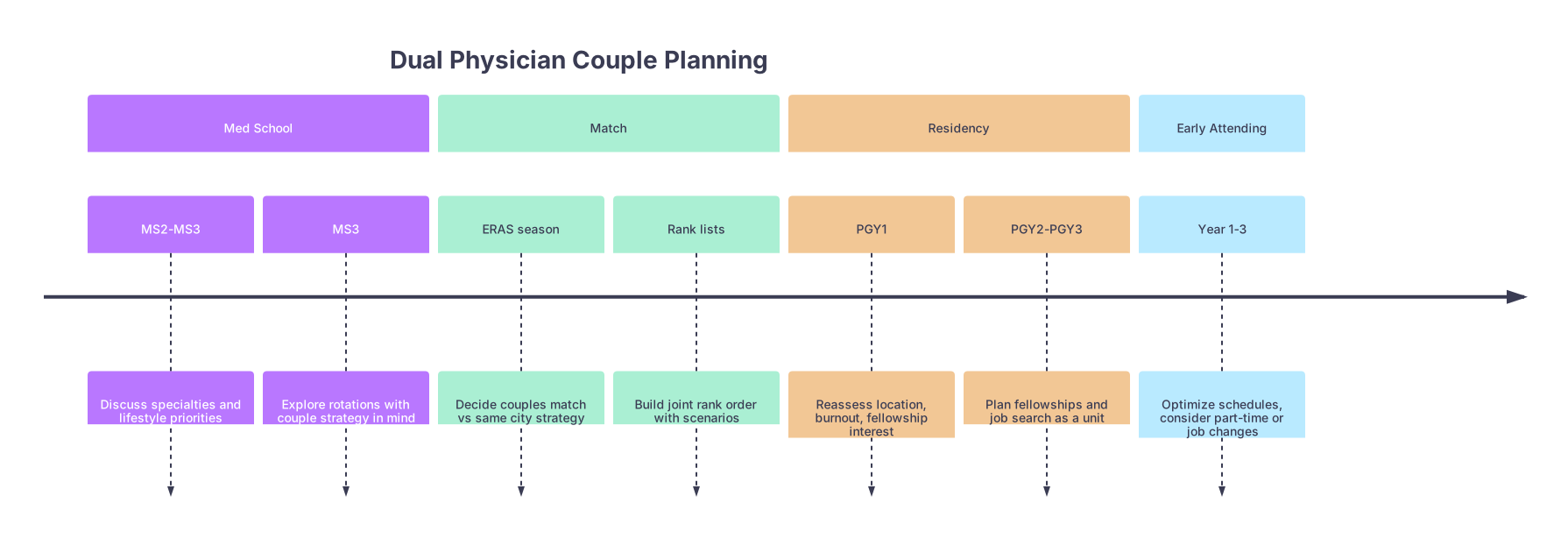
| Period | Event |
|---|---|
| Med School - MS2-MS3 | Discuss specialties and lifestyle priorities |
| Med School - MS3 | Explore rotations with couple strategy in mind |
| Match - ERAS season | Decide couples match vs same city strategy |
| Match - Rank lists | Build joint rank order with scenarios |
| Residency - PGY1 | Reassess location, burnout, fellowship interest |
| Residency - PGY2-PGY3 | Plan fellowships and job search as a unit |
| Early Attending - Year 1-3 | Optimize schedules, consider part-time or job changes |
Med school (especially MS3–MS4)
Don’t choose specialties in a vacuum.
If one of you is dead-set on neurosurgery, the other going into derm, ophtho, or another hypercompetitive lifestyle field may land you in two separate cities for training. That’s a choice, not an accident.Have the “who is more location-flexible” talk early.
If one of you could be happy in FM/Psych/Peds almost anywhere, and the other needs academics for research/fellowship, that matters.Use away rotations strategically.
If you’re planning to couples match, consider doing aways at the same institution or same city if both fields are offered there and the programs are decent for both of you.
Match (including Couples Match logistics)
Couples Match is powerful, but it can also wreck you if you don’t respect the math.
You are effectively ranking pairs of programs. That multiplies very fast and dilutes your chances at highly competitive spots unless you’re both superstar applicants.
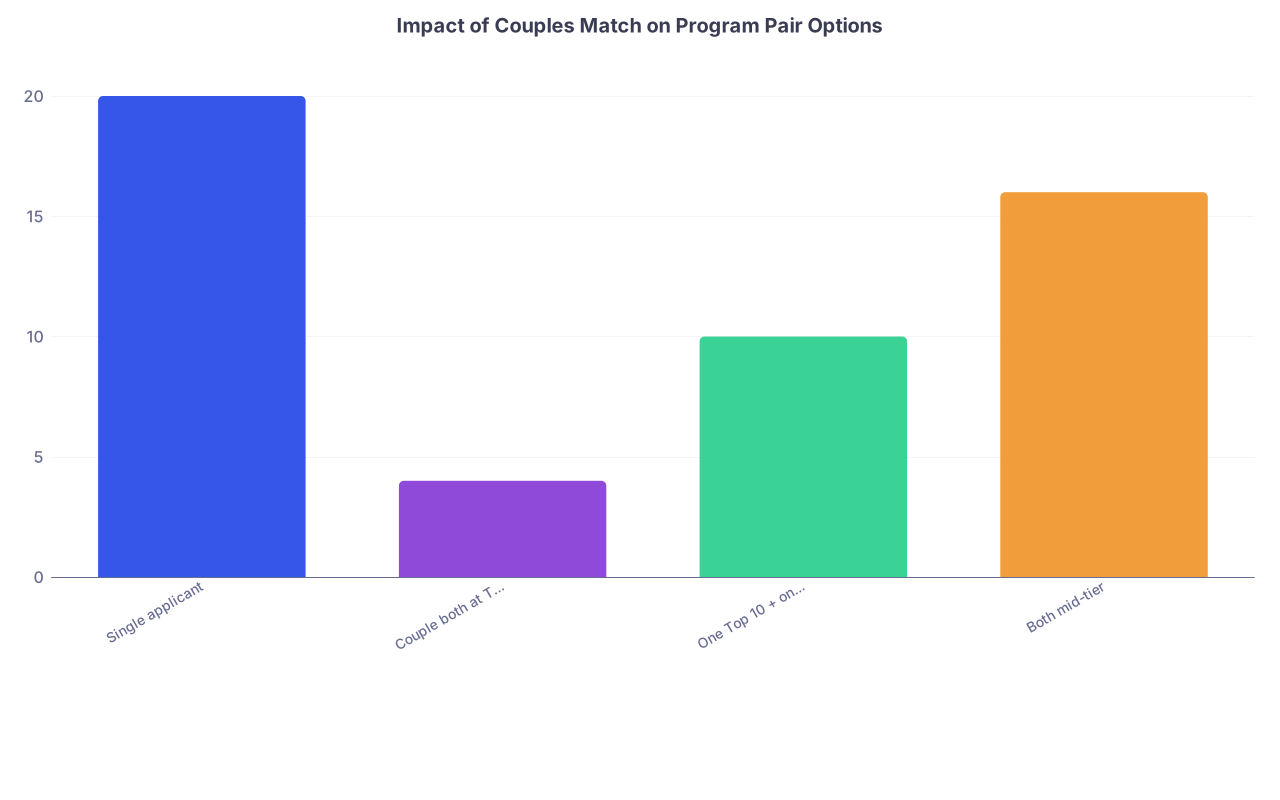
| Category | Value |
|---|---|
| Single applicant | 20 |
| Couple both at Top 10 | 4 |
| One Top 10 + one mid | 10 |
| Both mid-tier | 16 |
Rough idea: if each of you has 4 realistic top options, that’s 16 pairs. If you add mid-tier choices, the pairings explode—but quality and fit may drop.
Specific moves:
Decide together: Are we couples matching or just aiming for the same city/region?
- Couples match if: both your specialties are widely available in the same institutions/regions and you can build a reasonably large list of pairs.
- Consider not couples matching if: one person is in a super-competitive or niche specialty and the other is in a flexible specialty that can more easily follow after.
Don’t both go “prestige or bust.”
A common failure mode: both aim for top-10 programs in different specialties, couples match, rank a skinny list of elite pairings, and end up split or far down the list in places you never really wanted to be.Build your rank list in tiers:
- Ideal city + strong programs for both
- Solid city + strong for one, decent for the other
- Less ideal city + good lifestyle for both, programs fine but not flashy
Residency years
Here’s where lifestyle specialties actually start to show their value.
During residency, reality hits:
- Night float
- 28-hour calls
- Q4 weekends
- Board exams
- New babies
If both of you are in brutal call specialties in programs with no flexibility, you will be trading off missed holidays, child-care chaos, and pure exhaustion.
If one of you is in a lifestyle-friendly residency (Psych, FM, Path, PM&R, many Peds programs), that person often becomes the stabilizer:
- More predictable nights at home
- Ability to cover more non-clinical/life tasks
- Less total emotional depletion
Do not underestimate program culture differences. Two FM programs can feel like entirely different specialties in terms of resident happiness. Same with EM, IM, OB, etc.
When interviewing, ask current residents bluntly:
- “How many residents have kids here?”
- “What happens when a co-resident’s kid is sick and they have to leave suddenly?”
- “How many residents’ partners are also in medicine, and how supported do they feel?”
Programs that actively acknowledge dual-physician couples usually behave better when life happens.
Step 5: Planning for Fellowship (or Why Someone Should Probably Skip It)
Fellowship is where many couples blow up their own lives because they chase “ideal” training with zero strategic planning.
Scenario I’ve seen too many times:
- Person A: IM → Cardiology → Interventional
- Person B: EM in same city
- Person A leaves for 3 years of fellowship in a different city because prestige.
- Now you have two homes, two sets of expenses, potentially kids, and two people working 60–80+ hours a week.
Ask yourselves bluntly:
- Do both of us truly need fellowship for the life we want?
- Can at least one of us stop training after residency and start earning, stabilizing, and gaining location control?
- If we’re both doing fellowships, can we stack them in the same city or at least neighboring ones?
If one of you is already in a lifestyle-friendly field, that person is often the better candidate to skip fellowship and go straight into a stable job in the city where the other is training.
Or, if both of you are lifestyle-leaning fields (Psych + FM, PM&R + Peds), you might decide fellowship only if:
- It adds meaningful lifestyle/control (e.g., pain, sports, sleep, child neuro, etc.)
- You can both do them in the same location
Step 6: Geographic Strategy – Cities That Actually Work for Dual MDs
Some cities are inherently better for dual-physician couples:
- Multiple health systems
- Strong mix of academic + community
- Breadth of specialties
Think:
- Large academic centers: Boston, Philly, Houston, Chicago, Seattle
- Regional hubs: Denver, Minneapolis, Nashville, Charlotte, Raleigh-Durham
- Some mid-sized college towns with strong medical centers: Madison, Ann Arbor, Rochester (MN/NY), Columbus
Smaller cities with one big hospital can work if:
- One of you is in FM/Psych/Peds/IM where there are multiple outpatient groups.
- The other is employed by the main hospital.
But be cautious if:
- You’re both in niche fields (e.g., pediatric neurosurgery + derm). That’s how you end up three hours apart with long commutes or separate homes.
Step 7: Kids, Call, and Coverage – The Unsexy Reality
Lifestyle-friendly specialties are not just about you feeling less tired. They’re about logistical survivability.
Imagine:
- Toddler with a fever at 2 AM.
- One parent on 24‑hour call at the hospital.
- The other on overnight EM shift.
If you don’t have local family or a live-in nanny, that’s a crisis.
Having at least one parent in a specialty where:
- Nights are rare or coverable by partners
- Remote/tele options exist
- Part-time is accepted
…is often the difference between surviving and resenting each other.
Psych, FM, outpatient Peds, many PM&R or Derm jobs, and some Radiology/Path setups can do this very well.
On the other hand, two surgeons with Q3–Q4 call and no family nearby will rely heavily on:
- Live-in help
- Very expensive, very flexible childcare
- Or constant schedule negotiations and last-minute favors
Just be honest: are you OK with outsourcing a lot of parenting? Some couples are. Some are not. Align that with your specialty choices.
Step 8: How to Actually Have the Hard Conversations
All of this falls apart if you’re “too nice” to be direct. So here’s what you actually ask each other.
At a whiteboard, no phones.
“If you could design just your career, specialties, and city, what would it look like?” Each person answers separately.
“Where do these visions obviously collide?”
Write those conflicts down. Don’t smooth them over.Ask:
- “Who is more geographically anchored by family or cultural/community needs?”
- “Who cares more about academic prestige?”
- “Who is more open to a lifestyle-specialty even if it feels less ‘fancy’?”
Then build a joint 10-year sketch:
- Training locations by phase
- Rough plan for when (if ever) to have kids
- Which years will be objectively hardest on each person
You will be wrong in the details. That’s fine. The point is to learn how to think as a unit.
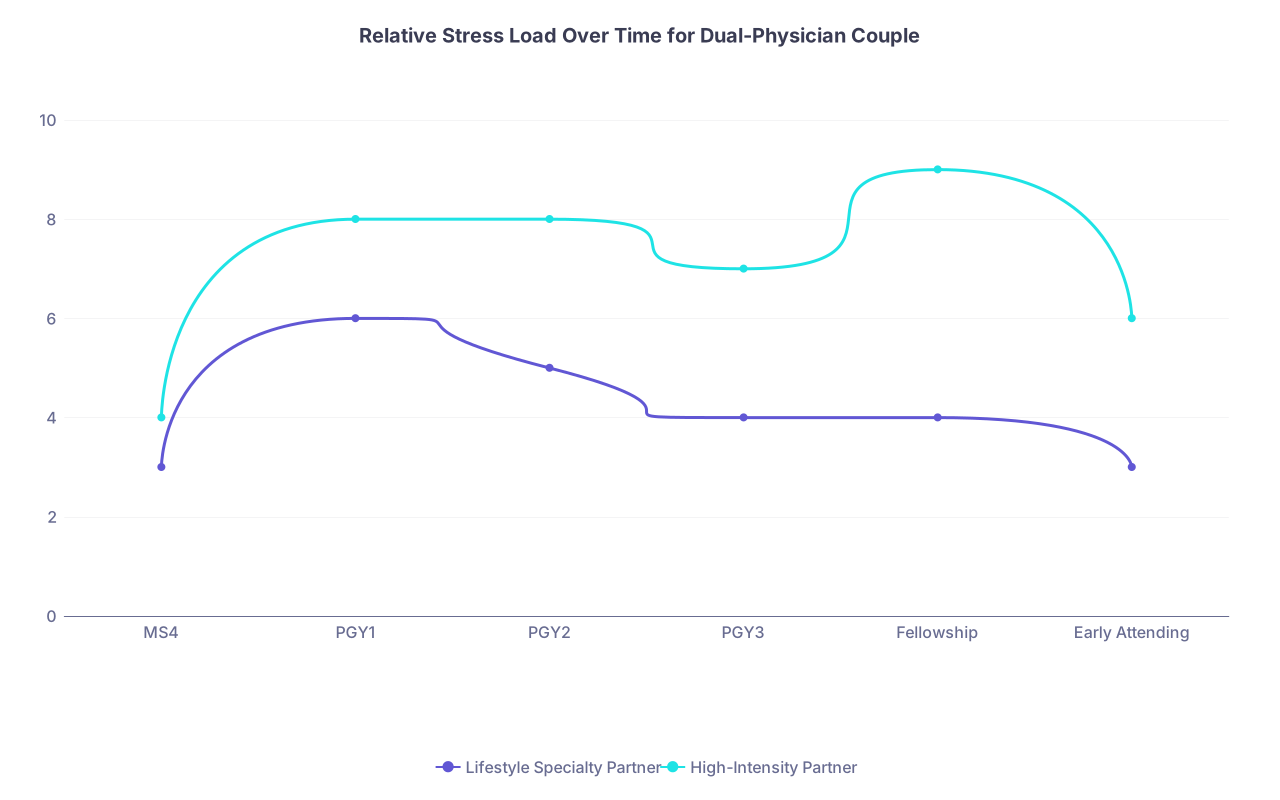
| Category | Lifestyle Specialty Partner | High-Intensity Partner |
|---|---|---|
| MS4 | 3 | 4 |
| PGY1 | 6 | 8 |
| PGY2 | 5 | 8 |
| PGY3 | 4 | 7 |
| Fellowship | 4 | 9 |
| Early Attending | 3 | 6 |
FAQ (Exactly 5 Questions)
1. We’re both interested in lifestyle-friendly specialties. Are we “wasting” our potential?
No. That’s prestige anxiety talking. Two well-trained physicians in FM, Psych, Peds, PM&R, or Derm can have excellent careers, real impact, and a life outside work. What is a waste is building two hyper-competitive, rigid careers you secretly resent because you never see each other or your kids.
2. Is Couples Match always the right choice for dual-physician couples?
No. Couples Match is a tool, not a moral obligation. If one of you is in a very competitive or rare specialty and the other is in a more flexible field, it may be smarter to let the competitive person match freely, then have the flexible partner target that city after. You trade short-term uncertainty for long-term control.
3. How early should we start planning as a couple?
Serious planning starts MS3 when you’re choosing specialties. That’s when your decisions begin to constrain each other’s options. Waiting until ERAS season to “think about it” is how people end up picking specialties that make living together during training nearly impossible.
4. What if one of us changes their mind about specialty or lifestyle priorities mid-residency?
Then you sit down and re-do the whole priorities conversation. People evolve. One partner burning out in a high-intensity field is a valid reason to pivot fellowship plans, job searches, or even consider a second residency if truly necessary. The rule is: no unilateral life-changing decisions without recalibrating as a unit.
5. Should one of us plan on working part-time long-term?
Not automatically. But it’s smart to identify which of you could more easily shift to part-time if needed (often the person in FM/Psych/Peds/OP IM/PM&R/Derm). You don’t have to commit now, but acknowledging who is more structurally flexible can lower anxiety when life throws you surprises.
Key takeaways:
- You’re not two independent careers. You’re a unit, and you should plan like one—starting in med school.
- At least one of you in a genuinely lifestyle-friendly, geographically flexible specialty makes everything else—from the Match to kids to jobs—far easier.
- The couples who do best aren’t lucky. They’re the ones who had hard, specific conversations early and were willing to trade a bit of prestige for a life that actually works.