
Last year a PGY-3 in anesthesia sat in my office, visibly exhausted, trying to smile while telling me he’d just matched into a prestigious cardiac anesthesia fellowship. The same resident who, two years earlier, had told anyone who would listen that he chose anesthesia to “have a chill, flexible career and see my kids.” I just looked at him and thought: there goes your lifestyle, quietly walking out the door.
People think lifestyle is about the specialty you choose. The real trap is subtler. It’s the fellowship and niche you drift into after residency that quietly turns a lifestyle-friendly field into a 24/7 grind you never intended.
Let me walk you through how this actually plays out behind closed doors.
The Myth: “Once I Match Lifestyle, I’m Safe”
The day you match into derm, radiology, anesthesia, ophtho, PM&R, or outpatient psych, you feel like you’ve won the game. You picked a “good lifestyle” field. You’re done, right?
No. That’s just level one.
Program directors won’t say this on interview day, but I’ve heard the same speech in private faculty meetings over and over:
“We need more people going into X subspecialty. Our department is short there. Start nudging them early.”
Translation: your “lifestyle” trajectory is now a resource for the department to deploy. You’re not crazy; you are being steered. And a lot of the fellowships they’re steering you toward are where lifestyle goes to die.
Lifestyle is not binary. Within every “good” specialty there are:
- Pure clinic or shift-based tracks with clean boundaries
- High-intensity niches that look glamorous, pay more, and quietly attach a pager to your spine for the rest of your life
Most residents don’t see that clearly until PGY-4, when they’re already deep into a track that’s hard to undo.
How Fellowships Hijack Lifestyle-Friendly Specialties
Let’s pick apart some of the classic “lifestyle” fields and show you where people accidentally set themselves up for the exact life they were trying to avoid.
Anesthesiology: From Lifestyle to “Living in the Heart Room”
You chose anesthesia for predictable OR days, good pay, minimal notes, and a shift-based life.
Then this happens:
- As CA-2 you spend a month in cardiac. It’s impressive. Big cases. TEE. Surgeons know your name.
- Faculty start saying, “You’re really good at this. You should do cardiac.”
- You like praise. You like being “the best.” You start thinking: “Cardiac is more marketable, and the money’s better.”
Here’s the reality I’ve seen at multiple places:
- Cardiac anesthesia often means early starts, late finishes, and your name at the top of every “sick case” list.
- Call is heavier and more stressful. Those 3 a.m. emergent dissections and ruptured valves? That’s you.
- Once a group knows you’re cardiac-trained, you become the default magnet for cases no one else wants.
Compare two actual attendings in the same group:
| Role | Weekday Hours | Call Burden | Typical Stress Level |
|---|---|---|---|
| General Anesthesiologist | 7a–3:30/4p | 1 in 8 weekends | Moderate |
| Cardiac Anesthesiologist | 6a–5/6p | 1 in 4 weekends + more late add-ons | High |
Same specialty. Wildly different day-to-day life.
The trap is this: cardiac (and similar high-acuity fellowships like critical care) can be great for people who genuinely want that intensity. But most “lifestyle” seekers who match anesthesia don’t realize that saying yes to that fellowship means:
- More early starts
- More nights
- More “you’re the only one who can handle this” cases
- More emotional load when things go south
You can absolutely craft a beautiful lifestyle in anesthesia. But not by blindly following the “prestige” fellowship your PD is cheering you into.
Dermatology: You Can Make It a 9–5… or a Never-Home Business
Derm is the poster child for lifestyle specialties. What people miss is that lifestyle here is shaped less by fellowship and more by the kind of derm you attach yourself to.
But fellowships still matter:
- Mohs / Procedural derm
- Cosmetics / Laser / Aesthetics
These look like the dream: procedures, cash pay, boutique clinics. I’ve sat in partnership meetings where senior docs quietly admit they’re making $800k–$1M+ but are also chained to a high-volume, business-heavy practice that eats their time.
Cosmetics and Mohs often mean:
- Long days packed with procedures (high RVU, high margin… so your partners push for max volume)
- A strong pressure to grow the business: marketing, social media, brand-building, multiple sites
- Patients who expect responsiveness, quick access, and “just squeeze me in” accommodation
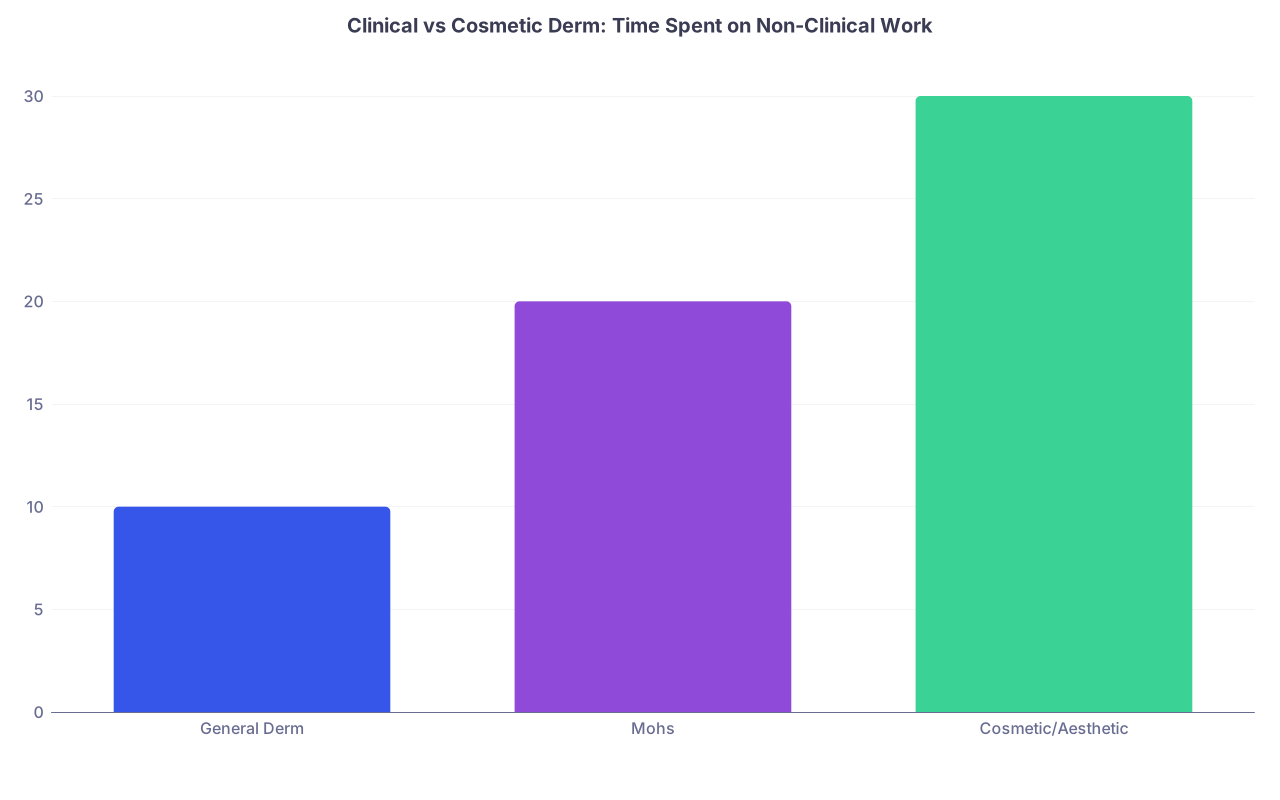
| Category | Value |
|---|---|
| General Derm | 10 |
| Mohs | 20 |
| Cosmetic/Aesthetic | 30 |
That “non-clinical work” bucket is meetings, business strategy, managing staff, handling patient issues, running “events.” It’s not on the brochure when you apply to a fancy cosmetic fellowship in New York or LA.
Is it a bad path? Not at all, if you want entrepreneurial chaos and high upside.
But if your version of “lifestyle” was 4 days a week, low drama, predictable clinic with time to pick up your kids every day, you could have had that as a general dermatologist without ever setting foot in a fellowship.
You just swapped that for a cosmetically oriented career that may pay more but demands more of you.
Radiology: The Subspecialty That Dictates Your Clock
Radiology might be the best example of “your fellowship is your life.”
Residents fantasize about:
- Remote work
- Flexible shifts
- Good pay for reading studies quietly in a dark room
All achievable. But here’s where people quietly ruin it.
Subspecialty dictates:
- How tethered you are to real-time clinical services
- How much night/emergent coverage you’re responsible for
- How easily you can go fully or mostly remote
A simplified snapshot I’ve seen again and again:
| Subspecialty | ED/Night Dependence | Remote-Friendly | Schedule Flexibility |
|---|---|---|---|
| Neurorads | High | Moderate | Moderate |
| Body | High | Moderate | Moderate |
| MSK | Low–Moderate | High | High |
| Breast | Low | Low–Moderate | Clinic-tied |
| IR | Very High | Very Low | Very Low |
IR is the classic example. Tons of residents fall in love with it. Procedures, direct patient contact, feeling like you “do” something tangible. I get it.
What they underestimate:
- IR call is brutal and chronic. Bleeding, strokes, traumas, emergent interventions.
- You’re now another proceduralist on the call schedule, not the quiet rads doc with protected nights.
- Many practices treat IR like a surgical subspecialty, not a lifestyle field.
The same applies, in milder ways, to neuro and body — lots of on-demand reads tied to ED, stroke teams, ICUs.
If your long-term dream was:
- Work from home several days a week
- Stack shifts, have extended stretches off
- Minimize nights and weekends
You don’t get that by reflexively subspecializing in the hottest, most “clinical” niche. You get it by thinking three steps ahead: which fellowship opens more doors for the lifestyle I want, versus locking me into around-the-clock service?
Ophthalmology & ENT: The Complex Case Trap
Both ophtho and ENT start off looking lifestyle-friendly compared to gen surg or ortho. Clinic-heavy, lots of elective OR, decent control of hours once you’re established.
Then fellowship talk starts.
In ophtho:
- Retina
- Cornea
- Oculoplastics
In ENT:
- Head & neck onc
- Otology/neurotology
- Airway, complex reconstruction
The more complex, tertiary-care your fellowship is, the more likely your life is to revolve around:
- Emergency consults
- Transfers from outside hospitals
- Post-op complications on high-risk patients
- Long, mentally draining OR days that don’t end just because the clock hits 5 pm
I watched an ophtho resident choose retina purely for the perceived prestige and paycheck bump. Today, he’s taking weekend call for detachments, late add-on surgeries, and complex follow-ups that derail his days. Meanwhile, his general comprehensive colleagues are doing mostly cataracts, higher volume, and going home on time.
Same specialty. Different micro-choices. Very different evenings.
Psychiatry & PM&R: When Niche Turns the Pager Back On
Psychiatry and PM&R can be remarkably lifestyle-friendly. Outpatient heavy, scheduled clinics, and the ability to strictly cap your hours if you structure it that way.
Fellowships can either preserve that or light it on fire.
In psychiatry:
- C/L psych, emergency psych, forensic, addiction, and certain academic niches can mean a lot more irregular hours, legal entanglements, or constant crisis management.
- A pure outpatient mood/anxiety practice? Very different life. Often no fellowship needed.
In PM&R:
- Interventional pain
- TBI and spinal cord injury
- Sports medicine
Interventional pain is the big trap. High compensation, shiny toys, procedures. But it can come with huge regulatory headaches, DEA scrutiny, demanding patients, and endless prior auth battles. Not to mention the business side: ASC ownership, injections volume pressures, referrals to maintain.
| Category | Value |
|---|---|
| General Derm | 10 |
| Mohs | 20 |
| Cosmetic/Aesthetic | 30 |
(Think of those numbers as “lifestyle risk score.” Lower is safer. Higher means more chance your job eats your brain.)
Again: if you love that work, great. But most residents who chose these specialties for balance never consciously decide, “I want to trade some of that balance for higher complexity and chaos.” They just follow the fellowship current.
Why Residents Keep Walking into These Traps
It’s not because you’re naive or stupid. The deck is built this way.
Here’s what you’re up against, from the inside:
1. Departmental Needs Masquerade as Mentoring
Faculty and PDs rarely say, “We need more X-specialty to cover our service.” Instead you hear:
- “You have a real talent for this.”
- “This fellowship will keep all doors open.”
- “You don’t want to limit yourself to general work.”
Sometimes that’s genuine. Often it’s also “we’re desperate for more people to do nights/weekends in this niche, and you’re recruitable.”
I’ve literally heard in closed meetings:
“We’re short in cardiac and IR. Start getting the juniors excited about those tracks.”
No one says, “By the way, your lifestyle will be worse.” They just highlight prestige and marketability. Conveniently.
2. Prestige and Ego Drive Decisions
Residents are competitive. You’ve spent your entire life climbing to the “top” tier.
So when a fellowship is framed as:
- “Top-tier”
- “Hard to get”
- “Only the strongest applicants go there”
People override their original goals. Lifestyle suddenly feels flimsy next to status.
You wouldn’t believe how many times I’ve seen someone say, “I know it’s rough, but it’s [insert famous program]. I can always back off later.” They almost never do.
3. You Only See the Sexy Parts During Training
During rotations and electives, you see the cool cases, the charismatic attendings, the dramatic saves.
You don’t see:
- 12 consecutive years of interrupted Christmases because you’re the only person with that skillset in your group.
- The 10 p.m. phone calls about a patient you saw three weeks ago who’s decompensating.
- The spouse at home who quietly stopped inviting you to things because “you’re always on call anyway.”
Lifestyle damage is slow and cumulative. Which makes it very hard to grasp as a PGY-3 watching a complex case unfold in a big academic center.
How to Protect a Lifestyle-Friendly Path Before You Sign Up for the Wrong Fellowship
You cannot outsource this thinking to your mentors. Their incentives are not aligned with your life. They’re aligned with their service lines, their department’s gaps, their academic pipeline.
You have to do the ugly, unglamorous work of interrogating what a niche actually looks like 5, 10, 20 years out.
Here’s how to do it like an insider.
Step 1: Define Lifestyle for Yourself in Concrete Terms
Not abstract “work–life balance.” Numbers.
| Priority | Non-Negotiable Target |
|---|---|
| Nights per month | ≤ 2 |
| Weekend days per month | ≤ 2 |
| Typical weekday finish | Out by 5:30 p.m. |
| Remote work | At least 1–2 days/week |
| Vacation | ≥ 4 weeks/year |
If you cannot write this down, you will get swept into someone else’s plan.
Then, when you consider a fellowship, you don’t ask, “Is it lifestyle-friendly?” You ask, “What does this path typically mean for these numbers?”
Step 2: Bypass the Salespeople and Talk to the Exhausted Attending
You want the truth? You do not ask the fellowship director. You talk to:
- The mid-career attending with three kids
- The person 7–10 years out who looks vaguely tired but honest
- The former fellow who quietly left that niche after a few years
Ask them, directly:
- How often are you actually on call?
- How many nights did you sleep in the hospital last month?
- What time do you actually leave on a normal day?
- How much of your work can be done from home?
- If you could go back, would you choose this fellowship again?
Do this at multiple sites. Patterns will emerge quickly.
Step 3: Look at Job Ads Like a Cynical Economist
Fellowship brochures lie. Job ads are more honest if you know how to read them.
Scan postings for your target subspecialty in places you’d realistically live:
- How many mention “participation in call pool required”?
- How often do “competitive compensation” and “high volume practice” show up together?
- Are they advertising “24/7 service,” “rapid growth,” “expanding coverage”?
Then compare that to job ads for generalists in the same specialty.
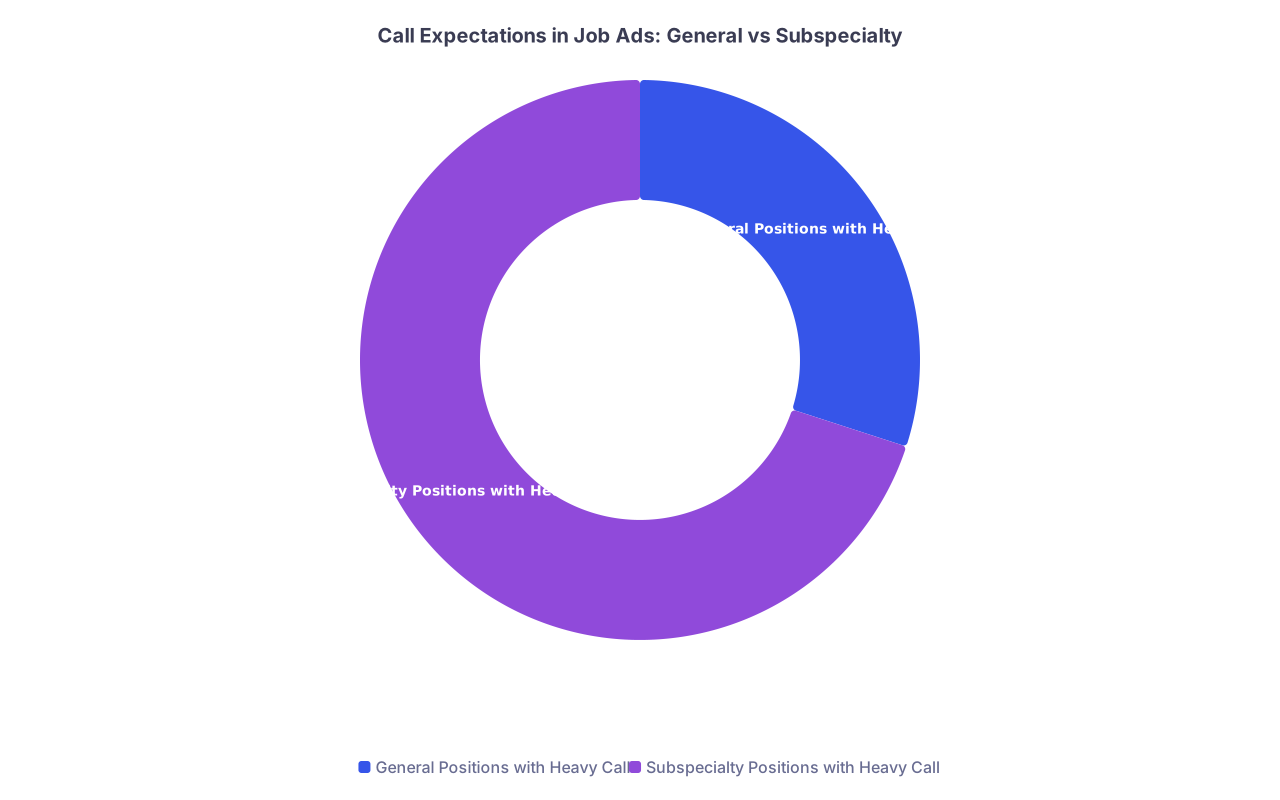
| Category | Value |
|---|---|
| General Positions with Heavy Call | 30 |
| Subspecialty Positions with Heavy Call | 70 |
You don’t need exact statistics. The directional trend is obvious once you read 50 ads.
Step 4: Consider the “Lifestyle Exit Plan” Before You Enter
Smart attendings quietly keep a trapdoor.
They’ll say:
- “I did cardiac for 8 years, now I mostly do general and take light call.”
- “I did IR early on, collected skills and credibility, then transitioned to a more diagnostic-heavy mix.”
- “I used my fellowship to get into a group, then negotiated my way to the schedule I wanted once I had leverage.”
Some fellowships lend themselves to this. Others are harder to unwind. It’s much easier for a general anesthesiologist to keep a good lifestyle than for a single IR doc trying to step back in a small community.
If there is no clear way to throttle down in your 40s and 50s, ask yourself whether that’s really the path you want to strap yourself to.
The Quiet Power Move: Sometimes the Best Fellowship Is No Fellowship
Here’s a dirty little secret a lot of academic folks hate admitting: in many lifestyle specialties, no fellowship may give you the most freedom long term.
Hospitals and private practices need:
- Solid general anesthesiologists
- Bread-and-butter radiologists
- Comprehensive ophthalmologists
- General dermatologists
- Straightforward outpatient psychiatrists
- Broad PM&R docs working in MSK/spine without ultra-niche training
Those roles:
- Have more job options in more locations
- Are easier to flex to part-time or 0.8 FTE
- Are less likely to make you the only one in the group who has to cover a specific high-acuity service
The most content attendings I know in “lifestyle” fields usually did one of three things:
- No fellowship, intentionally staying broad
- A lighter fellowship that refined skills but didn’t tether them to an always-on service
- A heavy fellowship early, followed by an intentional pivot to a more general or mixed role once established
They built optionality. They didn’t just chase the hardest, shiniest fellowship because it looked good on a CV.
Bottom Line: Fellowship is a Multiplier, for Better or Worse
Your specialty choice sets the stage. Your fellowship choice writes the script. Your first job cements it.
Fellowships can amplify a lifestyle-friendly path into something fantastic: flexible schedules, niche expertise, strong negotiating leverage. Or they can drag your “good lifestyle” specialty into a lifestyle that looks suspiciously like the ones you wanted to avoid all along—just with different branding and better coffee.
If you remember nothing else, remember this:
- Do not let prestige, flattery, or departmental needs drive a 30-year decision.
- Define what you actually want your days and weeks to look like.
- Interrogate every fellowship and niche through that lens—ruthlessly, not romantically.
You’re in the phase now where everyone’s talking about “what fellowship are you thinking about?” The real question you should be asking yourself is, “What does 5 p.m. look like for the version of me who chose that path?”
Answer that honestly, and your next moves—rotations, mentors you seek, fellowships you consider or reject—will look very different.
You’ve picked a lifestyle-friendly specialty. Good. The next few years will determine whether it actually stays that way. The first attending contract you sign is where this all gets real. But that’s another conversation, and we’ll get there.