
The programs that sell “great lifestyle” the hardest are often the ones most likely to burn you out.
That sounds backwards, but I’ve watched this play out over and over. Applicants chase “lifestyle-friendly” specialties and get blinded by the promise of protected time, flexible schedules, and happy residents. Then they land in a program where the lifestyle pitch was a smokescreen for low volume, weak training, absent faculty, or a culture that quietly punishes anyone who actually uses those “lifestyle perks.”
You’re applying to radiology, derm, anesthesia, PM&R, path, psych, maybe outpatient-heavy IM or pediatrics. You’re smart to think about lifestyle. You’re not smart if you let the “we’re super chill” sales pitch shut off your radar on interview day.
Let’s protect you from that.
1. The Fake “Happy Resident” Vibe
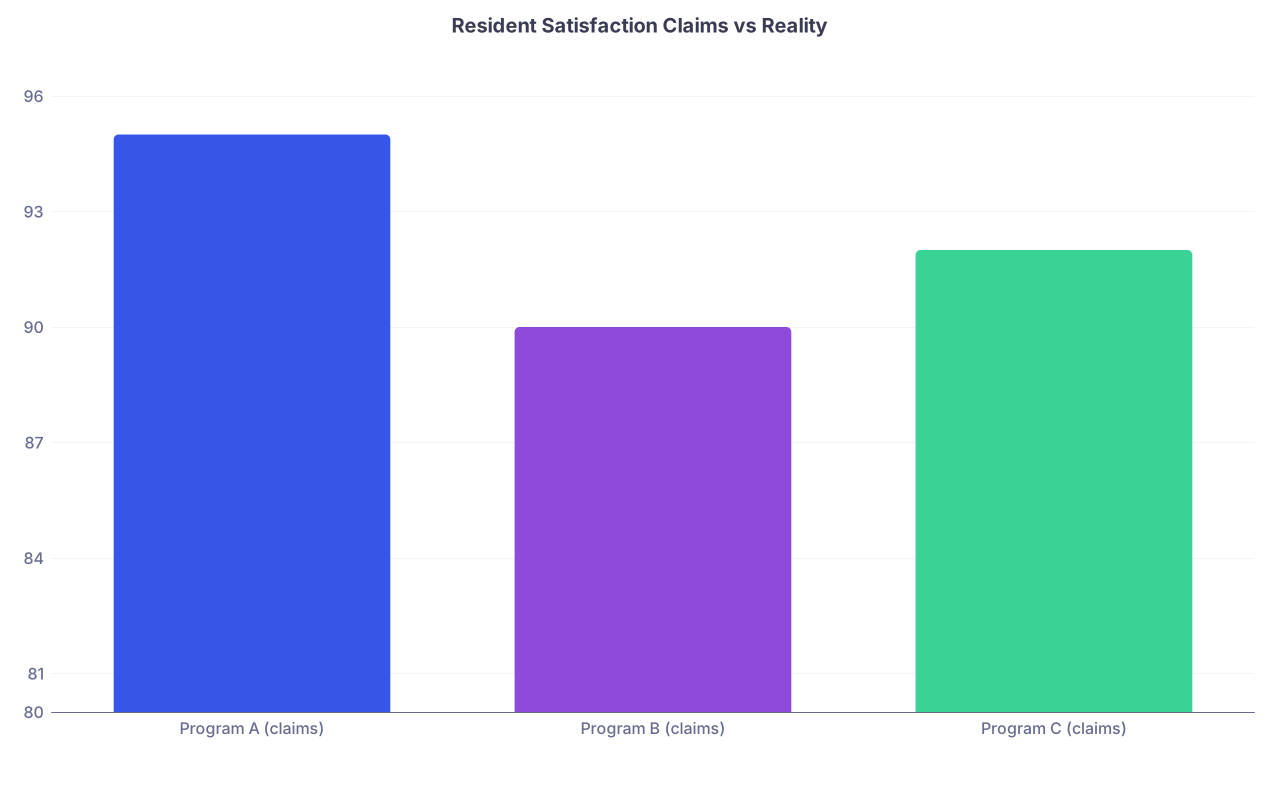
| Category | Value |
|---|---|
| Program A (claims) | 95 |
| Program B (claims) | 90 |
| Program C (claims) | 92 |
Every program claims their residents are happy. The bad ones overcompensate.
Here’s what applicants miss: real happiness looks subtle and specific. Faked happiness looks loud and vague.
Watch for these red flags in “lifestyle-friendly” programs:
Residents speak in slogans, not specifics.
If you ask, “What does your typical day look like?” and you get, “Oh, it’s super chill, we have great work-life balance” without actual times, numbers, or examples, that’s a problem. Happy residents usually say, “I’m here 7–5 most days, maybe one late night a week, and I can still get to the gym and see my partner.”Group-think answers at the social.
You ask, “Do you feel supported when you’re struggling?” and five residents at the table all say the same canned phrase: “We’re like a family here.” That’s not an answer. That’s a script. Real support sounds like: “When my dad was in the hospital, my PD helped rearrange my rotation so I could be there.”Residents dodge any question about conflict or change.
If you ask, “What’s something you’d improve about the program?” and everyone suddenly gets cagey or says, “Honestly, nothing,” walk away. That’s either fear or delusion. Neither is lifestyle-friendly.
What you want instead:
Concrete, even slightly messy answers. Someone who says, “Yeah, nights are rough. But it’s q4, we get post-call truly off, and seniors step up if you’re drowning,” is more trustworthy than the person telling you it’s all rainbows.
If the vibe feels like you’re talking to PR reps instead of exhausted but honest humans, believe that feeling.
2. “Low Volume” That’s Actually Low Training
In lifestyle-oriented specialties, people fall into a dangerous trap: confusing low volume with good lifestyle.
I’ve seen this in:
- Dermatology programs with almost no complex med-derm or surgical volume.
- Radiology programs where residents complain Step 3 was harder than their daily cases.
- Pathology programs boasting about how “chill” the call is because there basically isn’t any.
Less work today can mean worse options later. You don’t want to graduate undertrained and unemployable.
Here’s how low-volume red flags show up on interview day:
Residents brag about how little they work but struggle to describe what they’re actually learning.
“We’re usually out by 2 or 3” sounds nice until you ask, “How’s your exposure to X (peds derm, neuro-rads, cardiac anesthesia)?” and they shrug.No one talks about graduates going to strong fellowships or competitive jobs.
Ask directly: “Where have recent grads gone for fellowship?”
If you get, “Some stay here, some do private practice,” with no specifics, that’s code for: we aren’t competitive.The program director emphasizes “wellness” and “balanced volume” but dodges outcome data.
They should be able to tell you board pass rates, procedure numbers, case logs, and job placement with confidence.
Use your specialty’s norms. For example:
| Specialty | Healthy Training Volume Signal | Red Flag Signal |
|---|---|---|
| Derm | Mix of complex med-derm, peds, surgery cases | Mostly acne, rashes, cosmetics |
| Radiology | Solid overnight call, trauma, diverse modalities | Very little call, mostly outpatient plain films |
| Anesthesia | Regular OR exposure, critical care time | Mostly healthy elective cases, minimal ICU |
| PM&R | Adequate inpatient rehab + EMG + MSK | Outpatient only, almost no procedures |
| Psych | Inpatient, outpatient, consults, variety | Purely outpatient clinic, minimal acute care |
Do not let “we go home early” distract you from “we barely see anything complex.” That’s how you end up stuck or scrambling for extra training later.
3. The “Wellness Theater” Programs

Some places weaponize wellness language to cover up their issues. The more wellness posters you see, the more suspicious you should be.
Signs of wellness theater:
- They show you the nap room, the wellness room, the meditation space… but you never hear residents say they actually use them.
- Leadership brags about “wellness initiatives” but residents look tired, guarded, or cynical when it comes up.
- “We have a wellness committee” gets repeated ten times, but no one can describe one concrete, resident-driven change that actually improved their lives.
Ask these questions and pay close attention to resident faces when they answer:
- “Do you ever get called in on your post-call day?”
- “Have any wellness changes actually happened in the last year from resident feedback?”
- “If you’re sick, can you truly call out without fallout or guilt?”
The biggest red flag: systems that claim to protect your time but don’t have backup plans.
For example, in a supposedly chill anesthesia program: “We’re never here past 5” … until there’s no one to relieve you and staying late becomes normal. That’s not wellness. That’s understaffing dressed up as “teamwork.”
You want programs where wellness isn’t a separate “initiative.” It’s baked into scheduling, coverage, and a culture where saying “I need help” doesn’t get you labeled as weak.
4. “Lifestyle-Friendly” Because Residents Cover Everything
A nasty little trick: some programs decrease attending presence and call it “autonomy” and “flexibility,” while dumping the work onto residents.
I’ve seen:
- Lifestyle-obsessed rads programs where overnight “home call” actually means you’re glued to your workstation all night, solo, with minimal backup.
- Psych programs where attendings are mainly telehealth or part-time, leaving residents to handle all the chaos, supposedly for “independence.”
- Path programs where residents do grossing, frozen sections, AND endless scut because the staff is thin.
On interview day, red flags:
- Residents describe long stretches with no in-house attending overnight.
- “We have a lot of independence” with an edge of anxiety in the voice.
- Attending offices are often empty; tours feel weirdly quiet for a teaching hospital.
- Faculty you meet are mainly part-time or split across multiple sites.
Ask:
- “How often do you staff cases directly with attendings?”
- “On nights, who is physically in-house? Who is available by phone?”
- “How many full-time faculty are primarily dedicated to this program?”
If attendings are rarely around but residents are “autonomous,” guess who’s really holding the bag. That’s not lifestyle. That’s risk.
5. The “Everyone Gets Along” Lie
You’ll hear this phrase on almost every interview day: “We all get along; we’re like a family.”
Sometimes it’s true. Often it means: we don’t talk about conflict here, and if you’re different, you’ll be isolated fast.
Here’s how to distinguish real camaraderie from fake harmony:
Real camaraderie looks like:
- Residents teasing each other, interrupting, being casual even when leadership is around.
- Different personalities: introverts, extroverts, parents, single people, nontraditional residents.
- Someone openly admitting, “Yeah, we had some issues with X last year, but we worked through it by doing Y.”
Fake harmony red flags:
- Everyone is weirdly aligned in personality and opinions.
- No one mentions a single challenge, disagreement, or improvement needed.
- Diversity—of race, background, or thought—is thin or performative.
You must ask about conflict directly:
- “How does the program handle a resident who’s struggling?”
- “Have there been any major changes based on resident complaints?”
- “If you had a problem with an attending, who would actually listen?”
If the answers are vague, or everyone glances at each other before speaking, your “friendly” program might actually be a place where problems get buried and resentment simmers. That’s not a lifestyle you want for three to seven years.
6. Opaque Schedules and Hand-Wavy Workload Answers

| Step | Description |
|---|---|
| Step 1 | Ask about typical day |
| Step 2 | Ask about outliers |
| Step 3 | Probe for specifics |
| Step 4 | Red flag - hiding workload |
| Step 5 | Clarify expectations |
| Step 6 | Gets clear answer |
| Step 7 | Still vague |
Any program that really respects your time will be proud of their schedule. They’ll know their numbers cold.
Lifestyle-red-flag programs are weirdly vague:
- “It depends on the rotation.” But they never give actual ranges.
- “We try to keep it reasonable.” That’s a non-answer.
- “You’re never here too late.” Too late for who?
Do not accept squishy answers. You’re signing up for years of your life.
Ask for:
- Start and end times on core rotations.
- Number of nights per month, and how often you’re post-call truly off.
- Weekend frequency and what “weekend call” actually means.
Then compare what residents say to what leadership says. If the PD claims, “Most residents are out by 4,” and residents quietly tell you, “We’re usually here till 6,” believe the residents. That disconnect is a huge red flag.
Also watch for:
- No one can show you a sample schedule.
- They avoid talking about recent changes to duty hours.
- “We’ve been working on fixing that” without clear evidence of progress.
A lifestyle program that cannot provide transparent, concrete schedule expectations is either disorganized or hiding something. Both will wreck your life.
7. Toxic “Chill” = Low Expectations, Low Support, Low Standards
There’s another side to this. Not all bad programs are malignant. Some are apathetic.
These are the “chill” residencies where:
- No one pushes you.
- Feedback is rare or superficial.
- You can coast and no one really notices.
Sounds relaxing. Until you realize you’re graduating without skills, confidence, or solid letters.
Warning signs:
- Residents repeatedly say, “They leave us alone a lot,” but cannot point to structured teaching conferences, feedback, or mentorship.
- Faculty seem disengaged on interview day—late to sessions, checking phones, giving minimal answers.
- No one can name a specific attending who’s known for excellent teaching or career support.
Ask:
- “How often do you get direct feedback on your performance?”
- “Who do you see as your main mentor here?”
- “What does a strong resident look like to this program? How do they differentiate themselves?”
If the answer sounds like: “As long as you show up and don’t cause trouble, you’re fine,” that’s not lifestyle. That’s stagnation. You will pay for that later when you need strong fellowship or job applications.
8. The “Resident-Led” Program That’s Actually Resident-Run
Some smaller or community programs, especially in lifestyle fields, sell themselves as “resident-led” with tons of leadership opportunity. Sometimes that’s great. Sometimes it means residents are doing jobs attendings or admins should be doing.
Red flags:
- Residents are heavily involved in scheduling, call redistribution, covering system gaps.
- Residents talk about having to “fight” for changes rather than being heard.
- Leadership brags about being hands-off while residents clearly hold the program together.
Listen for:
- “We made our own curriculum because…” – followed by a story of abandonment, not empowerment.
- “We had to push really hard to get X basic thing (like protected didactics, call rooms, or backup call).”
Leadership should be there to protect your time and your education, not lean on you to manage chaos that’s above your pay grade.
9. Ignoring Board Pass Rates and Outcomes Because “Lifestyle”
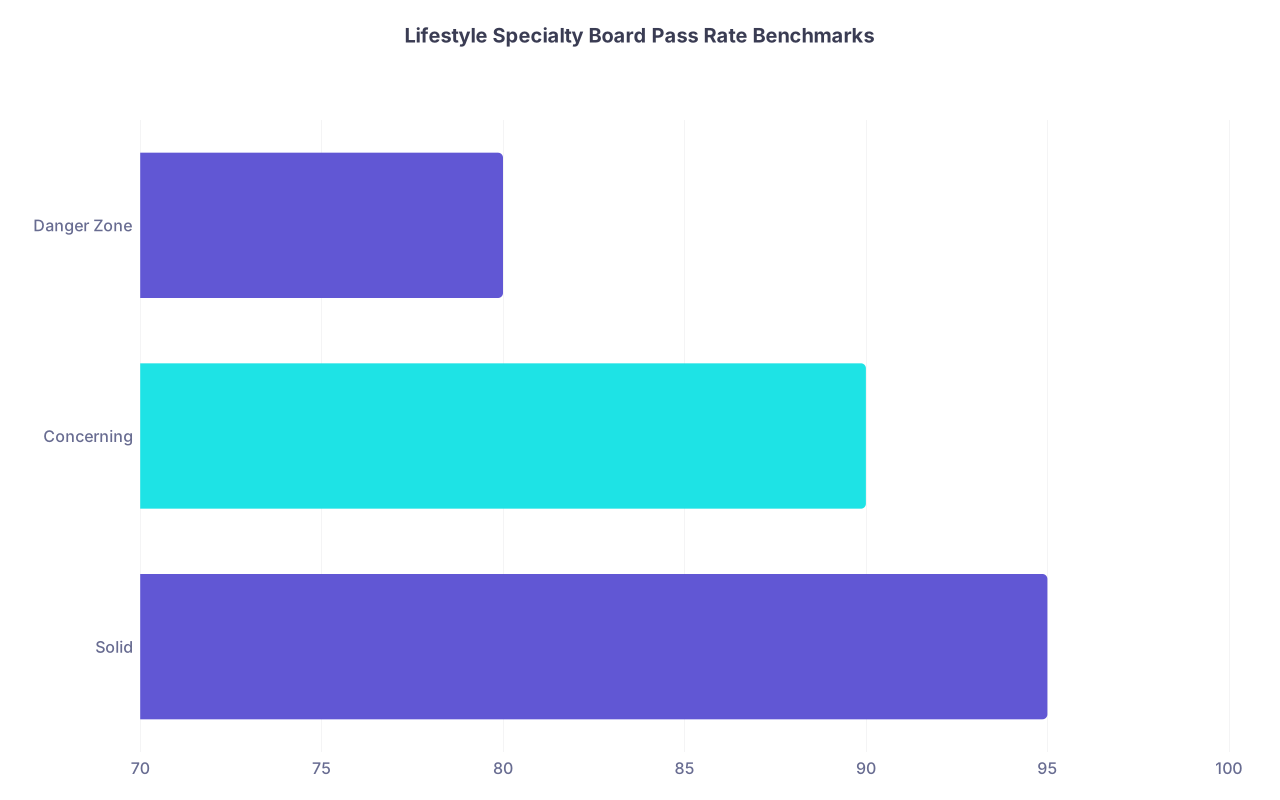
| Category | Value |
|---|---|
| Solid | 95 |
| Concerning | 90 |
| Danger Zone | 80 |
This one makes me a little angry. Some programs lean so hard on their “great lifestyle” pitch that applicants forget to ask the one question that will define your future:
“What are your board pass rates and where do your graduates end up?”
If a program cannot easily show:
- Consistently high board pass rates for your specialty
- Graduates getting good jobs or fellowships that you’d actually want
…then all the talk about early afternoons and light call is meaningless. You’re being sold a vacation, not a training program.
On interview day:
Ask the PD directly:
“What have your board pass rates been over the last 5 years?”
Ask residents:
“Do you feel prepared for boards? How strong is the program’s support for exam prep?”
Huge red flag if:
- They dodge the question.
- They only talk about a single great year.
- Residents privately admit, “We mostly prep on our own, there’s not much structure.”
Lifestyle without competence is a trap. Employers and fellowship directors don’t care how well-rested you were in residency if you can’t do the job.
10. The Gut Feeling You Keep Explaining Away

You know that weird, low-grade discomfort you feel sometimes on an interview day? When everything sounds good on paper, but something in the air feels off?
Do not ignore that.
Common internal warnings you should listen to:
- “Everyone said the right things, but I don’t think they believed them.”
- “I felt like I had to be careful what I asked.”
- “Residents looked tired in a way that didn’t match the lifestyle they were selling.”
- “I can’t picture myself hanging out with these people or being honest with them.”
Applicants make a huge mistake by treating their rank list like a math equation: board scores + location + lifestyle = decision. It’s not math. It’s three to seven years of your life, your health, your relationships.
If your gut says, “Something’s wrong here,” you don’t always need to know exactly what. Just don’t rank that program high because the schedule looked pretty on paper.
11. How to Pressure-Test “Lifestyle-Friendly” Claims in Real Time

Here are concrete ways to test whether a program’s “great lifestyle” is real or a trap:
Ask residents:
- “Walk me through your last week—what time did you arrive and leave each day?”
- “When was the last time you felt truly overwhelmed here, and what happened?”
- “What’s one thing you wish you’d known about this program before you matched?”
- “If you could go back, would you rank this place first again? Why or why not?”
Ask faculty/PD:
- “What’s changed in your program in the last 2–3 years because of resident feedback?”
- “What are you actively trying to improve right now?”
- “What do you think makes this program hard, even with the good lifestyle?”
Then, notice:
- Do residents and faculty give consistent stories?
- Does anyone acknowledge challenges without looking terrified?
- Is there humility and forward movement, or just defensive sales talk?
And one more test:
Ask residents what other programs they interviewed at and why they picked this one over those. If the only answer is “location” or “it was chill,” that’s thin. If they say, “I chose here over [well-known program] because training here is strong but you can still have a life,” and they give specifics, that’s different.
Final Takeaways: Don’t Be the Person Who Learns This Too Late
Let me boil this down, because if you remember nothing else, remember this:
Real lifestyle-friendly programs don’t need to oversell it.
They’ll talk concretely about schedules, case volume, and support. Residents will be honest about what’s hard and what’s good. You’ll feel like you can breathe there.Beware “chill” programs that quietly undertrain you or overload you.
Low volume, absent attendings, wellness theater, vague answers, and weak outcomes are all red flags dressed up as “balance.”Take your gut seriously.
If the data and the vibes don’t match—or if everyone sounds perfect but nothing feels real—do not talk yourself into ranking them high just because they promised you more free time.
You can have a good life in residency and still become an excellent physician. Just don’t trade your future competence and sanity for a glossy “lifestyle” brochure that falls apart the second you start intern year.