
The wrong fellowship can turn a chill specialty into a 2 a.m. dumpster fire. And it happens all the time.
If you chose a “lifestyle” specialty on purpose—radiology, anesthesia, pathology, PM&R, derm, ophtho, etc.—you’re playing a different game than the people chasing trauma nights and transplant call. But then graduation looms, everyone is “doing a fellowship,” and residents casually walk themselves into call-heavy, burnout-prone niches that completely break the lifestyle they built their whole identity around.
I’ve watched radiology residents who loved 8–5 reading rooms end up in neuro call hell. Anesthesiology residents who wanted predictable days suddenly chained to a pager as cardiac fellows. PM&R residents who thought they were signing up for outpatient MSK but accidentally chose a stroke-heavy inpatient fellowship that wrecked their sanity and their marriage.
These are not rare horror stories. They’re predictable outcomes from predictable mistakes.
Let’s walk through the biggest fellowship-choice errors that turn lifestyle-friendly specialties into call nightmares—and how you avoid them before you sign away your next 1–3 years.
1. Assuming “Lifestyle Specialty = Lifestyle Fellowship”
This is the foundational error. If you get this wrong, everything else follows.
Residents think:
- “Radiology is lifestyle, so any fellowship in rads must be chill.”
- “I chose anesthesia because I want control over my schedule; a year of cardiac will be fine.”
- “PM&R is outpatient and flexible, I’ll just pick the fellowship that sounds impressive.”
That’s how you go from:
- 1–2 weekends a month → every other weekend plus late evening add-ons
- Predictable days → “we don’t leave until the list is done”
- Home call that’s mostly quiet → your pager is a grenade
Concrete reality check
Here’s a rough sense (and yes, there are exceptions) of how fellowship choice can radically swing call burden inside “lifestyle” specialties:
| Base Specialty | More Lifestyle Fellowships | Higher-Call Fellowships |
|---|---|---|
| Radiology | Breast, MSK, Body MRI | Neuro IR, ER, some IR |
| Anesthesiology | Regional, Pain (outpatient) | Cardiac, Critical Care |
| PM&R | MSK, Pain, Sports | SCI, TBI, Neurorehab |
| Dermatology | Cosmetic, Laser, Cosmetic Derm surg centers | Oncologic derm in tertiary centers |
| Ophthalmology | Comprehensive, some refractive | Retina, Oculoplastics (ED-heavy settings) |
The mistake: choosing “interesting” or “prestigious” without asking, “What does call actually look like in this subspecialty at the kind of place I’m likely to work?”
You don’t pick a fellowship title. You pick a life.
What to do instead today:
Pull the current fellow aside in each program you’re vaguely interested in and ask one blunt question: “How many nights and weekends did you have your pager on in the last 4 weeks?” If they hesitate, that’s your first red flag.
2. Confusing Academic Call Patterns with Real-World Jobs
Fellowship call ≠ real-world call. But people misread both, in both directions.
Two classic mistakes:
- “This fellowship has brutal call, but real jobs will be cushy.”
- “This fellowship seems chill; I’ll easily find that schedule after graduation.”
I’ve seen plenty of anesthesiology residents do a cardiac or critical care fellowship at a big academic center with 1–2 in-house nights per week and think, “It’s just one year.” Then they graduate into a community hospital where:
- There are only 2 cardiac-trained anesthesiologists
- They’re now on home call every other night for any emergent CABG
- Weekends become landmines of “urgent add-on” cases
Same story in radiology:
- Neuro or IR fellowship with Q3 call in training
- Post-fellowship “lifestyle” job is actually a regional referral center where neuro/IR call is essentially “you own the nights”
The trap formula
Residents fall for some version of:
“It’s just a year. And later I’ll pick a nicer job.”
Except:
- Your skill set locks you into certain practice types
- The jobs that really need you often have the worst call
- “Market demand” very often = “nobody else wants these hours”
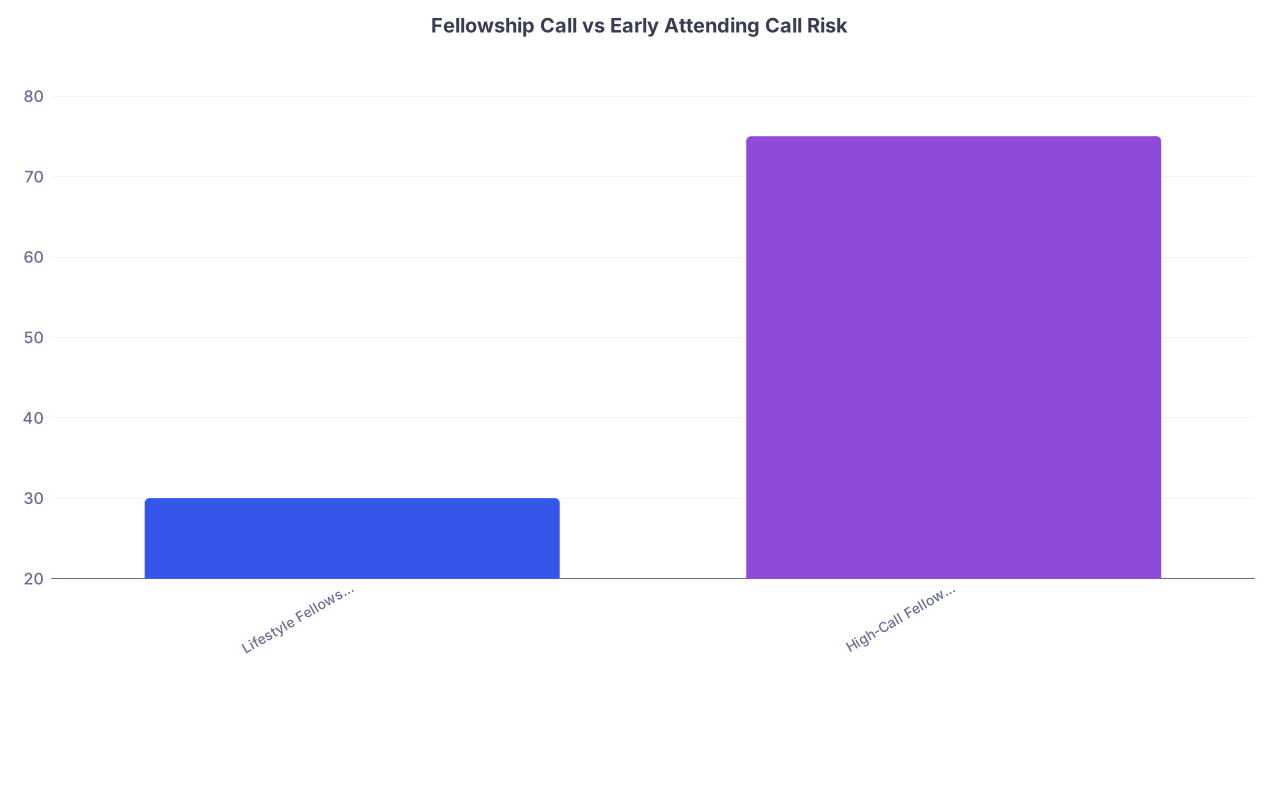
| Category | Value |
|---|---|
| Lifestyle Fellowship | 30 |
| High-Call Fellowship | 75 |
Rough translation: if your fellowship is heavy call in a rare or high-intensity niche, your first attending job probably will be too.
Protective move:
When you talk to faculty in your desired fellowship, ask specifically:
- “Where did your last 5 fellows go?”
- “How many of them take in-house or frequent home call now?”
- “Are they mostly at community or tertiary centers?”
If they start bragging about “all level 1 trauma centers” and “quaternary referral centers,” mentally translate that to: your nights and weekends are not safe.
3. Ignoring the Shift From In-House Call to Home Call (That Isn’t Really Home)
A lot of lifestyle people tell themselves a comforting lie:
“It’s home call, so it won’t be that bad.”
This is exactly how anesthesiology, radiology, PM&R, and even derm folks end up exhausted with “no official in-house call” on their contract.
Home call can be worse than traditional call when:
- You’re chronically half-awake, never fully off
- You’re constantly logging in from home to review studies/notes
- You’re driving in multiple times a night from 20–30 minutes away
- The rest of the team “counts” your home call as “not real work,” so you’re still expected to be sharp at 7 a.m.
I’ve heard some combination of this at nearly every hospital:
“Yeah it’s home call, but they really want you to come in for pretty much everything.”
Here are red flag phrases in fellowship interviews or recruitment emails:
- “Mostly home call”
- “We don’t track RVUs on call nights” (translation: you’ll do a ton of work for free)
- “Our fellows are incredibly dedicated” (translation: they tolerate abuse)
- “You’re rarely called in more than X times per night” (rarely = regularly enough to mention)
Questions you must ask current fellows:
- “How many nights per month are you on home call?”
- “How many nights last month did you get zero calls?”
- “How often do you end up driving in after midnight?”
- “What time do you actually leave the hospital the day after a bad call?”
Do not accept “it depends” as an answer. Push for numbers.
4. Chasing Prestige Over Predictable Sleep
This is the ego trap.
You’re in a lifestyle specialty. You picked it for good reasons—family, hobbies, sanity, a long game career. Then someone says “cardiac,” “neuro-IR,” “retina,” “stroke,” “oncologic derm,” and your brain shifts from “life I want” to “look how elite I am.”
Here’s what prestige-over-lifestyle sounds like in real time:
- “I don’t want to be ‘just’ a general anesthesiologist.”
- “Everyone in my program is subspecializing; I don’t want to seem less ambitious.”
- “I should do a neuro fellowship so I’m marketable everywhere.”
- “Sports/MSK is too ‘soft’; spine or SCI is more serious medicine.”
But your body does not care about your prestige. It only cares about:
- How often it gets to sleep more than 4–5 hours uninterrupted
- Whether it’s getting paged at midnight, 2 a.m., and 4 a.m.
- Whether you ever get a real weekend
Prestige-heavy fellowships that regularly blow up lifestyle:
- Cardiac anesthesia in high-volume CT centers
- Critical care for anesthesiology or IM folks at academic ICUs
- Neuro interventional radiology/IR in trauma-heavy hospitals
- Retina fellowship in places with constant ED consults for vision changes
- Certain stroke/SCI PM&R fellowships that function like 24/7 internal medicine services
Sometimes the right answer for a lifestyle-focused resident is extremely unsexy:
- General radiology with extra exposure in MSK or body
- Regional anesthesia instead of cardiac
- Pure outpatient MSK/pain with strong ultrasound skills
- Refractive/cataract instead of retina
- Cosmetic derm instead of oncologic derm in a cancer center
Brutal but true:
If you care more about your shift end time than the name of your fellowship, you’re allowed to choose the “less prestigious” option. Future you will be grateful when you’re actually home for dinner.
5. Not Matching Fellowship Choice to Realistic Job Market
Another way to destroy your lifestyle: pick a fellowship that virtually guarantees you’ll work in the worst-call environments because that’s where the demand is.
Examples I’ve actually seen:
A radiology resident who wanted a quiet community hospital job does neuro IR.
Reality: community hospitals don’t need a full neuro-IR service; level 1 trauma centers do. Lots of nights. Lots of ruptured aneurysms at 3 a.m.An anesthesia resident who loves outpatient ortho and regional does cardiac.
Reality: cardiothoracic surgery is not an ASC kind of operation. They end up at a big hospital with 24/7 CABG coverage.A PM&R resident who hates inpatient but wants to be “marketable” does SCI.
Reality: they’re now tied to academic or regional rehab centers with big inpatient services—and yes, call.
The market often channels certain fellowships into specific practice settings:
| Fellowship Type | Most Common Job Setting | Call/Lifestyle Risk |
|---|---|---|
| Cardiac Anesthesia | Large hospital / CT center | High |
| Neuro IR / IR Radiology | Level 1 trauma / referral center | Very High |
| SCI / TBI PM&R | Academic rehab / big hospital | Moderate–High |
| MSK Radiology | Community / outpatient imaging | Lower |
| Outpatient Pain (PM&R/Anes) | Private practice / ASC | Lower–Moderate |
| Breast Imaging | Outpatient breast centers | Lower |
Does every job follow these rules? No. But if you ignore these patterns, you’re willingly walking blindfolded toward the part of the market that works nights and weekends.
Reality check exercise (do this now):
- Go to 2–3 job boards (e.g., GasWork for anesthesia, ACR for rads, AANEM, AAPM&R, AAO, ASDS).
- Search for jobs with your dream fellowship.
- For 10 postings, write down:
- Practice type (academic, community, private)
- Call expectations listed
- Repeat for a more lifestyle-friendly fellowship in the same specialty.
You’ll quickly see which paths statistically lean toward nights and weekends.
6. Believing Program Leadership’s Version of “Not That Bad”
If you want to ruin your future lifestyle, rely on program directors and faculty to honestly describe call intensity.
They’re not lying to you. But they are deeply acclimated to pain.
Common translation guide:
- “Call is reasonable” = nobody has technically died from it
- “It ebbs and flows” = you’ll have random weeks from hell
- “We’re working on improving coverage” = it will get worse before it gets better
- “Our fellows handle call well” = we’ve selected for people willing to tolerate this
I’ve heard attendings say with a straight face:
- “Our fellows only cover 1 hospital at night” (but it’s a 1,200-bed tertiary center)
- “You’re off post-call” (except for that ‘quick’ noon conference and the 3 leftover tasks)
- “This year has been busier than usual” (they say that every year)
Who you should believe instead:
- Current fellows
- Recent grads (1–3 years out)
- Mid-career attendings who changed jobs because of call
Ask the same questions to all of them and look for patterns, not polished answers.
7. Underestimating How Much Call Wrecks You After Age 30
Lifestyle specialties often attract people who think long term: family, hobbies, fitness, not living at work.
Then they temporarily forget that 2 a.m. hits differently at 35 than 25.
You might be tolerating Q4 trauma nights in residency right now. You might even think, “This isn’t so bad. I can handle a few more years of this.” That illusion is one of the biggest fellowship traps.
Here’s what chronic high-call fellowships do to lifestyle-specialty residents:
- Normalize terrible sleep as “just a phase” (that somehow keeps extending)
- Train you to accept that late nights and weekends are part of being “serious”
- Shrink your energy for relationships, parenting, and anything outside medicine
Then you stack your early attending years on top of that because your niche only exists in high-acuity centers.
And suddenly you’re 38, still waking up at 2 a.m., 10–15 times a month, wondering where that lifestyle you planned went.
Harsh truth:
If you’re already counting down to the end of residency call, you have no business signing up for a fellowship that doubles down on nights and weekends. Your tolerance will not magically increase.
8. Forgetting That You Don’t Have to Do a Fellowship
The sneakiest mistake: assuming fellowship is mandatory when it isn’t.
For many lifestyle specialties, fellowship is optional. Or situational. Or only beneficial if it fits the exact job you actually want.
Residents still default to:
- “Everyone is doing one.”
- “I don’t want to be behind.”
- “Fellowship will give me more control later.”
The reality:
- In radiology, generalists are still extremely employable—especially in community practice—with often better lifestyle than niche subspecialists tethered to high-acuity services.
- In anesthesia, a good generalist with solid regional skills can build an excellent lifestyle in community groups or ASCs without ever stepping into a CT OR at 2 a.m.
- In PM&R, a well-rounded resident with strong MSK, EMG, and functional skills can land outpatient-heavy positions without a credential that chains them to inpatient call.
Sometimes the actual answer for lifestyle is:
- Skip fellowship.
- Take a general job with strong mentorship and clear call structure.
- Use CME and targeted short courses to sharpen niche interests without reconfiguring your whole life around them.
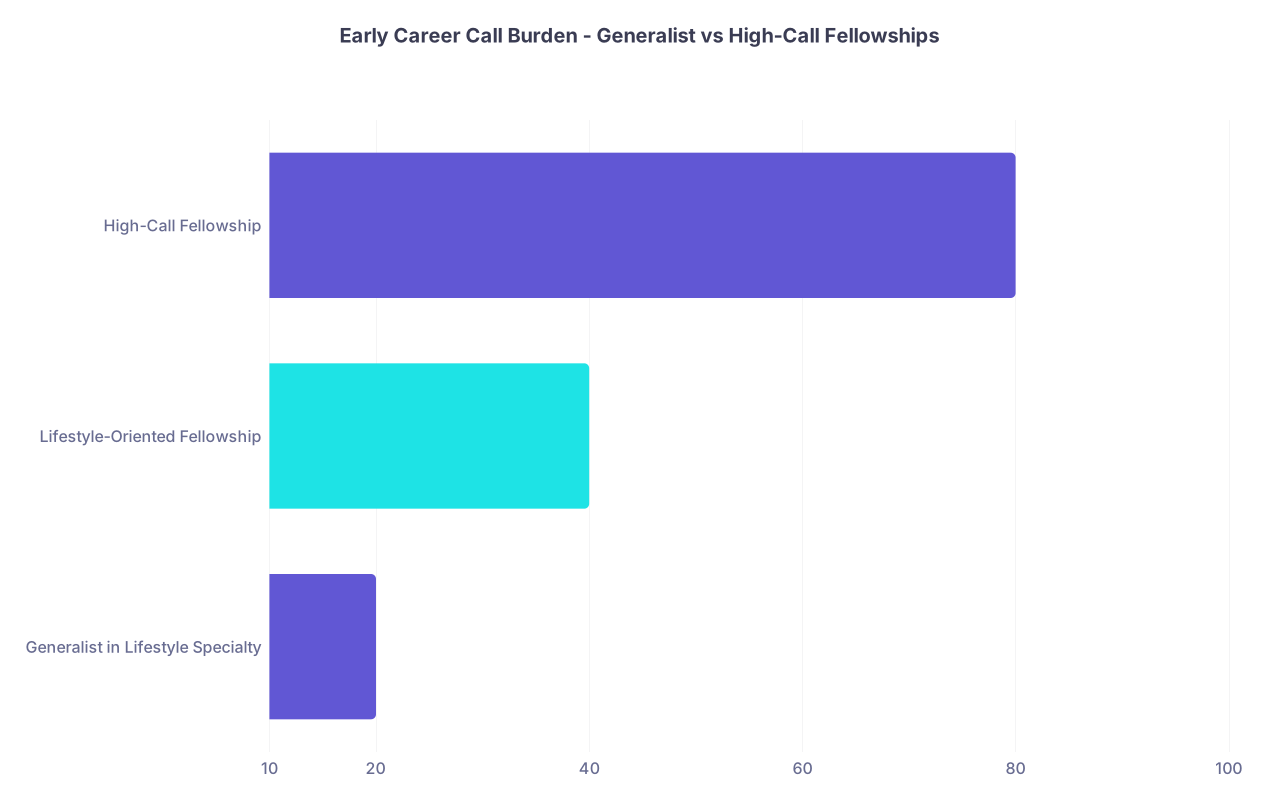
| Category | Value |
|---|---|
| Generalist in Lifestyle Specialty | 20 |
| Lifestyle-Oriented Fellowship | 40 |
| High-Call Fellowship | 80 |
If your main driver is “I want my nights and weekends back,” beware of reflexively signing up for another year that pushes them further away.
9. Ignoring the Program’s Culture Around Boundaries
Call volume is one thing. Culture is another.
Two fellowships can have the same number of nights on paper and feel totally different.
Bad culture signs that will turn even moderate call into a nightmare:
- Attendings brag about “back in my day” suffering
- Fellows apologize to attendings for asking for backup
- No one talks openly about mental health or burnout
- “Post-call” frequently turns into “just finish these few things”
- Weekend rounding or “just checking in” is normalized, even when not strictly necessary
In lifestyle specialties, you picked this path partly so you wouldn’t be owned by your pager. If the fellowship culture worships martyrdom, that lifestyle disappears.
When you interview, pay more attention to:
- How fellows talk about their attendings (tone, not words)
- Whether they joke about “only crying in the stairwell once a week”
- Whether anyone mentions childcare struggles, fatigue, or boundaries without getting weird looks from leadership
If you feel like you have to present as the “I’ll do anything, I don’t care about hours” fellow to impress them, that’s your sign: they will take you at your word.
10. Not Designing Backward from Your Ideal Day-to-Day Life
The biggest strategic error is starting with: “Which fellowship sounds interesting?” Not: “What do I want my average Tuesday to look like at 40?”
You should be designing backward from questions like:
- What time do I want to be home most days?
- How many weekends am I willing to give away each month?
- How often am I okay with being woken up at 2 a.m.?
- Do I want to coach my kid’s team? Have regular date nights? Train for marathons? Sleep?
Lifestyle specialties give you the raw material to say “yes” to those. The wrong fellowship takes that away.
Take an example:
You’re an anesthesiology resident who loves:
- Daytime regional blocks
- Outpatient joints and ortho
- Actually seeing your family in the evening
Bad backward design:
- “Cardiac is more prestigious and pays more.”
- Result: you’re in a CT-heavy job with night/weekend call.
Better backward design:
- “I want to mostly work outpatient / scheduled ORs, minimal nights, limited weekends.”
- Result: regional, pain (in the right setting), or even no fellowship and choose a group whose bread-and-butter matches your life goals.
Same for radiology:
- Want predictable days, largely outpatient, minimal nights? Breast, MSK, or general rads in the right group.
- Want to be irreplaceable during emergencies? Neuro IR or IR. Great if you love that. Career jail if you don’t.
Your Next Step (Do This Today)
Open a note on your phone or laptop and write two brutally honest lists:
“Non-Negotiables for My Future Life”
- Maximum nights on call per month
- Maximum weekends per month
- Earliest realistic bedtime and wake-up time you’re okay with
- How often you’re okay being called in from home
“Fellowships I’m Considering”
For each one, fill in:- Typical call (nights/weekends) in fellowship
- Likely practice settings after graduation
- Realistic call in those jobs (based on job postings + conversations with grads)
Then compare. If a fellowship flatly violates your non-negotiables, stop telling yourself it’s “just one year” or “for marketability.” You’re trading away the exact lifestyle you entered your specialty to protect.
Do that exercise before you send a single application. That’s how you keep a lifestyle specialty from mutating into a call nightmare you didn’t sign up for.