
What if the “lifestyle specialty” you picked for the easy call schedule quietly destroys your life outside medicine anyway?
That happens more than anyone wants to admit. And it’s almost always because of the same set of lazy assumptions and avoidable mistakes.
Let’s walk through them so you don’t get trapped.
Mistake #1: Confusing “Lifestyle Specialty” With “Lifestyle Residency”
This is the classic trap.
You hear:
- “Derm has the best lifestyle.”
- “Rads is super chill.”
- “OPH is basically 9–5.”
So you assume: once you match into one of those, life gets easier. You’ll have dinner at home. Sleep. Time to work out. Maybe even weekends.
Then I watch people match into:
- A malignant dermatology program with constant unspoken demands for late nights and endless research
- A radiology program where you’re q4 call in the ICU doing procedures as a prelim or transitional year
- An ophthalmology program with a brutal PGY-1 that has nothing to do with eyes and everything to do with cross-cover chaos
The specialty’s career lifestyle can be great.
The residency lifestyle can still be trash.
Here’s the mistake: making decisions based only on what attendings in private practice are doing, not what current residents at that program are living.
Red flags you’re doing this:
- You’ve spent more time on Reddit ranking “lifestyle specialties” than actually reading program call schedules
- You can’t describe how the call system works at your top 3 programs beyond “I heard it’s chill”
- You’ve never directly asked a resident: “What does your worst week look like?”
Avoid this by separating two questions:
- Does this specialty’s attending life fit the long-term balance I want?
- Does this specific program have a residency lifestyle I can survive without burning out?
You need yes to both. Not just the first.
Mistake #2: Ignoring Program-Level Lifestyle Data (Because It’s Boring)
Most applicants skim websites looking for buzzwords:
- “Collegial culture”
- “Supportive environment”
- “Wellness”
- “Resident-led…”
Almost none of that tells you about actual lifestyle. You need objective-ish data.
Here’s what people skip—because it feels tedious—and regret later:
| Factor | Why It Matters for Lifestyle |
|---|---|
| Call frequency | Nights, weekends, post-call rules |
| Case volume per resident | Determines work intensity, scut load, fatigue |
| Clinic vs OR vs reading room mix | Impacts pace, autonomy, and schedule |
| Number of hospitals covered | Travel time, chaos, paging overload |
| Night float structure | Consistency vs random nights |
If you do not know:
- How many weekends a month you’re working as an intern
- Whether you actually get post-call days off
- How many hospitals you cover at night
- If there is a night float system vs 24–28 hour call with “home by noon” fantasy
…you’re basically gambling your sanity.
Here’s what I’d drill residents on during interviews (and yes, be that person):
- “How many weekends did you have fully off last month?”
- “Are people actually out post-call, or is there always some reason you stay?”
- “How many cross-cover pagers are you holding on nights?”
- “What rotation is universally hated here and why?”
If residents hesitate, glance at each other, or laugh bitterly…believe that more than the glossy brochure.
Mistake #3: Choosing a “Lifestyle” Specialty for the Wrong Primary Reason
Another quiet disaster: picking a specialty mainly for lifestyle when you don’t actually like the work.
I’ve seen people do this with:
- Radiology (“I hate reading images but it’s good hours and pay”)
- Pathology (“I don’t really like looking at slides but no patients sounds nice”)
- PM&R (“I’m not sure what they do exactly, but I heard it’s chill”)
Here’s the problem: residency is too hard if you don’t care about the actual content. Even “lifestyle” specialties demand:
- Studying for boards and in-service exams
- Taking calls you don’t enjoy
- Working with attendings who expect engagement
If you’re only there because, “I just want my evenings,” you’re going to be miserable the second things aren’t perfectly chill. And they won’t be.
The right order of operations is:
- Pick something where the day-to-day work doesn’t drain your soul
- Among those, choose the specialty with the best long-term lifestyle fit
- Within that, select programs that don’t crush residents during training
Reversing this—starting with lifestyle, then trying to tolerate the work—is how you end up burned out in a specialty that was supposed to “save” you.
Mistake #4: Underestimating How Much the City and Commute Sabotage Lifestyle
People obsess over specialty and program name. Then they ignore two killers:
- Cost of living
- Commute and geography
You can match into a so-called lifestyle specialty and still have no life because you:
- Spend 1–2 hours a day commuting across a congested metro area
- Pay so much in rent in Manhattan/SF/Boston that you moonlight constantly just to tread water
- Live 35 minutes away because it’s the only place you can afford, making every early morning and late night worse
I’ve watched residents in “cush” derm or rads programs look exhausted because their daily grind is:
- 5:15 alarm
- 35–45 minute drive or subway packed in like cargo
- 10–11 hour day
- Repeat in reverse
You care about lifestyle? Then you care about:
- Average commute times for residents
- Whether residents can afford to live within 10–15 minutes of the main hospital
- How many hospitals you rotate through and where they are
If current residents are living 30–40 minutes away and shrugging like “yeah, it’s just how this city is,” that’s your warning. No one magically adds time to your day to compensate.
Mistake #5: Believing the “Lifestyle” Hype About Competitive Specialties
Competitive ≠ lifestyle.
Some of the “lifestyle” specialties are competitive because they’re believed to be cushy. That creates its own problems.
Here’s what you’re not told:
- Dermatology residents at certain academic programs grind hard on research, manuscripts, and protected time that isn’t really protected
- Radiology residents are often crushed with ICU-intensive prelim years, plus long stretches of call and overnight reading
- Ophthalmology and ENT have intense OR days, early starts, and steep learning curves that eat mental bandwidth
Look at what the training really looks like, not just what people say about the attendings.
I’d compare like this:
| Specialty | Training Lifestyle Risk | Commonly Overlooked Issue |
|---|---|---|
| Dermatology | High at big academic centers | Research pressure, hidden hours |
| Radiology | Moderate–High in some programs | Brutal prelim, overnight calls |
| Ophthalmology | Moderate | Tough PGY-1, early OR days |
| Anesthesia | Moderate | Early starts, long cases, call |
| PM&R | Lower–Moderate | Inpatient rehab can be busy |
Don’t mistake average national lifestyle for your individual program’s reality. You’re not training in a spreadsheet.
Mistake #6: Ignoring Culture Clues That Predict Abuse of Your Time
Programs almost never say, “We don’t care about your life.” They show it.
What I listen for when residents talk:
“We’re like a family, we all hang out here.”
Translation: Could be great. Could also mean you’re expected to live at the hospital and your life is the program.“We’re super flexible about staying late when there’s work to be done.”
Translation: There is always more work to be done. So you always stay.“Nobody really uses vacation in big blocks; we tend to just take a few days here and there.”
Translation: Either the schedule is fragile, or there’s informal pressure against long, true breaks.
Things that correlate with lifestyle problems:
- Residents joking darkly about wellness days
- Residents unable to answer directly about whether duty hours are followed
- Admiration of “workhorses” who stay late without logging hours
- Leadership bragging about high case volume and “grit” but never once mentioning how you rest
One attending’s phrase I still remember:
“We don’t send anyone home until the work is done.”
Fantastic. Except the work never ends. That line is code for “we will use every drop you give.”
Mistake #7: Focusing Only on PGY-1 and Ignoring PGY-2+
Many students ask only about intern year. They obsess over whether they’re doing:
- TY vs prelim medicine vs prelim surgery
- How many nights as a PGY-1
- Which rotations are toughest
They barely ask about PGY-2+ when they’re actually in the core specialty.
That’s backwards.
Your PGY-1 can be rough and still survivable if:
- Your PGY-2–4 are humane
- You’re excited for what’s coming
- The schedule gradually improves
But if your core years are relentless, and you chose the specialty primarily for lifestyle, you’ve just set yourself up for years of cognitive dissonance.
Drill down with residents:
- “Which year is your worst, and why?”
- “Does call get better as you progress, or just different?”
- “Who has it worst right now, PGY-1, 2, 3, or 4?”
If they say “honestly, PGY-3 is the worst because you’re pseudo-chief, lots of responsibility but not enough control,” that matters more than “intern year is fine.”
Mistake #8: Not Matching Lifestyle Expectations With Your Own Personality
Here’s the part people really don’t like hearing:
Some of you say you want lifestyle, but your personality doesn’t match the way “lifestyle specialties” often operate.
Patterns I see:
- You’re energized by acute emergencies and immediate decisions → then you pick rads because it’s “less hectic” and feel caged
- You love talking with patients all day → then you choose path because “no call” and end up lonely and disengaged
- You hate sitting still → then go into radiology or derm clinic where most of your time is spent seated, and you get restless and irritable
Lifestyle isn’t just number of hours. It’s:
- What type of work you’re doing in those hours
- How your energy cycles match the typical day (early mornings vs later starts, constant people vs analytics)
You can absolutely sabotage your balance by grinding through a misaligned specialty with “good hours.”
Mistake #9: Believing “I’ll Fix Lifestyle Once I’m an Attending”
This is one of the most dangerous illusions.
You think:
- “Residency will be rough, but after that I’ll pick a chill job.”
- “I’ll just push hard now and cash out on lifestyle later.”
Except people carry the same patterns forward:
- You train in malignant culture → you normalize overwork → you end up in a group that mirrors that
- You burn out your relationships and health during residency → you graduate with nothing stable to protect, so you keep overworking
- You get used to equating productivity with worth → you take on more shifts, more cases, more calls than you need
I’ve watched plenty of people in “lifestyle specialties” as attendings:
- Doing 1.5–2.0 FTE worth of work for money or status
- Taking extra call for “just a few more years”
- Continually postponing their life to the next phase
If you don’t protect some boundaries in residency, you’re unlikely to magically build them later. Residency is where habits and identity around work get stamped in.
Mistake #10: Not Tracking Your Own Non-Negotiables Before You Rank
Most applicants don’t write this down. They just kind of “feel” their preferences.
Then, when the pressure hits, they rationalize:
- “Well, the name is better, so I can live with the worse call.”
- “It’s only three years.” (It’s never “only” when you’re in it.)
- “Everyone struggles; I’ll power through.”
You need a brutally honest list of what you will not sacrifice, or you’ll sacrifice all of it under prestige and FOMO.
Make a short list (3–5 items). Not fantasies. Non-negotiables.
Examples:
- “I must sleep at least 6 hours most nights; chronic 4-hour sleep is a deal-breaker.”
- “I must be within 20 minutes of the hospital; multi-hospital 40-minute commutes are out.”
- “I need one fully off weekend per month to stay sane.”
- “I need a program where residents actually use their full vacation.”
And then—this is the hard part—actually drop programs from your rank list if they fail these.
If you’re unwilling to remove a program that stomped all over your non-negotiables, then be intellectually honest: you didn’t have non-negotiables. You had preferences. Very different things.
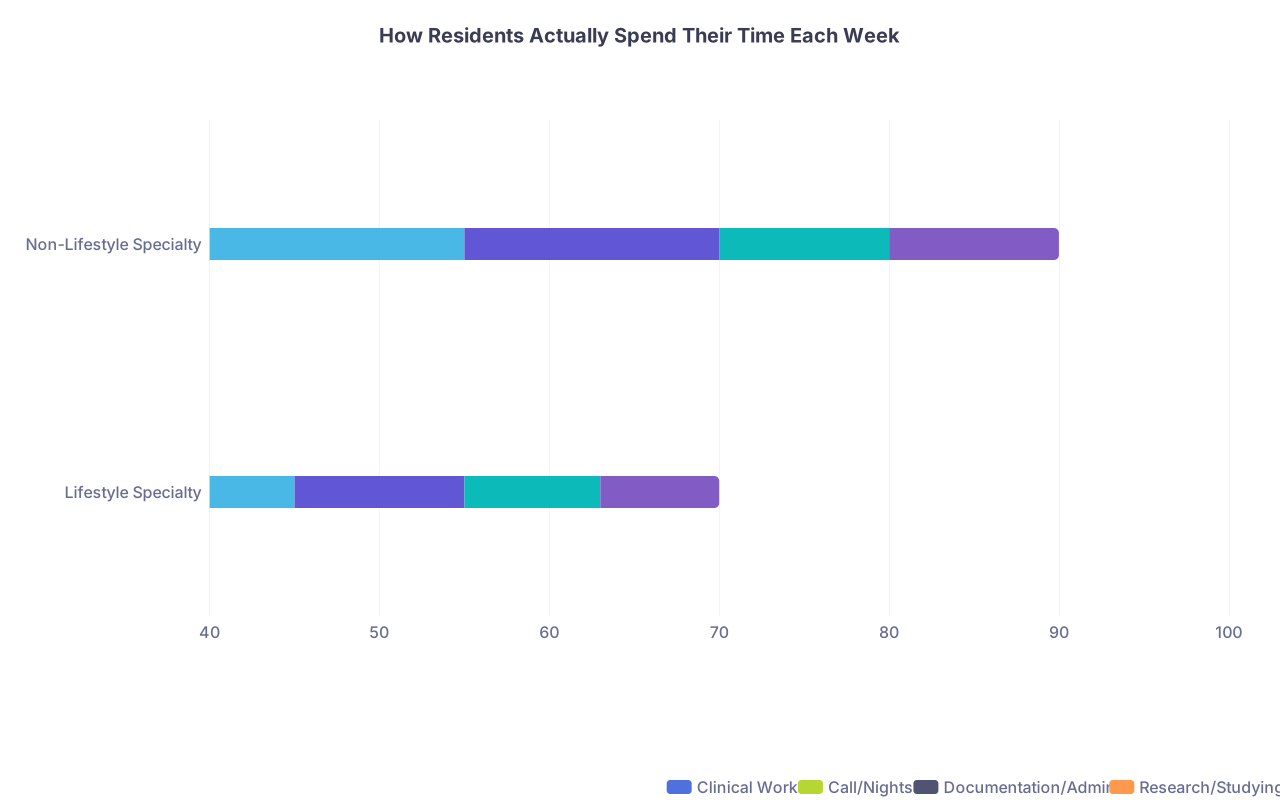
| Category | Clinical Work | Call/Nights | Documentation/Admin | Research/Studying |
|---|---|---|---|---|
| Lifestyle Specialty | 45 | 10 | 8 | 7 |
| Non-Lifestyle Specialty | 55 | 15 | 10 | 10 |
Notice something: even in “lifestyle” fields, the margin is not as big as you think during training. Small differences in call, culture, and commute can be the difference between sustainable and wrecked.
Mistake #11: Taking Resident Opinions at Face Value Without Reading Context
You should listen to residents. But you should also interpret them the right way.
Two common traps:
- Overweighting the happiest, most resilient resident’s perspective
- Overweighting the most miserable, burned-out resident’s rant
What I watch instead:
- Body language when they talk about call
- Whether they have lives outside work: hobbies, relationships, kids, anything
- If more than one resident independently says the same negative thing
Direct but telling questions:
- “What do you wish you had known before matching here?”
- “If you had to do it over again, would you rank this program first?”
- “Do people ever leave or transfer out?”
If answers feel rehearsed or all residents cluster around you with the same party line, that’s suspicious. Good programs don’t need to choreograph their people.

| Step | Description |
|---|---|
| Step 1 | Choose Specialty |
| Step 2 | Reconsider Specialty |
| Step 3 | Evaluate Programs |
| Step 4 | Remove from Rank List |
| Step 5 | Assess City and Commute |
| Step 6 | Check Culture Clues |
| Step 7 | Rank Higher |
| Step 8 | Like Daily Work? |
| Step 9 | Program Lifestyle OK? |
| Step 10 | Can You Live Close? |
| Step 11 | Respects Boundaries? |
That’s the actual decision tree most people say they’re using. In reality, they shortcut all the “No” branches and keep everything on their rank list. Don’t do that.
Mistake #12: Overvaluing Prestige, Undervaluing Life
Let me be blunt.
If you’re choosing between:
- A big-name, malignant, high-volume “top” academic program in a brutal city with awful commute
vs - A solid, mid-tier program in a smaller city with reasonable volume, humane call, and sane residents
…and your stated top priority is “lifestyle,” yet you rank the first one higher because the name sounds better at parties—you’re lying to yourself.
I’ve seen this exact story play out in:
- Dermatology
- Radiology
- Anesthesia
- Even “lifestyle” niches within IM (like allergy or rheum tracks later on)
The prestige glow lasts maybe 3–6 months. The schedule and culture last 3–5 years. Your body doesn’t care where your letterhead is from when you’re post-call and shaking from exhaustion.
If lifestyle truly matters to you:
- Take the smaller city over the glam metro if the day-to-day is kinder
- Take the lower-prestige name if the residents look genuinely alive
- Take fewer research opportunities if what you want is a stable, outpatient, non-academic future
You’re not obligated to impress anyone with your match result except the future you who has to live with it.
The Bottom Line
Keep three things tight in your head:
- Specialty ≠ Program. A “lifestyle specialty” doesn’t guarantee a lifestyle residency. Program culture, call structure, and geography can absolutely wreck balance.
- Lifestyle is more than hours. Commute, city cost, personality fit, and culture around boundaries all shape whether your life outside the hospital exists or quietly dies.
- Your rank list is your last real leverage. Set real non-negotiables, believe red flags when you see them, and be willing to drop shiny programs that don’t respect your time or your health.
Do not trade your life for a specialty that was supposed to protect it.