
It’s 8:15 p.m. You’re finishing sign-out at a community hospital where night float just walked in on time, again, and is actually happy to be there. You’ve seen your patients, staffed with an attending who knows your name and your partner’s name, and you’re already thinking about which show you’ll watch before bed.
Your med school group chat lights up. A classmate at Big Name University Hospital is still in the ICU, “just finishing notes” on a 22‑patient list, trying to figure out which attending to text for an admission because no one ever told them the unwritten rules. They’re on day 23 of a 27‑day stretch.
Same specialty. Same PGY year. Completely different life.
Let me tell you why that happens—and why certain community programs consistently beat big-name academic powerhouses for work-life balance, no matter what the glossy recruitment brochures say.
The Core Reality: Different Business Model, Different Life
The fundamental truth nobody spells out on interview day: community hospitals and big academics live by different incentives. That bleeds directly into your hours, your call schedule, and how much of your life you get back.
In big academic centers, the engine is:
- NIH money
- RVUs on high-complexity patients
- Fellow-driven subspecialty services
- Reputation (US News rankings, “Top 20”, all that nonsense)
In strong community programs, especially in lifestyle-friendly specialties, the engine is:
- Efficiency
- Bread-and-butter volume
- Keeping attendings and staff from quitting
- Patient satisfaction and local referral patterns
Translation: academics optimize for prestige and complexity; community optimizes for throughput and sustainability.
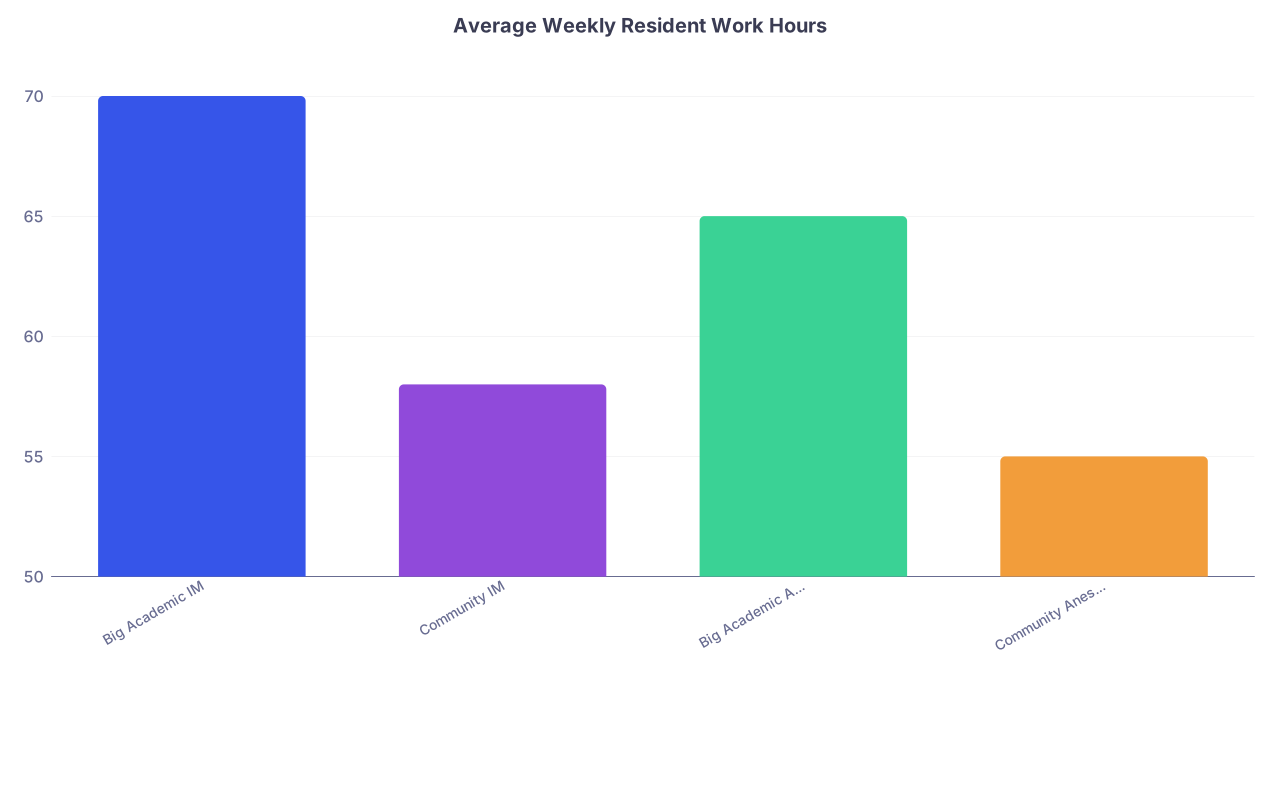
That’s why you see this kind of pattern:
| Category | Value |
|---|---|
| Big Academic IM | 70 |
| Community IM | 58 |
| Big Academic Anesthesia | 65 |
| Community Anesthesia | 55 |
These numbers are ballpark, but they’re not fantasy. I’ve seen multiple program surveys look like this behind closed doors. The residents know it. The PDs know it. Nobody advertises it.
What “Lifestyle-Friendly” Looks Like in Reality (Not on Brochures)
You’ll hear “lifestyle-friendly” thrown around for specialties like:
- Dermatology
- Radiology
- Anesthesia
- PM&R
- Ophthalmology
- Pathology
But inside those specialties, the difference between a malignant lifestyle and a sustainable one often comes down to one thing: community vs big-name academic.
Let’s walk through what actually changes.
1. The Workload Is Built for Attendings, Not Free Labor
In many big academic hospitals, services are built on the implicit assumption that there will always be a resident around. So the census creeps. The expectations creep. “The residents will handle it.”
Community hospitals that rely on hospitalists, PAs/NPs, and non-teaching services design things so that if you disappeared tomorrow, the machine still runs. Residents are a bonus. Not scaffolding.
That means:
- Caps that actually mean something
- Attendings who sign notes, return pages, and help move patients
- Non-teaching services absorbing overflow instead of just dumping on you
In a lifestyle specialty like anesthesia at a large academic center, you might be the warm body that is “cheaply” filling awkward staffing gaps. In a well-run community program, they staff the ORs as if no residents existed, then use you for protected learning and incremental help. That’s a very different day-to-day life.
Anatomy of a Work-Life-Friendly Community Program
Let me walk you into the resident room at a community-based IM, anesthesia, or radiology program that truly protects lifestyle. This is what lives under the hood.

Patient Mix: Bread-and-Butter vs “Museum Cases”
At big academic centers, residents brag about “zebras” and “crazy pathology.” They’re not exaggerating. Those centers attract tertiary and quaternary referrals from 4–5 states. That means:
- Constant admissions of the sickest of the sick
- Long, fragmented hospital stays
- Multidisciplinary chaos with 6 services leaving notes on the same patient
You learn a ton. And you pay for it with your life.
In a strong community program, even in specialties like radiology and anesthesia, the case mix is tilted toward:
- Bread-and-butter appendectomies, lap choles, ortho cases
- Routine imaging: CTs for abdominal pain, chest X-rays, MRIs for joints
- Stable inpatients with common problems
You still see acuity. You still learn. But the mental overhead is lower. Fewer committees and tumor boards. More straightforward decisions.
Service Design: Caps That Aren’t Fiction
Here’s the dirty secret: many academic programs proudly state “we cap at 10–12” on the website. On the ground, no-one enforces it. You get “admit till midnight” orders disguised as “flexibility.”
I’ve watched community PDs at mid-sized hospitals pull up census numbers in clinical competency meetings and call attendings out: “Why is my PGY‑2 carrying 20 again? We agreed on 14. Fix it.”
At community programs that actually respect lifestyle, caps are sacred. Because if they don’t protect you, you leave. And losing residents hurts their service coverage, their hiring pipeline, and their reputation in a very direct way.
How Schedules Quietly Differ: The Part You Don’t See on Interview Day
Most applicants look at the same ERAS bullet points:
- “Night float system”
- “1 in 4 weekends”
- “No 24+4 anymore”
Sounds similar on paper. The execution is wildly different.
| Aspect | Big Academic Tertiary Center | Strong Community Program |
|---|---|---|
| Call/Nights | Heavy, often stretched | True caps, shorter stretches |
| Weekend Coverage | Frequent, 2-3 per month | 1-2 per month common |
| Post-call | Often eroded by 'just one more thing' | Protected, you go home |
| Clinic Time (Rads/PM&R/Derm) | Double-booked, fellow-driven | Controlled, predictable |
| Conference Protection | Frequently ignored | Actually protected |
The biggest difference I’ve seen:
At big-name academic centers, there’s always “one more thing” keeping you past your supposed end time. Discharges. New admissions. Consults from three services who all think their note is the most important thing on earth.
At well-run community programs, the culture is closer to: “Sign out is at 5. If the ED hasn’t called by 4:45, whoever comes in after is tomorrow’s problem.” Attendings enforce that because they want to go home too.
Lifestyle Specialties: How Community Beats Academics, Specifically
Let’s get specific by specialty. Because the patterns are repeat offenders.
Radiology
At big academics:
- Night float often brutal with high-complexity trauma and transplant imaging
- Fellows soak up the rare/interesting cases first
- You’re on pager constantly as the “film reader” for half the hospital
- After-hours volume insane because the ED shotgun-orders everything
At community programs:
- More balanced mix of outpatient and inpatient reads
- Fewer fellows, so more hands-on procedures for residents (paracenteses, biopsies, etc.)
- Call is real but manageable; volume is high, complexity slightly lower
- ED ordering patterns slightly saner because the hospital doesn’t want unnecessary imaging spend
Work-life difference? You actually leave close to the end of your shift most days. You have fewer “urgent” extra scans at 4:59 p.m.
Anesthesia
Big academic center:
- Endless add-on cases
- CA‑1s staying late while fellows do the “cool” hearts and neuro cases
- Complex cases that go sideways and keep you past midnight
- ORs that run late because there’s always another research case or high-dollar elective case
Community hospital:
- OR block time used more predictably, with penalties when surgeons chronically run over
- Fewer “unnecessary” after-hours elective cases clogging your life
- Attendings care a lot more about turnover efficiency and getting home
- Often more true post-call protection (because they don’t have backup residents sitting around)
In lifestyle terms: your days are more predictable. You have fewer “somehow we’re here till 9 p.m. again” disasters.
PM&R, Derm, Ophtho, Path
These are already more lifestyle-friendly, but the flavor changes.
At academics:
- Clinics packed with complex tertiary referrals that require long visits, complicated workups, multi-team coordination
- Heavy academic expectations: talks, research, presentations, “scholarly activity”
- Conferences, tumor boards, cross-disciplinary meetings
At community:
- Clinics more focused on common, straightforward pathology
- Less academic “busywork” and fewer required projects
- More direct attending teaching, often from people who’ve been in that community for 15–20 years and know exactly what you need to function in practice
You end up with more mental bandwidth to actually have a life. Or do research you care about, on your terms.
Attendings: Who Owns You, And Who Protects You
Here’s where community programs quietly win big.
In big-name academic centers, attendings are pulled in five directions:
- Grants
- Publishing
- National societies
- Department politics
- Fellows / subspecialty clinics
Residents can become just another obligation. They’re “supposed” to teach you, but no-one really measures it aside from some weak anonymous evaluations once a year.
In a good community program:
- Attendings often choose to be there specifically for the balance and the stability
- They’re more clinically focused and less distracted by research metrics
- The PD and chair know exactly who is burning residents out—and will actually intervene
I’ve sat in faculty meetings where a community PD said out loud: “I don’t care if he’s the highest biller in the group. He’s killing the residents. He either adjusts his expectations or we pull residents from his service.”
You hear that a lot less in prestige-driven academic systems, where the department’s star researchers often get whatever they want.
The “Prestige Tax” You Pay at Big-Name Programs
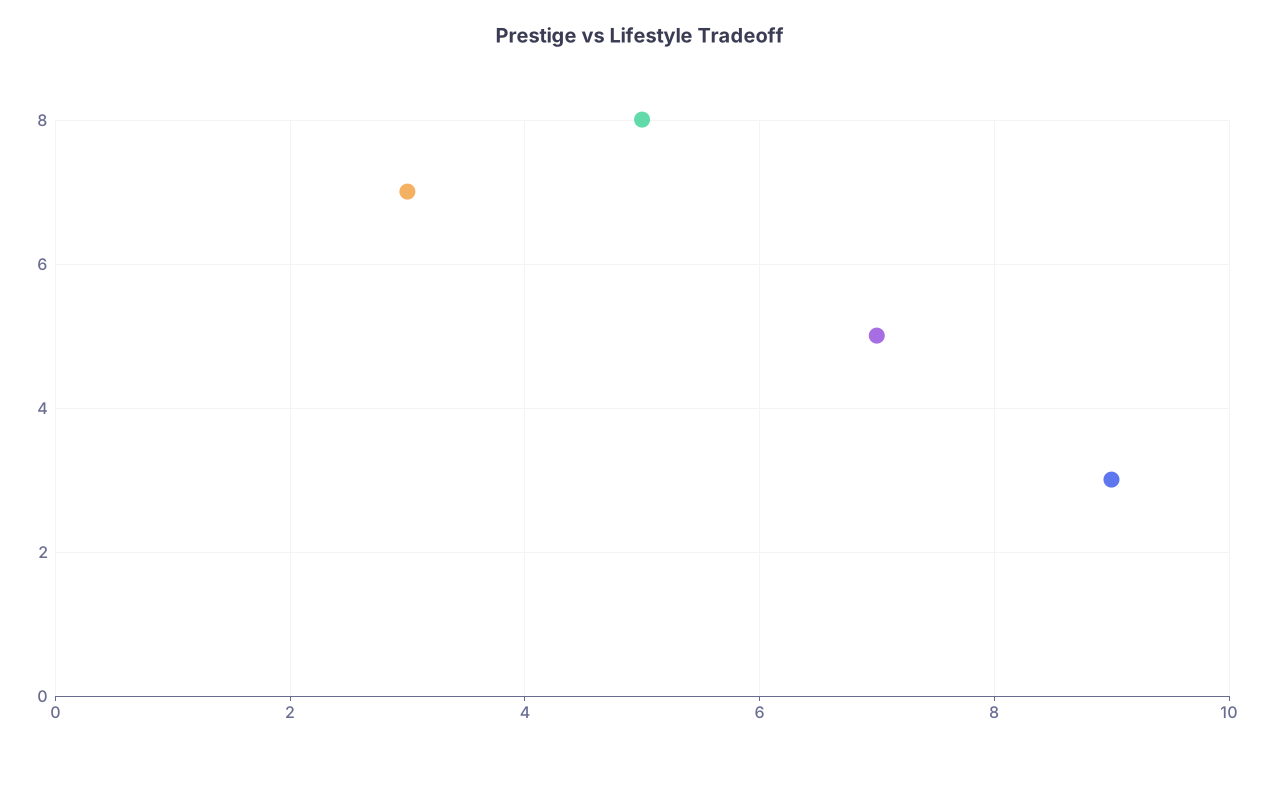
Here’s the trade no-one names directly: you pay in hours and stress to get the brand.
| Category | Value |
|---|---|
| Top 10 Academic | 9,3 |
| Mid-tier Academic | 7,5 |
| Strong Community | 5,8 |
| Small Community | 3,7 |
Think of that chart like this:
- X-axis (first number): prestige/research heft
- Y-axis (second number): lifestyle/work-life balance
Top 10 academics: 9, 3. Incredible name, painful life.
Strong community program: 5, 8. Enough reputation to get you a job, a far better life while training.
You’re not stupid. You know brand matters. But in radiology, anesthesia, PM&R, derm, path, ophtho—your fellowship and your first job will care more about:
- Your letters of recommendation
- Your actual skills
- Your reputation as a solid, safe, sane colleague
You don’t need a “Top 10” on your CV to get any of that. But you might need your sanity intact.
The Stuff You Only Hear in Resident Workrooms
This is where the real intel comes from. Not the PD speeches. Not the PowerPoint.

Patterns I’ve seen over and over:
At some huge-name academic hospitals, residents text each other about whether it’s “safe” to use their vacation because services are chronically understaffed.
At well-run community programs, vacation is built into the schedule and actually taken. People plan trips. PDs brag: “Our people actually use all their days.”
Academics: senior residents tell interns, “Yeah, officially you’re capped at 14, but when things are bad, we just do what needs to be done.”
Community: seniors tell interns, “If they try to push you over cap, you page me and the chief. We shut that down.”
Academics: you hear, “You need to be here to see the really complex stuff if you want to be competitive.”
Community: you hear, “You’ll get enough complexity. You also won’t be a shell of a human by PGY‑3.”
Residents vote with their feet. When community programs that truly protect lifestyle open up, word spreads quietly. You start seeing stronger and stronger candidates ranking them highly, especially in lifestyle-friendly specialties.
How to Spot the Good Community Programs (and Avoid the Bad Ones)
There are bad community programs. Some are cheap labor factories with no teaching and awful call. Do not romanticize “community” just because it’s not academic.
You’re trying to find the sweet spot: community-based, real teaching, sane culture.
Use your interview days and away rotations to dig up this data. Ask current residents and watch their body language.

| Step | Description |
|---|---|
| Step 1 | Interested in lifestyle specialty |
| Step 2 | Consider academic or hybrid |
| Step 3 | Prioritize strong community |
| Step 4 | Rank highly |
| Step 5 | Approach with caution |
| Step 6 | Need strong research for fellowship? |
| Step 7 | Program protects caps and post call? |
Plain English checklist you should quietly run:
- Do residents actually leave on time on average days? Not interview-day theater—ask about a random Tuesday in February.
- Is post-call really post-call, or do they “just need a few admissions covered” every other day?
- How often do they violate caps, and what happens when they do?
- What percent of residents graduate on time without needing “wellness” LOAs or schedule gymnastics?
You’ll get more honest answers in small side conversations than in the big interview room.
Long-Term Impact: Life After Residency
One last point: the habits you learn in residency stick.
If you train in a place where:
- Saying no is punished
- Boundaries are seen as laziness
- Working 80+ and lying about it is normal
You carry that into attending life. I’ve watched people trained at brutally malignant big-name programs walk into relatively cushy community jobs and still martyr themselves, because they don’t know another way.
Residents from balanced community programs, especially in lifestyle-friendly fields, tend to:
- Negotiate better schedules
- Refuse abusive call structures
- Recognize unsafe workloads early
They’ve seen what “normal” looks like. They’re not gaslit into thinking suffering is a badge of honor.

FAQ (Exactly 4 Questions)
1. Will choosing a community program hurt my chances at a competitive fellowship in a lifestyle specialty?
Not usually. For things like pain, MSK rads, interventional PM&R, or subspecialty anesthesia, what matters most is: strong letters, solid clinical skills, maybe one decent project, and a PD who will go to bat for you. I’ve seen fellows at brand-name places who came from no-name community residencies because their mentors picked up the phone. If you want a hyper-competitive niche (like IR from rads at the absolute top-tier spots), a big-name academic background helps, but it’s not the only route.
2. Are all academic programs bad for lifestyle and all community programs good?
No, and do not think that way. There are academic programs that fiercely protect their residents and community programs that quietly break people. You’re looking for culture and enforcement: caps, post-call, weekend frequency, how chiefs talk to you, how residents look at 4 p.m. on a normal day. Filter by behavior, not label.
3. How do I ask about work-life balance without sounding lazy on interviews?
You don’t ask, “What’s the work-life balance like?” That’s useless. Ask concrete questions: “How often are caps exceeded?” “What does a typical call day look like from start to finish?” “How strict is post-call protection?” “How many weekends per month is a PGY‑2 usually working on average?” Sharp programs will give you specific answers; vague hand-waving is your warning sign.
4. If I’m undecided about fellowship, should I default to academics ‘just in case’?
Not automatically. If you’re leaning strongly toward a lifestyle specialty and you know you care about your time, a strong community or hybrid program can keep all doors open while preserving your sanity. You can always build a research niche with targeted mentorship, even in community settings. What you cannot easily undo is three years of chronic exhaustion and cynicism at a prestige factory.
Key Takeaways
Certain community programs beat big-name academics for work-life balance because their entire structure—financial, cultural, operational—is built around sustainable clinical work, not prestige metrics. In lifestyle-friendly specialties, that difference becomes dramatic.
If you care about how you feel during residency, not just what your badge says, you should treat strong community programs as prime options, not consolation prizes.