
The biggest lie in residency recruitment is not about salary, research, or fellowship chances. It is about lifestyle.
Everyone says the same thing: “We value wellness. We protect your time. We’re very flexible.”
Most of it is theater.
I’ve sat in rooms where program directors rehearsed which buzzwords to hit for interview season. I’ve watched them redesign the website to look “resident-centered” while quietly approving another month of 28‑hour calls. If you want a truly lifestyle-friendly specialty and program, you have to learn to read what they do, not what they say.
Let me walk you through how PDs and chiefs quietly signal true lifestyle—especially in the so‑called “lifestyle specialties” like dermatology, radiology, pathology, PM&R, anesthesiology, and outpatient-heavy fields. And how to spot the fake flexibility that burns residents out just as hard as general surgery, only with prettier brochures.
What “Protected Time” Really Means (And When It’s Fake)
Programs love to flaunt “protected time” on interview day. The phrase is basically currency now. But there are three very different versions of it:
- Protected on paper only
- Softly protected if convenient
- Actually, truly protected
The third group is small.
Here’s how insiders sort them.
The Paper-Only Kind
This is where the schedule says:
- Didactics: Thursdays 1–4 pm, protected
- Academic half-day: Weekly, no clinical responsibilities
But what you see in reality:
- Residents still answering pages during conference
- Attendings calling during didactics to “just clarify one thing”
- Nurses told: “Page the resident anyway; if it’s urgent, they’ll step out”
If a PD tells you proudly, “All our teaching is protected,” the words are cheap. The real test is this:
Ask current residents separately:
“When you’re in conference, are you actually not responsible for your patients?”
They’ll tell you the truth with their body language if not their words. I’ve seen residents on radiology and anesthesia rotations sitting in lecture with two phones on the desk, apologizing as they step out every ten minutes. On paper, fully protected. In lived reality? Useless.
The Softly Protected Kind
This is more common in moderately lifestyle-friendly programs. The rule is basically:
- You should be in didactics,
- Unless something “can’t wait,”
- And what “can’t wait” is defined by whichever attending is most anxious that day.
The quiet signal you’re looking for:
If residents say things like, “We usually get to stay for all of it, but when we’re slammed, we have to leave,” that’s code for: service wins, education loses.
Not evil. Just not truly lifestyle-friendly.
The Rare, Actually Protected Time
I’ve only seen this at a minority of programs, but it exists—especially in some derm, rad onc, rads, PM&R, and a few unicorn IM and peds programs.
True protected time looks like this:
- Cross-cover system during didactics—someone else owns the pager
- Attendings know and respect the boundary, and chiefs enforce it
- When attendings violate it, PDs actually push back and back their residents
You want to hear phrases like:
- “We have a jeopardy system during conference—one person covers for the team.”
- “We don’t cancel didactics for clinic volume.”
- “Even on high acuity rotations, we defend that time pretty hard.”
And you want those lines coming from residents, not just leadership.
Fake Flexibility: The New Marketing Trick
The latest trend: when programs can’t honestly say they have good hours, they pivot to “flexibility.”
“Flexibility” is the new shiny word. It sounds modern, resident-centered, wellness-forward. Inside the program though, it often translates to: “We will stretch you to cover every gap because you are ‘flexible.’”
Here’s how fake flexibility usually looks from the inside:
- “You can always switch shifts!” → Translation: you will be guilted into covering everyone’s emergencies, and there’s no structural backup.
- “We don’t micromanage your time off.” → Translation: there’s no formal system, so you’re negotiating every vacation with three people who all feel overworked.
- “We’re very understanding about days off when you need them.” → Translation: nothing is guaranteed; everything is discretionary.
Real flexibility in a lifestyle-friendly specialty has structure. Fake flexibility has vibes and “we’ll figure it out.”
Let me show you the difference.
| Aspect | Real Flexibility | Fake Flexibility |
|---|---|---|
| Schedule changes | Formal swap system, clear rules | Case-by-case, “ask the chief” |
| Vacation approval | Transparent, predictable process | “We try our best,” informal agreements |
| Backup/jeopardy | Written jeopardy/backup policy | Ad hoc begging for coverage |
| PD role | Enforces boundaries | Says yes to everyone, no structure |
Programs with true lifestyle respect tend to be explicit, sometimes even annoyingly bureaucratic. Programs with fake flexibility rely on “we’re all family here” energy. Families are great—until they need you to skip your sister’s wedding because someone’s out with COVID.
Specialty Matters… But Program Culture Matters More
Yes, some specialties are structurally more lifestyle-friendly: derm, rads, path, PM&R, rad onc, ophtho, allergy, outpatient-heavy primary care. But I’ve seen residents completely crushed in all of those fields at the wrong programs.
Let’s get something straight:
- A malignant derm or rad onc program will destroy your quality of life
- A sane, structurally protected IM or peds program can give you a better life than a “prestige” lifestyle specialty where everyone’s constantly covering gaps
The real determinant is how the program handles three pressure points:
- When service gets unsafe or overloaded
- When residents say “no”
- When attendings or hospital admin push for more productivity
Watch how they respond to those.
The Quiet Signals PDs Send About Lifestyle
PDs almost never say, “We will work you to death.” Even the malignant ones now sprinkle their PowerPoints with wellness slides and yoga stock photos. The game is in the subtext.
Here are concrete things to look for and the hidden meaning behind them.
1. How They Talk About Duty Hours
Listen very closely when someone inevitably asks:
“How strict are you about duty hours?”
If a PD laughs and says, “We definitely comply,” and then quickly pivots? Red flag.
If a resident says, “We’re honest in reporting… but you know, sometimes you just stay till the work is done,” that tells you the culture: work > rules.
The line that usually reveals the most is from chiefs or APDs:
- “We rarely violate, but on XYZ rotation it can be tight.” → honest, probably ok
- “You’ll learn how to log it so it works out.” → translation: under-reporting is standard
- “Our residents are very dedicated; they don’t watch the clock.” → translation: we like martyrs
2. The Way They Describe Their “Busiest” Rotation
Every program will brag about their sickest service. The ICU. Cancer center. Trauma month. It’s how they prove they’re “strong clinically.”
Listen for what happens after that.
Lifestyle-respecting programs in otherwise lifestyle-friendly specialties will say things like:
- “Our ICU month is tough, but you have post-call days reliably and a night float that prevents crazy stretches.”
- “Our heme-onc service can be heavy, so we limit the number of consecutive weeks.”
Programs that quietly prioritize service will say:
- “You’ll learn a ton, it’s a grind but you come out a much stronger physician.” (No mention of guardrails.)
- “It’s our rite of passage.” (Code for: we let it be punishing on purpose.)
I was in a recruitment meeting once where a PD explicitly said, “We don’t want to scare them with details on ICU hours—just say it’s ‘high-yield.’” That’s how the sausage gets made.
3. Resident Body Language When Hours Come Up
This is the most reliable signal on interview day.
When someone asks, “What’s a typical week like in terms of hours?” look at the residents. Not the PD. Not the APD. The residents.
Patterns I’ve seen over and over:
- Good programs: residents answer quickly, without looking at each other, with relatively consistent stories.
- Shaky programs: one resident says “60ish,” another quietly says “70–80 on consults,” and they exchange looks.
- Bad sign: nervous laughter, “it depends,” or “it’s better than some places.”
If they keep using vague language—“reasonable,” “manageable,” “not too bad”—push for a number. Watch who suddenly gets quiet.
How Lifestyle Programs Protect Time in Reality
Let’s talk specifics. Because I’ve seen the inner workings at some of the better lifestyle-friendly programs, and the difference is structural, not just philosophical.
1. They Use Jeopardy/Backup Systems Aggressively
True lifestyle-focused PDs are obsessed with coverage systems. They know sick calls, family emergencies, parental leave, and random disasters will happen. So they build in slack.
At these programs, you’ll see:
- Jeopardy residents explicitly listed on the schedule
- Clear rules: maximum number of times you can be pulled in a block
- Data tracking of jeopardy usage so the same people aren’t constantly getting burned
At fake-flexibility programs, you hear:
“We just all pitch in and help cover each other.”
That sounds nice. In reality, it means someone always gets screwed, and it’s usually the most conscientious resident.
2. They Don’t Treat “Academic Time” as Free Labor
In the best lifestyle cultures—especially in radiology, derm, and PM&R—“research time” or “elective” doesn’t magically turn into coverage time whenever a service is short.
If a PD says:
- “We sometimes flex research residents back to service if we’re really short-handed.”
Understand what that actually means: your supposed lighter block is a reservoir to patch holes.
Residents will tell you the truth if you ask something like:
“If someone calls out sick on a heavy month, who usually gets pulled to cover?”
If they say “the elective or research person,” that’s your answer.
3. They Enforce Hard Stop Times on Key Rotations
Lifestyle-friendly programs quietly do something very simple: they define non-negotiable stop times on certain rotations.
Not just “aim to leave by 5.” Real, enforced norms like:
- “Sign-out is at 5 pm; if you’re still here at 6 repeatedly, we re-evaluate workload.”
- “No routine pagers to day team after 6 pm unless emergent.”
Again, you want to hear this from residents, not leaders. Especially on classic lifestyle rotations—outpatient clinics, electives, radiology, derm clinic, pathology sign-out. If those are bleeding into nights frequently, something is broken.
The Lifestyle Specialties: Where PD Culture Makes or Breaks You
Let’s walk through a few of the biggest “lifestyle specialties” and the specific PD signals to watch.
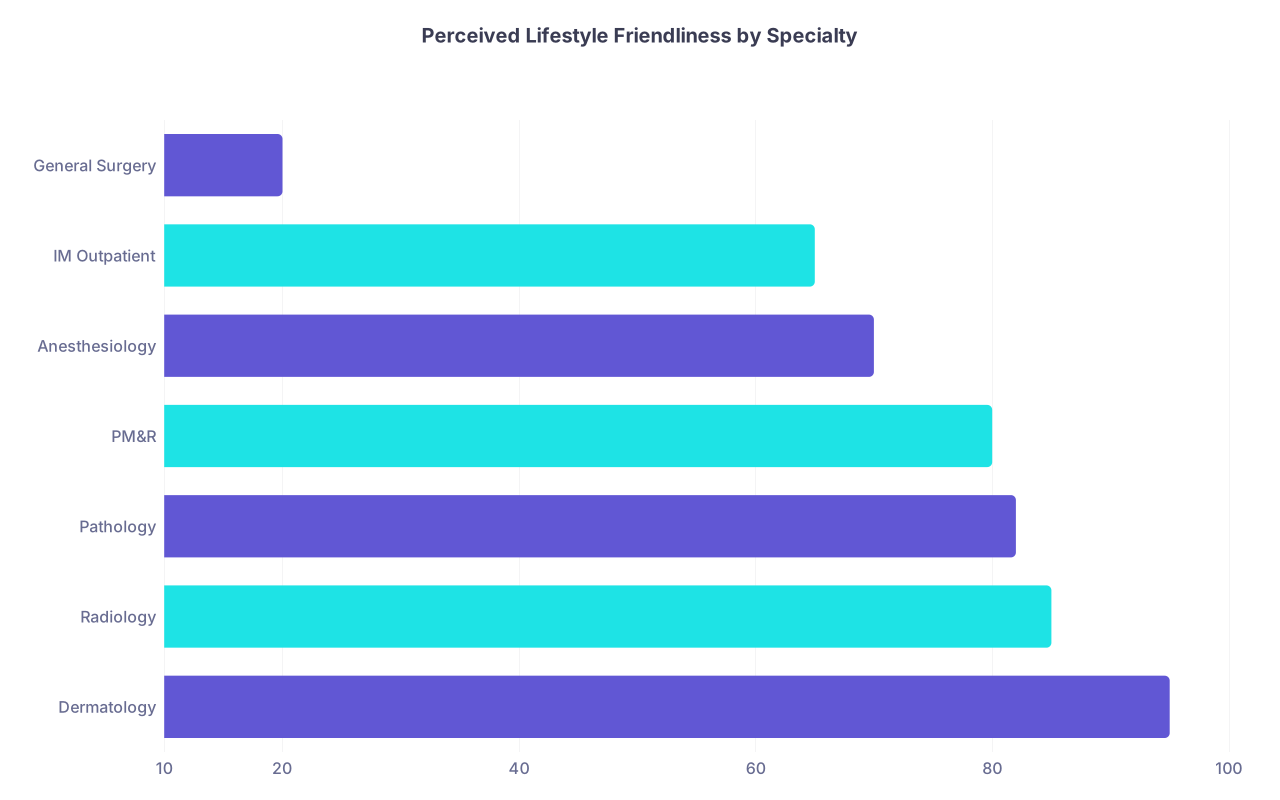
| Category | Value |
|---|---|
| Dermatology | 95 |
| Radiology | 85 |
| Pathology | 82 |
| PM&R | 80 |
| Anesthesiology | 70 |
| IM Outpatient | 65 |
| General Surgery | 20 |
Dermatology
You’d think derm is always cush. It isn’t.
Red flag signals in derm:
- Heavy inpatient consult time with no cap → lifestyle evaporates fast
- PD bragging excessively about complex onc/immuno volume → usually means longer days, more call
- Residents doing a lot of extra unpaid aesthetic work “for experience” → nights and weekends suddenly gone
Lifestyle-protective signs:
- They clearly separate clinic days and consult days, with predictable hours
- Cosmetic exposure is scheduled, not squeezed in after full clinic
- Residents roll their eyes when outsiders think they work “9 to 3”—because it’s more like 8–5, but still controlled and humane
Radiology
Radiology can be an absolute lifestyle gem… or a call/overnight grind masked by dark rooms and cool tech.
Quiet signals of trouble:
- Lots of talk about “front-line ED coverage” and “owning the stat reads” without detail
- Night float blocks that sound decent until someone admits they’re actually 6p–8a with cross-coverage
- Residents saying “the work never stops, you just have to decide when to leave” → translation: volume > sanity
True lifestyle moves:
- Night float with sane shift lengths and recovery days that are real days off
- Defined volume expectations so you’re not constantly pressured to squeeze in “just a few more reads” before leaving
- PD explicitly saying, “We don’t expect you to stay late just to burn down the worklist.”
Pathology
Path gets romanticized as slow-paced and chill. That can be true. But it can also become a quiet hell of endless cases and sign-outs if the volume is unchecked.
Unhealthy signs:
- Residents doing regular work at home in the evenings “because sign-out is heavy”
- No clear policy on how late grossing or frozen sections run
- PD emphasizing “service to clinicians” above everything else—means they’ll push to prioritize speed over your life
Healthy lifestyle signs:
- Residents say, “Yeah, I usually leave by 5–5:30, even on busy days.”
- Call is home call that’s truly rare, not every other night frozen chaos
- Autopsy burden is controlled and not dumped entirely on juniors
PM&R
PM&R can be incredibly humane—or quietly awful if they try to behave like medicine without medicine staffing.
Bad signals:
- Tons of cross-coverage across multiple hospitals or units
- PD bragging about their residents “managing medically complex patients independently” on nights without clear backup
- Weekends that are “light” but actually consume most of your day regularly
Good signs:
- Residents describe weekend coverage as a defined, short rounding block, not 12-hour quasi-IM call
- Strong presence of midlevels or hospitalists for medical management so you’re not drowning in intern-level work
- Very clear distinction between “rehab physician” duties and hospitalist duties
Anesthesiology
Anesthesia can be one of the best or one of the sneakiest lifestyle traps.
Lifestyle-killing patterns:
- Culture of “finishing the room” meaning you regularly stay 1–3 hours past scheduled end
- PD or CA-3s bragging about insane case volume and no mention of formal relief systems
- Overnight call without meaningful post-call protection (“You can still get a lot done post-call if you’re efficient” = madness)
Lifestyle-preserving moves:
- Explicit early relief systems for residents who started earliest
- Post-call truly off, not “post-call clinic” or “required teaching”
- Residents actually getting out within 30–60 minutes of their listed end time most days
How to Extract the Truth on Interview Day
You only get a few hours with each program. Most applicants waste that time asking generic questions and letting themselves be sold.
You’re not doing that.
Ask targeted, structural questions that force concrete answers. Examples:
- “On your heaviest rotation, what are realistic arrival and departure times on weekdays?”
- “In the past year, how often have residents been pulled from elective or research time to cover service?”
- “Who covers your pager during didactics or academic half-day?”
- “If you’re post-call and the team is short, do you ever stay past your expected time?”
- “How is Jeopardy or sick-call coverage structured? Is there a limit on how often someone can be pulled in a block?”
And then the most important move:
When the PD leaves the room, ask the residents:
“Did you feel like what was presented just now matches your actual day-to-day?”
Watch the pause. Watch the eye contact. That half-second silence is where the truth lives.
The Real Hierarchy: Lifestyle Within “Lifestyle Specialties”
You want brutal honesty? Here it is.
At most institutions, if you pick from the classically lifestyle-friendly specialties and then choose a program that structurally protects time, your baseline life will be dramatically better than almost any surgical resident and a large chunk of IM, EM, and OB.
But the order inside lifestyle specialties still matters:
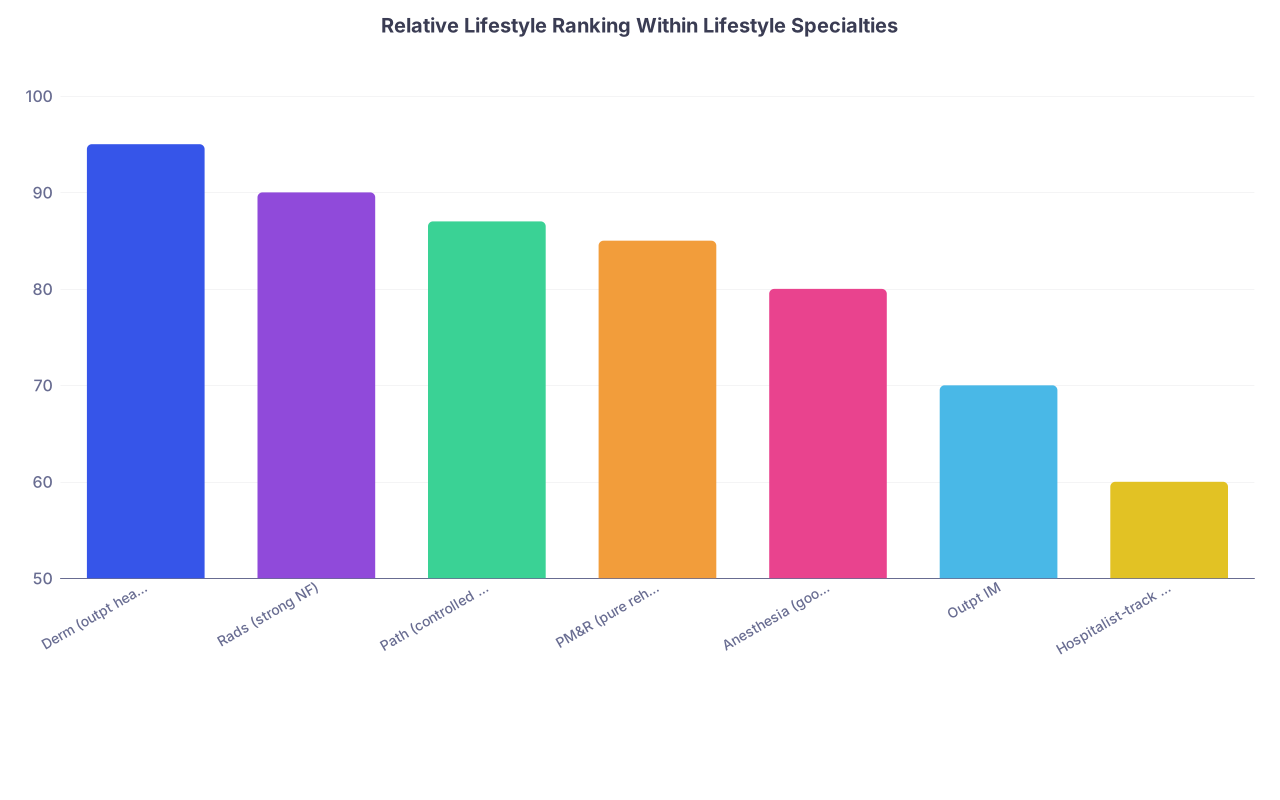
| Category | Value |
|---|---|
| Derm (outpt heavy) | 95 |
| Rads (strong NF) | 90 |
| Path (controlled volume) | 87 |
| PM&R (pure rehab) | 85 |
| Anesthesia (good relief) | 80 |
| Outpt IM | 70 |
| Hospitalist-track IM | 60 |
That’s relative, obviously. And it collapses quickly if you land in a malignant culture.
The key is not to chase the specialty with the best reputation for lifestyle. It’s to find:
- A reasonable specialty
- At a program with explicit, enforced structures
- Run by a PD who actually chooses residents’ lives over marginal gains in hospital productivity
Those PDs exist. They’re just not the loudest ones.
Putting It All Together
Protected time vs fake flexibility is not a philosophical debate. It is a scheduling reality.
Programs that truly value your life:
- Put protections into the schedule
- Enforce them when attendings push back
- Accept occasional service pain in order to preserve resident sanity
Programs that only perform wellness:
- Talk about flexibility
- Depend on your guilt and professionalism to close every gap
- Quietly normalize residents sacrificing their own time as the default
As you look at lifestyle-friendly specialties, do not be hypnotized by the field’s reputation or the city or the fellowship list. Look for how they handle time when it’s inconvenient.
That’s where lifestyle really lives.
You’re not just choosing a specialty. You’re choosing how your 20s or early 30s will feel at 6:30 pm on a Tuesday when the list is still long, your pager is buzzing, and your friend just texted you about dinner.
Choose the programs where, in that moment, the system—not just your willpower—protects you.
With that radar tuned, you’re in a different league than most applicants. You’ll see through glossy wellness slides in under 30 seconds. Next step is knowing how to signal to those rare, truly lifestyle-protective PDs that you’re exactly the kind of resident they want—that is a different kind of strategy, and we can dissect that another day.