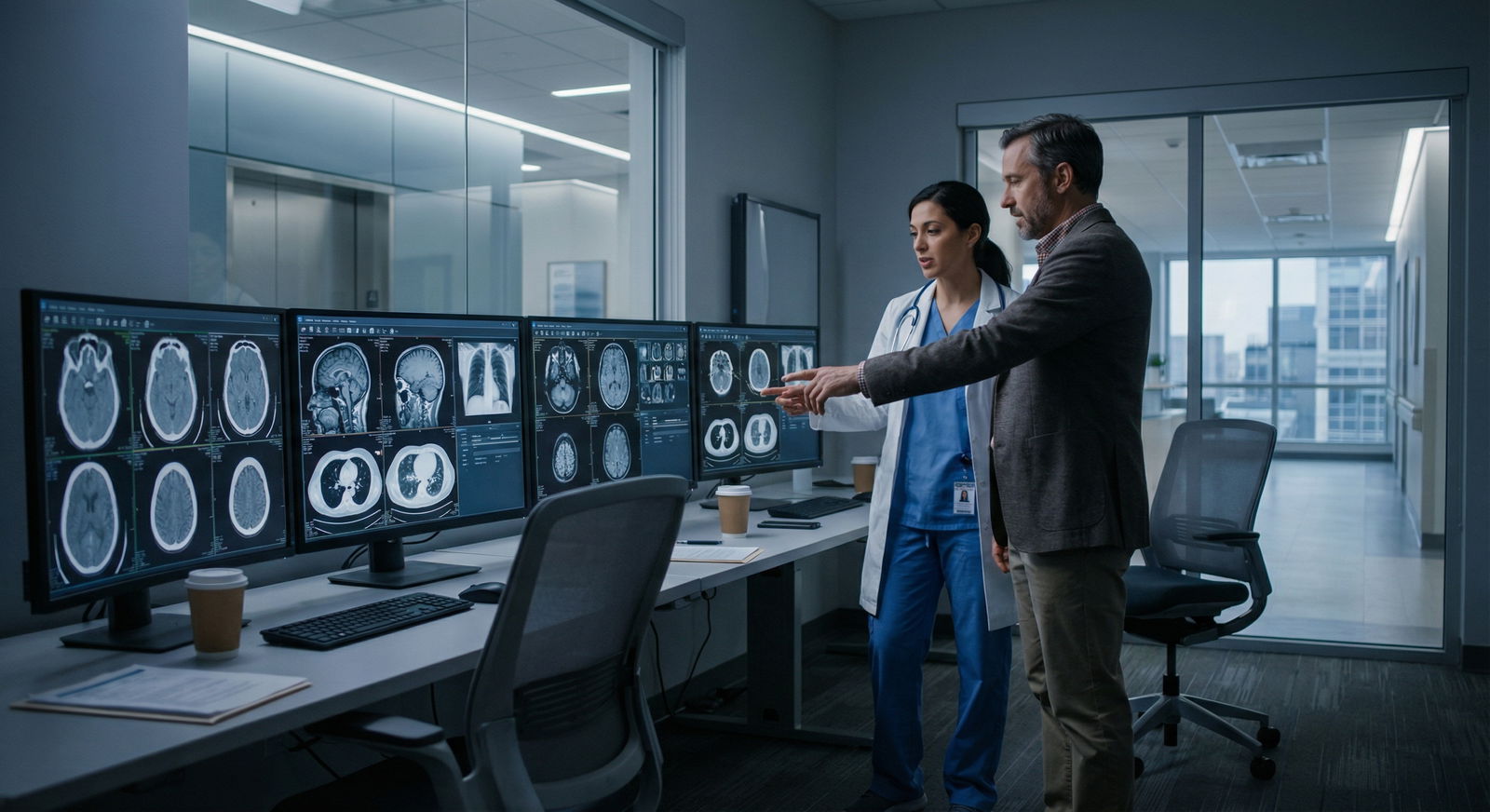
It is 10:15 p.m. You are on General Surgery call as an MS3. Trauma rolls in, CT chest/abdomen/pelvis is done, and everyone is just…waiting. Waiting for “reading room says prelim is in.” You glance at the clock, wonder who exactly is reading these studies at this hour, and more importantly, what their life looks like. You have heard radiology is “lifestyle.” You have also heard horror stories about 7-on/7-off nights and 3 a.m. pulmonary embolism calls.
You are trying to figure out the truth: what does a radiologist’s schedule actually look like? Day shifts vs nights. In-house call vs teleradiology. Hybrid models that mix everything together. How it feels in residency versus as an attending.
Let me break this down specifically.
1. The Core Radiology Schedule Types
There are three main schedule architectures you will see in radiology once you get beyond the generic “it’s shift work” comment:
- Classic day shifts (with or without evening “swings”)
- Dedicated night coverage (in-house or teleradiology “nighthawk”)
- Hybrid models (variable days/nights, blocks, or rotating templates)
Every group customizes these, but the skeleton is very similar across academic centers and decent-sized private practices.
1.1 Day Shifts: The Lifestyle Backbone
Day shifts are what most people picture when they say radiology has good lifestyle. You show up in the morning, you leave at a predictable time, and your pager does not own your soul at 2 a.m.
Typical patterns you will see in residency and practice:
Traditional academic day:
Roughly 7:30/8:00 a.m. to 5:00/5:30 p.m.
Case mix: ED, inpatients, scheduled outpatients, procedures.“Business hours plus” day:
7:00 a.m. to 6:00 p.m., sometimes with a shortened day on another shift to compensate.
Often in private groups trying to extend daytime coverage over early ED rush.Early bird:
6:30 a.m. to 3:00/3:30 p.m.
You take the morning surge from the ED and inpatients, then leave before traffic. Very popular with people with young kids or long commutes.
What makes day shifts lifestyle-friendly:
- You usually know exactly when you are done.
- Nights and weekends can be heavily reduced or eliminated once you are senior or in certain practice arrangements (though not always).
- Less circadian abuse: you go to bed and wake up at normal times.
What usually gets glossed over: the work is dense. Radiology is not “surf the internet and sign a couple films.” On a busy day in a community hospital, you might read:
- 80–120 cross-sectional studies (CT/MRI) if you are doing mostly ED and inpatients.
- Or 40–60 mixed modalities (CT/MR/US/plain films) with consults and procedures.
The lifestyle benefit is not low intensity; it is predictability. The scanner stops sending your name cases after your shift, and someone else picks them up.
2. Nighthawk: The 2 a.m. Backbone of Modern Radiology
“Nighthawk” is radiology-speak for overnight coverage, usually via teleradiology. Historically, residents in academic centers covered nights in-house and attendings slept. Then teleradiology companies exploded, hospitals outsourced overnight reads, and the word “nighthawk” became standard.
There are two main versions you need to understand: what it looks like in residency, and what it looks like as an attending.
2.1 Nighthawk in Residency: In-House Chiefs of the Dark
Most ACGME radiology residencies have some form of in-house night float:
- Typically starts PGY-3 or PGY-4 once you have enough autonomy.
- Structure often: 1–4 week blocks, anywhere from 1–6 blocks per year depending on program and how heavily they lean on residents.
Common patterns:
- 7 nights on, 7 off (7p–7a or similar)
- 6 nights on, 8 off
- 5 or 6 consecutive nights mixed into a 4-week rotation
Case mix at night:
Almost all ED and emergent inpatients:
- Trauma CTs, head CTs for stroke or trauma, CT AP for belly pain, PE protocols.
- Stat MR for cord compression in larger centers.
- Portable chest and abdomen radiographs from ICU.
Procedural volume drops but does not vanish:
- Rare emergent abscess drain, nephrostomy, or stroke thrombectomy support in interventional radiology (if you are rotating through IR call).
What night float feels like in a solid academic program:
- Intense for 12 hours. You might read 80–150 ED studies per shift in a busy Level I trauma center.
- Constant communication: ED attending pinging you every 10 minutes when it is bad. Surgeons calling about free air, neurosurgery demanding CTA results.
- You grow very fast. There is no substitute for consecutive nights of nothing but acute pathology.
Lifestyle side: night float is terrible in short bursts and bearable in concentrated blocks. Most residents would rather do one brutal month and then be done for several months, versus scattered random overnight calls that wreck sleep every week.
2.2 Nighthawk Attending Life: The 7-on/7-off Myth and Reality
As an attending, “nighthawk” almost always means teleradiology. You sit at a home workstation, a corporate office, or a remote reading center. Common schedule template:
- 7 nights on, 7 nights off
- Shift length 9–10 hours (e.g., 9 p.m.–7 a.m.)
- Sometimes variation: 7 on, 14 off for ultra-high volume work
This is where lifestyle gets weird.
Pros:
- Massive time off in chunks. Seven days off, every two weeks. People use these to travel, live in low-COL areas, or stack side interests.
- No commuting. You log in, read, log out.
- No clinic, no procedures, minimal meetings.
Cons:
- Full inversion of your circadian rhythm. Chronic night shift is not benign. You will see higher rates of metabolic issues, sleep problems, and burnout if you ignore sleep hygiene.
- High volume and relentless pace. Many telerads live at 12–15 RVUs per hour or more. You will be judged on speed and output.
- Less face-to-face interaction with clinicians and trainees. If you are the type who needs a team and personal connection, pure nighthawk can feel isolating.
Lifestyle verdict: This can be extremely lifestyle-friendly for the right personality. Or absolutely miserable if you hate nights, isolation, and high-volume production pressure.
3. Hybrid Models: Where Most Radiologists Actually Live
Most real-world radiology jobs are not pure 8–5 days OR pure nights. They are some version of “we cover days, evenings, nights, and weekends with a mixed schedule.”
There are a few dominant hybrid schemas.
3.1 Day + Evening (“Swing”) Coverage
Swing shifts are bridge shifts. They cover the high-volume late afternoon and evening ED surge. You will see:
- 11 a.m.–8 p.m.
- Noon–9 p.m.
- 2 p.m.–10 p.m.
Who does these:
- ED/trauma-focused rads in large practices.
- Junior partners or new hires.
- Sometimes a rotating responsibility shared by everyone.
Lifestyle upsides:
- You avoid morning traffic and rushed pre-rounds.
- You still usually sleep at night.
- You can handle kid drop-offs or mid-morning errands which is a huge hidden perk.
Drawbacks:
- Your social life shifts later. Dinner with friends at 7 p.m.? Not happening.
- You often handle the worst of ED volume and last-minute inpatient add-ons.
Out of all the radiology shifts, many people quietly like swing the most once they try it. Especially if they care more about avoiding early mornings than about strict 8–5.
3.2 True Hybrid Day/Night Templates
In private practice especially, a common model is: everyone takes some nights, but nobody does nights exclusively.
Example template in a 20–30 person group:
- 80–85% of shifts are days (7:30–4:30, 8–5, etc.)
- 10–15% are evenings or nights, with extra compensation.
- Nights might be:
- In-house if a busy trauma center.
- From home reading ED cases via VPN/telerad setup.
These jobs often come with:
- Protected post-call time off after true night shifts.
- Shift differentials: nights pay more, evenings slightly more than core day.
- Flexibility to opt into more nights for higher income, or less if willing to accept lower pay.
From a lifestyle lens, this is where radiology looks very attractive compared to surgery, OB/GYN, or EM:
- Nights are usually shift-based and finite, not “24-hour call plus add-ons plus morning clinic.”
- When your shift is over, you are done. No rounding, no list of patients waiting for you in the morning.
- You can choose practice settings where night load is minimal if you prioritize a traditional schedule.
4. Academic vs Private Practice vs Teleradiology: Schedules Side by Side
To make this less abstract, here is how the common archetypes stack up.
| Model | Days | Nights / Call | Lifestyle Angle |
|---|---|---|---|
| Academic Radiologist | 8–5 mostly | Limited nights, some weekends | Teaching, stability, modest pay |
| Private Practice Partner | 8–5 + some swings | Rotating nights/weekends | Higher pay, moderate call burden |
| Teleradiology Nighthawk | None/rare days | 7-on/7-off nights | Huge time off, circadian hit |
| Hybrid PP Employee | Mixed days/swings | Partial nights with premium | Flexible, customizable load |
4.1 Academic Radiology
Standard academic job:
- Heavily day-focused: 8 a.m.–5 p.m.
- Intermittent evening or weekend call:
- Typically home call with telerad tools.
- Or short in-house weekend coverage (e.g., 8 a.m.–3 p.m.).
Why people choose academics from a lifestyle standpoint:
- Predictability. Core schedule looks similar most of the year.
- Fewer financial and RVU pressures compared to private practice or corporate telerad.
- Protected academic time can buy you lighter clinical days.
Trade-offs:
- Pay is lower than robust PP jobs, often significantly.
- Committees, teaching, and research expectations can add invisible “off-the-clock” time.
4.2 Private Practice
Highly variable, but a common pattern in a mid-to-large private group:
- 4–5 daytime shifts per week, mix of 7–4, 8–5, maybe a swing.
- Approximately 1:7 to 1:10 weekends (day coverage).
- Some nights shared across partners or contracted with telerad.
Many PP groups now:
- Contract out deep overnight coverage (e.g., 11 p.m.–7 a.m.) to telerads.
- Keep only “late evening” shifts (e.g., up to midnight) for local rads.
Lifestyle implications:
- You can absolutely build a radiology career with almost no true overnights by choosing certain groups wisely.
- In exchange, you will work harder during the day, with more volume and occasionally longer shifts.
4.3 Pure Teleradiology Groups
Telerad groups chunk their workforce into time zones and shift blocks. Typical offerings:
- 7-on/7-off 9 p.m.–7 a.m.
- 7-on/7-off 5 p.m.–1 a.m. (swing-only remote)
- Part-time, e.g., 3 nights per week long-term
Volume is king here. Compensation is tightly linked to RVU production. The upside: you can live where you want, avoid hospital politics, and leverage time zones (e.g., reading “nights” for NYC while living in Hawaii and working evening hours).
Lifestyle decision point: Are you okay making your body live permanently semi-nocturnal in exchange for big blocks of time off and often higher per-hour compensation? Some people love it. Others wash out in a few years.
5. How Radiology Schedules Play Out in Residency
If you are trying to decide whether this specialty’s “lifestyle” fits you, you need to understand what your residency years look like. They are not cushy clinic hours.
5.1 Year-by-Year Rough Template
Most diagnostic radiology residencies (PGY-2 to PGY-5) use some pattern like this:
PGY-2 (R1):
- Almost all day shifts.
- Occasional late stay in ED or neuroradiology, maybe until 7–9 p.m., but supervised.
- No independent overnight call yet in most programs.
PGY-3 (R2):
- Introduction of night float.
- Maybe 2–3 weeks of nights per year initially.
- Some evening shifts as you staff the “late” ED or neuroradiology.
PGY-4 (R3):
- Heavier night float. 4–8 weeks of nights total, depending on program.
- More responsibility; sometimes full independent overnight with remote attending backup.
PGY-5 (R4/Chief):
- Call often decreases or shifts to more backup-level call.
- More electives, mini-fellowship blocks, or subspecialty focus.
- Still some weekends and nights, but overall less punishing.
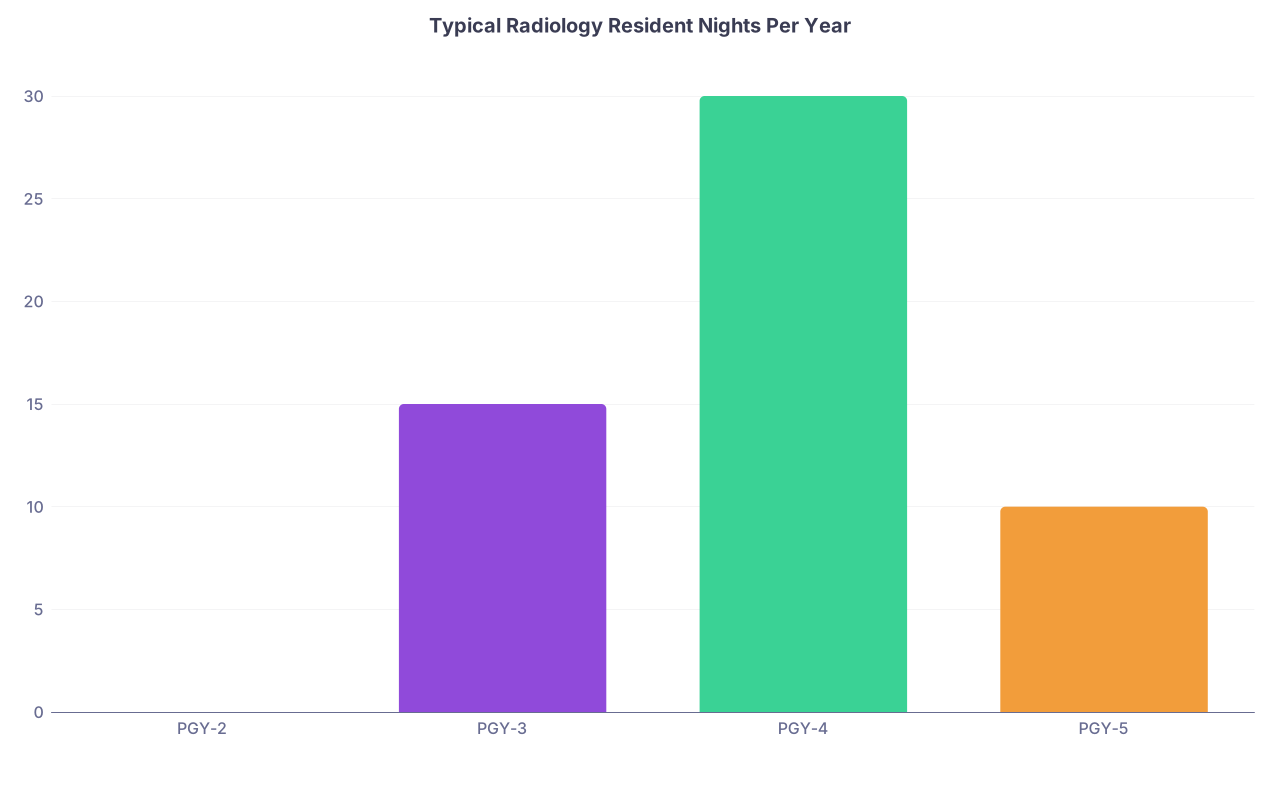
| Category | Value |
|---|---|
| PGY-2 | 0 |
| PGY-3 | 15 |
| PGY-4 | 30 |
| PGY-5 | 10 |
This is approximate but captures the general curve: minimal nights early, heavy in the middle, taper later.
5.2 Weekend and Holiday Reality
You will cover weekends in residency. But compared to surgical residencies:
- Weekend shifts are actual shifts, not 30 hours of misery.
- Typical weekend coverage:
- 8 a.m.–5 p.m. Saturday and/or Sunday.
- Or one long day + one short day.
Some programs use night float over weekends (Friday–Monday runs), so you get entire stretches off when you are not on call.
Holidays are divided like any other residency: you will work some Christmases, Thanksgivings, and New Years. The saving grace is that radiology is shift-based, so you are not stuck “rounding and then staying for add-ons plus clinic.” You start, you read, you finish, you go home.
6. What Actually Makes Radiology “Lifestyle-Friendly”
The schedule details are one thing. The structural differences compared with other hospital-based specialties are where radiology wins on lifestyle.
6.1 Shift-Based, Not Patient-Panel Based
If you leave at 5 p.m. in radiology, you are usually not:
- Getting called about “your” patient at 11 p.m.
- Logging into Epic at midnight to answer MyChart messages.
- Coming in early to “pre-round” before clinic.
You are off. Whoever is on the schedule handles new studies. The hospital is covered 24/7 without you being always on the hook.
6.2 Fewer True Emergencies That Drag You In
Interventional radiology aside, diagnostic radiologists are rarely physically dragged into the hospital at 2 a.m. The emergencies you deal with:
- Are image-based decisions, not procedures.
- Can often be done remotely once you have a PACS-compatible home setup.
That gives you real control over where you live and how you stack your day.
6.3 High Customizability Across Career
This is underappreciated. Your schedule as a radiologist is not fixed forever. I have seen:
- Young single rads go hard on 7-on/7-off nights to pay down loans at warp speed, then transition to few-or-no-nights jobs after 3–5 years.
- Parents of young children negotiate early shifts (6:30–3) and swing coverage to match child-care.
- Senior partners move into mostly day, low-volume subspecialty reading (e.g., outpatient MSK MRI) with essentially no nights.
Radiology is one of the few specialties where you can meaningfully change your schedule architecture multiple times in a career without changing your core skillset.
7. Sample Weekly Schedules: What Your Life Might Actually Look Like
Sometimes you need to see it written out. Here are three sample weeks.
7.1 Academic Body Radiologist, Mixed Service
- Monday: 7:30 a.m.–5 p.m. Inpatient/ED CT/US.
- Tuesday: 8 a.m.–5 p.m. Outpatient body MR/CT.
- Wednesday: 7 a.m.–3:30 p.m. Procedures (paracentesis, biopsies).
- Thursday: 8 a.m.–12 p.m. Clinical; 1–5 p.m. Protected academic time.
- Friday: 8 a.m.–5 p.m. ED plain films and CT with residents.
- Weekend: Off.
Every 6–8 weeks, they might have:
- Saturday: 8 a.m.–3 p.m. ED/inpatient coverage.
- Sunday: Off or 4–6 hours of remote backup/teaching.
7.2 Private Practice Generalist, Moderate ED Load
- Monday: 8 a.m.–5 p.m. Outpatient imaging center (mixed modalities).
- Tuesday: 7:30 a.m.–4:30 p.m. Inpatient/ED CT and US at main hospital.
- Wednesday: 11 a.m.–8 p.m. ED/swing coverage.
- Thursday: 8 a.m.–5 p.m. Outpatient and overflow inpatient.
- Friday: 7:30 a.m.–4:30 p.m. Mostly inpatient CT, few procedures.
- Saturday: Off.
- Sunday: 8 a.m.–12 p.m. Remote ED coverage (highly compensated).
Call burden: one true overnight per month with post-call day off, plus that Sunday morning every 4–5 weeks.
7.3 Teleradiology Nighthawk, 7-on/7-off
Week on:
- Monday–Sunday: 9 p.m.–7 a.m. from home.
Pure ED and inpatient cross-sectional imaging for 3–5 hospitals.
Week off:
- Zero clinical work, entirely off.
Many do admin tasks, CME, or simply decompress.
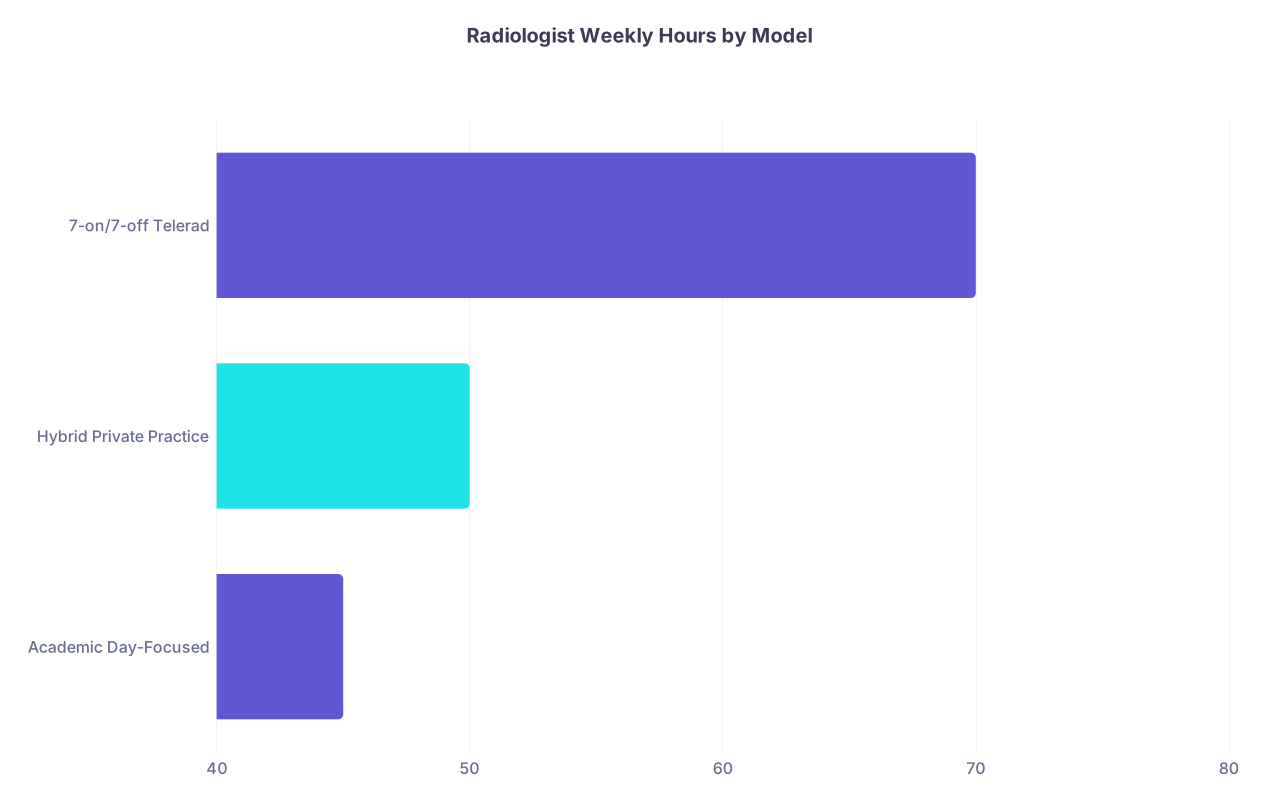
| Category | Value |
|---|---|
| Academic Day-Focused | 45 |
| Hybrid Private Practice | 50 |
| 7-on/7-off Telerad | 70 |
That chart is crude but captures why 7-on/7-off can feel intense even though half the days are off. Those “on” weeks are heavy.
8. Practical Advice If You Care About Lifestyle
If you are drawn to radiology mostly for lifestyle (be honest, most are at least partially), you need to be strategic.
8.1 During Residency
Pay attention to which rotations feel sustainable. Do you actually hate nights? Or is a block of nights every few months tolerable?
Ask upper-levels very specific questions:
- “How many nights did you do last year?”
- “What does a typical Friday night look like on ED CT?”
- “Does the program rely heavily on residents for night coverage, or do attendings/telerad pick up a lot?”
Watch attendings’ behavior. Which of them look burned out, and what schedule do they have? The pattern is rarely random.
8.2 When Evaluating Jobs
Do not accept vague answers like “reasonable call” or “lifestyle-focused” at face value. Translate that into numbers:
- How many nights per month?
- How many weekends per year?
- Are nights in-house, at home, or outsourced to telerad?
- Is there post-call protection?
- Can I buy out of nights with lower salary?
Good radiology groups are very used to these questions. If they squirm or hand-wave, that is a red flag.
8.3 Know Yourself: Circadian Preference Is Not Trivial
Some people function beautifully on evenings and late nights. Others fall apart.
If you:
- Naturally sleep late and feel sharp at 10 p.m.,
you can exploit that in radiology. Swing shifts and partial nights can be your niche, with premium pay and relatively low competition.
If you:
- Are wrecked by even one late night a week,
you need to prioritize academic or daytime-heavy PP jobs with outsourced nights.
9. Where Radiology Actually Ranks on Lifestyle
You are reading this in a “Most Lifestyle Friendly Specialties” context. Let me be blunt.
Among hospital-based, acutely oriented specialties, diagnostic radiology is near the top for lifestyle once you are out of training. Why:
- Work is almost entirely shift-based.
- True emergencies that drag you in from home are rare in diagnostic-only roles.
- Flexibility of practice venue: outpatient-only, hospital-based, telerad, hybrid.
- Real possibility to aggressively trade off nights vs income vs case mix over time.
Radiology is not dermatology or pathology in terms of night burden, but it is dramatically better than:
- Surgery (any flavor)
- OB/GYN
- Cardiology
- Emergency Medicine (especially with current job market stress)
And if you play your cards right post-residency—choosing groups that align with your sleep and life priorities—the lifestyle can be extremely good.

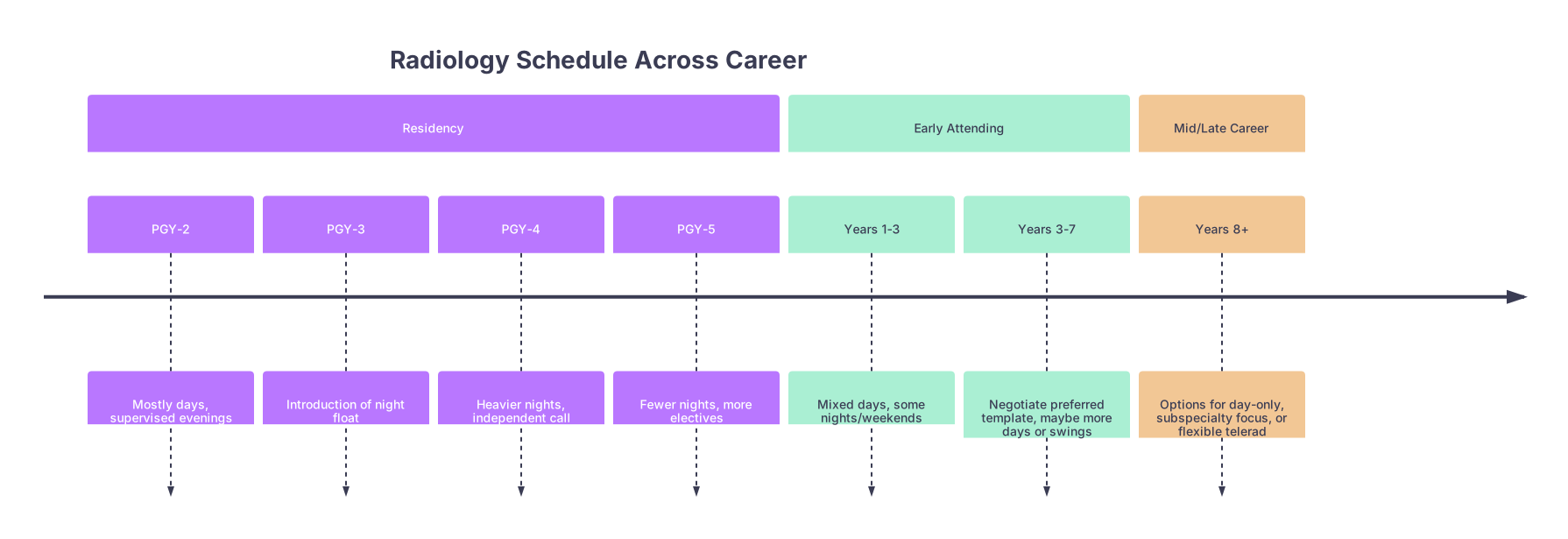
| Period | Event |
|---|---|
| Residency - PGY-2 | Mostly days, supervised evenings |
| Residency - PGY-3 | Introduction of night float |
| Residency - PGY-4 | Heavier nights, independent call |
| Residency - PGY-5 | Fewer nights, more electives |
| Early Attending - Years 1-3 | Mixed days, some nights/weekends |
| Early Attending - Years 3-7 | Negotiate preferred template, maybe more days or swings |
| Mid/Late Career - Years 8+ | Options for day-only, subspecialty focus, or flexible telerad |

FAQs
1. Is it realistic to have a radiology job with no nights at all?
Yes, but it narrows your options. Outpatient imaging-center jobs, some academic subspecialty positions (e.g., breast imaging, neuro in certain centers), and highly senior partner tracks in stable private practices can be essentially day-only. You will often trade something for that—lower compensation, slower partnership track, or limited geography—but day-only radiology jobs absolutely exist. Many radiologists transition toward those as they advance in their careers.
2. How bad are radiology night shifts compared with EM or surgery call?
They are intense but finite. Overnight radiology, especially in big ED-heavy centers, is high throughput and high cognitive load, but you are not physically running between patients, doing procedures nonstop, or dealing with family meetings. You sit, you read, you dictate, you answer calls. Compared with EM, the pace can be similarly relentless but more controlled. Compared with surgery call, it is vastly kinder on your body—no rounding the next day, no 30-hour marathons, and very little being physically dragged into the hospital once you are an attending with remote access.
3. Do radiology residents really have good lifestyle?
The honest answer: better than many other residencies, but not “easy.” You will have real nights, real weekends, and high-volume, high-stakes shifts. You will often leave on time, and you will not be pre-rounding at 5 a.m. or in the OR until 7 p.m. every day, but you will be mentally tired. Where radiology residency wins is predictability and limited “scut” compared with other fields. You are there to interpret images and consult; you are not managing ward lists or chasing labs at midnight.
4. If I know I hate nights now, should I still choose radiology?
You can, but you need to be deliberate. You will still do nights in residency; there is no escaping that. If you absolutely cannot tolerate nights physically or mentally, radiology might be rough in training. Long term, though, you can target day-focused academic jobs, outpatient imaging centers, or highly subspecialized roles that eliminate or minimize nights. So it is not a dealbreaker, but you must go in with eyes open and prioritize job selection very aggressively after training.
Key takeaways:
- Radiology is fundamentally shift-based, which makes true time off actually “off,” especially compared to most procedural and inpatient specialties.
- Schedules vary widely: pure days, pure nighthawk, and countless hybrid models where you trade nights and weekends for pay, location, and case mix.
- If you care about lifestyle, the specialty gives you tools to design your career around your sleep, your family, and your priorities—but only if you are intentional about the residency you choose and the jobs you accept.