
The myth that “lifestyle” specialties escape RVU pressure is flat-out wrong. The RVU machine just dresses differently in clinic than it does in the OR.
If you are chasing dermatology, PM&R, radiology, outpatient psych, allergy, EM, or any of the other so‑called “lifestyle friendly specialties,” you cannot ignore how RVU-based compensation actually works. The gap between what is promised (“you’ll clear 450k working 4 days a week”) and what is paid (“you’re at 0.78 of target; we need you to open access”) lives in three details:
- The threshold
- The floor (or lack of one)
- The burnout risk hidden in both
Let me break this down specifically, with the numbers people actually see in contracts and what it feels like on the ground.
RVU 101 For “Lifestyle” Jobs: What Actually Matters
You already know the abstract: RVUs are a measure of physician work, used to pay you per unit. That is not what dictates your life. What dictates your life is:
- How many RVUs you are expected to produce (annual target).
- How much they pay per RVU (conversion factor).
- What happens above that target (bonus) and below it (clawback / no bonus / probation).
Most academic, hospital-employed, and even a fair number of “private” groups now use some version of this.
The Typical Structure
Here is the pattern you will see over and over:
- Base salary tied to a target RVU (e.g., $260k for 5,500 wRVUs).
- Threshold: Once you exceed 5,500 RVUs, you earn bonus at, say, $50 per wRVU.
- Floor: If you only hit 4,800, either your next year’s base drops, or they start “reconciling” your pay.
That threshold number is not random. It is where burnout begins or does not.
Thresholds: Where “Lifestyle” Quietly Dies
Thresholds are the invisible line between “comfortable outpatient job” and “I am clicking boxes at 9 PM again.”
The trap is simple: lifestyle specialties tend to have lower RVUs per encounter and heavy administrative drag. Your day looks easy on paper. It is not.
Example 1: Outpatient Psychiatry
A very common psych comp model for hospital-employed:
- Base: $260,000
- Target: 4,500–5,000 wRVUs
- Conversion factor above target: $50–$60 / RVU
On paper? Reasonable. In practice:
- 99213 / 30-min med check: ~0.9–1.3 wRVUs depending on coding
- 90792 / 60-min new visit: ~3 wRVUs
If your clinic forces 50% of your sessions into 30-minute follow-ups with high no‑show rates (very common in community mental health and Medicaid-heavy populations), you must overbook or double book to hit your threshold. You do not get “credit” for noshows, crises, or phone calls with families.
So to hit 5,000 wRVUs in a year:
- Assume 70% of visits are 30-min follow-ups (1.0–1.3 RVU), 30% are longer or new.
- Realistically you need 16–20 showed visits per day, 4–4.5 days per week, almost every week.
- That leaves essentially no margin for admin time, call, or non-billable care (which psych is full of).
If the contract says “base is guaranteed for year 1, then reconciled to productivity,” your lifestyle is directly tied to whether you can live at that pace without melting down.
Example 2: Dermatology
People romanticize derm: “four-day weeks, 9–4, 600k.” Possible in some high-intensity cosmetic practices. Not typical for an employed medical derm job.
Typical academic / hospital-affiliated derm:
- Base: $325–375k
- Target: 6,000–7,000 wRVUs
- Conversion factor above target: $55–$65
Derm RVUs per patient are better than psych but the visit volumes are serious:
- Established patient 99213/99214: ~1.3–2.0 RVUs depending on complexity and procedures.
- Shave biopsy / cryo add a bit, but not as much as people think.
To hit 7,000 wRVUs:
- You are usually at 30–40 patients per day, 4 days a week, plus a procedure block.
- Add an academic expectation? Now you are charting at night or stacking your Fridays with “admin” that turns into overflow clinic.
Lifestyle? Maybe. But the threshold is tuned assuming that volume. You slow down meaningfully to breathe, your bonus disappears or your new base gets cut.
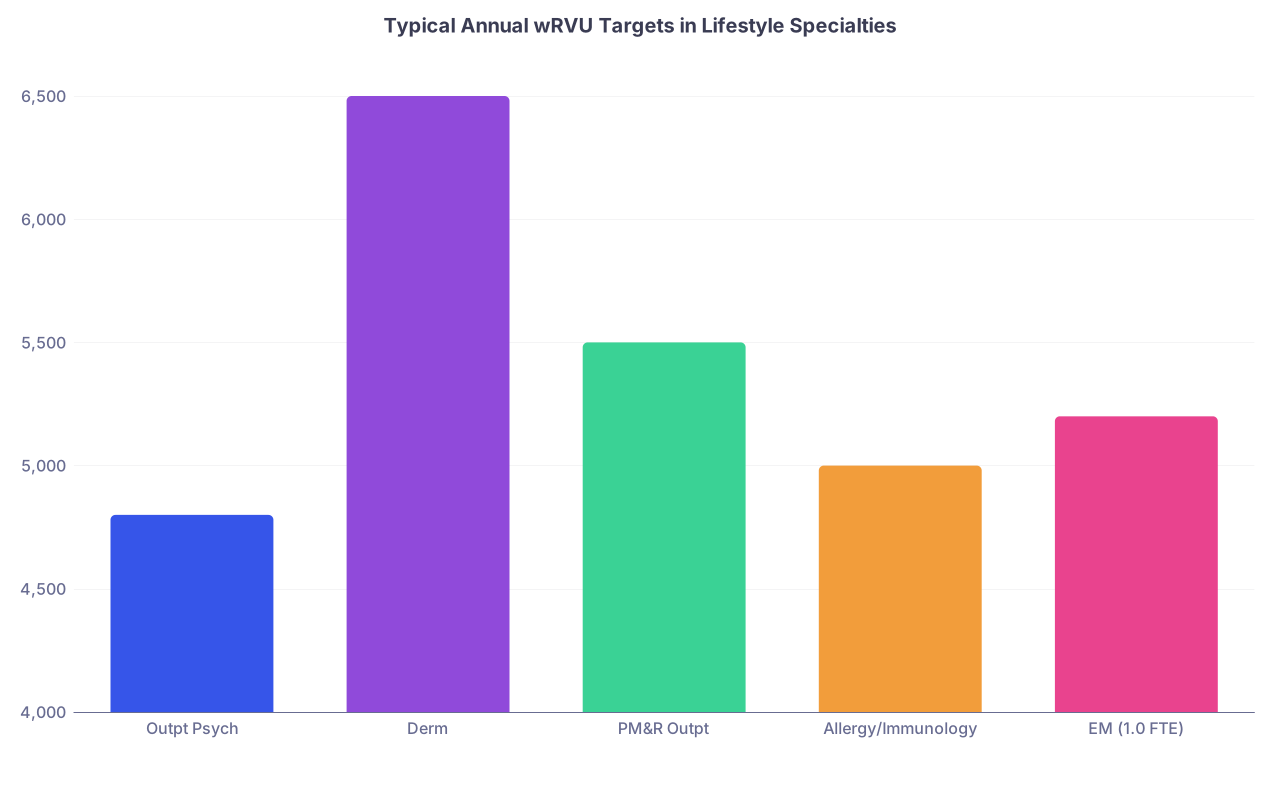
| Category | Value |
|---|---|
| Outpt Psych | 4800 |
| Derm | 6500 |
| PM&R Outpt | 5500 |
| Allergy/Immunology | 5000 |
| EM (1.0 FTE) | 5200 |
Floors and Guarantees: The Fine Print That Decides Your Panic Level
The most dangerous line in a contract is not the base salary. It is the “reconciliation” clause.
You will see a lot of versions of this, especially in “lifestyle” specialties where administrators assume you are trading dollars for fewer hours.
Common Floor Structures
There are three main flavors:
Hard guarantee, no true floor
Year 1: Guaranteed salary regardless of RVUs.
Year 2 onward: Salary “reconciled” to RVU production with no minimum.
Translation: You have 12 months to build volume or your base can drop 20–30% overnight.Soft floor
They say: “Your base will not drop by more than 10–15% per year.”
Translation: Death by 1,000 cuts. Each year you miss target, your base ratchets down, and it is very hard to climb back up once your schedule is full of low-RVU follow-ups.True floor
“Guaranteed base of $250k at 4,000 wRVUs. Above 4,000, bonus at $55 per RVU.”
This is what a sane lifestyle contract looks like. Worst case, you live at the floor. Best case, you push up during certain seasons / years and collect bonus.
Here is how those differences look side by side.
| Model Type | Year 1 Base | Year 2 If 80% Target | Protection Level |
|---|---|---|---|
| No true floor | $260,000 | $208,000 | Low |
| Soft floor (15%) | $260,000 | $221,000 | Medium |
| True floor | $260,000 | $250,000 | High |
That $40–50k swing is exactly where burnout risk lives. Because people do not easily accept a 20% pay cut. They just start working more.
Burnout Risk: Where RVUs Break “Lifestyle” Jobs
Every “lifestyle” field has its own flavor of burnout tied to productivity pressure. Let us walk through a few you are probably eyeing.
Outpatient Psych: Emotional Load vs RVUs
What I have seen repeatedly:
- Contract: 60‑minute new, 30‑minute follow-ups, 4 days/week, 14–16 patients per day, plus one admin half-day.
- Reality by year 2: Schedulers cram you to 18–20 patients per day. Complex trauma, SI checks, med issues, disability paperwork. Still 30 minutes. RVU targets barely met.
The burnout triangle in psych with RVU models:
- Emotional intensity of each encounter.
- High no‑show rate lowering effective RVUs per hour.
- Documentation and portal messages that are non-billable.
RVU-based psych jobs can be fine if:
- The no-show population is low or there is intelligent overbooking.
- The target is <4,500 wRVUs for a 4‑day clinic week.
- There is protected admin time in the template, not “admin on your own time.”
When they set the target like a procedurally heavy field but pay like ambulatory medicine, you get quietly wrecked.
Dermatology: Volume Creep and Cosmetic Side Hustles
Derm has two worlds: pure med derm (academic / large health systems) and hybrid med‑cosmetic or private groups.
In RVU-based med derm:
- Administrators see wait lists and think “capacity,” not “ceiling.”
- The RVU threshold assumes 25–30+ patients per clinic half-day.
- You get subtle pressure: “Could you open a few acute slots?” “Can you help with access targets?”
Most derm burnout I see under RVU contracts looks like:
- Four clinic days that are wall-to-wall with almost no buffer, plus “admin day” that becomes overflow.
- Added pressure to hit system-wide access, quality, and portal message metrics, none of which are compensated but all of which consume your only breathing space.
The practices that truly preserve lifestyle:
- Keep thresholds more like 5,000–5,500 RVUs for 4 days/week.
- Offer a fixed salary with modest RVU bonus rather than tying everything to a high target.
- Or add high-margin cosmetic cash pay that lets you ease production pressure on the medical side.
PM&R (Outpatient / MSK): Hidden Time Sinks
PM&R looks chill on paper: bread-and-butter MSK, spasticity, EMGs, injections. The RVU story is trickier.
You are juggling:
- Low-RVU follow-ups (0.9–1.3 RVUs)
- Procedures (EMGs, joint injections, Botox) with better RVUs
- Massive care-coordination overhead: PT/OT, equipment vendors, case managers, disability paperwork, family meetings.
RVU-based PM&R burnout clusters around:
- Unrealistic clinic templates that do not account for counseling and coordination.
- Targets set like general neurology or ortho spine, without acknowledging the social work built into every visit.
- “Productivity reviews” where leadership shows you stacked bar charts of your RVUs against orthopedics or neurology and expects you to “close the gap.”
The sustainable setups:
- 5,000–5,500 wRVUs for 4–4.5 clinic days/week.
- Explicitly carved-out non-billable time per half-day (1–2 slots blocked) that is not backfilled “just this week.”
- Balanced mix of procedures and clinic, often with one full procedure day.
Allergy/Immunology and Other Clinic-Heavy Fields
Allergy, rheum, endocrinology, GI motility clinics—same problem pattern:
- RVU per patient is modest.
- You are dealing with high complexity and tons of test results and portal traffic.
- When thresholds creep above 5,000 for a “4-day” schedule, you start doing invisible work at home.
In allergy specifically, watch for:
- Long food challenge visits coded in ways that underpay the time.
- Uncompensated phone calls with schools, parents, multiple specialists.
- Targets that assume full templates from day 1, when referral streams take 12–18 months to mature.

| Step | Description |
|---|---|
| Step 1 | High RVU Threshold |
| Step 2 | Increased Daily Volume |
| Step 3 | Less Time Per Patient |
| Step 4 | More After Hours Charting |
| Step 5 | Chronic Fatigue |
| Step 6 | Burnout |
| Step 7 | Lower Visit Quality |
| Step 8 | Patient Complaints or Errors |
EM and Radiology: RVUs with a Different Face
You might not think of EM or radiology as “lifestyle,” but a lot of people put them in that bucket compared to surgical fields. Their RVU pressures are real, just structured differently.
Emergency Medicine: RVUs per Hour vs Shift Expectations
EM comp is often a hybrid:
- Hourly/shifts + productivity bonus per RVU.
- Or base pay assuming a certain RVU/hour, then bonus above.
Here is the catch: RVUs in EM are tied to acuity and throughput. To maximize RVUs:
- You need fast room turnover.
- High-acuity, procedure‑rich cases help, but they also increase cognitive/emotional load.
In “lifestyle” EM jobs (community hospital, 12–14 shifts/month, “no nights after 50”), burnout comes when:
- Administration quietly increases expected RVUs/hour.
- Scribes are removed, or triage nurses are cut.
- Boarding explodes and you are doing floor medicine in an ED bed while still responsible for front door flow.
The RVU math is unforgiving:
- 3.0 RVUs/hour may be fine.
- 4.0–4.5 RVUs/hour across 10–12 hour shifts, with no consistent backup, is where older docs start eyeing urgent care or telemed.
Radiology: Clicks, Studies, and Tail Risk
Rad is productivity-driven by design:
- Each study has RVU weight.
- You are graded on RVUs per hour or per day, then normalized into FTEs.
“Lifestyle” rad jobs (telerad, outpatient imaging groups, private practices with 7‑on/14‑off patterns) have:
- Explicit minimum RVUs/shift.
- Tiered bonuses if you exceed baseline.
The burnout here:
- Constant pressure to push more cases through, often in poorly staffed environments.
- Little control over case mix; a day full of complex body CTs is not the same as a day full of screening mammos, but sometimes the RVU difference does not reflect the cognitive drag.
- Night shifts where the volume target is set by admin who have never sat at a PACS station at 3 AM.
The better lifestyle rads jobs:
- Tie comp to a realistic, long-term sustainable RVU/day (often agreed upon by partners, not just admins).
- Allow intentional downshifting (e.g., 0.7 FTE) without disproportionately slashing per-RVU rates.
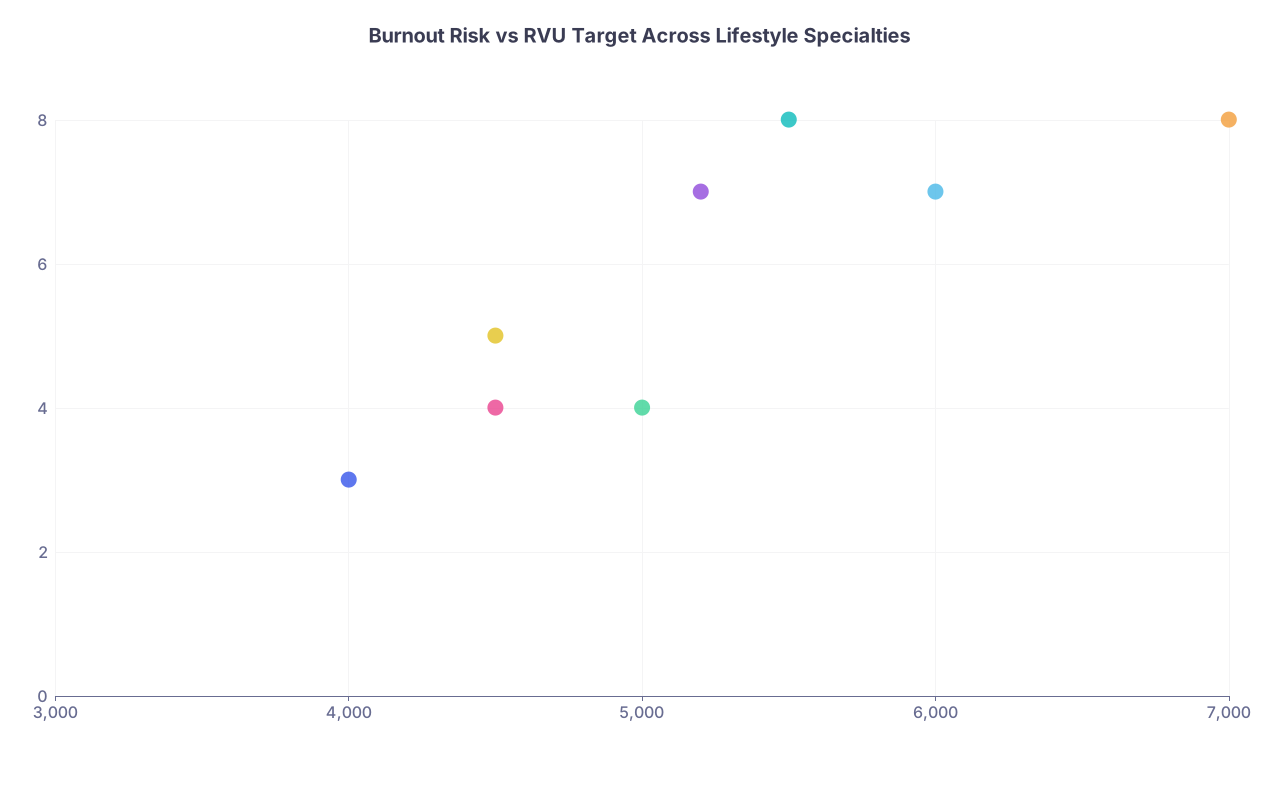
| Category | Value |
|---|---|
| Psych L | 4000,3 |
| Psych H | 5200,7 |
| Derm L | 5000,4 |
| Derm H | 7000,8 |
| PM&R L | 4500,4 |
| PM&R H | 6000,7 |
| EM L | 4500,5 |
| EM H | 5500,8 |
(x-axis = annual wRVUs; y-axis = rough burnout risk 1–10 from real-world patterns)
How To Read a Lifestyle RVU Contract Like Someone Who Has Been Burned Before
Residents and fellows almost never get taught how to dissect these contracts. So they anchor on base salary and sign. Then they discover that “4-day workweek” means “4 days scheduled in clinic, 1 day charting.”
Here is how to actually evaluate the offer.
Step 1: Normalize the Target to Your Workweek
Ask these exact questions:
- What is the annual wRVU target for full bonus eligibility?
- How many clinical days per week and weeks per year is that based on?
- How many patients per clinic day are expected to hit that?
Then do the division.
Example: Outpatient psych
- Target: 5,000 wRVUs
- Schedule: 4 clinic days/week, 46 weeks/year
- That is ~27 RVUs/week per day, or ~108 RVUs/week.
If an average follow-up is 1.25 RVUs and new visit is 3 RVUs, and your mix is 80% follow-up, 20% new:
- Average patient ≈ 1.6 RVUs (if you are lucky with coding / add-on codes).
- You need ~68 patients/week → ~17 per clinic day.
If they are promising 60-minute new visits and 30-minute follow-ups, and you have no built-in admin time, 17/day is already tight. If there is any no-show rate, you will need to overbook.
If you cannot reconcile the math with a humane pace, the job is not lifestyle. It is just outpatient.
Step 2: Demand Clarity on Floors and Reconciliation
You want to see something like:
“Base salary of $260,000 corresponding to 4,000 wRVUs, which is guaranteed and not subject to downward adjustment during the term. Additional compensation of $55 per wRVU above 4,000.”
Red flags:
- “Base is subject to adjustment based on productivity as determined annually by employer.”
- “Guaranteed for the first year; in subsequent years base will be reconciled to actual productivity at the then-current compensation plan.”
- Any vague reference to “market-competitive compensation models” without spelled-out numbers.
Translate those vague clauses in your head as: “We reserve the right to cut your pay if we decide you are not working hard enough.”
Step 3: Identify Unpaid Work
Ask specifically:
- How are non-face-to-face services (portal messages, phone calls, family conferences) handled?
- Is there protected, non-clinical time in my weekly schedule that is not tied to RVU production?
- Are there any RVU credits for teaching, supervision, or admin roles?
Lifestyle specialties get buried under non-billable care. If everything is RVU-driven, you will be working nights. Period.

What Reasonable Lifestyle RVU Targets Actually Look Like
Let me put concrete ballparks down. These are ranges where I have seen physicians maintain genuine work‑life balance, assuming 4 clinical days/week, 46–48 working weeks/year, with some admin time built into the schedule.
These are not maximal earnings numbers. These are sustainable ones.
| Specialty | Reasonable Annual Target | Notes |
|---|---|---|
| Outpatient Psychiatry | 3,800–4,500 | Requires real admin time and low no-shows |
| Dermatology | 5,000–5,500 | 30–35 pts/day, some procedures |
| PM&R Outpatient | 4,500–5,500 | Mix of clinic and procedures |
| Allergy/Immunology | 4,300–5,000 | Accounts for counseling, testing time |
| EM (1.0 FTE) | 4,500–5,200 | Depends heavily on shift length and acuity |
If you see:
- Psych at 5,200+ RVUs
- Derm at 6,500–7,000+ RVUs
- PM&R at 6,000+ with heavy clinic
- Allergy at 5,500+
…and they are calling it “easy lifestyle,” you should assume you will either:
- Burn out.
- Cheat on the “4-day week” and quietly work 5+ days worth of time.
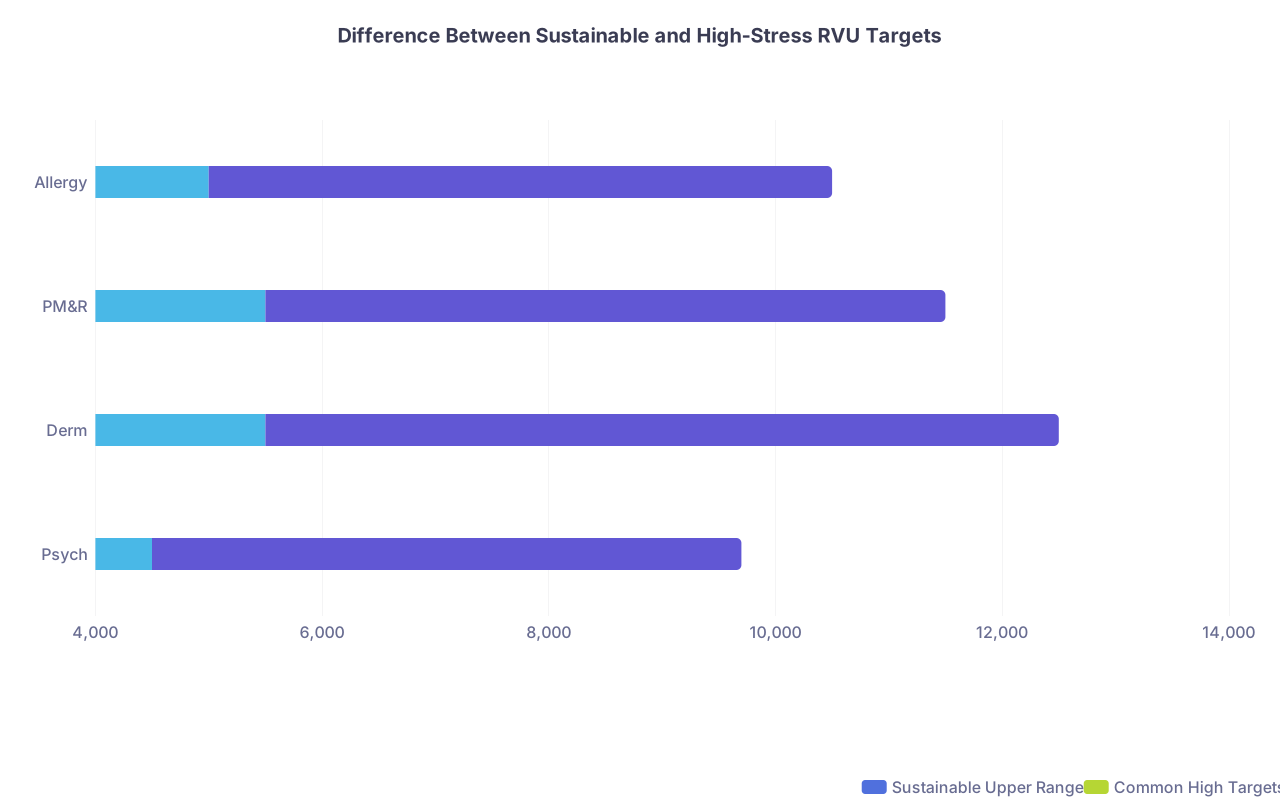
| Category | Sustainable Upper Range | Common High Targets |
|---|---|---|
| Psych | 4500 | 5200 |
| Derm | 5500 | 7000 |
| PM&R | 5500 | 6000 |
| Allergy | 5000 | 5500 |
Strategic Moves During Residency and Fellowship
You cannot fully control your first job, but you are not powerless either. A few levers you can pull now to avoid sleepwalking into a bad RVU deal.
1. During Rotations: Ask Attendings the Right Questions
Not “Do you like your job?” That tells you nothing. Ask:
- “What is your annual RVU target and how many patients do you see per day to hit it?”
- “Does your base pay get cut if you miss target?”
- “How many hours per week do you spend charting outside of clinic?”
You will see who leans back in their chair and sighs. Pay attention to that body language.
2. Track Your Own Throughput and Tolerance
As a resident:
- How many complex outpatients can you see in a half-day before you start cutting corners?
- How long do your notes take if you are doing them properly?
- Could you maintain that tempo for 5–10 years with other responsibilities (family, aging parents, health)?
This is not a “work harder” issue. There is a personal bandwidth reality. If you consistently tap out after 10–12 meaningful encounters per half day, do not accept a job that implicitly expects 18.
3. Negotiate on Structure, Not Just Money
New grads focus on:
- Base vs bonus.
- Relocation.
- Sign-on.
You need to care about:
- Lower target with same per-RVU conversion (even if base drops a bit).
- True floor language—something like 70–80% of target RVUs at full base with bonus above.
- Protected admin half-day that is not just a “suggestion” for the template.
You can absolutely say:
“I am willing to accept a slightly lower base if we can lower the RVU target to 4,500 and make that the threshold for full base, with bonus above that. My priority is sustainability.”
If they refuse and frame it as “we need team players who are committed to productivity,” that is code for “we burn through people.”

The Psychological Trap: Comparing Yourself to Colleagues Who “Crush RVUs”
You will see them.
In every group, there is someone who lives to produce. In derm, they run two or three rooms, 45 patients/day. In psych, they do 20 follow-ups daily, document with four-line notes, and never seem stressed. They brag, or more subtly “encourage” you: “You just need to be more efficient. You can easily get to 7,000 RVUs.”
Two things:
- Their physiology and risk tolerance are not yours. Maybe they do not have kids. Maybe they tolerate chronic low-grade stress. Maybe they are three years from a coronary. Not your problem.
- Groups will use their outliers to reset the “normal.” If one person can do 7,000 RVUs, targets creep up quietly for everyone.
You need to define what “enough” looks like for you before this happens. For many in lifestyle fields, that is:
- Comfortable base with limited or no bonus chasing.
- 4 days/week where you can actually think.
- Some ability to go home mentally off-duty.
The RVU model can support that. If and only if you do not let someone else’s ceiling become your floor.

Where This All Leaves You
“Lifestyle friendly specialty” is not a guarantee. It is a starting condition. RVU-based compensation can either support that lifestyle or quietly dismantle it.
The pattern is predictable:
- Targets set just a little too high.
- Floors and reconciliation clauses that punish slowing down.
- Non-billable work stacked on top with no credit.
- Peer pressure from high producers.
You are not going to fix the entire RVU system as a new grad. But you can learn to read the signals, ask the right questions, and choose environments where the numbers match the story you are being sold.
For now, your job is to get specific: know the RVU ballparks for your specialty, normalize them to a 4‑day clinic week, and decide what you are actually willing to trade for that extra $40k in bonus. Once you have that clarity, you can start picking targets—geographic and institutional—that are more likely to treat “lifestyle” as real, not just a recruitment slogan.
With those expectations calibrated, you are ready for the next hard step: comparing concrete job offers, side by side, and choosing the one that lets you still recognize yourself in five years. But that analysis deserves its own deep dive.