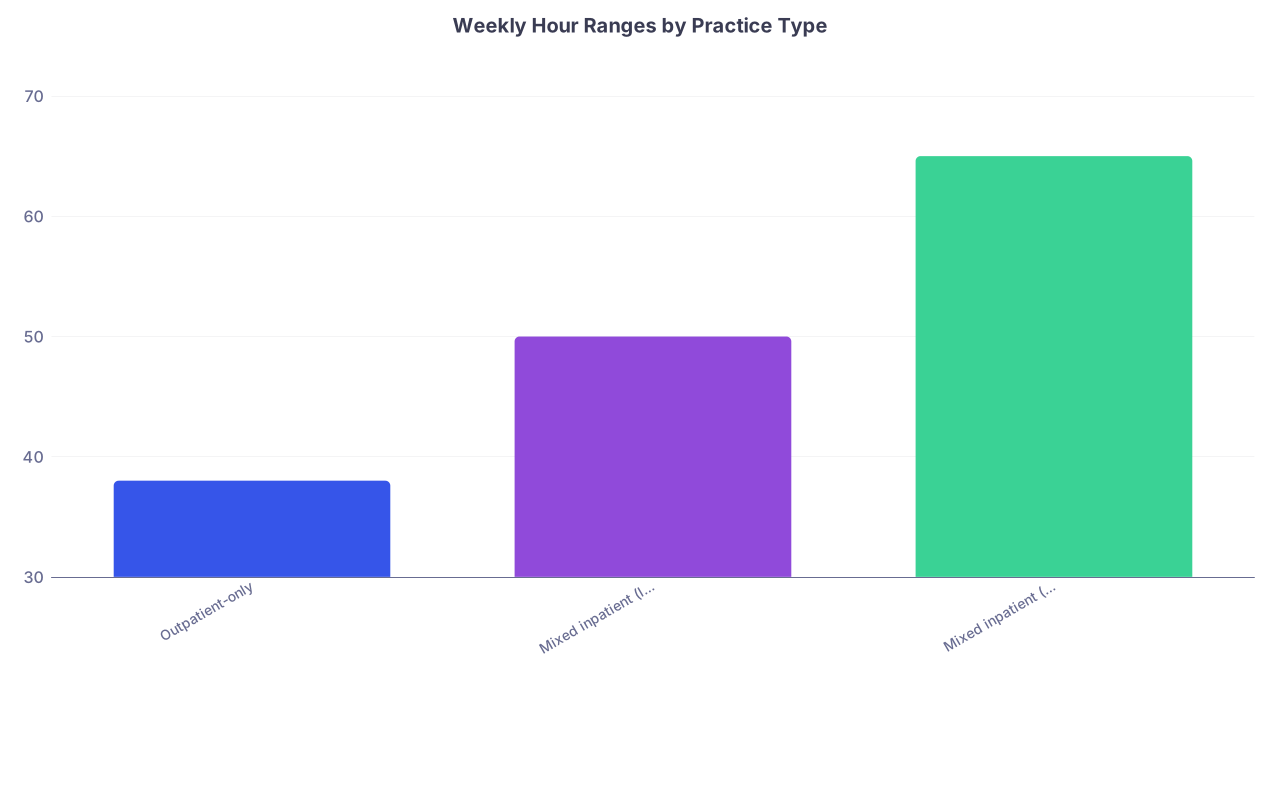
| Category | Value |
|---|---|
| Outpatient-only | 38 |
| Mixed inpatient (lighter) | 50 |
| Mixed inpatient (heavy) | 65 |
Outpatient-Only vs Mixed Inpatient: A Deep Dive into True Time Commitments
You are a PGY2 in internal medicine, post-call, staring at the clock in the work room. It is 10:45 AM. Officially, your “24‑hour” call ended at 7. You are still here, still charting, still fielding pages “just because you know the patient.”
Or you are an MS3 on a cushy outpatient month—clinic wraps at 4:30 PM, the attending is home for dinner at 6, and you are wondering: “Is this real life? Could my future actually look like this?”
You are trying to decide: go for an outpatient‑only lifestyle (primary care, outpatient psych, rheum in a clinic‑heavy group, etc.) or accept a mixed inpatient role (hospital weeks, consults, call) in something like GI, cards, pulm/crit, hospitalist hybrids, or a “traditional” IM practice.
People will throw you vague answers:
“Outpatient is 8–5, easy.”
“Inpatient is harsh but rewarding.”
“Lifestyle is what you make it.”
That is not good enough. You need hour counts, calendar realities, pre‑charting time, inbox grind, post‑call drift. You need the unromantic math.
Let me break this down specifically.
1. What We Actually Mean by “Outpatient-Only” and “Mixed Inpatient”
First, clean up the categories, because people abuse these terms.
Outpatient-Only (True Clinic Practice)
When I say “outpatient‑only,” I mean:
- You do not admit patients.
- You do not round on inpatients.
- You do not take in‑house call.
- You might take phone call for your own panel or clinic (triage line, refill questions, results), but you are not in the hospital at 3 AM putting in central lines.
Common examples in lifestyle‑friendly lanes:
- Outpatient psychiatry in a group or private practice
- Outpatient family medicine or internal medicine in a large multispecialty group with hospitalists covering all admissions
- Allergy/Immunology with hospitalists or inpatient consult services handling the rare admission
- Dermatology (classic one)
- Outpatient‑dominant endocrinology or rheumatology where inpatient consults are minimal or covered by a separate team
- Some outpatient neurology jobs, especially headache or general neuro embedded in big systems
Key feature: your time is organized around clinic sessions, not “shifts” or “call.”
Mixed Inpatient (Clinic + Hospital)
“Mixed inpatient” is where people get burned because it sounds benign in job ads.
This bucket usually means:
- You have clinic days and inpatient/consult days or weeks.
- You take some sort of call—home call, night float, or weekend rounds.
- Your pay is often higher than pure outpatient, but so is the volatility in your schedule.
Examples:
- GI: 3 days clinic, 1 endoscopy block, 1 inpatient consult day; plus call
- Cardiology: clinic plus inpatient service weeks and call
- Pulm/crit: ICU weeks + clinic + sometimes general wards
- Hospitalist with clinic half‑days, or “hybrid” primary care who follows their own admits
- Some ortho, ENT, urology jobs with shared call and dedicated clinic + OR days
- OB/GYN in traditional models (clinic + L&D + surgery + call)
Key feature: time is organized around blocks (hospital weeks, ICU weeks, call schedules) with clinic layered in.
2. The Real Weekly Hours: Numbers, Not Vibes
You care about what your life looks like Tuesday at 7 PM. So let’s do the math.
Outpatient-Only: What a Real Week Looks Like
Let us use a fairly typical full‑time outpatient model in a large system. Assume:
- 8 half‑days of clinic per week (4 full days)
- 2 half‑days for admin (charts, inbox, calls, refills, “walk‑in” charting tasks)
- No in‑house call, but some after‑hours inbox or patient messages
A very standard schedule:
- Clinic: 8:00–12:00 and 1:00–5:00 (with a “lunch” that mostly turns into catch‑up)
- Patients per half‑day: 8–12, depending on specialty and system cruelty
- Documentation: done between patients, at lunch, and 0.5–1 hour at end of day
The lie is that this is “8–5.” Here’s the honest breakdown.
Typical day (busy but not insane):
- 7:30–8:00: Pre‑charting / reviewing labs
- 8:00–12:00: AM clinic
- 12:00–1:00: Grab food, handle messages, finish 2–3 notes
- 1:00–5:00: PM clinic
- 5:00–6:00: Finish notes, return calls, wrap up inbox
That is 10–10.5 hours physically at work most clinic days.
If you are efficient and your system actually supports you (decent MA support, no ridiculous template), real outpatient‑only:
- 4 clinic days × 10 hours ≈ 40 hours
- 1 “admin” day where you actually work 6–8 hours (some can be remote)
So you land around 42–48 hours/week actual working time.
Outpatient psych, derm, allergy in many private or concierge settings can genuinely hit:
- 35–40 hours/week total, with very little evening work
- Sometimes 3.5–4 days/week of in‑person time, plus some light remote admin
On the other extreme, outpatient FM in a high‑volume, RVU‑heavy practice:
- 4.5–5 days/week on site
- 10–11 hours/day including charting and inbox
- Total: 50–55 hours/week
Still outpatient. Still “good lifestyle” relative to surgical subspecialties. But not 9–5.
Mixed Inpatient: The Hidden Hours in a “50-hour Job”
Now take a GI doc in a mid‑sized city. Here is a very typical month:
- 3 weeks mixed: 2–3 days clinic, 1–2 procedure days, some consults sprinkled in
- 1 week inpatient service: GI consults, endoscopy, call coverage
- 1–2 weekends of call (home call, but you are responsible for all consults and emergencies)
Let us translate that into hours.
On a “normal” mixed week (no full service week):
- Clinic days: 8–6 on paper, 7:30–6:30 in reality = ~11 hours × 2–3 days
- Procedure day: 7–4 or 7–5 = 9–10 hours
- Admin: maybe 0.5–1 day; realistically, this stuff bleeds into evenings
So your mixed week is usually:
- 2.5 clinic days × 11 hours ≈ 27.5
- 1 procedure day × 9.5 hours ≈ 9.5
- Admin bleed + inbox + pre‑chart: 4–6 hours
→ ~41–43 hours on a “lighter” week.
Now the inpatient service week:
- 7:00–5:30 or 6:00 (rounds, consults, procedures, family meetings, charting)
- Often 1–3 nights where you logins / phone calls persist until 9–10 PM
- Weekend: 6–8 hours/day both days if you are covering consults
So service week:
- 5 weekdays × 11 hours ≈ 55
- Sat/Sun × 7 hours ≈ 14
→ ~69 hours + mental overhead of call.
If you average this over a month:
- 3 “mixed weeks” ≈ 42 hours each → 126 hours
- 1 “service week” ≈ 69 hours
- Total monthly ≈ 195 hours / 4 weeks ≈ 49 hours/week average
That sounds… almost reasonable. Until you realize those 69‑hour weeks hit you hard, and you cannot schedule your life around the spikes. And your worst weeks are truly brutal.
Now zoom out across different practice types.
| Practice Type | Realistic Weekly Hours |
|---|---|
| Outpatient psych (group/private) | 32–42 |
| Derm (established non-academic) | 35–45 |
| Outpatient FM/IM (large system) | 45–55 |
| Allergy/Immunology (clinic-heavy) | 40–50 |
| GI (mixed inpatient) | 48–65 (peaks >70) |
| Cards (general, mixed) | 50–70 |
| Pulm/crit (ICU + clinic) | 55–75 |
Those are not “residency” hours. Those are attending hours.
3. Where the Extra Time Actually Hides
Here is the real trap: the official schedule underestimates everything that is not on the calendar.
Let’s pull it apart.
For Outpatient-Only
Hidden time sinks:
Inbox and result management
- Lab results, imaging follow‑up, MyChart messages, refill requests.
- In a primary care or endocrine clinic, your inbox can be a whole second job.
- Many outpatient docs log 0.5–1.5 hours/day in inbox alone. Sometimes at home.
Charting “small gaps”
- One extra minute per patient across 20 patients = 20 minutes.
- Multiply by 4 days/week = 80 minutes.
- Multiply by 48 weeks/year = 64 hours. That is a full workweek, gone.
Pre‑charting and care coordination
- Prior authorizations
- Letters to other physicians
- FMLA / disability forms (primary care and psych know this pain)
“Just checking labs after dinner”
- Everyone tells themselves they do “just 10 minutes” from home.
- It is rarely 10. And it fragments your time off into garbage.
Outpatient‑only is more controllable. It is not light by default. It can be brutal in a badly designed system.
For Mixed Inpatient
On top of all the outpatient garbage above, you add:
Transition days
- The day before a service week: finish clinic work, pre‑plan coverage.
- The day after a service week: catch up on clinic inbox that festered.
Post‑call drift
- Even home call: interrupted sleep kills next‑day efficiency.
- You are physically present fewer hours, but mentally wiped. Your “off” time is half‑quality.
Weekends that are not really weekends
- You might technically be “off” 2 weekends/month, but the others are consumed by rounds, calls, or living around the pager.
- Family and non‑medical friends stop planning anything big on your call weekends. Life compresses into your “good” weekends.
Emergency add‑ons
- Extra urgent cath?
- Late add‑on ER consult?
- L&D emergency for OB?
- These blow up your day unpredictably.
This is the crux: outpatient‑only has grind, but it is mostly linear and predictable. Mixed inpatient has peaks and valleys. You might average similar hours in some jobs, but the variability punishes your lifestyle.
4. Specialty-Specific Patterns: Where Lifestyle Really Lives
Since this series is about “most lifestyle‑friendly specialties,” let us tie the time patterns to specific fields you are probably eyeing.
Psychiatry (Outpatient-Dominant)
Psych is the poster child for lifestyle in most markets, with a big asterisk.
True outpatient psych:
- 4 days/week of patient contact, 1 admin day
- 45‑minute intake, 20–30 minute follow‑ups, or even 50‑minute therapy for some
- Many psychiatrists cap at 10–14 patients/day by choice
Real weekly time:
- Conservative group or hospital job: 36–42 hours/week
- Private practice with good boundaries: 24–32 clinical hours + 4–6 admin hours
Mixed inpatient psych (consults, unit coverage):
- Acute weeks easily stretch into 55–65 hours with night call episodes
- Average may still land around 45–50, but the bad weeks are very bad
If your priority is time control and predictable evenings, you aim for pure outpatient. Period.
Dermatology
Derm is a clinic sport. OR time exists but is still scheduled, block‑based, and rarely 2 AM emergencies.
Standard derm practice:
- 4–4.5 days of clinic
- 25–35 patients/day in established practice (yes, it can be high-paced)
- Procedures integrated into clinic time
Hours:
- 7:45–5:30 most days
- Light admin and minimal true call
- Realistic 38–45 hours/week
Academic derm with consult service and residents can add some evening work. But even then, it usually beats most mixed medical subspecialties by a mile.
Allergy/Immunology
Quiet winner for lifestyle if you keep it outpatient‑heavy.
Common setups:
- 4 clinic days, 1 admin day
- Minimal inpatient consult volume in many places, or shared equally so no one lives in the hospital
Real hours:
- 38–48 hours/week depending on volume and support
- Call is often low intensity, mostly phone advice for allergic reactions or asthma—rarely physically going in at night
If you see an A/I job with heavy inpatient, you are looking at a niche market or poorly staffed system. Ask hard questions.
Outpatient Primary Care (FM / IM)
This is the one everyone mislabels as “easy lifestyle.” It can be. It often is not.
Compared to mixed inpatient:
- You do not have hospital weeks.
- You do not have true in‑house call.
- But your inbox volume and panel responsibility are enormous.
Schedule realities:
- 4.5–5 days/week in clinic
- 18–24 patients/day in many systems (sometimes more, which is absurd)
- 30–90 minutes/day of inbox at baseline, more after flu season, more after care gaps campaigns
Total hours:
- Sanely run practice: 45–50 hours/week
- RVU sweatshop: 55+ hours/week, with evening charting at home
Outpatient‑only vs mixed inpatient here:
- A primary care doc who does not follow their inpatients and uses a robust hospitalist system → stable 45–50 hour weeks.
- A “traditional” FM doc who admits patients and rounds before or after clinic → you are approaching mixed inpatient hours and lifestyle pain.
5. Concrete Schedules: Side‑by‑Side Week in the Life
Let’s put actual weeks next to each other. Same person, different job.
Scenario A: Outpatient-Only Psych, Group Practice
- Mon: 9–5, 9 patients, 1 hour total charting/inbox
- Tue: 9–4, 7 patients, half admin afternoon
- Wed: 9–5, 9 patients
- Thu: 9–3, 6 patients, 2 hours admin from home after
- Fri: No clinic. 3–4 hours admin / reading / supervision
- Weekends: Off, no call
Total real hours:
- Mon–Thu: ~8 + 7 + 8 + 6 = 29
- Fri: 3–4
→ 32–33 hours/week.
Super lifestyle. This exists. Especially in urban, well‑staffed markets or private practices with good control over panel size.
Scenario B: Mixed Inpatient GI, Community Hospital
- Week 1 (Routine):
- Mon: Clinic 8–6 (arrive 7:30, leave 6:30)
- Tue: Procedures 7–4, notes until 5
- Wed: Clinic 8–6
- Thu: Admin half‑day, endoscopy half‑day, home by 4:30
- Fri: Clinic 8–5
- Sat/Sun: Off but on backup for urgent ER calls (2–3 hours phone time over weekend)
That week:
Mon–Fri: 10.5 + 9 + 10.5 + 8 + 9 = 47 hours
Weekend: ~3 hours of phone madness
→ ~50 hoursWeek 2 (Service):
- Mon–Fri: Inpatient GI service 7–6. Episodes of evening phone calls till 9 PM.
- Sat/Sun: 7–1 rounds plus consults, home by 2, some afternoon calls.
That week:
- Mon–Fri: 11 hours × 5 = 55
- Sat/Sun: 7 hours × 2 = 14
→ 69 hours + sleep fragmentation.
You feel the difference in your bones, not just in the numbers.
6. Key Decision Points: What You Should Actually Ask on Interviews
If you want a lifestyle‑friendly job, you need to interrogate the time commitments, not just the marketing language.
Here is what I ask or advise people to ask.
For outpatient-only jobs:
- “How many patient contact hours per week are expected?”
- “How is inbox time counted—during the clinic day, or after?”
- “How many patients per half‑day do your full‑time clinicians see?”
- “Who handles prior auths, paperwork, and forms?”
- “What is your expectation for chart completion—same day, 24 hours, 48 hours?”
For mixed inpatient jobs:
- “How many weeks per year are inpatient or ICU service?”
- “What is your average daily census when on service?”
- “Is call in‑house or from home? How often are you physically coming in at night?”
- “What is the post‑call policy? Do you truly leave at X time?”
- “Who covers your outpatient inbox while you are on service?”
- “Actual number: what do your partners consider an average weekly hour count in a normal month vs a service-heavy month?”
You are not being “demanding” by asking this. You are doing basic due diligence on the next 20 years of your life.
7. Where “Most Lifestyle Friendly” Actually Converges
If you strip away prestige talk, reimbursement games, and ego, and you care primarily about time and control, here is the pattern I keep seeing:
Most consistently lifestyle‑friendly specialties, when practiced in outpatient‑only or truly light‑call models:
- Outpatient psychiatry
- Dermatology
- Allergy/Immunology (clinic‑dominant jobs)
- Some outpatient neurology (headache, general neuro in big systems)
- Outpatient PM&R with no or minimal inpatient rehab coverage
- Outpatient‑only primary care in sane systems (less common than it should be)
Lifestyle hinges less on the specialty label and more on:
- Fraction of time spent in inpatient/call settings
- Volume pressure per clinic day
- How much uncompensated admin work bleeds into your evenings and weekends
- Whether “off” means actually off, or just “not scheduled in clinic”
If you design an outpatient‑only role with strict boundaries, you win. If you sign up for a “hybrid” mixed inpatient job without grilling the hidden time costs, you will donate years of your life to a pager.
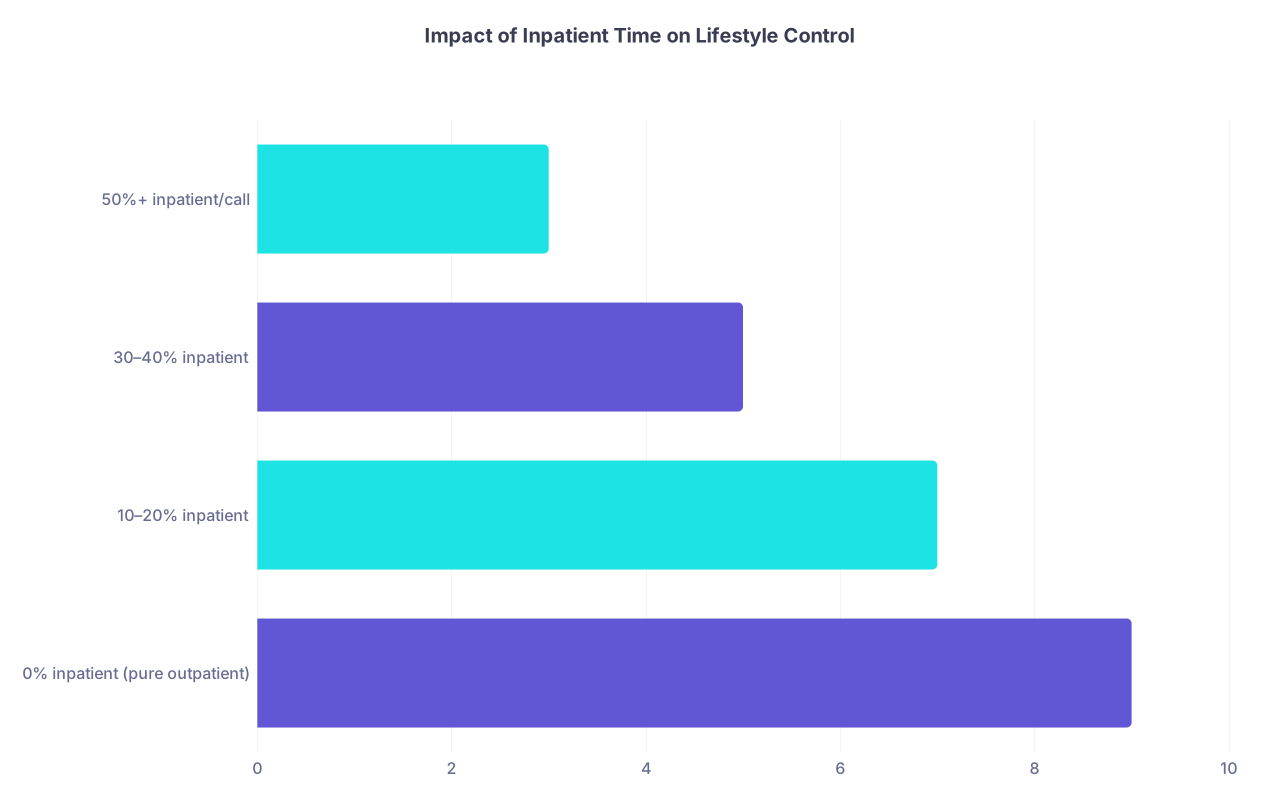
| Category | Value |
|---|---|
| 0% inpatient (pure outpatient) | 9 |
| 10–20% inpatient | 7 |
| 30–40% inpatient | 5 |
| 50%+ inpatient/call | 3 |
(Scale 1–10: higher = better lifestyle control, based on schedule predictability and protected off‑time.)

| Step | Description |
|---|---|
| Step 1 | Choose Specialty |
| Step 2 | Pick any specialty |
| Step 3 | Target outpatient only jobs |
| Step 4 | Mixed inpatient subspecialty ok |
| Step 5 | Outpatient dominant fields best |
| Step 6 | Priority is Lifestyle? |
| Step 7 | Willing to do inpatient? |
| Step 8 | OK with service weeks and call spikes? |
FAQ (Exactly 6 Questions)
1. Is outpatient-only always better lifestyle than mixed inpatient?
Usually, yes, but not automatically. A high‑volume outpatient primary care job with 25 patients/day and an overflowing inbox can hit 55+ hours/week and feel worse than a well‑structured mixed cardiology job with moderate service weeks. The difference is that outpatient‑only tends to be more predictable. Mixed inpatient creates brutal peaks even if the average looks similar on paper.
2. Which specialties give me the best shot at a 40-hour workweek as an attending?
Realistically: outpatient psychiatry, dermatology, allergy/immunology, and some outpatient neurology or PM&R jobs. Also certain non‑procedural concierge or direct primary care practices with consciously limited panel sizes. You will not find this life in standard mixed inpatient IM subspecialties, hospitalist roles, or surgery.
3. How bad is inbox and admin work in outpatient-only jobs, really?
For primary care and some endocrine/rheum jobs, inbox/admin can easily consume 5–10 hours/week if the system is inefficient. In psych and derm, it is often lighter but still nontrivial. If the clinic template leaves zero buffer between patients, all of that work shifts to evenings and your “8–5” becomes 8–7 or 8–8. Ask about support staff and exact expectations during job interviews.
4. Do academic jobs have better or worse time commitments than private practice?
Depends. Academic jobs often have more non‑clinical time and lighter volume per clinic, which helps. But you can pay for it with committees, teaching, and research expectations. In procedural or mixed inpatient subspecialties (GI, cards, pulm/crit), academic vs private does not magically rescue your lifestyle. The inpatient weeks are still long. Outpatient‑only academic roles (psych, derm, allergy) can be excellent for lifestyle if leadership respects boundaries.
5. If I like the hospital environment, am I doomed to a bad lifestyle?
No. But you need to be strategic. Hospitalist jobs with true 7‑on/7‑off and reasonable census can give massive blocks of free time, even if your “on” weeks are 60+ hours. Light call consult services in low‑acuity hospitals can also be decent. What destroys lifestyle is a constant mixture—clinic plus regular call plus frequent add‑ons—without real off‑time.
6. How early in training should I commit to outpatient-only vs mixed inpatient?
You do not need to lock that in during MS3. Pick the specialty first. Then, during residency and fellowship, deliberately seek both clinic‑heavy and hospital‑heavy rotations to learn what your body and brain tolerate. By PGY3 (or early fellowship), you should have a clear sense of whether service weeks energize or drain you. Use that to target jobs: outpatient‑only contracts in lifestyle‑friendly specialties, or carefully structured mixed inpatient roles if you genuinely enjoy the hospital.
Key takeaways:
- “Outpatient‑only” usually means 38–50 hours/week with high predictability; mixed inpatient means similar or higher averages with brutal peaks and compromised off‑time.
- Lifestyle is less about the specialty name and more about how much call, inpatient time, and hidden admin work your job quietly includes.
- On interviews, force specificity: patient volumes, service weeks per year, call intensity, and who owns your inbox when you are on the wards.