
The fastest way to destroy a “lifestyle friendly” specialty is a bad clinic operations setup.
You can match into dermatology, allergy, rheum, outpatient cards—pick your supposed lifestyle prize—and still end up miserable if your MA ratios, scribe support, and front-desk systems are trash. I have watched more than one new attending in a “dream job” quietly start looking for another position within 9–12 months. Not because of the medicine. Because of the workflow.
Let me break this down specifically.
The Myth: Lifestyle = Specialty Choice
Residents love to talk about lifestyle like it is baked into the specialty. Dermatology is “cush.” Endocrine is “chill.” Hospitalist is “rough.” These are lazy generalizations.
What actually protects your time:
- How many support staff you have per physician
- What those staff are allowed and trained to do
- Whether you’re documenting in real time or at 9 p.m. on your couch
- How many non-visit tasks your day absorbs (refills, portal messages, prior auths, forms)
Three allergists in the same city can have completely different lives. One is home by 4:30 with inbox zero. One is charting until midnight. One is gradually burning out and wondering why this “lifestyle” specialty feels like internal medicine with hives.
The difference is not the IgE levels. It is operations.
So if you are in residency, looking at “outpatient-heavy, lifestyle-friendly” specialties, you need to start hearing a different set of questions in your head:
- “What is your MA ratio per provider?”
- “Do you use scribes? Virtual or in-person?”
- “How's your inbox volume and who triages it?”
- “Who handles prior auths and forms?”
- “What percentage of my time will be direct patient care versus admin?”
If you do not ask this, program directors and recruiters will happily talk to you about case mix and research support while you walk into a time sink.
MA Ratios: The Quiet Lever That Makes or Breaks Your Day
Most residents have no idea what a “good” medical assistant (MA) ratio looks like. They show up to clinic, someone rooms the patient, they see the patient, they leave. That is not how real life works when you own the panel.
What MA ratios actually mean
When someone says “we run 1:1 MA to provider,” they usually mean:
- One MA per physician session (0.5 day) or per full day, depending on local language
- That MA rooms patients, takes vitals, may do basic procedures (EKGs, shots, spirometry, etc.), cleans rooms, possibly sends out basic orders and messages
A “2:1” model could mean:
- Two MAs shared between one doctor
- Or two MAs covering two physicians (completely different reality)
You have to pin them down: “When you say 2:1, do you mean two full-time MAs for one full-time physician in clinic that day?”
For high-throughput outpatient specialties (derm, allergy, GI, ortho clinic), the MA ratio dictates how much of the work is truly physician-level versus what gets shoved into your lap because “we just don’t have enough staff.”
Let’s quantify it.
| Specialty | Lean Ratio (phys:MA) | Comfortable Ratio (phys:MA) | Aggressive Throughput (phys:MA) |
|---|---|---|---|
| Dermatology | 1:1 | 1:1.5–2 | 1:2–3 |
| Allergy/Immunology | 1:1 | 1:2 | 1:2–3 |
| Rheumatology | 1:0.5–1 | 1:1–1.5 | 1:2 |
| Endocrinology | 1:0.5–1 | 1:1–1.5 | 1:2 |
| General IM clinic | 1:0.5 | 1:1 | 1:1–1.5 |
Those “lean” ratios are what corporate clinics like to sell as “efficient.” They are not efficient for you. They are efficient for RVUs.
What actually happens at different ratios
Let me give you concrete scenarios. Imagine a 4‑hour clinic session, 16 patients scheduled (4/hr), fairly typical for a lifestyle-leaning subspecialty (rheum, allergy, endocrine, derm medical).
Scenario A: 1:0.5 (MA shared between two physicians)
You get:
- Your MA is bouncing between you and another doc
- Room turnover is slow; someone is always waiting
- Vitals sometimes missing, you recheck BP yourself
- Injections, EKGs, PFTs get delayed, so you either:
- Wait in the room, killing your schedule, or
- Leave and come back, doubling your walking and thinking time
Result: You spend visible time doing non-physician tasks. At the end of the session, you have 6–8 incomplete notes and a backlog of orders you clicked through too fast.
Scenario B: 1:1, but MA limited autonomy
This is common in “nice” clinics that still run poorly.
- MA rooms and does vitals
- But cannot pend orders, cannot use visit templates, does not handle callbacks
- You enter all orders, all refills, all letters
- MA does not assist in-room with procedures beyond handing you gauze
You feel “supported” only because you are used to residency. In reality, you are massively underleveraged.
Scenario C: 1:2, well-trained, protocol-driven MAs
This is the sweet spot in many lifestyle specialties.
- One MA rooms patient, gathers detailed HPI elements or symptom checklists, updates med list, reconciles allergies
- The second MA runs procedures (PFTs, injections, patch test placement, joint injection set up, etc.), manages phone triage overflow, queue management
- Both can pend orders in the EHR, use smart phrases, tee up patient instructions, and send provider-approved protocols for common issues (refills, lab reminders)
Now you walk in, do the part only a physician can do—complex thinking, risk discussion, nuanced diagnosis—and walk out. Each room is prepped, each visit has a skeleton note ready.
Red flags to listen for on interviews
You ask, “What is your MA support like?” and they say:
- “Our physicians are very self-sufficient; they like to stay in control of everything.” Translation: we underinvest in support staff and rationalize it as autonomy.
- “You’ll share an MA with the APPs.” Translation: NP/PA plus you plus one MA. Good luck.
- “We are working on hiring more MAs, but staffing is tough.” Translation: you will open in this broken state.
Follow-up questions that force clarity:
- “On a typical full clinic day, how many MAs are assigned solely to me?”
- “Who updates med lists and problem lists? MA or physician?”
- “Can MAs pend orders in the EHR?”
- “Who gives routine patient instructions and teaches device use (inhalers, injectables)?”
- “Do MAs handle any direct inbox messaging or is it all routed to provider?”
If they cannot answer specifically, they do not run a tight ship.
Scribes: The Most Underappreciated Lifestyle Tool
If you care about being home for dinner, scribes matter more than your fellowship title.
People think scribes are a “luxury” reserved for high-RVU dermatologists cutting out 20 skin cancers a day. That is outdated thinking. The EHR has exploded the documentation burden across every outpatient field. Allergy notes bloated with immunotherapy detail. Rheum notes with safety labs, infusion plans, disability forms. Endocrine notes full of CGM reports and complex insulin adjustments.
A functional scribe program converts two hours of nightly charting into real-time completion.
Scribe models you will actually see
Let’s categorize them realistically.
In-person scribes
Usually pre-med undergrads or gap-year grads. They sit in the room, chart in real time, and follow you around.Virtual scribes (live)
A remote person connected via platform or audio, listening to encounter in real time and charting.Ambient documentation (AI-based)
Systems like Nuance DAX, Tali, Suki. They record the visit audio and generate a draft note that you edit and sign.“Help” that is called scribing but really isn’t
MA “scribes” that can only enter vitals and limited elements; or back-office staff that “preps notes” by pasting templates.
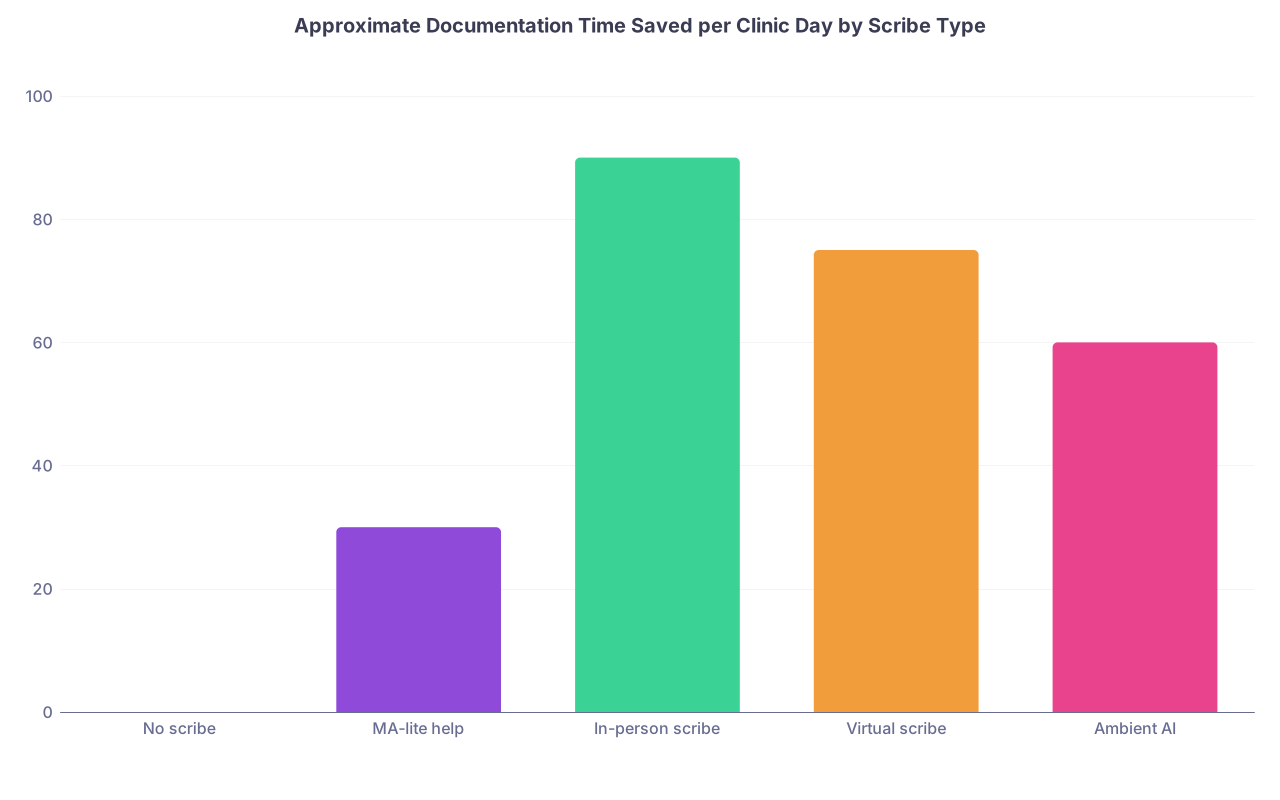
| Category | Value |
|---|---|
| No scribe | 0 |
| MA-lite help | 30 |
| In-person scribe | 90 |
| Virtual scribe | 75 |
| Ambient AI | 60 |
These numbers are rough, but the ranking is consistent with what most people report in real life.
What good scribing looks like in lifestyle-friendly clinics
I have seen this work extremely well in derm and allergy clinics:
You open the patient chart. The note already has:
- Chief complaint
- Updated meds and allergies (from MA)
- ROS autopopulated per template
- Last visit summary and relevant labs pulled in
In-person or virtual scribe then:
- Captures the HPI in structured narrative as you talk
- Documents exam findings as you say them out loud (“No synovitis in MCPs, mild effusion left knee…”)
- Inserts your assessment and plan paragraphs as you dictate in the room
When you walk out:
- You glance over the note, fix a couple of wording issues, sign.
- Orders are either pended by MA/scribe or quickly entered because the plan is already written, not in your head.
Your cognitive load stays where it belongs—on patient care—and your charting time (the part everyone underestimates) drops dramatically.
Where scribes go wrong
The bad setups are easy to spot:
- High turnover, constantly training new scribes
- Scribes not actually in the loop on workflows (they do note text but not orders or letters)
- “We have scribes available some days, not others” → you never build a rhythm
- Clinic expects you to see substantially more patients with scribes but does not shorten your total day
When you are interviewing for a “lifestyle” practice and they advertise scribes, your questions should sound like this:
- “Are scribes guaranteed for all of my clinic sessions or only certain days?”
- “Are they in-person or virtual? How long do they typically stay (turnover)?”
- “Do physicians generally leave with charts done? What time do most docs leave the office on full clinic days?”
- “Has adding scribes increased visit volume expectations? By how much?”
If every answer is basically, “We use scribes so we can cram more patients in and you still go home with open charts,” that is not lifestyle. That is throughput dressed up.
Front Desk, Triage, and the Invisible Workload
People obsess over MA ratios and scribes because those are tangible. The more insidious threat to your time is invisible work: portal messages, refill requests, triage calls, forms, prior auths.
Lifestyle specialties are not immune. They are targeted.
- Allergy: biologic prior auths, injection clinic scheduling, detailed avoidance letters, school forms.
- Rheum: immunosuppressive safety labs, infusion orders, FMLA and disability forms, med changes with pharmacies arguing about coverage.
- Endocrine: CGM/insulin pump downloads, supply refill chaos, endless “sugars running high, what do I do” messages.
- Derm: prior auths for topicals and biologics, cosmetic quote questions, “rash got worse” triage photos.
If the clinic has weak front-desk and nursing triage systems, all of that drops into your inbox. Then your “8–4 clinic” becomes 8–5:30 with an hour of messages.
Systems that actually protect your time
You want to hear about protocols, not vibes. Specifically:
Nurse or MA triage tree
Nurses or senior MAs filter messages using protocol algorithms. Only messages that require physician-level judgment reach your inbox.Refill protocols
Many routine refills (on stable therapy, recent labs ok) get auto-refilled via protocol without bothering you. Or at least pended with labs already ordered.Prior auth team
A dedicated group (could be centralized across a system) that handles 80–90 percent of the grunt work of prior auths. They gather documentation, initiate appeals, use canned language—all you do is sign off on a short justification or co-sign.Portal message policies
Clinics set patient expectations: “Non-urgent questions may take 2–3 business days. Complex questions may require a visit.” Some systems now bill for long, complex portal exchanges. That alone cuts down on novel-length messages.Forms workflow
Disability forms, FMLA, school documents are pre-processed by staff: demographics filled in, last visit dates, meds, ICD codes, etc. You add the clinical brain part and sign.
If this sounds like fantasy, it is because many residents only see under-resourced academic continuity clinics. Private groups, well-run multispecialty groups, and some academic subspecialty clinics have all of this. And their physicians are the ones who actually experience “lifestyle friendly.”
How Different Specialties Play This Game
Let us get specific and a little blunt.
Dermatology
Derm has the highest variance between heaven and hell.
Heaven:
- 1:2–3 MA ratios with cross-trained techs
- Scribes (often pre-med or MA-scribes)
- Aggressive rooming and turnover—patients are never idle in room waiting on “just the doc”
- Superb front desk that handles cosmetic vs medical bifurcation, prior auth team that knows every biologic trick
Hell:
- 1:0.5–1 MA shared model
- No scribes; you are charting every skin exam and procedure step
- You are asked to see 30–35 patients per full day “because derm is quick”
- Every isotretinoin, biologic, and acne spiral generates inbox explosions
The difference is pure operations. Same specialty, opposite lifestyles.
Allergy & Immunology
Allergy can be incredibly lifestyle friendly—if the clinic respects staff ratios and immunotherapy workflows.
Well-run:
- 1:2 MA ratio; some clinics also have dedicated shot nurses
- Allergy shot clinic offloads a huge amount of traffic
- Scribes (even part-time) make new patient and complex asthma visits smooth
- Prior auth staff familiar with omalizumab/dupilumab/mepolizumab routines
Poorly run:
- You manage your own shot room scheduling
- Every biologic prior auth starts at your desk
- No scribe; complex seasonal allergies + asthma visits documented from scratch at night
- High portal volume (“Can I eat this food?”, “Does this rash mean I’m allergic to X?”) with no triage filters
Most lifestyle benefit in allergy comes not from the pathophysiology but from how well the injection and biologic ecosystem is supported.
Rheumatology
Rheum tends to attract people who want longitudinal relationships and reasoned pace. Operations can sabotage that quickly.
Efficient rheum clinic:
- 1:1–2 MA ratio, with emphasis on lab tracking and infusion coordination
- MAs or nurses handle standing lab reminders, vaccine reminders, standardized DMARD safety monitoring
- Prior auth team deeply familiar with TNF inhibitors, JAK inhibitors, etc.
- Scribing or very robust templates to handle extensive joint exams and long problem lists
Broken rheum clinic:
- You personally track labs and call patients about every abnormal result
- You write all the letters: work notes, disability statements, complex appeals for off-label indications
- Infusion scheduling is chaos, every “late for infusion” problem ends up in your inbox
- No scribe, slow MA, and notes with nineteen problems documented after hours
Rheum can be fantastic lifestyle if protected. Or it can turn into administrative quicksand.
Endocrinology
Endo’s lifestyle reputation lives or dies by two things: diabetes tech support and phone/portal protocols.
Good setup:
- Diabetes educators and nurses handle CGM/pump training and routine data downloads
- Protocol-driven insulin titration for common scenarios handled by RN with your standing orders
- Prior auth handled centrally for GLP-1, SGLT2, CGM, and pump supplies
- Reasonable follow-up intervals and scheduling templates that leave time for complex new diabetes, thyroid cancer, etc.
Bad setup:
- Every CGM download and pump adjustment is “please ask Dr. ___”
- Pharmacy mess with GLP-1 shortages lands daily in your inbox
- Patients are told “message your doctor any time for sugar issues,” with no filters
- You spend evenings scrolling through attached PDFs and handwritten logs
Endocrine is a prime example where operations turn an “easy” clinic into a cognitive and time nightmare.
Use Data and Structure, Not Vibes
You should not have to guess whether a clinic will protect your time. Ask questions like you are auditing them. Because you are.
Here is a concrete framework you can literally reference before signing anything.
| Domain | Strong Setup Indicator | Red Flag Indicator |
|---|---|---|
| MA Support | 1:1–2 per physician, clear task list | Shared MA, vague roles |
| Scribes | Guaranteed access, all clinic days | “Sometimes,” “as needed,” high turnover |
| Inbox | Nurse triage, protocols, message limits | All messages routed to MD |
| Prior Auths | Dedicated team, standard workflows | “Provider handles most of it” |
| Forms | Staff pre-fills, batching system | Docs get raw forms directly |
| Day End Time | Most docs out ≤30–45 min after clinic | Docs still charting 1–2 hours later |
If you want to be more analytical, track this during an on-site visit:
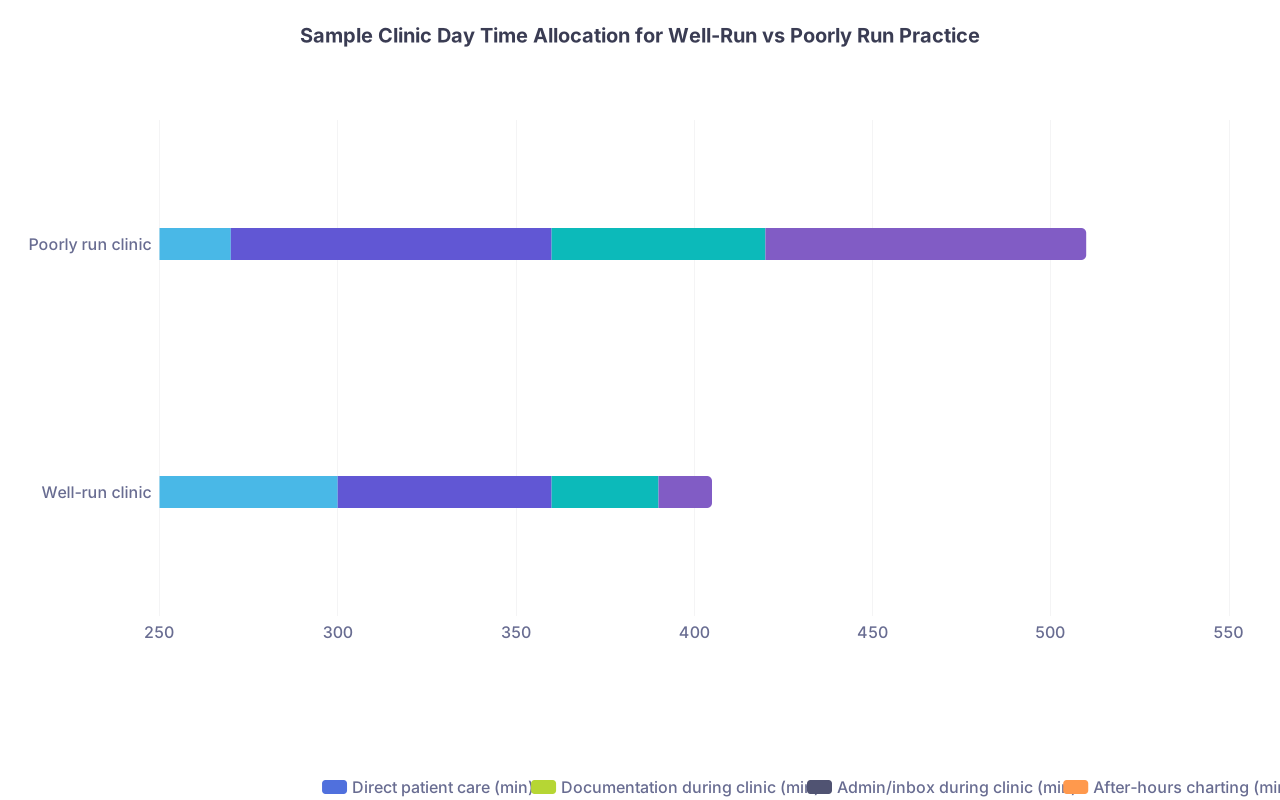
| Category | Direct patient care (min) | Documentation during clinic (min) | Admin/inbox during clinic (min) | After-hours charting (min) |
|---|---|---|---|---|
| Well-run clinic | 300 | 60 | 30 | 15 |
| Poorly run clinic | 270 | 90 | 60 | 90 |
That last bar—after-hours charting—is where “lifestyle-friendly” either survives or dies.
How to Judge This as a Resident: A Practical Playbook
You are still in residency or fellowship. You see little pieces of this but not the whole machine. Here is how you close the gap.
1. Shadow like an auditor, not a student
When you do elective rotations in derm, allergy, rheum, endocrine, or any outpatient field, stop only thinking about the diseases. Start counting:
- How many MAs are visible per hallway or pod?
- Does the attending walk into rooms with chart open and note scaffolded, or are they starting from blank?
- Do they finish notes before leaving clinic? Ask casually: “How many notes do you usually finish after going home?”
Better yet, ask them directly: “What part of your day feels most chaotic or broken?” People answer this honestly off the record.
2. On interviews, ask the questions no one else asks
Most applicants ask, “What is your patient mix?” or “What’s your call schedule?” Those matter, but lifestyle is not built there. Insert questions like:
- “Walk me through a typical full clinic day for one of your physicians—from arrival to leaving the building.”
- “On your busiest clinic days, what time do you usually get home with all your documentation done?”
- “Who is your first line for patient calls and portal messages?”
- “Do you have data on inbox message volume per provider per day or week?”
If they stare blankly at the message volume question, they are not tracking one of the main drivers of burnout right now.
3. Talk to junior attendings and APPs, not just leadership
Program directors and department chairs are often insulated from the daily grind. Junior attendings (1–5 years out) and experienced NPs/PAs live in that grind.
Ask them:
- “What do you wish you had asked before you signed?”
- “How supportive is the clinic when you say, ‘this workflow is not sustainable’?”
- “Have you seen anyone leave because of workload or operations?”
You will get real answers, sometimes after a brief pause and a sideways look.
Visualizing Your Future Week
It helps to visualize not just a day, but a week. Because lifestyle is cumulative.
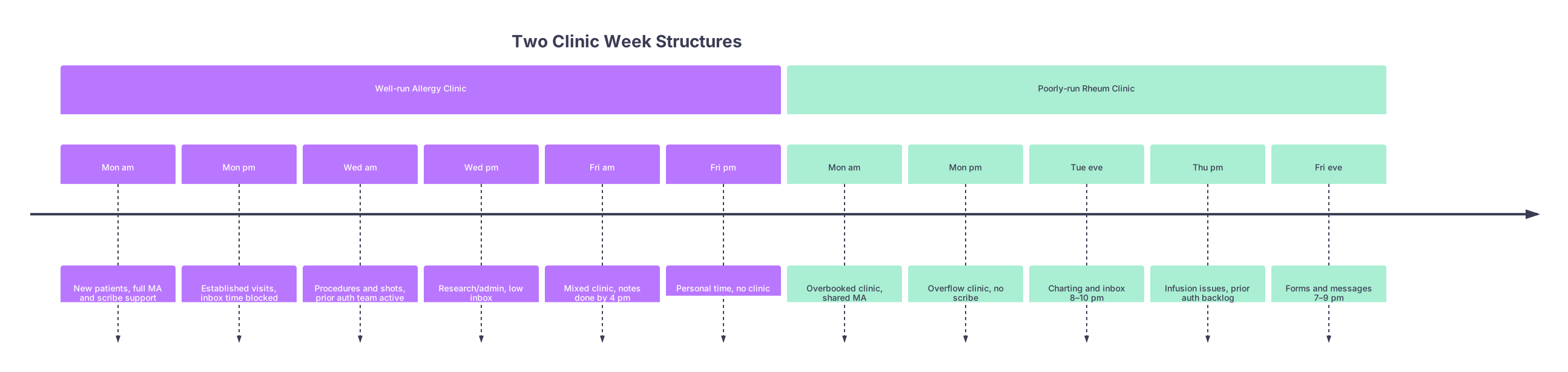
| Period | Event |
|---|---|
| Well-run Allergy Clinic - Mon am | New patients, full MA and scribe support |
| Well-run Allergy Clinic - Mon pm | Established visits, inbox time blocked |
| Well-run Allergy Clinic - Wed am | Procedures and shots, prior auth team active |
| Well-run Allergy Clinic - Wed pm | Research/admin, low inbox |
| Well-run Allergy Clinic - Fri am | Mixed clinic, notes done by 4 pm |
| Well-run Allergy Clinic - Fri pm | Personal time, no clinic |
| Poorly-run Rheum Clinic - Mon am | Overbooked clinic, shared MA |
| Poorly-run Rheum Clinic - Mon pm | Overflow clinic, no scribe |
| Poorly-run Rheum Clinic - Tue eve | Charting and inbox 8–10 pm |
| Poorly-run Rheum Clinic - Thu pm | Infusion issues, prior auth backlog |
| Poorly-run Rheum Clinic - Fri eve | Forms and messages 7–9 pm |
Same nominal “three half-days of clinic” specialty. Very different weekly life.
Final Thoughts: Operations Are Non-Negotiable
If you remember nothing else:
Specialty is only half the lifestyle equation. The other half is clinic operations: MA ratios, scribes, and how invisible work is handled. Ignore that and you will be surprised—and not in a good way.
Ask operational questions early and often. “Who does what?” is more important than “What diseases do you see?” when you are evaluating how livable a job is.
The best lifestyle-friendly practices invest heavily in support staff and systems. They understand that a physician’s time is too expensive and too scarce to waste on tasks that a well-trained MA, scribe, or nurse can do.
Choose your specialty with your brain. Choose your practice with an operations checklist. That is how you actually protect your time.